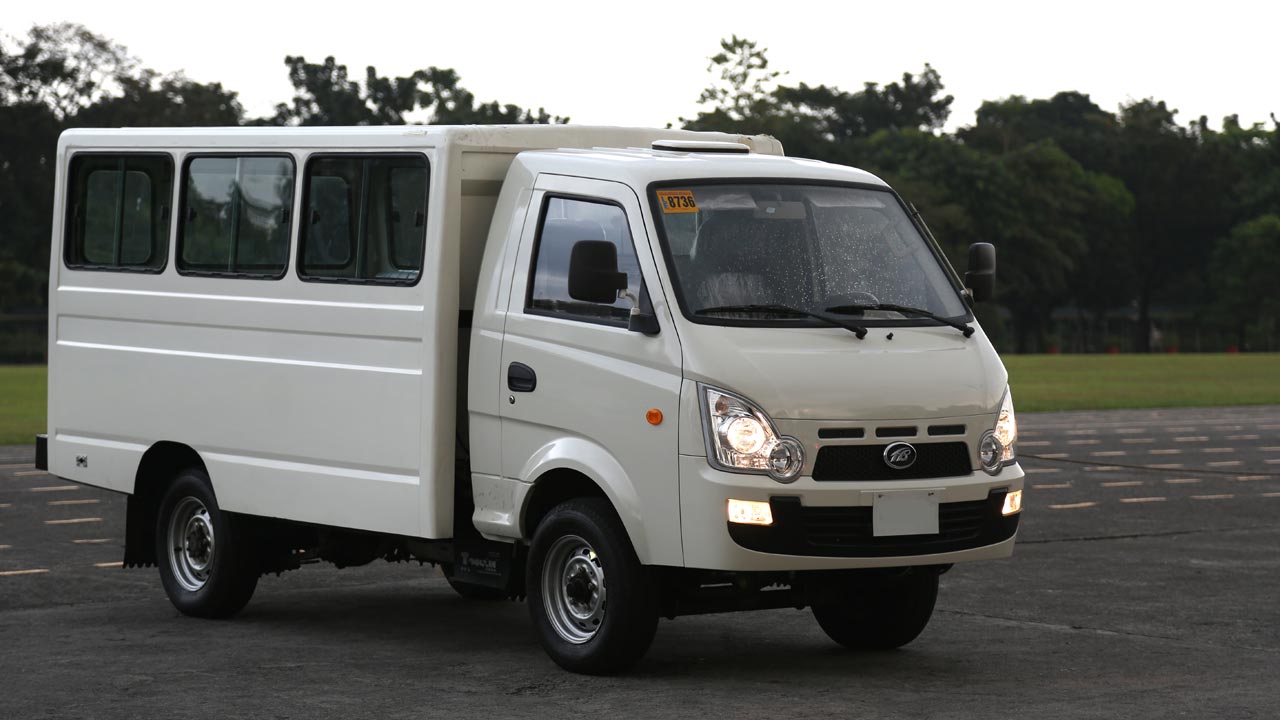
BAIC Philippines’ new ute brandishes payload numbers that are both impressive and–with rugged live-leaf suspension at front and in back–refreshingly realistic.
That 16-seat capacity on the passenger rear body is at the same time conservative (there’s just enough elbow room to go to 18) and fairly backed by a metric ton of max loading. The dropside flatbed variant fares even better with a third of a ton more in payload.
Taguig City, Philippines | 27 January 2017—Isuzu Philippines Corporation (IPC) has unveiled the new D-Max LS X-Series, adding limited-edition touches to the popular pick-up’s 4×2 top-spec trim that refine the aerodynamics of the top-scoring 38.46km/l diesel sipper.
At the January 27 unveiling at BHS Amphitheater, Bonifacio Global City, IPC President Hajime Koso with the X-Series D-Max in Cosmic Black
“There is no denying that the Isuzu D-MAX is an ideal vehicle for leisure activities and is also a highly capable workhorse. With the arrival of the new D-MAX X-Series, the model now addresses the lifestyle mobility requirement of active and urbane families too. So now, no other pickup truck available in the local market can offer the combination of utility, reliability, versatility and high style that the D-MAX X-Series does,” said IPC President Hajime Koso.
Distinguished by a gunmetal-grey radiator grille with bright red Isuzu badge in the center and limited-issue two-tone 18” wheels, the X-Series D-Max features factory-fitted spoilers in the front, at the sides and atop the leading edge of the cargo deck to make it even more stable and whittle down its aerodynamic drag co-efficient at cruising speeds. A front skirt to scoop away air flowing under the vehicle adds down-force for a touch more control traction. While, on the cargo box, top-edge fairings along the side and up against the crew cab, plus trailing bottom side-skirts, mitigate drag-inducing turbulence.
At the unveiling, Isuzu ambassador Derek Ramsay with X-Series offerings
“Isuzu Philippines sold 3,966 D-MAX units in 2016, with deliveries rising 27.3 percent when compared to the model’s sales result in 2015. This growth, which is in lockstep with the pace of commercial vehicle demand in the country, was fueled largely by the continuous upgrades that the D-MAX has received. The introduction of the new X-Series line is meant to sustain the D-MAX’s upward trajectory,” Koso said.
The enhancements ought to improve fuel-efficiency further on the D-Max which had garnered the top-score, that 38.46km/l rating, at the mass fuel-eco run done by the Department of Energy in May 2016 (with same generation model, 3rd-gen, though before the September facelift, and with the same 3.0L CRDi VGS turbodiesel). Completing the premium kit-out are black leather interior touches featuring red stitching to match the exterior’s red accents, and intricately embroidered X-Series badges on the front-seat seat-backs.
The business end of the X-Series in Splash White with its cargo box fairings and trailing side skirts, and those special-issue two-tone alloy wheelsAt the unveiling, the X-Series in Venetian Red
“Aside from its already sporty looks, Isuzu collaborated with Under Armour to create a special X-Series collection sports apparel and items which are ideal for those buying this limited edition D-MAX variant. We picked this brand because it embodies the same characteristic of the X-Series which is tough and active” Koso added.
Premium items create another dimension to buying into the X-Series package. Partnering up with a leading sports brand, Isuzu bundles a selection of Under Armour products with an X-Series purchase—buyers can select from among a variety of Under Armour sport shirts, accessories and bags.
X-Series editions are offered for the 4×2 variants of the D-Max top-trim 3.0L LS line-up, adding P100k to the list price and coming out to P1.26M for the MT model and P 1.33M for the AT. Available colors are Splash White, Venetian Red and Cosmic Black.
Hyundai Philippines updates the Grand Starex, the upsized second-generation to their popular Starex line, with a variant configured specifically for the transport sector. Listed at P1.398M, a sticker price that adds P60k to that of their 2.5L GL 5MT base variant with its 10 or 12-seat capacity, the new Grand Starex Super Express is set up with the 15 seats that now make it a stronger contender in both chartered and public transport roles.
The passenger couches are utilitarian, value-engineered into compact footprints while providing ample comfort and legroom in short to medium duration city travel. The efficiently sized furniture allows fixing of the middle seating rows further forward—forward enough to make room for the variant’s defining rear-most seating area with its two side-facing benches providing 6 out of the Super Express’ 15 seats. The result is commuter-class capacity on the Grand Starex with its large sliding doors on both sides and the full-width tailgate offering quick and easy access for curb-side boarding.
Other specifications appear unchanged from that of the 2.5L GL 5MT base variant of the popular Starex line that’s known for exceptional ride comfort even on a front-engine, rear-drive layout with its conventionally rigid (and robust) rear axle. The Super Express becomes the second variant (after the base GL) to feature the Grand Starex’s simpler, fleet-sensible 100ps (98hp) 2.5L TCi SOHC 8-valve turbodiesel delivering peak torque of 227Nm an early 2000rpm. And prospective owners are offered warranties capped at three-years or 100,000km.
SOURCE | Press Statement of Hyundai Asia Resources, Inc., “Hyundai Launches The Super 15-Seater Starex,” 2017:
MANILA, 25 January 2017 – Hyundai Asia Resources Inc., the Philippines’ official distributor of Hyundai vehicles, has finally launched the new Hyundai Grand Starex Super Express in response to the fast-growing commuting needs of mobile Filipinos.
The Grand Starex Super Express is the commercial version of the best-selling Grand Starex, which has received a wide-range of awards (from Most Comfortable Ride, Best Safety Features, Best Engine Performance, Best Full-size People Carrier, to Automobile of the Year) from various award-giving bodies since 2001.
While the Grand Starex aims to give luxurious comfort to families on-the-go, the Grand Starex Super Express was engineered with the Filipino commuters and drivers in mind, for Hyundai truly understands the daily stress of commuting in a cramped space, travelling in back-breaking seats and embarking/disembarking to the inconvenience of other passengers.
Vast & Versatile Capacity: Whether people or cargo, the Grand Starex Super Express is ready to move with utmost comfort and efficiency. Having the widest interior space, it gives more leg room and hip room for passengers than most shuttle vans. What’s more – the Grand Starex Super Express’ 15-seating capacity is multipurpose: simply fold the bench-type rear seats, and you’ve got your own transport vehicle that is perfect for your long, tall and wide cargos.
Easy In-and-Outs: Designed to be passenger-friendly, the Hyundai Grand Starex Super Express stands out from the other 15-seaters in the market with its double sliding doors. These doors allow passengers to load and unload from both sides of the vehicle, making it a game-changer in the transport industry.
The Front Runner: Commuting doesn’t have to be noisy and hot like the traffic outside. The Grand Starex Super Express is powered by a 2.5L TCI diesel front-engine, rear-wheel-drive that isolates engine noise and prevents rising temperature under the seats of the drivers and passengers which are prevalent among commuter vans of today.
A/C for All: Passengers will always recall their pleasant commuting experience with the Grand Starex Super Express because it guarantees an equal, accessible and powerful air conditioning system. With A/C vents evenly distributed from the front seats up to the last row, it’s easier for everybody to keep their cool with the Grand Starex Super Express.
3 Year Warranty: The Hyundai Grand Starex Super Express brings peace of mind with its 3-year or 100,000 kilometer warranty—a premium benefit for vehicles used for commercial purposes.
With the Hyundai Grand Starex Super Express, you can finally change the way you define “commute”. Suggested Retail Price is at P1,398,000.
Discover how the Grand Starex Super Express combines commuting and comfort by visiting www.hyundai.ph or your nearest Hyundai dealership today.
A top editor once told me, “don’t worry if there’s other stuff, even people, in your shot … these could bring warmth.” Well, on this 2015 shakedown drive to Sagada with the then new BAIC M20 MPV, the other stuff were not incidental, not just tolerated but caught deliberately, fortunately, in the composition.
A picture, any picture, ought to tell a story all its own. There’s nuance, there’s atmosphere, there’s a notion of what comes after, all conveyed in life made still for endless scrutiny. And, on the hardy M20 there’s even the odd pun to plumb: people-mover in foreground, a person, and movement, in back. I did warn you, a pun.
Seriously, though, the photo’s story is yours for the telling. There’s the M20–big, wide, metal sleek and placidly parked in the foreground. She’s pointedly stationary, as underscored by the van blurring by (an old L300 Versavan by the looks of her roofline), and she seems empty. Enter the man in red. He’s not the main subject of the image, but his presence, his striding stance away from the scene, could somehow explain it. You have to ask: Is he leaving or looking?
The actual narrative is explained by what he’s gazing at over his right shoulder. It was the seventh hour of a drive that started at midnight, a push from Manila to Sagada to test the new MPV. This scene finds us, a party of five passenger/drivers, on Halsema Highway and caught in the shadows of a mountain sunrise while those peaks to the west were already getting sunlight.
It was a serene moment on what was once considered, up to a handful of years ago, as one of the most dangerous roads in Asia (but is now a proud and well paved wonder). That guy in red, our car buddy, a well traveled engineer, had gotten the jump on us. We put the M20 on a lay-by to do what anyone would do in the situation … look for a spot to do a selfie.
If you see a beat photographer toting an SLR, seemingly overdoing it with mainstay smartphones these days already featuring excellent camera optics and sensors, just remember: bringing the gear is merely incidental to him insisting on having traditional options.
Case in point: this photo of Honda’s versatile Mobilio, the surprisingly flexible yet compact seven-seat MPV that’s a hair shorter than their popular sub-compact sedan, the City.
To depict the elegance of the Mobilio’s fluid yet compact form encasing its surprising utility, it was important to capture its proportions authentically. And that, to steer clear of distorting wide-angle optics, takes a far shot pulled in with long glass. This photo was taken from across a wide, four-lane road, through a middlin’ long 100mm lens on a full-frame SLR.
And, to let the softness of her pearl white paint come through amidst the peeking dusk, the trees left as they were in cool dark shade to offer framing contrast, manual controls were needed to decouple metering from the focusing process. For this exposure, I chose to spot-meter on whatever midtone was available (not the asphalt which was already in twilight) and still not take the measurement as gospel truth but as mere guide to set the shutter speed manually. If I had gone with stock metering options, like center-weighted or evaluative, the result would have been the kind of overexposure that could burn all contour off the Mobilio’s faceted fuselage.
Instead of dismissing the photo as a black-box SLR’s accomplishment (a contradiction, yes, since men accomplish, gear do not), think of it as a study in focal length selection and brazenly overridden exposure settings–the stuff that’s possible with modular and manual equipment that gets out of your way.
Built on the platform of the stubby Brio hatchback, the Mobilio stretches matters into the form-factor of a three-row MPV that’s tall inside as well as afoot. Riding just a centimeter lower than the recently launched BR-V (the Brio platform further evolved into a crossover SUV), the Mobilio must’ve hinted at the possibility of the more rugged people-mover.
With the Mobilio’s large diameter wheels and exceptional 19cm of ground clearance, don’t be surprised to find it in the darnedest of places, both lush green and craggy grey.
Suzuki hit the sweet spot with their second-generation Celerio, upsizing its value proposition with the new hatchback’s roomy dimensions, and updating its refined powertrain with a continuously variable transmission (CVT) that’s easily gamed into delivering remarkable hybrid-like performance.
Bigger but still nimble
Introduced late in 2015, the new Celerio turns the badge into a plus-sized A-segment hatchback with uncompromised seating for five adults and a weekender’s worth of luggage space with its best-in-class 254-liter cargo compartment. It’s now longer by 10cm with a proportionate lengthening of the wheelbase by 9cm, and it boasts of better headroom with a height increase of 7cm.
Those stretched dimensions now tracing straighter character lines seem to have brought more efficient options for making the unibody rigid enough. At 830kg, the new Celerio weighs slightly less than its previous generation model—to the tune of 30kg when comparing base variants. And weight savings did not come from thinning down the metal, this much is clear. The second-gen Celerio is thick-gauged enough to make it slightly heavier than the same-sized Toyota Wigo at 800kg, and the larger Mitsubishi Mirage at 820kg.
Handling and comfort are well balanced. She’s poised when cornering, the steering remains precise and body roll is managed well enough to keep the driver in confident stasis while steering and shrugging of G’s. The bigger dimensions leading to a longer wheelbase and wider tracks might even have improved the Celerio’s sporty demeanor.
Supple enough for both comfort and for keeping all four wheels planted, the suspension feels robust enough, the ground clearance sensible enough, for confidently taking on those occasional softroad challenges. And the wheels mount sedan-sized 165/65 R14’s—good feet under a light sub-compact, good enough but also shrouded by roomy fenders that can take wider rubber if you feel like tweaking those tires.
Quiet power
They kept the engine from the last generation Celerio, and with good reason. The K10B engine, with three inline cylinders displacing just 1.0L, delivers a surprisingly wide powerband and flat torque curve. Torque reaches useful strength long before the published peak of 90NM at 3500rpm. On rollout, there’s already 65NM on tap, or 72 percent of peak, at just 1000rpm. Then, for accelerating, bringing it to 2000rpm keeps things smart enough, putting out 80NM, or 88 percent of peak, and with the engine still at a quiet purr. From there on, torque reaches peak at 3500rpm, and stays above 90 percent until 6000rpm. The engine gets throaty only at around 3000rpm, comfortably above the turns you’ll need for smart acceleration in city driving.
On the automatic gearbox variant, the powertrain is completed with a two-range JATCO CVT7, the same continuously variable transmission used on the Mitsubishi Mirage CVT variant. The CVT7 adds an auxiliary gearbox between the CVT’s pulleys and the shaft to turn the drive wheels. With this auxiliary gearbox and its low and standard gear ratios, the pulleys meant to have continuously varying diameters are kept compact while still delivering a generously wide range of gear ratios starting with a deep bottom ratio of 1:4.07 in the low range, and going up to an exceptionally tall overdrive ratio of 1:0.55 in the standard range.
With this configuration, there’s low range gear reduction to multiply torque for fully loaded and/or uphill situations, and high range overdrive to turn the Celerio into a low-revving highway cruiser. Predictably, in the organized mass fuel-eco test conducted by the Department of Energy and by Petron last May, the Celerio CVT variant got top numbers overall with combined highway and city mileage pegged at 29.4km/l.
Game gearbox
In the face of the common complaint against CVT’s, about the rubber-band effect that typically plagues continuous variable transmissions, the Celerio offers an excellent workaround that could get the hatchback to performing as close to a hybrid as you can get without it being, you know, an actual hybrid. (Read on for a lighter take on how this can be, but see our related story, Gaming the Celerio CVT, for a deeper look into the mechanics of what we discovered).
As on most automatic gearboxes, conventional or CVT, the Celerio’s JATCO CVT7 uses a hydraulic torque converter to connect engine to transmission. Torque converters both tolerate and exploit slippage—tolerated because it’s a physical fact, there being slippage when you’re pumping fluid from an impeller to a rotor to transmit torque, and exploited because that slippage causes gear reduction that in turn multiplies torque. And that slippage is eventually eliminated with a lock-up clutch that creates hard contact between the torque converter’s pumping elements. Lock up happens late in the cycle, particularly on conventional automatic gearboxes, kicking in when the vehicle has reached cruise, after shifting all the way up to top gear.
While slippage is left to occur, it’s what actually causes that unpleasant rubber-band effect in CVTs. With hefty throttle, the torque converter’s slippage multiplies torque that quickly tapers off as the driven rotor catches up with the impeller’s revs. This complicates the task of the CVT’s controller, putting it behind the curve as it hunts for ideal gear ratios and corresponding pulley diameters. Result is momentary excess torque at insufficient speed, the engine roaring too much for the amount of force it delivers (that rubber-band stretching before coming back taught again).
The Celerio’s JATCO solution is elegant: since the torque converter feeds into a continuously variable system (no distinct gears, no shift shock), the CVT7 gearbox triggers the lock-up clutch early on, as early as during roll out, in fact. To bring it into play, use this Rule of Twos as described in our related story, Gaming the Celerio CVT: roll out by just stepping off the brake pedal and then easing in the gas to bring revs up to 2000rpm, no higher, and then wait for about 2 seconds. That much gas for that long will get you to 20km/h where you’ll notice revs dropping to 1500rpm. That’s your cue, the lock-up clutch is in and you now have hard, no-slip contact in the torque converter.
Go gentle on the throttle for those crucial seconds on roll out and you’ll be able to step on the gas however you like afterwards, and this while being treated to the Celerio’s surreal alter ego. With an engine that offers rich torque early on, that’s quiet until you want it to be otherwise, and with no slippage in the system to induce the dreaded rubber-band effect, this gamed Celerio will make you think Suzuki had somehow added an electromotor under the hood … she’ll be that zippy, and quiet.
And, beyond defeating that slippage and its rubber-band effect with this workaround, there’s also the option to come back out of clutch lock-up with a shift from standard down to low range on the CVT7 to contrive a fast-twitch kickdown where there shouldn’t be any, not on a CVT. (See our story on gaming the Mitsubishi Mirage CVT and find the parameters for doing this contrived kickdown safely on the larger hatchback that features the same JATCO gearbox.)
For all comers
At a friendly P549K for an eco-friendly fuel miser, drive her right and the Celerio CVT is the closest you’ll come to experiencing a hybrid without it being, you know, an actual hybrid, and at the fraction of the price.
The previous generation Celerio
Nevertheless, there are fans who lament the upsizing upgrades that, in their view, make the Celerio less sporty, no longer a pocket rocket. But the engineering is pretty much intact, made more elegant on a hatchback broken out of its small car niche and brought closer to the mainstream big leagues.
The numbers show it: the Celerio was Suzuki’s main growth driver in 2016, delivering an increase of 134 percent over the previous year’s older model sales (see their news release). And, what really should matter to all fans, both old and new, is that the young Celerio line is growing up but remains as sporty as when it had started out … you just have to look deeper to see it.
On Suzuki’s Celerio CVT (continuously variable transmission) variant, what would seem a drawback is something that’s stock on all continuous variable transmissions. But, rather remarkably, it’s something that can be worked around, particularly on the Celerio’s JATCO CVT7 gearbox.
Transmission trade-off
The usual complaint against CVT’s is that rubber-band feel of the electronics searching for the ideal gear ratio when accelerating with heavy revs. It manifests with the engine momentarily producing audibly strong revs although without transmitting the commensurate torque to the drive wheels. And yet, that effect is actually caused by intentional slippage in what connects engine to CVT.
Just downstream of the engine is a hydraulic torque converter that uses fluid force pumped from an impeller into a rotor (like two propellers face to face, one blowing at the other) to transmit torque to the core of the CVT gearbox. As expected, there’s slippage in the system, the speed of the impeller typically being faster than that of the rotor that it pumps fluid into, but it’s not merely tolerated.
That slippage is also intended to multiply torque, with multiple revolutions of the impeller to a single one for the rotor translating into actual, albeit somewhat abstract, gear reduction. In fact, there’s liberal slippage in some transmissions (indicated as having high stall speeds) to harness this fluid amplification of torque.
On the compact CVT7 gearbox driving the light Celerio hatchback, this slippage does seem to be kept at a minimum, but it’s still there. And, while this is going on in the torque converter, the core of the gearbox is where pulleys connected by steel belt have their diameters automatically expanded or contracted to continuously vary the gear ratios. Varying pulley diameters to drum up ideal gear ratios already takes finite time, with algorithms still having to act through mechanical servos. And, that perpetual hunt for ideal ratios becomes more complex when coping with surging or receding torque caused by slippage in the torque converter.
Other words, that rubber band effect? It’s caused by slippage in the torque converter changing the parameters even while the electronics are in the process of implementing ideal gear ratios. This analysis of the problem is lengthy, sure, but it’s also the exercise that Suzuki must have endured to have chosen the JATCO CVT7 gearbox for the Celerio. Because, as it turns out, when they made the pulleys more compact by adding an auxiliary two-range gearbox on the CVT7, the dynamics of driving smaller discs, and the serendipity of not having to step through discrete gears (as on a conventional AT), gave JATCO a way to eliminate slippage as soon as the driver makes it superfluous.
Slippage in torque converters is eventually eliminated when the impeller and rotor revolutions come close to matching up and a clutch kicks in to lock one to the other, but this lock-up clutch is typically activated late in the cycle—as on conventional automatic transmissions, only when the vehicle has already reached top gear, after slippage has cushioned all those up-shifts. But, on the JATCO CVT7, since the torque converter feeds into a continuously variable system—no distinct gears, no shift shock—the gearbox triggers the lock-up clutch as soon as the revolutions on impeller and rotor come close to matching up. And, on the CVT7, that can happen as early as on roll-out.
Gaming the gearbox
The solution then, as it’s made available on the CVT7, is to throttle gently until the lock-up clutch kicks in—the gentler you are on the gas, the sooner the lock-up. Use this Rule of Twos: roll out by just stepping off the brake pedal and then easing in the gas to bring revs up to 2000rpm, no higher, and then wait for about 2 seconds. That much gas for that long will get you to 20km/h where you’ll notice revs dropping to 1500rpm. That’s your cue, the lock-up clutch is in and you now have hard, no-slip contact in the torque converter.
After that short 2 second wait, feel free to put in as much gas as you want. Go stronger with 2500rpm after the 2 second wait and you’ll get distinctly smart acceleration, promptly reaching 100km/h and levelling off to 2000rpm for an easy highway cruise. Go higher and the engine starts to get throaty around 3000rpm. Floor it and the Celerio’s drive-by-wire system will intervene, making throttle up assertive but still somewhat gradual, to accelerate well beyond 100km/h with the revs regulated to a 6000rpm maximum.
Of course, the JATCO CVT7 is remarkable not only because of this feature for early clutch lock-up. There’s the option to even come back out of lock-up with a shift from standard down to low range to contrive a fast-twitch kickdown where there shouldn’t be any, not on a CVT. (See our story on gaming the Mitsubishi Mirage CVT and find the parameters for doing this contrived kickdown safely on the larger hatchback that features the same JATCO gearbox.)
Easy economy
But, bringing things back to urban realities, if you settle for bringing revs back to 2000rpm after that 2 second wait (after that drop to 1500rpm with the lock up clutch kicking in), you’ll soon get to a city cruising speed of 60km/h that can then be sustained with just 1500rpm, there with the Celerio delivering max-conserve figures that are off the scale (beyond the instrumentation’s 30km/l max indication).
Using this Rule of Twos while generally staying under 2500rpm, I got mileage of 12km/l through 100km of moderate traffic in the city, 10km/l when dealing with heavy traffic that slowed travel to an average of 15km/h. This is still consistent with the 29.14km/l that made the Celerio CVT the top scorer on the mass fuel-eco test conducted by the Department of Energy (DoE) and Petron last May over a test course that included a fair stretch of NLEX.
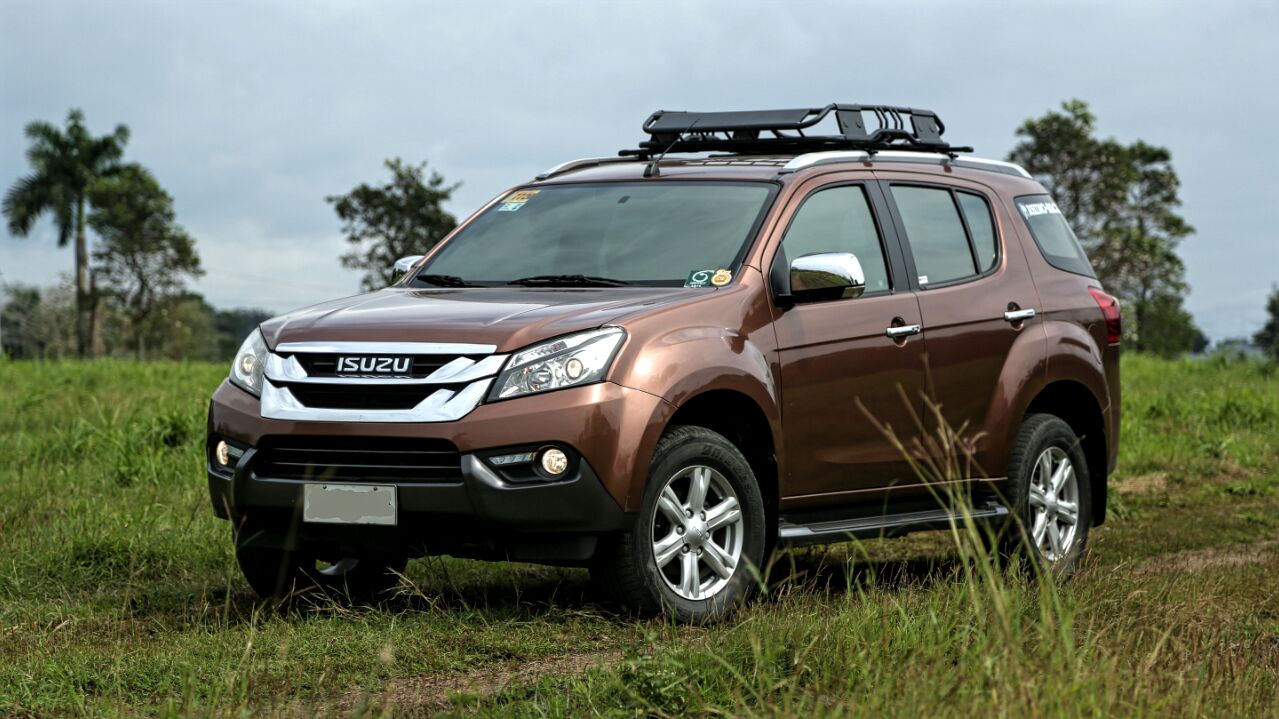
The sure-footed Isuzu Mu-X 4×4 LS-A makes the additional expenses of an offroader easy to bear. There’s the 100Kg additional weight, the 1kml hit on fuel economy, and that P100k sticker price premium typical to 4×4 variants.
But, on the Mu-X 4WD SUV, those drawbacks fade away the moment you hit rough country. And, with some contrived shortshifting on the 5-speed automatic gearbox (using her sequential manual override) it’s quite feasible to turn the big bruiser into a city commuter, or bring her economically up to highway cruising speeds–to just sip diesel while still en-route to those fun, far flung hinterlands that the Mu-X 4×4 is built for.
Go beyond city limits and your taxicab go-anywhere option becomes the tricycle. They’re at the top of the food chain in the rural transport system. So you’d think they’d have more headroom for passengers. But, alas, the trend seems to be for lower, sleeker, claustrophobic sidecars.


 Hyundai Philippines updates the Grand Starex, the upsized second-generation to their popular Starex line, with a variant configured specifically for the transport sector. Listed at P1.398M, a sticker price that adds P60k to that of their 2.5L GL 5MT base variant with its 10 or 12-seat capacity, the new Grand Starex Super Express is set up with the 15 seats that now make it a stronger contender in both chartered and public transport roles.
 The passenger couches are utilitarian, value-engineered into compact footprints while providing ample comfort and legroom in short to medium duration city travel. The efficiently sized furniture allows fixing of the middle seating rows further forward—forward enough to make room for the variant’s defining rear-most seating area with its two side-facing benches providing 6 out of the Super Express’ 15 seats. The result is commuter-class capacity on the Grand Starex with its large sliding doors on both sides and the full-width tailgate offering quick and easy access for curb-side boarding.
 Other specifications appear unchanged from that of the 2.5L GL 5MT base variant of the popular Starex line that’s known for exceptional ride comfort even on a front-engine, rear-drive layout with its conventionally rigid (and robust) rear axle. The Super Express becomes the second variant (after the base GL) to feature the Grand Starex’s simpler, fleet-sensible 100ps (98hp) 2.5L TCi SOHC 8-valve turbodiesel delivering peak torque of 227Nm an early 2000rpm. And prospective owners are offered warranties capped at three-years or 100,000km.


 Introduced late in 2015, the new Celerio turns the badge into a plus-sized A-segment hatchback with uncompromised seating for five adults and a weekender’s worth of luggage space with its best-in-class 254-liter cargo compartment. It’s now longer by 10cm with a proportionate lengthening of the wheelbase by 9cm, and it boasts of better headroom with a height increase of 7cm.
 Supple enough for both comfort and for keeping all four wheels planted, the suspension feels robust enough, the ground clearance sensible enough, for confidently taking on those occasional softroad challenges. And the wheels mount sedan-sized 165/65 R14’s—good feet under a light sub-compact, good enough but also shrouded by roomy fenders that can take wider rubber if you feel like tweaking those tires.
 On the automatic gearbox variant, the powertrain is completed with a two-range JATCO CVT7, the same continuously variable transmission used on the Mitsubishi Mirage CVT variant. The CVT7 adds an auxiliary gearbox between the CVT’s pulleys and the shaft to turn the drive wheels. With this auxiliary gearbox and its low and standard gear ratios, the pulleys meant to have continuously varying diameters are kept compact while still delivering a generously wide range of gear ratios starting with a deep bottom ratio of 1:4.07 in the low range, and going up to an exceptionally tall overdrive ratio of 1:0.55 in the standard range.
 As on most automatic gearboxes, conventional or CVT, the Celerio’s JATCO CVT7 uses a hydraulic torque converter to connect engine to transmission. Torque converters both tolerate and exploit slippage—tolerated because it’s a physical fact, there being slippage when you’re pumping fluid from an impeller to a rotor to transmit torque, and exploited because that slippage causes gear reduction that in turn multiplies torque. And that slippage is eventually eliminated with a lock-up clutch that creates hard contact between the torque converter’s pumping elements. Lock up happens late in the cycle, particularly on conventional automatic gearboxes, kicking in when the vehicle has reached cruise, after shifting all the way up to top gear.
 The Celerio’s JATCO solution is elegant: since the torque converter feeds into a continuously variable system (no distinct gears, no shift shock), the CVT7 gearbox triggers the lock-up clutch early on, as early as during roll out, in fact. To bring it into play, use this Rule of Twos as described in our related story,
 Go gentle on the throttle for those crucial seconds on roll out and you’ll be able to step on the gas however you like afterwards, and this while being treated to the Celerio’s surreal alter ego. With an engine that offers rich torque early on, that’s quiet until you want it to be otherwise, and with no slippage in the system to induce the dreaded rubber-band effect, this gamed Celerio will make you think Suzuki had somehow added an electromotor under the hood … she’ll be that zippy, and quiet.