She looks like her predecessors, those commonplace mini multi-cabs that are the 8th and 9th generation models of Suzuki’s classic kei-truck line reaching back to 1961, but she’s much bigger.
Isabela is the country’s second biggest grower of rice, the biggest of commercial corn that’s used for feeding livestock. And the province that’s landlocked by rough coasts beaten by Pacific Ocean weather needs to truck their millions of tons of staple grain the hundreds of kilometers to exit the fertile Cagayan Valley. No surprise that it was there, just last week, that Isuzu hosted their first ever Truck School session outside Metro Manila. On March 21 and 22 in Aurora City, the country’s top truck-maker trained scores of drivers of their fleet operator customers from Isabela and Cagayan, trained them on keeping their top-of-the-line EXZ tractor heads in good and efficient operation.
Truck School students get hands-on training on Isuzu’s top-of-the-line EXZ tractor head
Dubbed the Hybrid Rice Champion of the country, Isabela grows dwarf rice–a breed engineered to have shorter stalks, requiring less resources to bring to maturity than conventional rice, and making these more hardy against wind and storm. Their crops are of such quantities that farmers contract out the gathering of these to small mechanized harvesters that can each process 50 cavans a a day.
A harvester crew at work in a dwarf rice field
The 1.3 million tons of rice that Isabela produces each year amounts to 224 percent of the province’s consumption, with the surplus production being trucked through Dalton Pass in Nueva Vizcaya on through Nueva Ecija and to Metro Manila and points further south. The very definition of long haul missions, these hundred-kilometer trips through countless towns and high mountain passes take two days each way. And, like super-tankers carrying other basic commodities, its heavy lift tractor trailers that are the most efficient rice haulers, each pulling 30 to 40 tons of payload.
Seemingly in synch with the safety initiative of the members of the Motorcycle Development Program Participants Association (MDPPA), the Car Awards Group, Inc. (CAGI) is now set to launch their new Motorcyle of the Year category. The MDPPA’s move is prompted by record sales in 2016 with total units sold among all members exceeding a million for the first time ever, depicting a situation where we now have a significant and exceptional number of new riders on congested roads. Although the CAGI move has already been several years in the making, this addition of motorcycle awards to their car and truck categories will have a similar effect informing consumers and helping them make the right decisions–in this case, on choosing which two-wheelers that best suit their efforts to beat traffic.
PressStatement by Car Awards Group, Inc., “2017 Philippine Car and Truck of the Year to Kick-off at Manila International Auto Show; Inaugural Motorcycle Awards to be Unveiled,” 2017:
Car Awards Group, Inc. (CAGI) together with their long-time partner Worldbex Services International (WSI) is set to launch the Car and Truck of the Year, as well as the inaugural Motorcycle of the Year at the upcoming Manila International Auto Show at the World Trade Center in Pasay City.
The said presentation ceremonies will be staged on March 31, Friday at the yearly four-day event slated from March 30- April 2, 2017.
The Car of the Year – Philippines (COTY-P) and the Truck of the Year – Philippines (TOTY-P) are prestigious awards bestowed on the best new vehicles annually. Organized by the Car Awards Group, Incorporated (CAGI) since 2004, nominees go through extensive qualitative and quantitative testing to determine the year’s awardees.
For this 2017, aside from the usual automotive citations, the thirteen-year award-giving body will introduce the Motorcycle of the Year-Philippines (MOTY-P) for the very first time.
“We are excited and at the same time honored to get the ball rolling for our activities at the said big event,” said newly-elected CAGI president Ronald de los Reyes.
“The group is busy preparing for everything. Aside from COTY and TOTY, we are looking forward to kicking off the first MOTY at MIAS,” he added.
Aside from the launch presentations, last year’s Car of the Year and Truck of the year winners, the Honda Civic RS Turbo and the Isuzu D-Max, respectively, will also be displayed at a prime location of the show.
For their part, MIAS has already catered to 500,000 attendees since 2005. Not to mention hosting nearly 200 participating companies from the automotive sectors, 500 exhibitors and 400 car display units in the show’s 30,000 sqm. exhibit area.
CAGI has been partnering with WSI since the beginning of the Manila International Auto Show, the event which has been considered the biggest motoring and driving affair in the Philippines held every summer.
Not for nothing but the top-spec SsangYong Rodius, the full size MPV with a premium saloon’s rear-wheel-drive handling, an early boost turbodiesel mated to a fast-twitch Mercedes-Benz 5G-tronic automatic gearbox, a cavernous cabin fitted with three sitting rows instead of the four it can accommodate, and a driveline designed from the start to have on-demand four-wheel-drive, yup, that one … we’d nickname her the “Diplomat.”
SsangYong’s top of the line Rodius ELX 2.0L 5AT 4WD has power to clear datum in a hurry, and with all-weather ( nearly all-terrain) traction. Her seats could be slid into a roomy rolling office configuration (or even an emergency sleeper) that rivals that of any stretch limo. And her P1.59M price tag isn’t something any flag delegation would be embarrassed disclosing to constituents or oversight committees.
Anyone would be sceptical about the Super Carry’s remarkably small 0.8L two-cylinder diesel, even with its output boosted to 32hp / 75Nm by an inter-cooled turbocharger. As compact as it is, the Suzuki micro-truck can still weigh 1600kg when loaded. That’s over a ton and half that needs pushing. Is a 32hp diesel really enough of a powerplant? We we’re sceptical too, but that was before we took her down the Tagaytay-Talisay road with a six passenger loadout … and brought her back up again. Repeat: brought her back up again.
The Tagaytay-Talisay road brings vehicles from mountain down to lakeside in just 15 minutes, that’s how severe its grades are, and it offers the option of not having to go back up and through Tagaytay to get back to Manila. There’s the option of going through Talisay and on through to the Star tollway for a flat return trip. That flatlands fallback wasn’t necessary, though, not on the surprising Super Carry.
Going back up to Tagaytay
With a diesel’s long stroke leverage, the small engine’s torque was always there, pushing the Super Carry with a six-passenger half-load. There were inevitable stints in first gear, speed topping out at 20km/h whenever steep grades robbed us of momentum, but the Super Carry would climb relentlessly, bringing us back to Tagaytay’s altitude with just a few minutes more than it would have taken a sedan with a perky powerplant.
And, while heading back north to Manila, the Super Carry showed that its dinky diesel is powerful enough to merit holding back on the flats. The micro-truck’s accelerator pedal is a drive-by-wire affair with a built-in speed governor. Although stomping on the pedal in either 4th or 5th gear brings healthy acceleration that feels like it could bring you to 90 or 100km/h, respectively, the speed governor steps in to close the throttle back up to maintain a 86~88km/h maximum (actually 80km/h as monitored by GPS tracking).
The Super Carry’s drive-by-wire accelerator module
Clearly, the Super Carry’s small turbodiesel is powerful enough to take Tagaytay from Talisay (even Baguio through Kennon, for that matter) and to merit speed-governing for the sake of safety and of efficiency (magic words in fleet managers’ ears). If not for anything else, the speed governor that’s backhanded proof of the small diesel’s sufficiency also brings cruise-control convenience: step on the pedal as hard as you like, the throttle will still open up just enough to maintain a max-conserve and radar-safe speed of 80km/h.
Suzuki’s Super Carry is just about the most common model exemplifying Japan’s pioneering Kei Truck concept. That’s true at least here in the Philippines where a decade’s absence of brand new units was hardly felt with the continued influx of surplus units from other markets. Its engineering DNA is clearly Japanese and driving the new Super Carry, reintroduced spanking new by Suzuki Philippines, shows how they got their trademark micro-truck specs exactly right.
It’s as if they took a good mainstream truck, solid and stubby, measured its essentials, and then scaled these features down faithfully to a fraction of their original mass. Astonishingly, because of its wheelbase geometry, an actual truck’s well articulated suspension system, and even those stock 155 R13 tires underneath, the Super Carry is as stable on its haunches as are full-fledged workhorses that weigh two or three times as much.
The Super Carry retains large truck equilibrium so well, she’s easily steered even with just the gear reduction of an unpowered steering column. Quite appropriate since the truck’s scaled down mass means a typical, average-sized driver on a Super Carry would have muscle power like that of a giant’s behind the wheel of a conventionally sized truck.
And now, this impression of being a ten-foot tall trucker on a solid light- or medium-duty truck is finally completed by the Super Carry’s unique diesel engine. The 793cc two-cylinder turbodiesel, quite remarkable in itself, makes the Super Carry perform the way it should with torque so rich you could launch even without stepping on the gas pedal—just like a serious hauler should.
UD Trucks launched their Croner medium-duty truck at a globally attended event in Bangkok last week. Arguably the most versatile truck platform in the medium-duty segment, the Croner line brings numerous cargo capacity, engine power and wheelbase geometry combinations, and has top-end mass and dimensions that make it bump up against the medium-heavy range of the spectrum.
Center-stage at the UD Trucks Croner launch held in Bangkok on March 1
It comes in three types with gross weight ratings from 10.4 all the way up to 17 tons. Units come either factory-built with bodies for long-haul, distribution and construction applications, or delivered as cab-chassis platforms to be worked on further by affiliated body-builders. Wheelbase lengths on all three types can be varied on the factory floor or by downstream builders from a minimum of 3450mm to a maximum of 6500mm, with increments of as little as 250mm.
From Nissan Diesel, to Volvo, to UD Trucks
Established in 1935 and known before as Nissan Diesel, UD Trucks became a wholly owned subsidiary of the Volvo Group in 2007. The UD name, now taken to mean ultimate dependability, draws on market recognition for Nissan Diesel’s trademark two-stroke Uniflow Diesel engine first introduced in 1955. The Croner is the second new model to come from the integrated operations of the partnered brands, joining the heavy-duty Quester line-up that they introduced four years ago in 2013.
The similarities in the design of the Croner and the Quester indicate an affinity that’s confirmed by Volvo Group Trucks Asia president Jacques Michel. Michel says that the Croner and Quester tandem, sporting a common design language with their cabin fascia and character lines, represents a new class of trucks meant specifically for growth markets across Asia, Africa, the Middle-East and South America. The Croner and Quester now relegate their medium-duty Condor and heavy-duty Quon trucks (popular and long running Nisssan Diesel trucks with origins dating back to before Volvo’s buy-in) to mature markets like those of Japan and Australia.
Medium-duty Croners and heavy-duty Questers in front of UD Trucks’ manufacturing facility in Samut Prakan near Bangkok
Asked further about the distinctions between their growth and mature market offerings, Michel said that while mature markets are stereotyped as having stricter emission controls, advanced infrastructure, and better road conditions, UD Trucks’ experience serendipitously points to differing markets having different needs, different sets of expectations, it’s that simple. By the sheer weight of circumspection and engineering apparent in the Croner’s features, how these address essential needs with robust, even generous, engineering, it’s clear that UD Trucks is fielding a new model that’s meant to be ready for anything that’s thrown at it in the workhorse medium-trucks segment of growing markets.
Variable vehicle
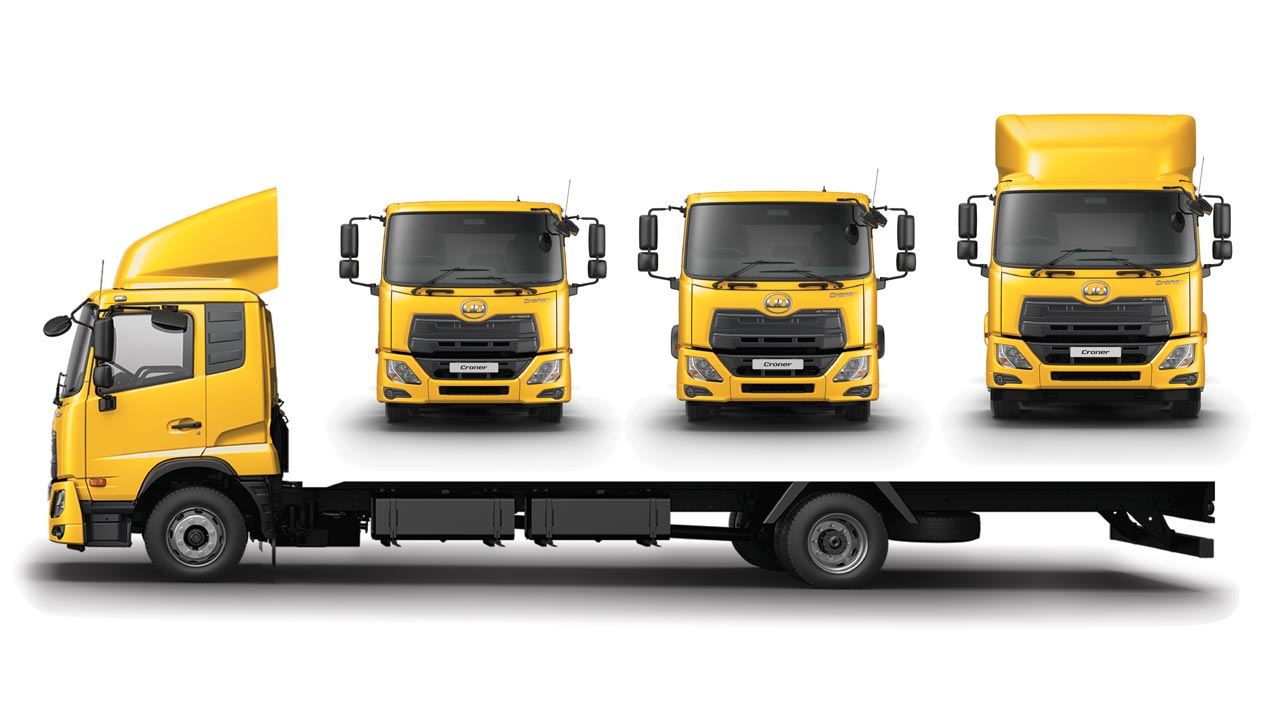
The Croner comes in three size/weight types. Lightest is the compact MKE with dimensions meant for tight city streets and gross weight ratings from 10.4 to 11 tons. There’s the mid-size and multi-purpose LKE with 12 to 14 tons. And there’s the long-hauling medium-heavy PKE with 15 to 17 tons.
With tensile strength asserted to be the highest in its class and balanced with healthy flexibility to stave off metal fatigue, the Croner’s chassis frame comes pre-drilled with bolt holes for sizing the cargo bed with wheelbase lengths from a minimum of 3450mm on all three types, to a maximum of 5250mm for MKE and LKE types, or 6500mm for the big PKE. Facilitating adjustment in wheelbase lengths by as little as 250mm increments, and to keep things modular for any driveline tailoring, the driveshaft from engine to the differential on the rear axle is composed of undulating segments, each joint dampening and isolating the effect of road shocks on the driveline.
Unlike other medium-duty models, the Croner offers only two-axle 4×2 drivetrains with wheel pairs on the rear axle, no configurations with three-axle 6×4 layouts. This puts a lot on two axles, both literally and figuratively, and reveals how confident they are in their claims of class-leading axle loads, both up front and in back, and with axle sub-assemblies tolerating extended grease-change intervals nearly three times longer than is typical.
The cabin itself features exceptional ergonomics highlighted by a flowing dashboard design that’s shaped around the driver’s wider range of motions. The driver’s seat is spring suspended, something you seldom see on medium-duty trucks. And, reflecting how its amenities are meant for hours- or days-long drives, the Croner is offered with sleeper-cab options, another rarity in the medium-duty segment.
Downsized diesel
Michel says that when UD Trucks started their four year development of the Croner it was with the express goal of making it 5 percent more efficient than its other medium-duty trucks. Aside from aerodynamic cab designs with reduced drag coefficients, they achieved this with new and downsized engines on which power densities were increased with the use of “super pressure” CRDi systems featuring sophisticated electronic control of injected fuel quantity and timing.
5 liter 4-cylinder GH5E normally aspirated diesel with super high pressure CRDi fuel injection system
The compact MKE and mid-sized LKE types are powered by a 5L 4-cylinder GH5E diesel engine while the big PKE retains an 8L powerplant, the 6-cylinder GH8E, with both engines being Euro 4 compliant and built rugged enough to have longer oil-change intervals. Those engine codes imply an evolution from the proven 8L 6-cylinder GH8 used on their existing Condor truck, the trailing “E” code on the smaller GH5E and the like-sized GH8E meant to signify fuel efficiency enhancements.
The advanced CRDi system delivers high torque, peaking early and lingering there on the contours of an exceptionally flat torque curve. Torque onset is rich and early enough to deliver an economy range from 900 to 1700rpm. Powerbands are improved tangibly enough that the Croner’s compact MKE type uses the GH5E tuned to 180hp unlike lighter counterpart Condor variants which have a bigger GH8 putting out 210hp. For the bigger mid-sized LKE type, the 4-cylinder GH5E is tuned to 210 and 240hp, numbers rivalling the 215 and 245hp on the old Condor’s 6-cylinder GH8.
Market influences
While the Croner is not meant for mature markets, it seems to also raise the bar somewhat, bringing features that meet the expectations of customers from those parts as well as from their biggest and most advanced growth markets. You’d see this in the air brakes actuators for each of the rear wheels, left and right, to deliver dedicated pneumatics to either side. Engine braking is also complimented with exhaust braking, a feature more common to heavy-duty trucks where exhaust valves are constricted to offer greater resistance to reciprocating pistons in idled engines kept in low gear.
At the Croner launch on March 1, left to right: Kamlarp Sirikittiwatn, President of UD Trucks Thailand; Jacques Michel, President of Volvo Group Trucks Asia and JVs Sales; Yoshihiro Murakami, President of UD Trucks; Håkan Karlsson, President of Volvo Group Trucks Asia and JVs; Nobuhiko Kishi, Senior Vice President of UD Trucks Brand and Product
The 6- and 9-speed manual transmissions offered on the Croner have clutch plates that are said to be the biggest in their class, making these feature better grip and durability. For high operating temperatures such as those in bumper-to-bumper equatorial traffic jams, clutches of Cerametallic material are offered as options.
Automatic gearbox option from Allison Transmissions
While automatic transmission options were made available on all variants to meet the needs of the South African market, their biggest growth market right now where there’s an emerging shortage of drivers for long haul jobs, UD Trucks went full tilt with the feature and sourced the gearboxes from industry leader Allison Transmissions.
The Croner’s AT gearboxes offer Allison’s advanced Continuous Power Technology where a hydraulic torque converter with high stall speed is used only on launch, potentially doubling torque with hydraulic slippage against the 1st gear, but then is in effect bypassed as the 6-speed gearbox shifts up into 2nd gear and then onwards. Taking over from the fluid coupling of the torque converter, there are five clutches in the transmission, a clutch for each of the gears except for 1st, where pairs on adjacent gears simultaneously grab onto or release from the engine’s torque to execute seamless sequential gear shifts. In essence, you have the equivalent of a industrial grade dual clutch transmission delivering continuous push or engine braking with an over-engineered setup where each gear in play has its own dedicated clutch.
Author test drives a Croner MKE at the March 1 launch
For the ability to adjust ride stiffness on demand (freeing operators from having to switch from durable steel- to flexible nylon-belted tires to soften the ride, for example), the Croner offers an adjustable air suspension system in the rear. The function of the air suspension setup is to soften up the ride when needed, to dampen road shocks in varying degrees to insulate fragile cargo.
Down the road
On all Croner variants, there’s the option for telematics that can receive and display remotely commanded travel routes, track motion on or off those routes, and map all these against the control inputs of truck drivers who are made to log into the system and can then be critiqued and coached by it. Data communications with home base can happen realtime over 2g or 3g cellular networks, or buffered for burst transmission later on when intermittent or low quality carrier signals clear up enough for digital exchanges.
Units arrayed for test drive at Croner launch last March 1
UD Trucks director for aftersales and soft products Samuel Artus says that in South Africa similar telematics on their other models were instrumental in recovering nine stolen trucks, this because perpetrators could not disable the factory-installed telematics equipment, equipment that, in a sense, are fleet trucks’ equivalents to airliner black boxes. So, while the telematics remain tools for fleet management, mainly, UD trucks has firsthand experience of how these may be used for security and they don’t discount the possibility of using the equipment’s telemetry to effect more deliberate protection of both vehicle and cargo in the future. Not yet in existence, still on a notional drawing board, there are further enhancements to the suite that could deter criminal elements from their usual M.O. of threatening or enticing drivers into allowing or abetting theft of their payload.
When it was officially launched last March 1 the Croner was already on the production floor at UD Trucks’ manufacturing facility in Samut Prakan near Bangkok which has a capacity of 10,000 units per year, per shift (they can double their output, running two shifts in a day). There, in a plant originally opened by Volvo in 1976, UD Trucks now produces medium-duty Croners beside heavy-duty Questers and even upscale Volvo haulers meant explicitly for export. Croner trucks are rolled out with bodies for numerous hauling and construction applications, or delivered as basic cab- chassis for delivery to body-builders kitted out to do further sizing and construction.
UD Trucks will announce prices for the Philippines when they bring the Croner to this market by the second half of the year.
Coming from the biggest truck brand in the country, by the sheer number of modern new haulers they have on the nation’s transport grid, Isuzu Philippines’ new truck school brings us the closest thing to third-party certifications for big-rig Category V drivers.
Before getting into the driver’s seat
Isuzu Philippines Corporation (IPC) had been doing on-site seminars for client companies, training fleet drivers in efficiently operating their trucks’ industrial-grade powertrains but only in the mode of typical after-sales services that are offered by other big brands as well. But since last year, Isuzu had been organizing regularly scheduled classes at common facilities that are attended by drivers from numerous fleet customers.
The class we observed last November was held at the Honda Safety Driving Center (HSDC) in Paranaque City, and was on the handling of the advanced MJX16 16-speed gearbox offered as an option on Isuzu’s top-spec CYH solid-frame truck and as a standard feature on their EXZ top-end tractor rig.
Karate chop into fifth
On the advanced MJX16, the design of the gearshift permits intuitive access to those 16 speeds but it does take some clear explanation and solid practice to get drivers to the point that they don’t feel compelled to their eyes off the road and eyeball their stick work. Think about it, even if those numerous speeds were implemented as eight notches on the stick-shift with two final ratios, a low and a high one, multiplying these into the required 16, it’d be a constantly daunting task to slot things into the intended gear. If it were left up to a simple crowding of gears onto two side-by-side H arrangements, any driver would balk at not looking down and somehow making sure he’s pulling the the stick down into 4th and not 6th, or even 8th gear.
The “Karate” sensei scans his students
Isuzu’s elegant solution (explained first in the classroom with nomenclature charts that really brought home how they intended to drill these details into the troops) is this firm détente between gears 1 to 4 and 5 to 7. After launching the truck, up-shifts to fourth gear follow the typical pattern burned into every driver’s muscle memory—straight down into 2nd, up-right-up for 3rd, straight down again for 4th.
To cross over into the higher range, you then give the stick a firm shove to the right (the instructor they have over from Japan likes calling it a “Karate chop”). This puts the stick in high range mode, toggling that old natural H pattern into accessing gears 5 to 8. There’s no pull to look down at the stick since that shove/chop makes this H arrangement separate from that for gears 1 to 4. Down shifting from 5th to 4th speed, crossing back down from high to low range is just as intuitive—shove/chop the stick left to toggle her back into the lower range then slot the stick into the upper right channel.
Gentle rungs on the shift ladder
Actual gear-shifting is done electronically, by wire, despite the meaty feel of these shifts, and this is most apparent with how Low and High final ratios (those two settings that multiply the 8 speeds into 16) are toggled with a splitter switch down the front of the stick. You can leave the switch in either mode but toggling between the two in a detailed shift ladder (low to high 1st then low to high 2nd and so on) delivers the close ratios you’d need when easing a heavy load up to cruising speed. You toggle that splitter with the stick in neutral before putting things back in gear. A gentle climb through all available ratios from launch would go like this …
IPC president Hajime Koso assists in giving troubleshooting tips
1st low: with the stick in neutral set the splitter to low, press down on the clutch pedal, slot the stick into 1st gear for roll out
1st high: bring the stick back into neutral (press down on the clutch pedal, bring the stick into neutral, step off the clutch pedal), toggle the splitter into high, step back on the clutch, slot the stick back into 1st gear
2nd low: bring the stick back into neutral, toggle the splitter into low, step back on the clutch, slot the stick down into 2nd gear
2nd high: bring the stick back into neutral, toggle the splitter into high, step back on the clutch, sloth the stick back down into 2nd
… and so on, you get the picture.
The shift sequence traversing all available speeds does add some significant steps to the process but these describe sub-routines in the algorithm that can be quickly burned into new muscle memory.
When using those speeds to create drag for decelerating, Isuzu’s advanced powertrains also feature engine-induced braking in two stages. There’s the typical engine braking that goes on with the engine idled while being pushed against by the roadwheels through a lower gear, and there’s the additional drag that’s available with exhaust braking where un-combusted gases are funnelled down before exiting the cylinders and made to put more resistant pressure on the reciprocating pistons. So, interspersed with those downshifts through all the speeds, through both high and low ratios of each gear, the driver has the option to tweak each stage’s braking potential.
Groundbreaking but also pragmatic
Having typically come up through the ranks from light and medium-duty trucks, it’s not surprising that most drivers use only a fraction of these new-fangled controls. They usually settle for a small sub-set of features, thereby handicapping themselves when trying to obey mandates, if any, to keep the engines turning in optimal RPM ranges while doing long and/or heavy hauling. Isuzu’s truck school offers them a chance to break the mold and drive advanced equipment with new competencies.
IPC president Hajime Koso at truck school
IPC president Hajime Koso explained that their initiative is in direct response to the dramatic growth they’ve experienced since 2015. In that year, Koso’s move to invest in ready ex-stock inventories even of Isuzu’s big C and E series trucks resulted in triple digit growth that got the truck maker the top position in all segments for the first time, leading the industry with their mainstay light- and medium-duty haulers and now also with their heavy-duty solid-frame and tractor-head trucks.
Truck school convened again last December to finish out the year with six sessions and, this month, Isuzu will bring it along with a truck fest exhibit to Isabela in Northern Luzon. This is in line with what Koso described as their strong push to bring their products and expertise out into the countryside, with IPC asking its dealers to help specify and organize similar activities for the Visayas and Mindanao regions as well.
This progression to common classes for their fleet customers, the first in the country, is as pragmatic as it is groundbreaking … it’s simply them doing their part to make sure their multitude of fleet customers, and many new clients, do get what they expected when they chose Isuzu. And, with truck school and its certificate courses being the creation of the country’s biggest truck-maker, well, it’s easy to see how this harks back to when big brands like IBM and Boeing had themselves created instruction programs for their complex products, programs that were eventually mainstreamed into courses from independent, third-party institutions. Would that these developments lead to similar evolutions.
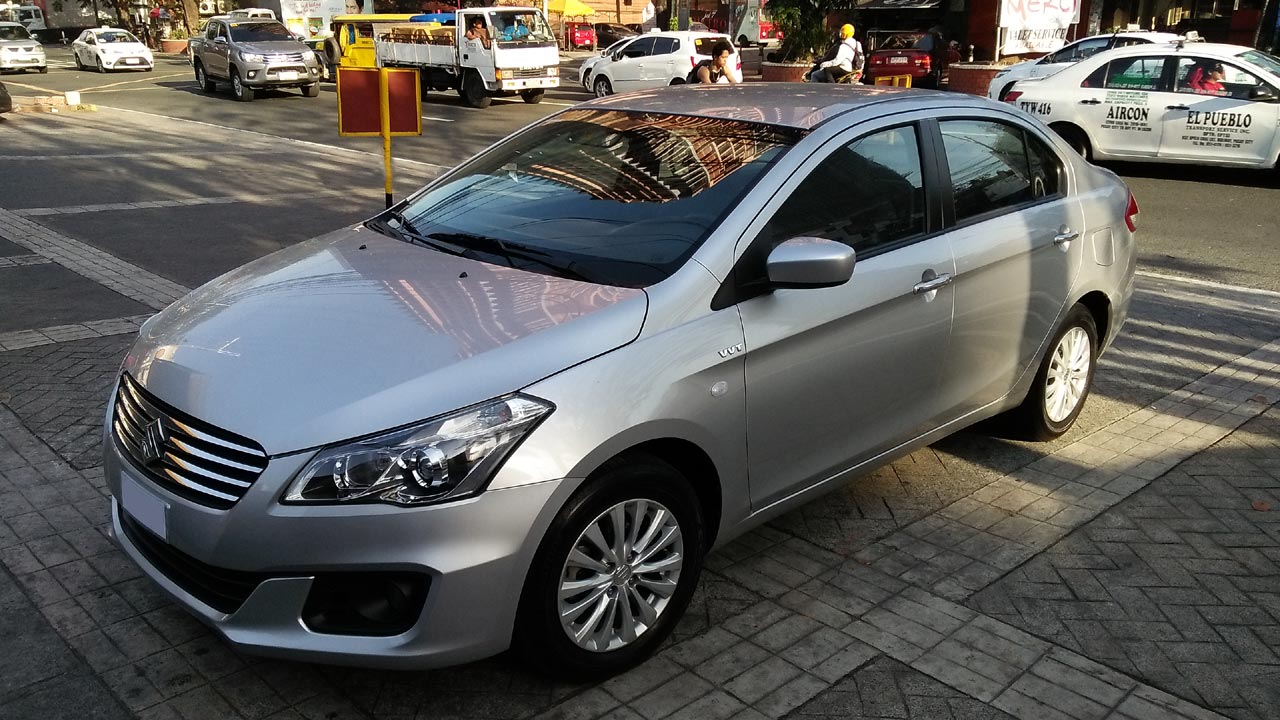
Get past the impressive trim on this base model—get used to it as the new normal, actually—and you’ll be more impressed with the Ciaz GL M/T’s powertrain that mates the small but VVT-equipped 1.4L K14B Suzuki engine with the nicely balanced ratios on a manual gearbox topped with an exquisitely positive stick-shift.
You can start by rolling her out like a diesel. Put her in gear and, with your foot off the gas, slowly let off the clutch pedal (letting the clutch plate ease onto the pressure plate) until you feel that initial bite. That’s when you press on the gas and further ease off the clutch pedal at the same time. The engine that can be quick to rev otherwise will then have all its revolutions pushing the sedan forward before you step on the gas in earnest, thus keeping revs down to under 1500rpm.
Then after, even still with just 1500rpm, the impulse to short-shift to save fuel in crawling city traffic is easy to give into. Topping out at 1500rpm, I could shift to second gear at 10, then to third at 25, then fourth at 40 and then finally to overdrive 5th gear at 50 km/h. And all these even with a full passenger load. The result was a quiet drive (onset of throatiness happens at 2000rpm) and fuel savings on city sorties that can impact the entire nation’s bottom-line.
Imagine getting to fourth gear by 40km/h and being able to stay there, lingering at a 1:1.00 direct drive ratio even if your speed drops down by as much as 5km/h, and cruising along with less than 1500rpm that gets you realtime mileage of 13km/l … to repeat, at 40km/h! The number gets to an astounding 20km/l, far as the trip computer is concerned, if you’re lucky enough to hit a fast moving patch and bring it to an overdrive fifth gear, city cruising at 50km/h with under 1500rpm.
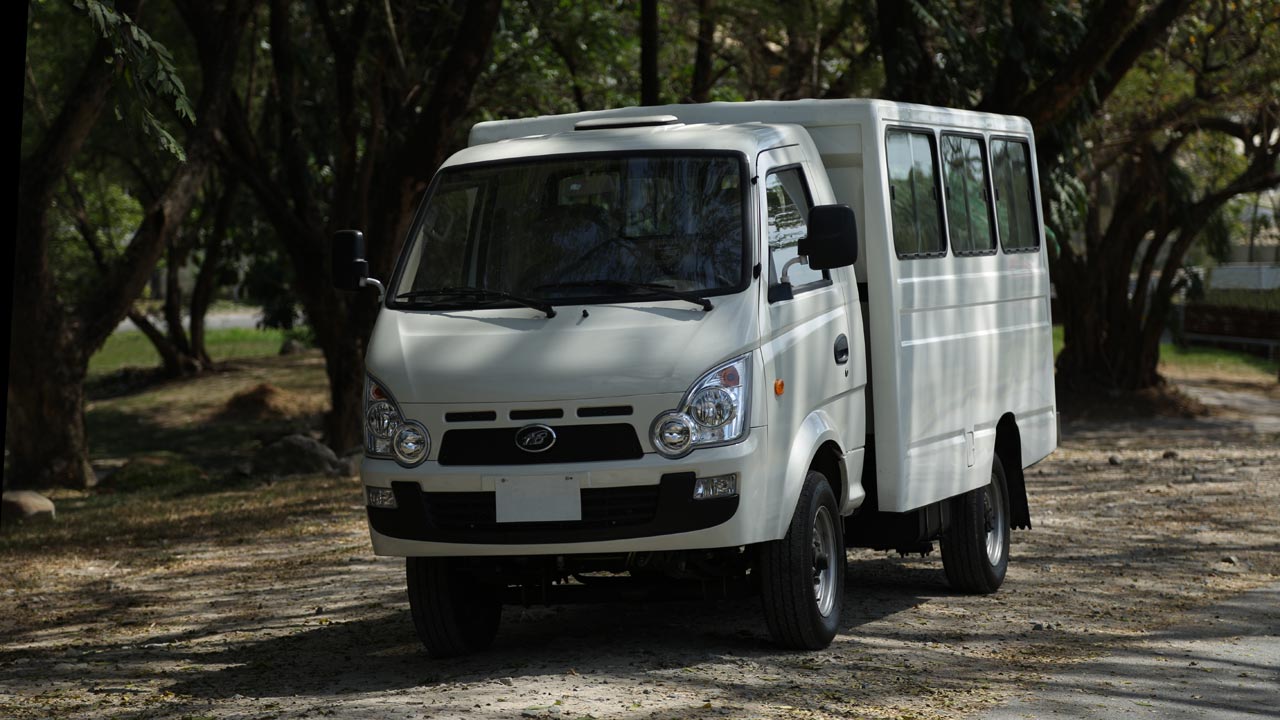
You’ll want to stick to roads, of course, but with the truck chassis of the Bayanihan H5, you’ll also like it in the dirt. Riding high enough and featuring a traditionally robust suspension system with ample articulation, BAIC’s new H5 is no slave to pavement.


 Not for nothing but the top-spec SsangYong Rodius, the full size MPV with a premium saloon’s rear-wheel-drive handling, an early boost turbodiesel mated to a fast-twitch Mercedes-Benz 5G-tronic automatic gearbox, a cavernous cabin fitted with three sitting rows instead of the four it can accommodate, and a driveline designed from the start to have on-demand four-wheel-drive, yup, that one … we’d nickname her the “Diplomat.”




 Established in 1935 and known before as Nissan Diesel, UD Trucks became a wholly owned subsidiary of the Volvo Group in 2007. The UD name, now taken to mean ultimate dependability, draws on market recognition for Nissan Diesel’s trademark two-stroke Uniflow Diesel engine first introduced in 1955. The Croner is the second new model to come from the integrated operations of the partnered brands, joining the heavy-duty Quester line-up that they introduced four years ago in 2013.

 The Croner comes in three size/weight types. Lightest is the compact MKE with dimensions meant for tight city streets and gross weight ratings from 10.4 to 11 tons. There’s the mid-size and multi-purpose LKE with 12 to 14 tons. And there’s the long-hauling medium-heavy PKE with 15 to 17 tons.
 With tensile strength asserted to be the highest in its class and balanced with healthy flexibility to stave off metal fatigue, the Croner’s chassis frame comes pre-drilled with bolt holes for sizing the cargo bed with wheelbase lengths from a minimum of 3450mm on all three types, to a maximum of 5250mm for MKE and LKE types, or 6500mm for the big PKE. Facilitating adjustment in wheelbase lengths by as little as 250mm increments, and to keep things modular for any driveline tailoring, the driveshaft from engine to the differential on the rear axle is composed of undulating segments, each joint dampening and isolating the effect of road shocks on the driveline.
 Unlike other medium-duty models, the Croner offers only two-axle 4×2 drivetrains with wheel pairs on the rear axle, no configurations with three-axle 6×4 layouts. This puts a lot on two axles, both literally and figuratively, and reveals how confident they are in their claims of class-leading axle loads, both up front and in back, and with axle sub-assemblies tolerating extended grease-change intervals nearly three times longer than is typical.


 This progression to common classes for their fleet customers, the first in the country, is as pragmatic as it is groundbreaking … it’s simply them doing their part to make sure their multitude of fleet customers, and many new clients, do get what they expected when they chose Isuzu. And, with truck school and its certificate courses being the creation of the country’s biggest truck-maker, well, it’s easy to see how this harks back to when big brands like IBM and Boeing had themselves created instruction programs for their complex products, programs that were eventually mainstreamed into courses from independent, third-party institutions. Would that these developments lead to similar evolutions.

 You can start by rolling her out like a diesel. Put her in gear and, with your foot off the gas, slowly let off the clutch pedal (letting the clutch plate ease onto the pressure plate) until you feel that initial bite. That’s when you press on the gas and further ease off the clutch pedal at the same time. The engine that can be quick to rev otherwise will then have all its revolutions pushing the sedan forward before you step on the gas in earnest, thus keeping revs down to under 1500rpm.
 Then after, even still with just 1500rpm, the impulse to short-shift to save fuel in crawling city traffic is easy to give into. Topping out at 1500rpm, I could shift to second gear at 10, then to third at 25, then fourth at 40 and then finally to overdrive 5th gear at 50 km/h. And all these even with a full passenger load. The result was a quiet drive (onset of throatiness happens at 2000rpm) and fuel savings on city sorties that can impact the entire nation’s bottom-line.