Front/rear facing seats bring efficient and safer seating on jeepney-type rear bodies

Shouldn’t someone be working on this, this double-coach configuration for truck chassis rear-bodies that harks back to how passengers travelled in train cabins with front- and rear-facing couches?

Not a radical thing, not rocket science, a double-coach configuration simply takes the commonplace jeepney-type benches on trucks’ passenger rear bodies, bisects the front and rear halves and rotates each of these 90 degrees, and puts doors on the right side, the curbside of the cabin.

Result would be the same seating capacity as on a side-facing counterpart—a critical issue for school-bus operators who need as many revenue-earning seats as safely possible to stay afloat—and two doors where there used to be one, each one serving half the number of passengers as compared to before.

Double-coach with foldable benches could be configured for multiple applications, from school-bus or commuter, to long deck panel truck.

The value of this configuration—in light of regulatory initiatives for modern and safer passenger accommodations on school-buses as well as public utility jeepneys—hinges on government acceptance of rear-facing seats as being equivalent to front-facing ones. And these should be acceptable since rear-facing postures are considered safer than front-facing ones, and significantly enough for the manufacturers of child seats to instruct that these be mounted rear-facing to transport kids aged three years or younger.
Why GrabTrike is a good thing even if you don’t actually use it

The GrabTrike option on the Grab app could serve as your online resource for holding tricycles to the fare matrix that’s probably posted for public reference but only in locations familiar to locals. Regulated by local government units, tricycle fares are intended to be fair. That’s a given. But with no easy access, no quick read on what these fares ought to be, the commuter is basically at the mercy of the tricycle driver and the prices he may quote.

It’s something that comes with a learning curve, figuring out standard fare after several trips to similar points, over what seem like equivalent distances. But when you disembark from long haul transport and want to take the countryside’s equivalent to the city’s taxicabs, that’s when asking around for how much so-and-so costs becomes a big old canary—something that marks you as,  well, as a mark.

So, you usually just get in the trike, trying to look like a local, and then just ask how much fare is when you get at your destination, like it was just a lapse in memory. If the fare sounds exorbitant, you have the option of haggling and maybe making a scene, but you’re already behind the curve at that point.


Enter GrabTrike. Even if you end up not actually using the service, firing up the Grab app and thumbing in origin and destination points, will show you the estimated fare for your trip (add the P25 Grab fee if you want to actually book it, or save it if you don’t). Presto! You’ve got a number to work with.

Here a suggestion for going native: if you want to keep looking like a local, round off the number to the nearest P5. Say it like, “di ba P65 lang?!” if the driver looks like he’s trying to pull the wool over your eyes. Even if the right fare is pesos less, you get to leave behind a consolation tip.

So far, Grab has been able to deploy the service only in Pampanga. If you think about it, their efforts to represent obscure fare matrices with their simplifying algorithms are already a public service in itself. Here’s hoping they roll out GrabTrike in other locales as well, and soon.

And, come to think of it, the same argument can be said of GrabTaxi where taxicabs do ply city streets. Even if you don’t actually use the service, running their app and checking the estimated fare for your trip gives you a fair estimate, sans the booking fee, assuming traffic conditions stay generally the same from start to finish.

Sidecar or armrest

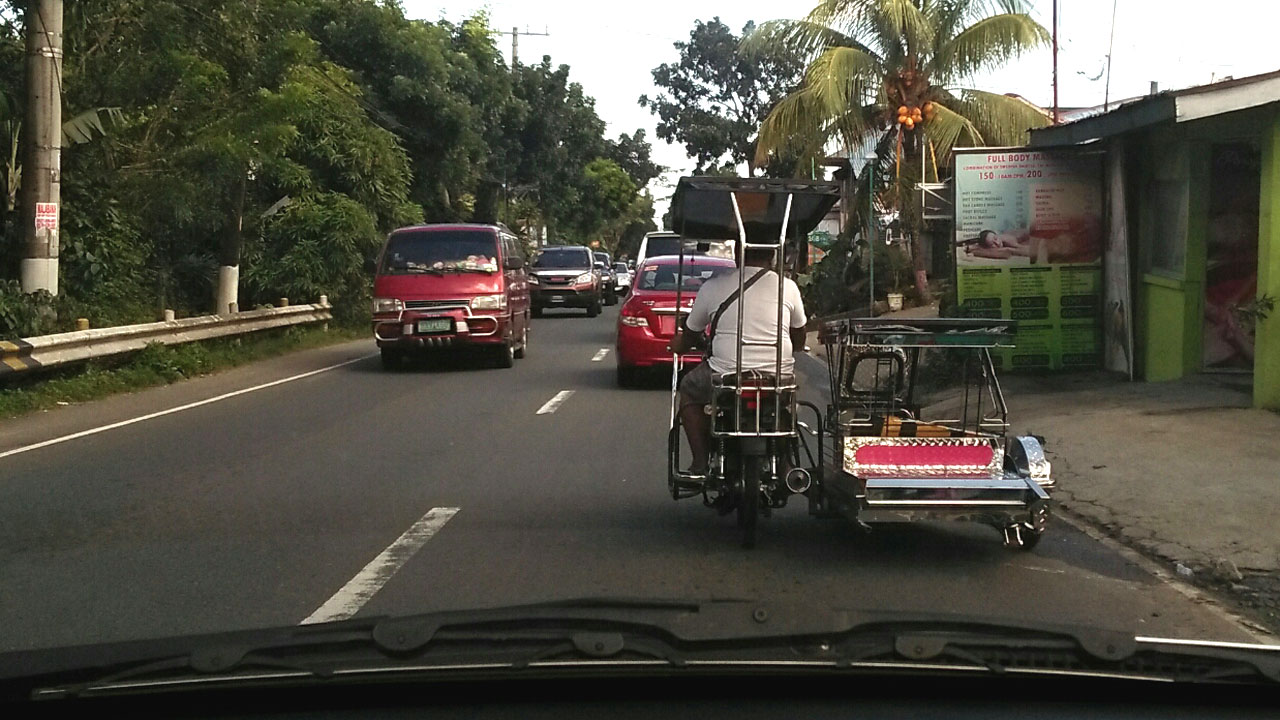
Go beyond city limits and your taxicab go-anywhere option becomes the tricycle. They’re at the top of the food chain in the rural transport system. So you’d think they’d have more headroom for passengers. But, alas, the trend seems to be for lower, sleeker, claustrophobic sidecars.

Quality Reporting From the Old Guard

moleskinesPeople’s appetites for stories are at their highest, and yet circulation numbers are dropping across the board. Picture a magazine with all the pages torn out and grabbed at by millions. Now stay focused on that image as you once again hear the platitude “it’s all about content.” What it means is that people are simply burning through the cover and seeing the stories. These can be long ones, short ones, the length made relative by cyberage attention spans.

What they seek, find, or more often than not stumble upon, are stories that can come from anywhere. They prefer it this way even if they don’t know it. They prefer to get wind of stories that other people are reading, and not admit that that’s why they’re reading them. It’s crowd-sourced relevance at its core.

Very seldom do they look first at the name of the publication. Not unless they’re nailed to it because of some regular need, being hooked to a daily fix, as in for news dailies. Everything else is catch as catch can. The publisher is looked at only after the headline called their attention, and looked to keenly for credibility.

If the story is such a scoop that it has to hurdle some scepticism, then the publisher’s reputation comes into play. And that’s when a story’s value gets away from crowd caused relevance and gets back to the brass tacks of having a brick-and-mortar entity stand by its news reports.

So, ironically, the better the content, the more informative it is or the more groundbreaking its revelations, the more it depends on the publisher’s traditional media reputation. Good investigative or exclusive content need to be attributed to the old guard to be distinguished from the more common citizen content that now saturates the ‘Net. Those old grey ladies of print and broadcast media still have a lot to contribute, and if they really get it, they’ll be marking new territory with the quality of their reporting.

Colored Powder for Airbags

DSC_1372

There I was, riding shotgun in a car that had entered a terminal skid. When the trees and brush were flashing sideways in our headlights, just when we felt the front tires hit the ditch and explode, I remember thinking, “oh crap, this is gonna hurt!” The next instant, someone slapped my face, and that was that. I never lost consciousness but with that airbag suddenly billowing out at blinding speed, I never saw it coming, thought someone had reached in through the window to give me a firm smack.

The airbags deflate immediately, part of the cushioning process, good for mitigating trauma, not so good for situational awareness. Because the bags retreat so quickly, it takes a moment to realize they had deployed, and that realization may not come in time because in the aftermath of that airbag action, a white cloud smelling of hot plastic fills the car.

Of course, if you realize that the airbags had deployed, you might put two and two together and figure out that it’s the white talcum powder they sprinkle onto the bags when these are packed into tight-fitting compartments, to prevent the fabric from sticking together. If you don’t connect things to the airbags, if you see the white cloud as some other thing caused by the accident you’ve just survived, you’ll likely think of something lethal.

“It’s a fire! We’re on fire!” your mind may very well scream, right before you scramble out in panic. And that’s not always a smart move. What if you’re on a highway with other vehicles zipping past trying to avoid your wreck. You’d be jumping out of the frying pan and into the fire, figuratively speaking of course. But with everything you’ll be handling in superfast time—that white cloud, a hot plastic smell, and of course, a wrecked car—who could blame you?

Matcha_No1_aluSo how about one simple change that could make things go very differently … how about a color for that talcum powder that doesn’t cause notions of smoke or of blunt force trauma? A white cloud looks like smoke, a red cloud, maybe like blood splatter. So, not white, not red, and not even pink for that matter. But what about green then, even blue? Point is, carmakers can look at coloring that talcum powder, making it look harmless, maybe even funny, when it billows and lingers in that cloud after the airbags deflate.