At MIAS 2017, Car Awards Group kicks off year’s search for best cars, trucks and now also motorcycles

The Car Awards Group, Inc. (CAGI) kicked off their official calendar at the Manila International Auto Show (MIAS) held last week with the launch of their Car of the Year Philippines (COTY-P) and Truck of the Year Philippines (TOTY-P) awards categories for 2017.  Coming after reports of last year’s record setting growth for the Philippines’ automotive as well as motorcycle markets, CAGI also announced the maiden season of the Motorcycle of the Year Philippines (MOTY-P) competition, the awards group finally rolling out counterpart awards categories for two-wheeled motor vehicles.

Press Statement by Car Awards Group, Inc. (CAGI), “Car Awards Group, Inc. (CAGI) Kick starts a Packed 2017 Season,” 2017:

MANILA, PHILIPPINES – To start the ball rolling for the new 2017 season, the Car Awards Group, Inc. (CAGI) held their momentous launch events at the Manila International Auto Show (MIAS) at the World Trade Center in Pasay City last March 31, 2017.

With the continuous vision of keeping the Filipino consumer informed of the best cars for sale in the market, CAGI not only kick started the rigorous search for the best vehicles contending in the Car of the Year Philippines (COTY-P) and Truck of the Year Philippines (TOTY-P) awards, but also opened the doors to the world of two-wheelers with the inauguration of the Motorcycle of the Year Philippines (MOTY-P).

The 2016 Car of the Year Philippines (COTY-P) winner, the Honda Civic RS Turbo and the 2016 Truck of the Year Philippines (TOTY-P) Isuzu D-Max are displayed at the entrance of the Manila International Auto Show.

“By welcoming new blood into our fold, the organization is expandingits reach, and tapping into the expertise of the motorcycle media to adapt our successful model,” said CAGI president Ronald de los Reyes during a speech.

“We believe that it’s about time that we also give due recognition to our fellow two-wheeled contemporaries on the road,” he added.

(L-R) Car Awards Group, Inc. (CAGI) Treasurer, Novelyn Quiamco; CAGI Vice President External, Andy Rodriguez; KPMG partner Jefree Tapia; CAGI President, Ronald de los Reyes; DPWH undersecretary, Atty. Karen Jimeno; Worldbex Services International Chairman, Joseph Ang; Carmudi Philippines Managing Director, Abishek Mohan; Carmudi Philippines Marketing Manager, Kris Lim, CAGI Techinical Director Mariano Tamayo and CAGI Vice President Internal, Joel Quinto are all set for this year’s CAGI season.

Special guests representing various sectors of government graced the launching ceremonies, such as Department of Tourism assistant secretary Inaki Jose and Department of Public Works and Highways undersecretary Atty. Karen Jimeno.

“The state of our country’s infrastructure affects our car preferences,” Jimeno mentioned in her speech as she related the event to current local issues.

Car Awards Group Inc. (CAGI) is in synergy with the local motorcycle media to make the first-ever Motorcycle of the Year Philippines (MOTY-P) a reality.

Since 2004, CAGI prides itself of holding annual test fests, where all vehicle entries go through a strict process of classification and sorting, before they are subjected to qualitative (consumer) and quantitative (performance) testing. Qualitative testing uses predetermined consumer metrics like the ride, fit, and feel, while quantitative testing uses GPS-based hardware to measure handling, braking and acceleration. Each year, winners for each category are announced, and from that winning pool emerges the year’s COTY-P, TOTY-P and this time, the MOTY-P.

“We expect more than a 100 motor vehicles consisting of cars, pickups and motorcycles to be tested this season,” de los Reyes shared.

The Car Awards Group, Inc. (CAGI) is comprised of members from various outlets in print, broadcasting and digital media

Aside from the official launch in MIAS, the usual Test Fest in September and October; and the awards night in November, this year’s season will include various dealer talks in April and May, test demonstrations in June and July, and the television special in December—thus further adding more excitement to the jam-packed season.

For the third straight year, www.Carmudi.com.ph presents this endeavor while internationally respected auditing firm KPMG is once again on-board as partner. The latter will be in-charge of all the data handling during the testing process, which consists of data gathering, tabulation, and up to the final audit and release of the official results.

CAGI is working together with KPMG, represented by its vice chairman on advisory Henry D. Antonio (center) and assistant manager on risk management Cedie Dimaculangan (2nd from left)

Car Awards Group, Inc. is a non-profit/ non-stock organization composed of motoring journalists from: Business Mirror, Cebu Daily News, Daily Tribune, Malaya Business Insight, Manila Bulletin, Philippine Daily Inquirer, Philippine Star, The Manila Times, Bulgar, Abante Tonite, Mindanao Daily News, AQ Magazine, Autocar.Ph, C! Magazine, Motorcycle Magazine, Power Wheels Magazine, Top Gear Philippines,2nerMagazine.com, Carmudi Magazine, Motortech.ph, Iginition.ph, Interaksyon.com,Kotse.com, ManilaSpeak.com, MotionCars.com, Ride and Drive Phils., SprocketPh.com,TessDrive.com,TimeAttackManila.com, Yugatech.com, DZMM, Inside Motoring on DZRJ 810 AM, Mellow 94.7, Motoring sa DZME, The Motoring Page on Mellow 94.7 FM, ABS-CBN, Auto Review, Spotlight TV. Media partners supporting us are: Jamesdeakin.ph, Turbo Zone, Ride Philippines, Real World Drive, Wheels & Gears, Turban Rider, Motorsiklo Xklusibo, Wheels Philippines, JAP Media, Lifestyle on Wheels, Makina, and Speed Magazine.

Suzuki’s family-sized Swift, alias the Ertiga

Based on the Swift platform, it’s better to describe the Ertiga MPV as an evolution of the sub-compact hatchback. It’s like they tried to make the sporty Swift a more sensible people and cargo mover, a family Swift, and ended up with an entirely new and versatile vehicle.

Genius steps

Creating the Ertiga seems to have been a genius move put together with a series of sensible increments, nothing earthshaking about the steps themselves until they finished, stepped back, and yelped, whoa! What’d we just do?!

They seemed to ask, “what if we make her boxy in back with a fourth pair of pillars?” Adding the Ertiga’s D pillars to the Swift’s A, B, and C pairs creates generous vertical cargo space in back.

Afterwards, they must’ve wondered, “what if we lengthen her, and her wheelbase?” Stretching the Swift’s length by 41.5cm, and its wheelbase by 31cm, turns the rear into a seriously tall and deep cargo bay while keeping things stable atop a proportionately long wheelbase and those minimal overhangs.

Then came that defining next step: “what if we raise the roof and put in a third row?” Adding 14cm to the Swift’s headroom lets passengers sit more upright. This shallows up the footprint of the middle seats, allowing the addition of a third foldable seating row in that cavernous rear.

More a maxi-wagon than a van

On the Ertiga, the result of all these studied steps is an MPV with the proportions of a high-roofed and boxy hatchback (like say the Honda Jazz). The Ertiga looks so much like a two-row crossover something that folks are often surprised by the number of passengers that go into and alight from a seven-seat Ertiga. The Ertiga is an MPV more by way of a maximized station wagon (like the Volvo XC70 with its third row of rear-facing jump seats) rather than a mini-minivan.

The Ertiga’s third seating row, what defines it as an MPV, splits 50/50 with either or both sides folding down flush into a flat deck. With that third row fully stowed, the Ertiga is configured as a tall station-wagon with generous leg-room in the second row.

When it’s passengers that take priority over cargo, creating a third seating row requires more than just unfolding the rearmost seats. The plush-cushioned seats all-around require some judicious slide adjustments to hit the right balance of having barely adequate legroom for both middle and back rows. Seating becomes cramped, but for a good cause, to convert cargo space into room for two (or even three) more passengers, and there’s good news in there being some useful leftover cargo space in back.

Swift handling

Upsizing from the Swift hatchback to the Ertiga MPV entailed an increase in curb weight of 195kg and in gross vehicle weight of 335kg. Do the math and you’d see that Suzuki’s engineers stayed on top of their game all throughout the redesign, increasing payload by exactly 140kg—that’s the weight of two average sized adults, them you’d put in that extra third row on the Ertiga.

Heavier, longer and taller than the Swift hatchback, the Ertiga MPV compensates with its larger wheelbase geometry—longer by 31cm, as mentioned, and wider by 0.5cm on its front and rear treads. And, going under that increased weight on the coil-sprung strut-suspension is ground clearance they’ve thoughtfully upped by 1.5cm.

The detailed tweaks to the Ertiga’s dimensions were kept so painstakingly proportionate throughout her development that the bigger MPV retains the original hatchback’s famous handling, the Swift’s Zen, so to speak. She’s solid and stable at high speed, and well planted when taking corners at mindful speeds. The increased weight and its raised height and center-of-gravity appear well compensated by the stabilizing effect of that exceptionally long wheelbase—the longest in the sub-compact MPV class at 2740mm versus the Toyota Avanza’s 2655mm and the Honda Mobilio’s 2650mm.

The taller cabin also compensates with a more rakish windshield that results in the Ertiga’s more aerodynamic shape. The reduced drag coefficient translates to less wind noise when she’s cutting through the air at high speed.

Swift power

The Ertiga’s engine, up-rated in good proportion to its increased weight, is still a Swift’s, albeit for a more powerful 1.4L variant that’s been discontinued in this market. In place of the Swift hatchback’s current 1.2L K12M that delivers peak power and torque of 87hp and 114Nm, there’s the Swift’s former 1.4L K14B with its 95hp and 130Nm to power the heavier Ertiga.

On the top-spec Ertiga with its 4-speed automatic transmission there seems to be moderate slippage in the torque converter, this to multiply torque when you need it. Rolling out with 2000rpm and then accelerating with higher revs at around 2500rpm triggers upshifts conventionally at 20km/h increments—going through 20, 40 and then 60km/h to finally reach an overdrive fourth gear. The lock-up clutch kicks in after another 20km/h increment at 80. After accelerating up to cruise, throttling it down to 2000rpm will keep you moving at 80km/h while a higher 2500rpm will put you at the 100km/h legal limit.

Best mileage we recorded on the Ertiga with 4-speed AT was 17.5km/l on the highway and 9km/l in the city, all these with five passengers and some day-trip luggage on board. You could get better average mileage overall if you keep those revs at or under 2000rpm, as little as 1750rpm being enough for a 60km/h city cruise already at 4th gear (but before clutch lock-up) and showing 18km/l realtime fuel economy on the trip computer.

All-in-all, the Ertiga with her K14B engine and 4-speed automatic gearbox handled and performed similarly to the Swift 1.2L AT. Not surprising, given her numbers. Although the Ertiga is burdened with 195kg more of curb weight and 335kg more in maximum gross weight, if you put a Swift’s load on her, just the five passengers and some luggage, the power to weight ratio comes up the same … even better, in fact.

If you run her with a gross weight of 1630kg (its max gross weight of 1770 less the 140kg of increased payload for two extra passengers), the Ertiga’s K14B engine would be pushing just 12.53kg per Nm of torque. That’s slightly better than on a fully loaded Swift 1.2L, its K12B engine pushing 12.6kg/Nm.

Cool people mover

Up-rating the Ertiga to the proven K14B engine more than compensates for the MPV’s additional mass, the VVT valvetrain keeping things efficient on highway transits and also cool on grueling city commutes. The K14B’s latent idling torque is so strong as to make the dual-type air-con positively frigid even in summer conditions … good news for when you have all seats occupied, each passenger requiring 600 BTUs of energy to keep cool.

In fact, the air-conditioning is so strong that you’ll appreciate their keeping the heater feature meant for wintered markets. Even in the summer heat, the air-con makes the interior so cold that condensation can build up and leave moisture deposits in the vents—causing mildew build-up after a while. To flush out the unpleasant smell, switch off the AC, flip her into heater mode and run the blowers full blast for a few minutes. End of the exercise, the interior will smell bone-dry clean again.

A Swift for others

The Ertiga is rather cramped for a three-row MPV but dismissing it this way and evaluating it against the template of minivan-like MPVs would be to miss the point of the Ertiga entirely. In a sense, the Ertiga is more a multi-role vehicle than other MPVs. That defining multi-purpose cargo space with its option for plush extra seating stays out of the way until you need it. It adds capability to the Swift platform, it doesn’t overstep and define the Ertiga as being just an MPV.

Drive her with a hatchback’s load and the Ertiga feels like a trunkless Swift while looking like a boxy-tall station wagon. When you eventually need to use that multi-purpose space, she can expand to carry an MPV’s seven passengers or oversized cargo loadout. And the space and power tradeoffs of transitioning from wagon to van mode, from partial to full load, are hardly worth considering when you’re given the capability to leave no one and nothing behind.

Volkswagen Philippines introduces the Crafter at MIAS 2017

Debuting at the ongoing 2017 Manila International Auto Show (MIAS) is the Volkswagen Crafter van. She’s huge for a so-called van, coming in the form of Europe’s ubiquitous do-all white-vans. But this commercial vehicle is meant for tailoring into an utterly private conveyance,  her hugeness leveraged into mobile real estate that Volkswagen Philippines is willing to decorate and landscape to your particular specs.

Remember the old VW Kombi from the 1970’s and 80’s? At some point offered as a minibus it quickly became a people box on wheels, fitted out as anything and everything you could live with to bring around your kinder and kit for all sorts of adventure. On some mods the roof even accordions up so you could almost stand upright in Kombis turned into cozy campers. It started the trend that had folks modifying big Detroit-made vans into rolling man caves, complete with crushed felt trim and other funky accoutrements.

But all of these, from the bantam-sized Kombi to the wide-bodied American makes, were all snug—the accommodations fit just for the hip, them Age of Aquarius roamers, and for single, unencumbered hot-rodders. The Crafter breaks that mold, leastwise enlarges it, raising the roof, literally, over a body that’s half again as big. Under the hood on the semi-forward one-box form is a powertrain that would get a 10-4 nod from any squinty trucker, with the modern safety and driving assist features that a soccer Mom would take for granted on anything sport-utility.

The Crafter on display at MIAS is a sold unit, with bespoke appointments specified by its owner in waiting. As described in Volkswagen’s literature: “The accessorized Crafter L on display is installed with 6 high-back Captain Seats, a 32” Samsung TV, touch-screen multimedia radio with navigation, window framing with van blinds, accent LED lights, and side step board.”

But, think about it, she’s done up as an unobtrusive transport, really. From living room or office desk, you step into the Crafter and pick up where you left off. Some time later you alight at a new place to get done what needs doing. It’s like you moved from one room to another, and then another … subtle luxury that comes at a base price of P4.0M, signing bonus for a limo-grade driver, not included.

Momo tires officially launched at MIAS 2017

It takes an international event to give proper venue to the official launch of the Momo brand, back in the country this time on mid-premium performance tires.  At the ongoing Manila International Auto Show, exclusive distributor Fuel Autotek Philippines, affiliate of the multinational Australian tire provider, has officially announced its presence here, the Philippines for them being a key market in the ASEAN region. Adding to the Momo brand and its deep history in international motorsports and the local street scene from before the turn of the century, Fuel Autotek completes their offering with Deestone tires from Thailand, trusted rubber for an even wider set of applications.  

Press Statement by Fuel Autotek Philippines, “Fuel Autotek officially forays into the Philippine Tire Market at the Manila International Auto Show 2017,” 2017:

Launches Fuel Autotek Sales Inc. as a Multinational Australian Tire Distributor in the country.

Launches MOMO Tires from Italy and Deestone Tires of Thailand at the Manila International Auto Show

Manila, 30 March 2017–Fuel Autotek Philippines, also known as Fuel Autotek Sales Inc., today officially launched and formally announced its entry into the Philippine tire market at the Manila International Auto Show (MIAS), 2017, held at the World trade Centre. The company has commenced its business in the Philippines with the distribution and importation of tire products from its two main brands, MOMO Tires from Italy and Deestone Tires of Thailand.

The MOMO Tires, leveraging on the brand’s 50 year motorsport heritage and expertise, proudly showcased its full line-up which consists of its summer range, lead by the flagship Top Run M30 high performance Run Flat Tire. Next are the MOMO Outrun M1, M2 & M3 passenger car radials with an asymmetrical tread design which is engineered for high performance and excellent driving comfort. Also in the line-up is the MOMO A-Lusion M9 high performance SUV tire and MOMO Mendex M7 light truck tire.

Deestone Tires from Thailand had a broader range of tires on display at the Fuel Autotek pavilion, starting from its new models, the Premium Tourer RA01 passenger car comfort tire and the Expedite R801E high performance passenger car tire. Additional highlights were Deestone’s Vincente and Carrera S high performance passenger car tires; Nakara passenger car tires, Payak SUV All Terrain & highway tires, and its Kacha light truck radials. Displayed and mounted on a Land Rover Defender were Deestone’s Mud Clawer, mud terrain tires, perfect for off-road enthusiasts and SUV owners alike. Also located at the Deestone section, were its Truck and Bus radials which are also being offered in the market.

Mr. Richard Crosher, CEO & Chairman of the Board, Fuel Autotek, said, the Philippines is one of the key markets for our company in the ASEAN Region. With our full range of tire products, we have embarked on a journey with a commitment to excite and ignite the passion of Filipino motoring community.
The Fuel Autotek – MOMO Tires Italy exclusive distributorship will bring premium branded tires with a competitive value price point, into the tire replacement market for the passenger car radial range. While Deestone Tires from Thailand, will strategically cater to the competitively priced, full spectrum of tire product requirements needed by the everyday motorist. It will also supply to the bustling trucking or hauling fleet of the transportation and logistics industry, with the demanding tire durability standards of the agricultural, industrial and construction sectors in the country.

Other brands carried by Fuel Autotek PH are: Roadwing truck and bus tires from China – distributed nationwide & the Kaizen truck and bus tires from India – distributed in the Visayas and Mindanao region.

For more information, please contact:
FRANZ KEVIN C. BUENASEDA
Marketing Manager
Fuel Autotek Sales Inc.
Tel. no. + 63 (2) 779 6540
Cell. no. 0917 835 7088

Tata’s Commuter Concept debutes at MIAS 2017

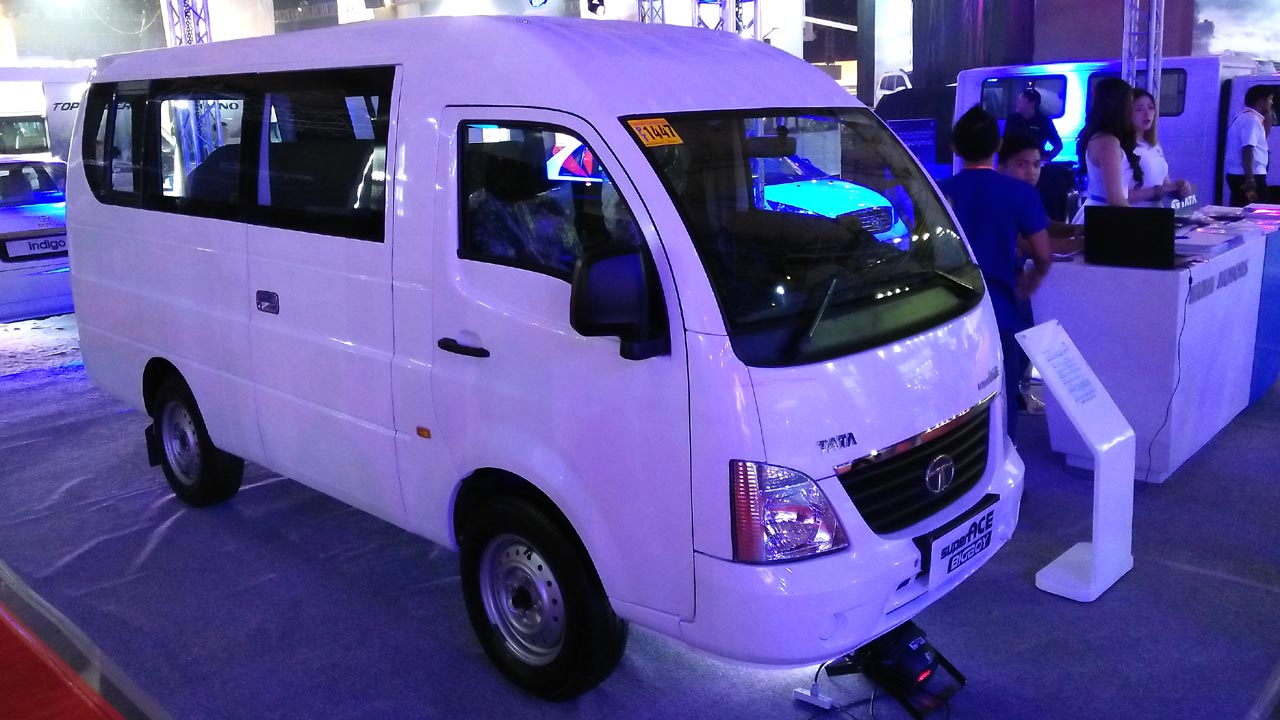
Tata Motors Philippines is looking to upscale its Super Ace truck chassis into a full-fledged people mover, evolving its local adaptation further along from the FB-type rear body of its Big Boy variant (which we had test-driven even while it was still just a prototype).

Tata Super Ace Big Boy with FB-type modular rear body

Body building contractor Centro had just finished on this Super Ace commuter concept unit the day before it was brought in for display at the 2017 Manila International Auto Show. The prototype is configured with four seating rows: the driver’s front row, two front-facing couches in the middle, and a fourth row with two foldaway side-facing benches in back.

Total seating is from 11 to 14, depending on how much elbow room you want to give to each passenger. In any case, an impressive loadout on the Super Ace chassis with a 70PS 1.4L turbodiesel to power it along with its dual-type aircon.

One last thing: outgoing Honda Philippines president gets unique send-off at MIAS 2017

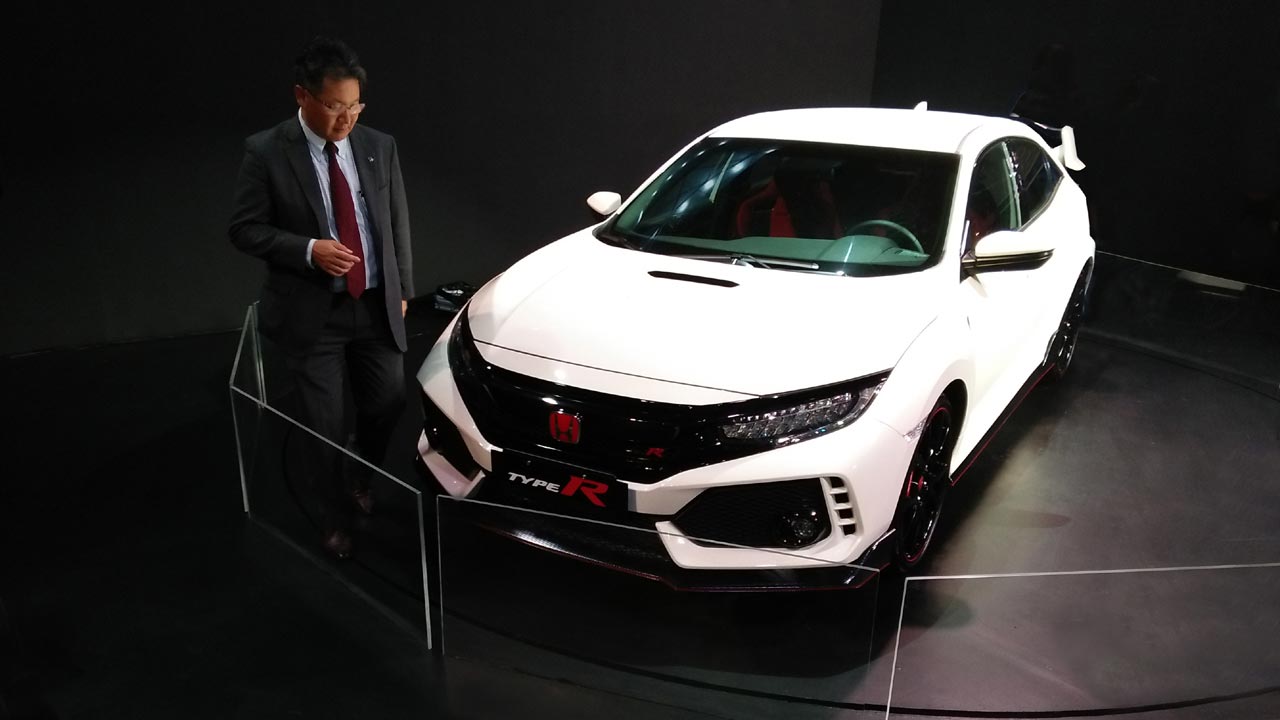
On opening day of the 2017 Manila International Auto Show, on the eve of his departure for his next posting, outgoing Honda Philippines president Toshio Kuwahara got a uniquely appropriate send-off when he launched the Civic Type R, the race-trimmed limited issue of the 10th generation Civic, among the last of numerous new models launched here under this leadership.

You can see the Type R at MIAS 2017 until Sunday, April 2, but Kuwahara-san is away by now, off to his new posting in Vietnam.

Out of Africa: Tata SFC 407 at MIAS 2017 has a revelation in store

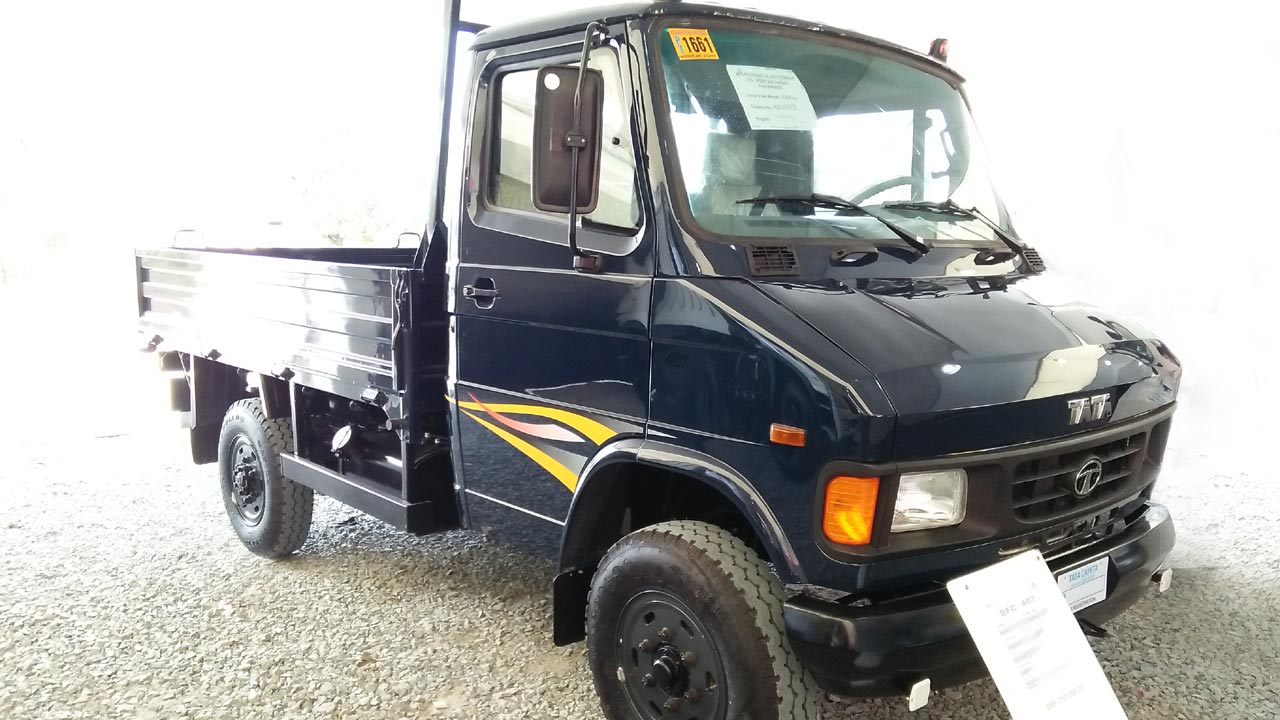
On display at the 2017 Manila International Auto Show (MIAS) until Sunday, April 2 is an interesting specimen of Tata’s rugged SFC 407 light truck. Tata Motors introduced the semi-forward-cab SFC 407 light truck in 1986 and the rugged do-all hauler is still popular, still in production now, three decades later.

So popular even here (after a preview last year resulted in a surprising number of orders for the truck listing at just P750k) they’ve had to divert stock destined for other markets.  On the unit displayed at MIAS the shipping sticker shows it originally intended for the Congo.

One important note: though the 407 is big-boned enough for rough African roads, she’s not an all-terrain 4×4.  But, hey, she sure looks the part, doesn’t she?  Look for the 407 at Tata’s outdoor display on the right side of the World Trade Center in Pasay City … she’s just a few steps away from the Mercedes-Benz Unimog.

Caltex launches new Delo 400 MGX asserting 80,000km oil change interval

Manila, 29 March 2017—Chevron Philippines, Inc., marketer of Caltex fuel and lubricants, has launched the reformulated Caltex Delo® 400 MGX SAE 15W-40 heavy duty diesel engine oil asserted to bring 80,000km between oil-changes on new and old engines, and formulated for excessive heat levels and even for the varying sulphur content in diesel fuel across the Asian region. Its specifications portraying it as so robust, Chevron saw fit to introduce the product gradually after its global launch in Malaysia last July, now launching it here only after they’ve prepared for what they anticipate to be a skeptical market.

Chevron launched their new Delo 400 MGX in the Philippines only after supplementing international findings with extended field tests done locally. They’ve partnered up with provincial bus operator Pangasinan Five Star Bus and city bus operator HM Transport, Inc. to test the new engine oil on several of their fleet units, the official launch happening only after completion of the first of three planned oil-change cycles on these vehicles.

Manuel C. Valerio, Chevron Philippines technical manager for finished lubricants, explains that the asserted 80,000km or 1,000 hours of engine running time between oil-changes applies to transport diesels on highway routes. The number translates to 60,000km in city operation, and 40,000km in industrial applications (such as on dump-trucks and other earth movers) based on maintenance practices in developed markets such as the US and Europe. In contrast, Valerio says that Philippine provincial and city bus operators implement oil changes every 15,000 and 12,000km, respectively, on vehicles with new or old engines. Valerio emphasizes that “Filipinos have that best practice when it comes to maintenance because they really put value in their equipment.”

Technical briefing at the official launch event for Caltex Delo 400 MGX

Valerio says that the increase in engine oil life and the savings this entails in operating expenses are so dramatic that they are mindful of their customers’ scepticism with their claims for Delo 400 MGX, and this even in light of the popularity of their Delo line in the local market. With their field tests with Five Star and HM Transport, Chevron is advocating gradual adoption of Delo 400 MGX and eventual acceptance of its full operating lifespan. Referring to Chevron’s tests in other Asian countries vis-à-vis locally accepted oil-change regimens, Valerio says: “We are quite a bit conservative compared with our neighboring countries. That is because the [fleet managers] have been used to that maintenance practice.”

The testing with Five Star and HM Transport has been going on for three months now, with the first oil change already done at conventional 15,000 and 12,000km intervals for the provincial and city bus operators, respectively. Currently testing with buses on their second oil change cycle, Valerio says they are now “encouraging them to extend to a little more than double [the interval].” For this second oil-change cycle, they are aiming to increase the interval from 15,000 to 30,000km with Five Star’s provincial buses, and from 12,000 to 25,000 with HM Transport’s city buses, Valerio says. By the time they complete their testing with a third oil change cycle later this year year, Valerio says they hope to have extended the intervals to those approaching the 80,000km potential of their new Delo 400 MGX.

Chevron officers lead the toast to the launch of the new Caltex Delo 400 MGX diesel engine oil

With the new Delo 400 MGX priced at the same level as their old MG formulation, Chevron is not levying a price increase on their improved product. With the new MGX reformulation resulting in longer oil-change intervals and therefore lower consumption, these indicate that Chevron intends to recoup their development costs through increased market share, making their gradual and well studied introduction of the new product even more remarkable.

<SOURCE> Press Statement by Chevron Philippines, Inc. “High-Performance Caltex Delo® 400 MGX Engine Oil Launched in the Philippines,” 2017:

New Caltex lubricant with ISOSYN technology provides unmatched protection in both high- & low-sulfur diesel fuel environments

MANILA, Philippines, March 29, 2017 – Chevron, marketer of the Caltex™ brand, unveiled its latest premium diesel engine oil, Caltex Delo® 400 MGX SAE 15W-40, to address commercial business needs while meeting stringent Philippine emission regulations. The revolutionary formulation constitutes a higher specification and is specially designed to comply with Philippine market requirements. It will benefit both new and old diesel engines and allow customers to utilize just one heavy-duty engine oil that operates efficiently in both high- and low-sulfur diesel fuel environments.

“Introducing the Caltex Delo® 400 MGX SAE 15W-40 to the Philippine market is proof of our commitment to provide customers with ground-breaking products that not only boost performance, but also reduce operating costs and maximize diesel engine durability,” said Lennard Kwek, Asia Pacific Marketing Manager, Chevron Lubricants.

The Caltex Delo® product range includes lubricants and coolants that provide premium protection, performance and bottom-line value for on- and off-road diesel-powered equipment. These products are utilized in all major heavy industries such as commercial transportation, construction, mining, agriculture and power generation.

Delo®’s industry-leading lubricants have logged 2.4 million kilometers and countless hours offering superior protection to diesel engine parts for smooth vehicle and equipment operations. Thoroughly field-tested in trucks using up to 5000ppm diesel fuel sulfur levels, the Caltex Delo® 400 MGX has demonstrated an exceptional performance capability in neutralizing harmful acids and retaining alkalinity in extended-drain operations.

“Heavy industry players are grappling with challenges such as excessive occupational heat exposure and maintaining an age-diverse fleet operating in both high- and ultra-low sulphur environments. With the local launch of the Caltex Delo ® 400 MGX, an American Petroleum Institute (API) and American and European Original Equipment Manufacturers’ (OEM) standard compliant diesel engine oil, heavy industries can finally experience synthetic-like performance at the cost of mineral products, significantly reducing premium lubrication costs,” said Joseph Bronfman, Area Business Manager, Finished Lubricants Philippines & Vietnam.

Advanced formulation and innovative ISOSYN® Technology

Chevron uses ISOSYN® Technology in top-tier Delo® product formulation. ISOSYN® Technology combines premium base oils, high performance additives and the company’s formulation expertise to deliver excellent diesel engine part protection at a competitive value. The Caltex Delo® 400 MGX SAE 15W-40’s new advanced formula delivers excellent soot dispersancy, wear protection and sludge control to guard against loss of engine life and help reduce oil consumption.

Caltex Delo® 400 MGX SAE 15W-40 also has the added advantage of a single fleet oil, which reduces the need for multiple diesel engine oils. Specifically developed to meet local emission regulations, OEM requirements and local market performance specification, Delo® with ISOSYN® helps extend service protection and optimize engine durability and operating costs.

The newly launched Caltex Delo® 400 MGX SAE 15W-40 is currently available in drum and gallon packaging through our appointed distributors at the same price as Delo 400 MG’s SRP.

Isuzu brings Truck School to Isabela

Making good on their promise to bring Truck School closer to their nationwide customers, Isuzu Philippines held their heavy trucks seminar in Aurora City, Isabela last week. The two-day, two-session event marked the eighth and ninth seminars they’ve held, and heralded the first sessions away from the nation’s capital, since they started the program last July. Isuzu made the most of their visit to Isabela, with the Truck School supporting the after sales efforts of BMD Motors, their exclusive distributor in the region, and following up with a Truck Fest exhibit in Santiago City to help with BMD’s marketing efforts as well.

Press Statement by Isuzu Philippines Corporation (IPC), “Isuzu Philippines furthers road safety advocacy, holds truck display in Isabela,” 2017:

STRENGTHENING its presence in growth areas outside of the National Capital Region, Isuzu Philippines Corporation (IPC) recently conducted major activities in Isabela.

From March 21 to 22, 2017 IPC mounted the latest installment of the Isuzu Truck Training series at the BMD Seed Farm in Aurora, Isabela. The activity, which formed part of IPC’s consistent thrust in promoting road safety through proper driver education, was attended by representatives of companies in the Isabela and Cagayan areas operating fleets of heavy-duty Isuzu trucks.

The two-part training seminar involved both classroom lectures and discussions, as well as the actual operation of the vehicles. Included in the sessions are lessons on the application of Isuzu’s 7-speed and 16-speed transmissions, fuel-efficient and safe driving techniques, and daily inspection of vehicles. Used in the driver training session were the Isuzu EXR, which has a 7-speed transmission, and the Isuzu EXZ, which is equipped with a 16-speed transmission. For lessons regarding vehicle inspection, an EXR tractor head was made available.

This latest Isuzu Truck Training activity basically duplicated the one IPC conducted at Honda Safety Driving Center. But in an effort to cater to its fleet customers who cannot attend the sessions in Metro Manila, IPC decided to expand the training series to regions outside of the capital. Supplementing the program are special training sessions conducted on the site of fleet customers who request for them.

As a part of its after-sales program for fleet customers, IPC conducts the training series free of charge.

“At Isuzu Philippines, our commitment to promote road safety is as important as our commitment to customers, which does not end after a purchase. Conducting the Isuzu Truck Training series allows us to pursue our efforts at helping make Philippine roads safer for everybody, which of course include the representatives of our valued fleet customers,” IPC President Hajime Koso said.

Following the training seminar was the Isuzu Truck Fest – Isabela. Held from March 23 to 26, 2017 at the Greenview Hotel in Santiago, Isabela, the event was meant to service the thriving commercial activity of the region.

Showcased in the latest edition of the Isuzu Truck Fest are the “Trucks for Life” models of IPC, which were presented in a diverse range of applications and sizes. Regardless of the model, however, all the trucks displayed were designed to address the various mobility requirements of businesses in the area.

“As one of the key growth areas in the country, Isabela is a strong market for commercial vehicles, which include trucks of all sizes and capabilities. The Isuzu Truck Fest – Isabela provided the local community a wide range of transport solution options that should help any business operate and grow in the most effective, sustainable and profitable way possible,” Koso said.

Referred to by the IPC head were the Isuzu vehicles displayed at the event venue, all of which configured for specific applications. Heading the list were the Isuzu EXR and EXZ heavy-duty trucks, which were shown as tractor heads and a unit of the CYZ dump truck so that customers may spec the trucks according to their requirements. For customers seeking trucks meant for lighter duties, IPC offered to them the NKR light truck, NHR with Ivan body option and the NQR in cab-and-chassis configuration. The light-duty N-Series trucks have been the bestselling in their segment for 17 consecutive years.

“Definitely, Isuzu Truck Fest – Isabela had been an informative, and thus useful, activity for consumers in this part of Luzon because it allowed them a proper venue to scrutinize the vehicles. This means consumers can better arrive at choices that suit their requirements best. As the representative of Isuzu in the region, we certainly welcome further inquiries and would be delighted to be of service to them,” said Isuzu Isabela Branch Manager Rizalina Domingo-Mijares.

Quick note: the new Super Carry is a big mini

She looks like her predecessors, those commonplace mini multi-cabs that are the 8th and 9th generation models of Suzuki’s classic kei-truck line reaching back to 1961, but she’s much bigger.


Dimensions


Unit

OLD models

NEW model

Increase

Length

mm

3295

3800

505

Width

mm

1395

1565

170

Height

mm

1865

1883

18

Wheelbase

mm

1855

2110

255

Curb weight
(of dropside flatbed variant)

kg

780

865

85