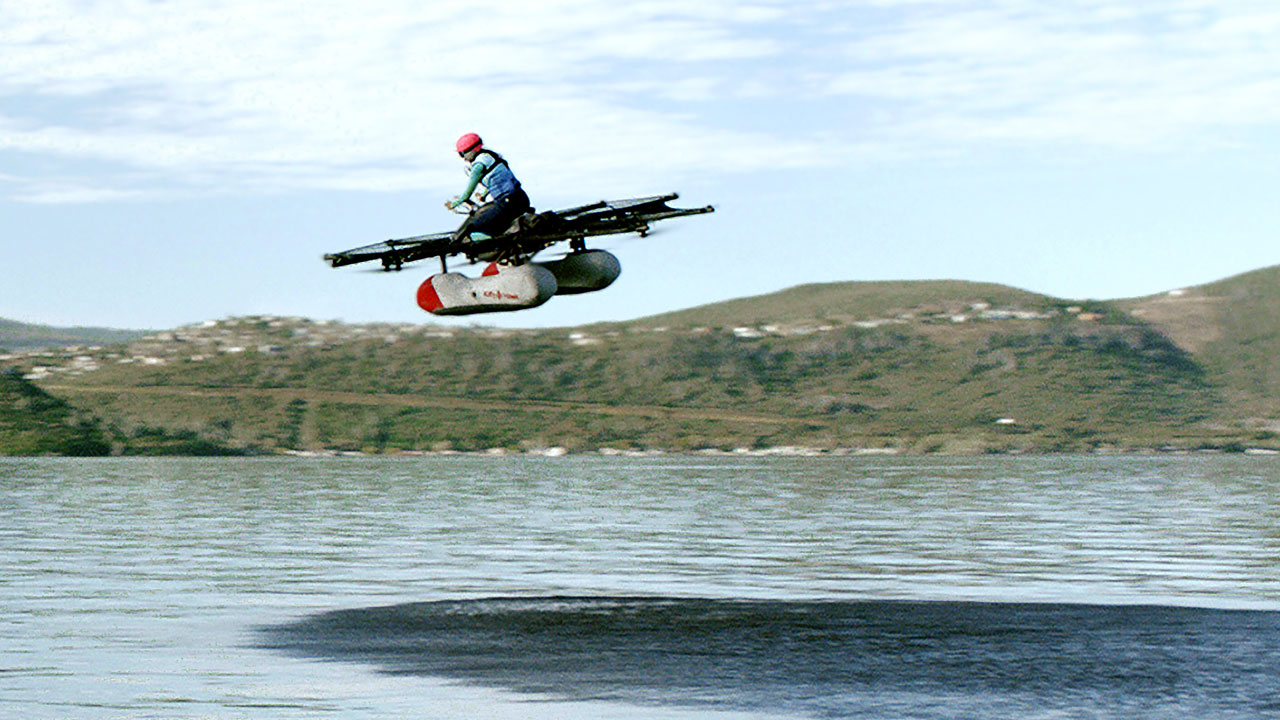
WWW, 24 April 2017—Google co-founder Larry Page has revealed the Kitty Hawk Flyer, tweeting a YouTube video showing its prototype being flown by outdoorsman and freelance writer Cimeron Morrissey. The prototype Kitty Hawk Flyer is an all-electric single-passenger octocopter that’s classified an ultralight, does not require a pilot’s license to operate, and can be flown only for recreation in uncongested areas, only over fresh water lakes and rivers. Developed by the Zee Aero division of the Kitty Hawk Corporation, the actual production model is promised to have a different look and feel from the prototype, and to go on sale by the end of this year.

With expectations raised by the involvement of Page, particularly with his work on Google’s self-driving car initiative, what has been spun up as his “flying car” project has delivered a vehicle that’s been described as coming up short on its promise. The significance of the Kitty Hawk Flyer is, after all, overshadowed by the announcement of other, bigger vehicles coming out soon in commercial numbers—air cars spec’d out to carry numerous passengers on road-bound city commutes and airborne intercity hops. In comparison to these commuter solutions that aim to become Jetsons-inspired futuristic mainstays, the Flyer presents as a, well, as a toy.
[youtube=http://www.youtube.com/watch?v=1MSeoJ4z_hY&w=380&align=right]
But, the thing about it that’s in plain sight, what obscures its role in shaping what private airborne transport can become, what makes it fly under the radar, so to speak, is what makes the Kitty Hawk Flyer’s manned flight a game changer. Bigger contenders, those that seem to fit the “flying car” template better, work off century-old engineering. These still use internal combustion engines to produce propeller-driven thrust, and fixed- or auto-rotating wings to generate lift. In contrast, with the Kitty Hawk Flyer, it may look like a seat was just grafted onto a scaled up drone, but it’s the first personal flyer concept evolved from this fairly new, multi-copter platform that’s being used, so far, only for unmanned flight.
Better context for appreciating the Kitty Hawk Flyer would be the jetpack. Futurists of the past had played with this personal, liquid-fuel rocket pack. It had its fair share of Hollywood appearances, in James Bond and off-beat race flicks, but the jetpack had endurance measured in seconds and could be flown only by stunt doubles, by brave and expert expendables. Now comes the Kitty Hawk Flyer with relatively mundane electric fans replacing the ignition of exotic rocket fuel, and with flight time extended to practical and useful minutes.
With the last century’s jetpack, there was little incentive to bridge and exploit that gap between a personal rocket and a full-blown orbital booster. The authorities can’t be expected to tolerate fire-spouting projectiles sending folks on personal trips tracing criss-crossing ballistic trajectories. But now, with the Kitty Hawk Flyer looking like commonplace drones and driven by non-volatile electrics, there’s no hint of the fantastic in the notion of larger, more serious electric multi-copters eventually coming online for near future commuters.



 The payWave system is asserted to be as secure as other NFC systems, the wireless handshake being so tight-beamed that it prevents unauthorized scans while the card remains in the hands of the cardholder, never having to be brought to a stationary swipe reader. Visa payWave cardholders stand to benefit from faster transactions as well with the elimination of traditional steps for card-swiping and signature or PIN authentication (only in instances where the transaction amount exceeds P2,000 will the cardholder need to sign or key in a PIN).
 CPI country chairman Peter Morris said: “Motorists gassing up using Visa payWave will definitely be able to experience quicker service in our forecourts. Motorists can transact securely and with ease, knowing that they remain in control of their card at all times.” Morris added that, “to excite consumers to try our latest innovation, we’re also holding a promotion that’s sure to give added value to their fuel purchase.”


 Strong/stable front: Steering is light and predictable even when going downhill, braking and then turning. The Super Carry’s signature tension rods shape the wheel mounts into strong tripods, preventing the front wheels from being pushed back in those turns, protecting the intended caster and camber, and stabilizing her on tight curves as well as on fast straightaways.
 Adaptive rear: With load compensating suspension and brakes in the rear (features typical on larger truck segments), the Super Carry does a decent job of keeping all four wheels planted under hard braking and vigorous turning. About 75% of leaf spring tension is online, all the time, with the other 25% implemented with a partial/floating bottom leaf that comes into play only when the mini-truck takes on a heavy load, or when doing some G-pulling turns. Braking is intuitive and predictable with the ventilated discs up front complemented by standard drums in the rear featuring Load Sensing Proportioning Valves (LSPVs)–LSPV maintains braking traction on the rear tires even when there’s little or no cargo to tamp down the back.