
That twisting road connecting the high Tagaytay ridge to the Taal lakeside town of Talisay is a favorite of mine, the many tight turns going down or back up all concentrated into a short and intense few minutes of absolute focus. And the ride I had that weekend was proving to be an excellent match.

We had a microhatch that balanced handling and riding comfort so well, my kids in back didn’t mind the roller coaster I had turned it into, steering the car through the twisties as if it were on rails. The whole family was with me so there was no messing around with making the tires squeal when coasting in and then powering out of turns. Ironically, I kept the speed well inside the safe zone with some race track tactics I’ve picked up along the way.
 Cruise into the approach of a tight downhill turn, brake strong before the turn-in point to get the speed down smartly, downshift for engine braking (and for keeping revs spooled up), then ease-off the brakes at the turn in. Foot off the gas until the apex, then power out the back end of the turn. Give it a few shakes, wait till we’re back on a bit of a straight, then shift back up to ease off on the gearbox. The balance between braking and downshifting was good enough that when I checked the wheels at a rest stop, the brakes were just normal hot, never coming close to overheating into uselessness.
On the climb back up to the Tagaytay ridge, I used both momentum and torque to retake the twisties, keeping approach speeds moderate and downshifting at the moment when I felt the engine just touch that pre-stall shudder. Surprisingly, the torque boost I got with the downshifts saw me overtaking not just big slower vehicles but even compact and mid-size sedans that, on paper, had the power to keep me in their rear-view mirror all day long.
All in all, an intense 30 minutes of driving on a surprising ride that was familiar in strange ways. All that shifting for engine drag or torque boosting? Routine on any manual transmission, yes, maybe slightly less natural on a semiautomatic with its overrides, okay, but not something you’d expect doing at all on a continuously variable transmission, not on a CVT. But this particular ride was the Mirage CVT, the award-winning high efficiency microhatch that has an ace up its sleeve with some surprising performance perks.
Not your usual CVT
 The Mirage CVT variants are equipped with the JATCO CVT7 transmission. First introduced in 2012 and now standard as well on other makes, the CVT7 is the first continuously variable transmission with an auxiliary gearbox.
Connecting the CVT to the engine crankshaft is a torque converter that uses fluid pumping to transfer force from the engine’s impeller to the transmission’s rotor. On conventional automatic transmissions, that torque converter would “lock-up” when the vehicle reaches cruising speed—meaning a clutch would press in to make a solid connection and eliminate “slippage” between the rotating impeller and rotor. But on CVT’s that don’t have to shift from one discrete gear to another, that solid link-up kicks in soon after roll-out.
” the JATCO CVT7 introduced a planetary gearbox that now adds a second, lower forward speed range labelled B “
 What defines a CVT are those variable-diameter pulleys with slope-sided grooves that widen to let the steel belt sink in lower or gradually narrow to lift the belt up and out—the wider the groove (the further apart the walls), the smaller the pulley diameter, the narrower, the bigger. At roll-out, the driving pulley is set small with a widened groove, the driven pulley set big with a narrower one. Driving a bigger pulley deepens the gear reduction (making more engine revolutions go into each turn of the wheels), driving a smaller pulley makes it shallow. As the car accelerates, gear reduction is made shallower, the driver pulley becomes bigger with a narrowing groove, the driven pulley gets smaller with a widening one.
Where before the only mechanism between the pulleys and the driveshaft was a clutch assembly for going into forward or reverse, the JATCO CVT7 introduced a planetary gearbox that now adds a second, lower forward speed range labelled B. Putting it in B would deepen the gear reduction on the transmission’s output, resulting in higher torque though at a lower operating speed range.

With the auxiliary gearbox, the CVT7’s ratios range from the exceptionally deep 1:4.07 on its low B starting ratio, to the exceedingly tall 1:0.55 of its top overdrive ratio in standard D (compare these to the 1st gear 1:3.54 and 5th gear 1: 0.80 ratios on the Mirage’s MT variant). To deliver this wide a ratio spread with a typical CVT would’ve entailed much larger and heavier pulleys with a deeper oil bath. Instead, the CVT7 works with a lighter, more compact pulley set and a smaller and tighter-wrapping steel belt, elegantly making these deliver the requisite ratios by splitting these into overlapping standard D and low B ranges.
D and B
The differences in torque delivery are obvious. To go uphill with a fully loaded car, putting it in B would be the natural choice to not strain (or even stall) the engine. But, once you hit the flats, you’d want to be in D to be able to accelerate all the way to cruise speed and maybe beyond.
For the B drive, I’d guess the CVT7 uses the biggest and heaviest components in the planetary gearbox—with the ring-gear engaged and turning the driveshaft through the multiple planetary gears on the carrier set.
Equally obvious is the difference in engine drag you’d be getting if you took your foot off the gas when in D or B. In D, very little engine braking comes in when you let off the gas. Though it’s still there, the drag is light, hinting at a direct connection between pulleys and driveshaft without much in the way of intervening gears. In B, the story is very different: letting off the gas results in instant drag from an idled engine.
I’d speculate that the gear sets for B are left to free-wheel and be drawn along with the spinning driveshaft when D is selected, to minimize the difference in their rotational speeds. This would explain why toggling between D and B on the fly is so fast. As far as I can tell, un-clutching the D set from the driveshaft happens simultaneously with clutches pressing in to engage the ring and carrier gears of the B set, and vice-versa. Such simultaneous sequences, and so confidently executed, can only be done if the target gear is already spun up, ready to be clutched in and primed to take on torque.
These said, when and how would you shift on the fly between D and B? Choosing which gear to roll-out on is simple enough. With the car still stationary, your foot on the brake, simply choose which gear to roll-out with. But once you’re rolling, could you, would you, shift down to B? You’re instincts serve you well if you hesitate. After all, this is a CVT with its Achilles Heel of a drive belt.
There are some important caveats to discuss, things never done on a CVT, but shifting on the fly from D to B, and vice versa, is not only possible, the auxiliary gearbox on the CVT7 even seems tuned to some spirited D/B toggling. With the car already rolling, shifting between D and B is so fast that it reminds me of the sequence on a good dual-clutch transmission, a DCT. As a matter of fact, toggling between drive modes is much faster than the initial roll-out shift from N to D which will see you waiting a full second before feeling the torque converter kick in and start to push against the brakes.
Gradual is good
First off, you roll-out a CVT, never launch it. That old trick of popping the selector from N to D while already redlining the engine is a sure recipe for a wreck.
” Attempt a launch and you’ll likely hear the racket of a linked metal belt disintegrating in the confines of the CVT box. So don’t do it. “
The JATCO CVT7 is rated for maximum torque of 133lb-ft, a figure determined by the strength of the steel belt driving and being driven by the pulleys, and a maximum that gives a 79% margin to the 74lb-ft of peak torque at 4000rpm produced by the Mirage’s 1.2L 3-cylinder MIVEC engine. Now factor in shift-shock forces that can spike torque to ten times normal with the sudden engagement of the converter and you’ll get the picture. Attempt a launch and you’ll likely hear the racket of a linked metal belt disintegrating in the confines of the CVT box. So don’t do it.

And, on a more subtle note, always roll out a CVT from a stop, don’t stomp on the gas pedal to recover it from rolling back down a slope (nor even from a reverse run after going through neutral, if that needs mentioning at all). Step on the brakes before putting her in D, then wait for the torque converter to eventually kick in and push against the brakes. Release the brakes and step gently on the gas only after the car has rolled a little on idle power. If you are on an uphill slope and the grade proves too much for D (you’ll feel the car slipping back), step on the brakes again, pop it in B, then do your roll-out sequence once more, and from the top.
That part about always waiting for the torque converter to kick in and push against the brakes before rolling off and only lastly stepping on the gas will, for one thing, give the CVT a chance to wring out all the slack from the drive belt before you accelerate, and more importantly, with practice, will burn something critical into muscle memory.
” Light, flexible and intricate components like … CVT belts will remain intact so long as changes in tension remain gradual … Burn that into doctrine and you’ll be fine. “
Here’s an old school analogy for you: the legendary UH-1 “Huey” medium-lift chopper of Vietnam War vintage was flown with the rotors always having enough pitch to give them positive lift in flight, even when the chopper is descending, the lift still there though not enough to counter the craft’s weight. Rotary-wing pilots had it trained into them that the main rotor should never be allowed to go into neutral lift until the chopper is back on the ground.
Why? When you eventually need to recover from the descent, pulling on the collective to put more pitch on the blades will likely cause too sudden an increase in opposing forces (lift versus momentum) and result in rotor separation. Yup, that means the spin-blurred rotor disc will go one way while the suddenly quiet fuselage you’re in goes another. Light, flexible and intricate components like rotor assemblies and CVT belts will remain intact so long as changes in tension remain gradual, not percussive (or traumatic, if you like things sensory). Burn that into doctrine and you’ll be fine.
Smart acceleration
Coming out of a gentle roll-out with engine revs under 2000rpm, you’ll notice a weak tug and a slight dip in rpm when you reach 20km/h. That’d be the lock-up clutch on the torque converter clamping down and making a solid link between the impeller and the rotor. And that’s when I think the CVT’s control unit hits its zone and starts active adjustments to the pulleys. In other words, when lock-up gives it something solid to work with, the CVT goes into full dynamic control of the pulleys, adjusting these in realtime to keep them at the best diameters.
” Popping into B on the fly to accelerate faster is like shifting on a semiautomatic, you don’t take your foot off the gas. “
 With the selector in standard D, try pegging your RPM after passing 20km/h and you’ll find that it’s easy to stay at say 2000 (for a gentle climb to cruising speed) or 3000rpm (for a slightly more spirited approach) with very little trimming on your accelerator while your speed climbs steady and smooth. It’s a strangely satisfying sensation seeing the revs exactly where you intend these to be while watching the speedometer needle sweep smoothly up … you just know your milking that MIVEC engine for every bit of torque it squeezes out of each drop of fuel.
With your gear ratios already managed by the CVT, there are a lot more reasons to manage your RPMs and smooth out your acceleration. With a full car on flat terrain, staying at 2000rpm will slowly bring you to a cruising speed of around 85km/h, trim up to 2250rpm and you’ll reach the 100km/h mark. Go higher, say up to 3000rpm on the climb up to a 100km/h cruise and you’ll find yourself not only throttling back as you reach the high 90’s but also realizing that you’ve just rushed something that maybe you didn’t really need to.
Toggling for a boost
 Now, finally: “downshifting” into B on the fly.
Popping into B on the fly to accelerate faster is like shifting on a semiautomatic, you don’t take your foot off the gas. In fact, you can even start throttling up right before going to B.
Keep your cruising revs between 2000 and 3000rpm at any speed and the Mirage will be in the ideal energy state for dropping into B when you need a torque boost (either for an overtake or an uphill climb). That pop into B will make the revs quickly climb by 1000rpm even if you don’t increase throttle, and by about 2000rpm if you do step harder on the gas just before shifting. Since the engine’s peak torque happens at 4000rpm, keeping your cruising revs between 2000 and 3000rpm gives you enough elbow room to reach and hover at the peak torque mark during a B sprint.
” B actually puts you in a lower speed range and there are rpm/speed levels you could be at in D when you shouldn’t even think of downshifting into B. “
 You don’t even have to look at your instrument cluster to know when you’re in the zone for a downshift. If you’re cruising while pressing down on the gas pedal by just a fraction and nowhere near the mid-point, you’re good to go. If you had to do a sprint in D to settle in behind a car you plan on overtaking, just ease off the gas first, pause for a moment to bank more momentum with time instead of throttle, and that should settle the revs back down to the vicinity of 2000rpm. And, just like that, you’re ready to pop into B for the overtake.
It’s also a good idea to stay in B until you complete the overtake and re-enter you’re lane. A premature return to D will have the effect of an upshift, of course, and could rob you of the torque that got you out and ahead in the first place. Besides, staying in B is a good way to have some engine braking potential in case oncoming traffic forces you to re-enter your lane behind another slow vehicle. At the end of the exercise, the overtake or sprint all done, shifting back into D could also be without ever letting up on the gas … like I said, toggling between D and B is like shifting on a semiautomatic.
An important point: recall that B actually puts you in a lower speed range and there are rpm/speed levels you could be at in D when you shouldn’t even think of downshifting into B. Say you’re already going pedal to the metal in D with revs reaching 5000rpm as you approach 100km/h in a sprint. This is definitely not the time to pop into B since doing so will immediately spike engine revs into the red zone which starts at 6500rpm. That rpm spike won’t just put the CVT belt at risk but could harm the engine as well.
Toggling to brake
” Brake first, get the speed down closer to where you want it, then pop into B to get the drag that’ll let you ease off and not ride the brakes. “
 On the flipside of things, don’t ever brake by just idling the engine and downshifting into B. If you’re coming off a speed run, the effect would be the equivalent of that hot-rod launch we’ve already covered. Engine braking with a pop into B should only be done to sustain drag, not initiate it. Brake first, get the speed down closer to where you want it, then pop into B to get the drag that’ll let you ease off and not ride the brakes.
When dealing with sharp curves, especially on a winding descent down hilly terrain, it’s best to use some watered down racetrack braking techniques. Brake firmly before the turn-in point, not a hard race brake, just a firm one to get your speed down to where you can safely take the turn, then pop the selector into B just before easing up and not coming entirely off the brakes.
The point of all these is to slow down first and mitigate the RPM spike that’ll suddenly follow the downshift, keep it as low as possible, keep it, again, gradual. Turn the process into a mantra: “hard brake, pop into B, ease off the brakes, turn.” Then, as you come out of the turn, accelerate a bit in B before popping back into D. Though, maybe you’ll want to stay in B if the roads are winding, turns following right after the other.
Braking or sport … or power
The draw of CVTs has been their greater efficiency over conventional automatic transmissions. Fixed, multiple gears simply can’t beat the physics of having dynamic ones that are constantly kept in their ideal ratios given the car’s speed and load. Mitsubishi Philippines’ assertion of 21km/l on an EUR combined cycle test is not only credible, you’d wonder why it isn’t higher.
 Even the JATCO innovation of an auxiliary gearbox on the Mirage’s CVT7 transmission was meant to gain engineering efficiencies in terms of size, weight, temperature and noise. But this self-same innovation had added a dimension that elevates the CVT controls above a pop car’s elementary forward and reverse, adding a low speed range with higher torque and engine drag potential that even Mitsubishi has been challenged in labelling properly.
In some markets, the low range is labelled B, for “braking,” in other markets its marked S, for “sport.” The B accurately describes one effect, but just one effect of the low range. The S could be more appropriate, though it invites the misperception that it simply changes the algorithms controlling the gearbox, like how sport mode lengthens the stay on each gear in an automatic transmission.
Clearly, the control set on the CVT7 is entirely new, but I can think of one similar innovation in the past that’s similar. Remember that very first Mirage from the 1980s, the one badged here as the Mitsubishi Colt? It had a curious second stick for shifting between E and P. E for economy, P for power. Toggling between either one simply changed the final ratio on the drivetrain. E shallowed up the reduction, P kept it somewhat deep to deliver higher torque.
The D on a CVT is fine, it’s the typical label for standard drive on an automatic, no need to think of it as E, or as the economical setting. But that B, or S, well, think of it instead as the Power gear and you’ll get a more complete picture of how and when to use it. All the better for making the most of the CVT7 which definitely has game, and which can be gamed. The overall weight that they saved with the auxiliary gearbox might as well be measured at the per ounce price of gold, that’s how much it enhances the driving experience on the Mirage CVT.


 So, even with the Magic being an India-specific configuration, its modification with jeepney-style benches expands its capacity, from the 6 who could sit on the original front and rear facing benches, to the 8 to 10 who’d fit on the side-facing benches in back. Most importantly, the foldable side facing benches could be stowed individually to create large, contiguous areas for cargo. It was this cargo-hauling feature that proved all-important on the real world mission that Tata let me take their Magic on.

 At the event, among the rocker dudes milling about, a surfer friend came up to me and gave testament to how good the Ace looks. He sized up the micro-truck and very frankly asked if and when we can take it to Baler for some days of sun and surf, the truck serving as home to gnarly blokes and their waxed up boards.


 AUTHOR’S NOTE:

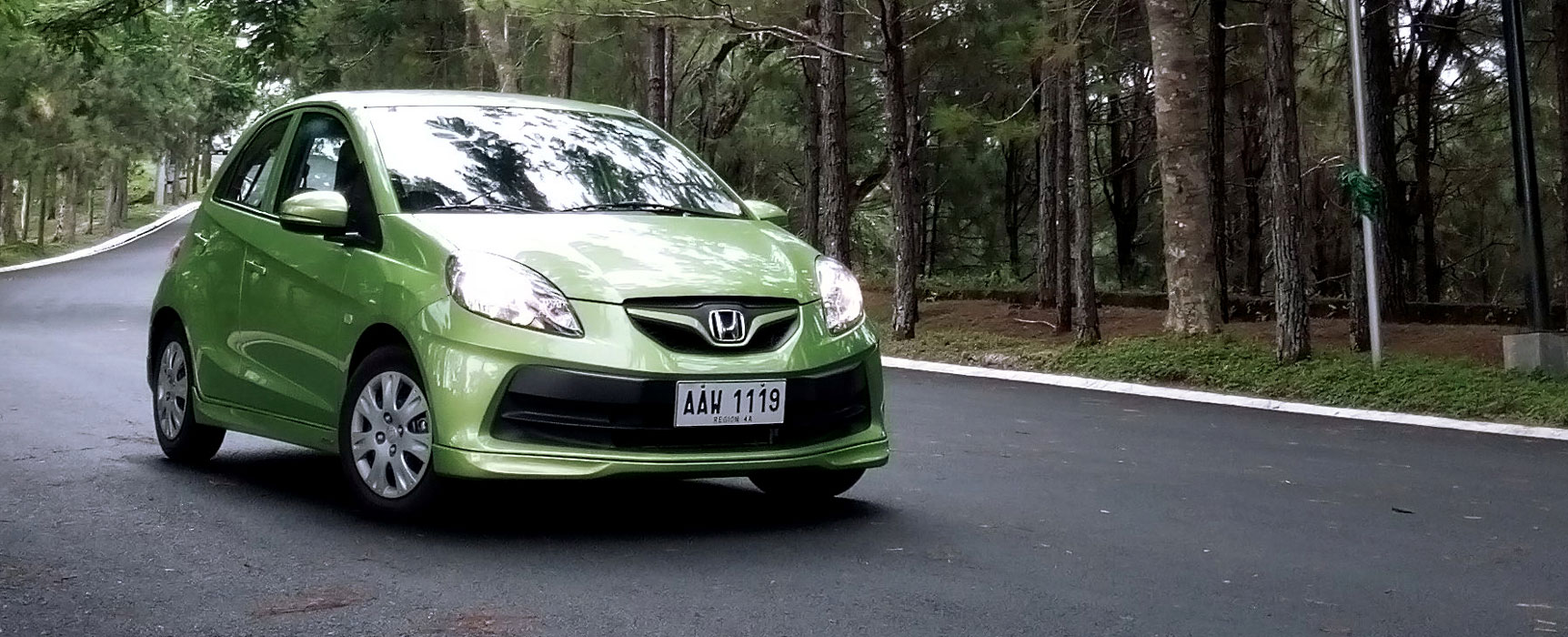


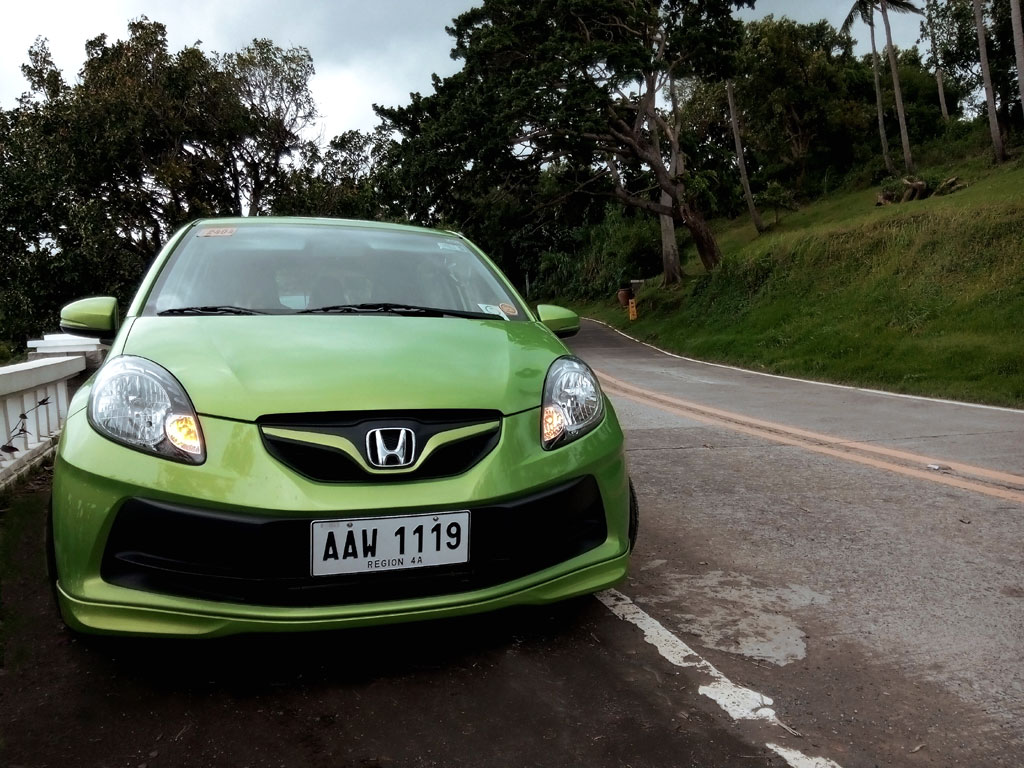
 The Brio is the smallest Honda currently on offer, the smallest vehicle you can get with the carmaker’s much vaunted VTEC variable valve lift and timing technology that turns efficient, low-emission powerplants into high-performance engines, and vice-versa. And here, all Brio variants feature the larger 98hp 1.3liter engine that was introduced in the RS variant for Indonesia back in 2013.
 The Brio is small but it’s a micro on a mission. With its mass packed into a rigid shape atop a squat wheelbase, the Brio corners like it’s on rails. No mincing words here: this micro-hatch feels like a go-kart going through turns … hence the impulse to pull G’s, going all Sport, all the time.
 The new engine design is so compact that, quite predictably, they thought of putting the 1.3 liter engine that had been an option on bigger past-generation Jazz and City sub-compacts, into the engine compartment of the micro Brio. So, instead of the 87hp 1198cc L12B i-VTEC with CVT automatic that came out on the Brio when it was first launched in 2011, we get the 98hp 1339cc L13Z1 i-VTEC engine (a plus 1.3 liter that sometimes gets tagged as a 1.4 lin other markets) with a conventional, and sturdier, torque converter AT.
 This means that a lion’s share of that impressive torque is already available even when the car is just rolling out. In fact, at its 800rpm idle, the engine already delivers around 70lb-ft or 75% of peak torque. Pop the selector into D on level ground and quickly taking your foot completely off the brake pedal will make the Brio 1.3 AT fairly lunge off its marks. There’s enough push to accelerate the Brio, foot off the gas pedal, to the 15km/h that triggers an upshift that shallows up the gear reduction on the drivetrain, increasing torque demand, and slows down the car—elegantly governing the speed of what otherwise could’ve become a runaway vehicle.
 By all indications, Honda also kept the same automatic transmission that had been mounted on the previous generation 1.3liter Jazz. The Brio has an electronically-controlled 5-speed gearbox with lock-up clutch. And the abundance of torque as well as the reduction introduced by slippage in the torque converter allowed them to go with a fairly tall set of ratios. Gearing starts at 2.995 in first gear, 1.678 in second, a near direct drive 1.066 in third, and an overdrive 0.760 in fourth complimented by an even taller 0.551 in fifth.
 On a full burn, you’ll notice the Brio staying in its nearly-direct-drive third gear as you zoom past 100km/h. It’ll stay in third as long as it can before hitting redline at 6500rpm when it’ll then up-shift and shallow up the reduction with a tall fourth gear overdrive.
 What works out well on the Brio is how much its D3, D2 and D1 drive modes are analogous to third, second and first gears on a manual transmission. If your stick instincts are good, simply watch your revs, make sure these are between 1000 and 2000rpm after your firm braking, and you’re okay to shift down a click for that turning descent.
 The revelation is that working with the VTEC engine’s strengths, even while it’s paired with a conventional automatic transmission, could bring out the Brio’s economy car alter-ego. If driven right, the Brio automatic is a credibly efficient city commuter, saving on both driver and fossil fuel energy during those weekdays between out-of-town weekend drives to stretch the legs both, again, of driver and of hatchback.



 The decision to keep the tires at 28psi proved fortunate when, at Real and already on the seaside road, the concrete pavement gave way to a long stretch undergoing upgrade. The bare ground still being tamped down had apparently been reshaped by heavy rain, the terrain turned into mounds and valleys.
 While the lack of powered features may sound unappealing, the manually operated controls are all simpler to maintain and keep expensive motors, wiring and switches off the list of parts that’ll probably need replacing during the useful life of the taxi sedan. Good news for fleet operators.
 On the return trip, after the Marifanta Highway (labelled “Marcos Highway” on some maps), we eventually hit traffic where I strove to conserve fuel by short-shifting, emulating what veteran cabbies do whenever they can get away with it, and I discovered that the F3 could short-shift with the best of them.
 The answer is in the engine’s output. While the engine’s 107hp at 5600rpm and 107lb-ft at 4800rpm seem unimpressive, its power contour is another thing altogether. The F3’s 1.5liter inline-4 already produces 70% of peak torque while still just idling at 800rpm . That’s 72lb-ft of torque coming off the engine even before you step on the gas. (In fact, you can roll-out with the engine at idle. Put her in first gear and then slowly let up on the clutch pedal without stepping on the gas. You’ll roll out past a slight engine shudder and accelerate to 8km/h—enough speed to gently roll over speed bumps—even with a full passenger load.)
 Step on the gas and the engine quickly reaches 84lb-ft, or 82% of peak torque, at just 1200rpm, and surges up to 93% at 2400. Beyond that, torque levels off while horsepower keeps climbing due mainly to the increased revolutions. Then, torque resurges to 97% at 4000, goes through 99.6% at 4400, and reaches peak at 4800rpm.
 It took a second look at the F3’s technology package to discover that it has the equivalent of Honda’s legendary VTEC system under the hood. The F3’s BYD473QE engine features VVL, not just VVT, that last letter signifying it could vary not only valve timing but valve lift as well. On the fly adjustment of both lift and timing gives the F3 a wide range of settings to optimize either power or efficiency depending on the car’s load and speed. It’s like having two kinds of powerplants doing the pushing—a booster for lift-off and an endurance engine for cruise, so to speak.


 If you’re on level ground, you’d stay in 2nd gear for just a few shakes, just until you reach 25km/h when the mounting revs would tell you its time to shift to 3rd. Reaching 3rd is when you’d settle in and wait half a minute or more for about 75% throttle (yes, this would be the time for a little more gas) to get you up to just under 50km/h. That’s when you’d finally shift into 4th and settle in again, though having to wait less time for the speedometer to reach 60km/h and, yes, even beyond. Opening up the throttle and pushing the pedal to its stops in 4th won’t make the engine revs sound much different but it can accelerate you enough to reach 70km/h on the speedometer, although that’s with you and just one passenger on board, and on flat ground … though I wouldn’t recommend it, more on this later.


 Driving around with this load, I could tell that the Ace could’ve taken on two more adults, bringing total load to the full dozen people that would’ve brought us very close to the up-rated 750kg of payload and 1750kg max loaded weight I’ve estimated. Although that ¾ ton payload would’ve meant longer stints at 2nd gear to get us up to cruise while favoring flatter routes, the modified suspension felt beefy enough to take the added weight … in fact, it might’ve even ridden better with a heavier load.
 The rudimentary mechanical steering system is positive enough, doesn’t show any slack, but the stiffened rear suspension makes the back end bounce a lot, a bump not having much effect up front but causing these multiple bounces in the rear that artificially make it weightless at repetitive instants. Factor in that jeepney-style body that necessitated the stiffer suspension in the first place and you have a steel box that has a relatively high center of gravity when it is empty (note that the India-spec Ace Magic passenger variant keeps its center of gravity low by using a fabric roof). You can imagine just how unpredictable all that inertia would be at high speed when the empty steel box goes up, becomes momentarily weightless, and then comes back down with the rear tires again biting into the pavement. Any unevenness in the regained traction of the rear wheels could slightly torque the vehicle right or left. It’s like an airplane doing touch-and-go landings all day long.
 The driver’s position on the truck’s cab-over layout provides an excellent vantage point, the angle of view making it easy to spot potholes and road ruts either in sunlight or in the headlight wash. The short front overhang kept the truck from digging its nose into sudden slopes, like the ones on the far side of big potholes, while its high 175mm ground clearance kept its transmission and differential clear of mid-line obstacles, particularly those high mounds unearthed by deep ruts on either side.
