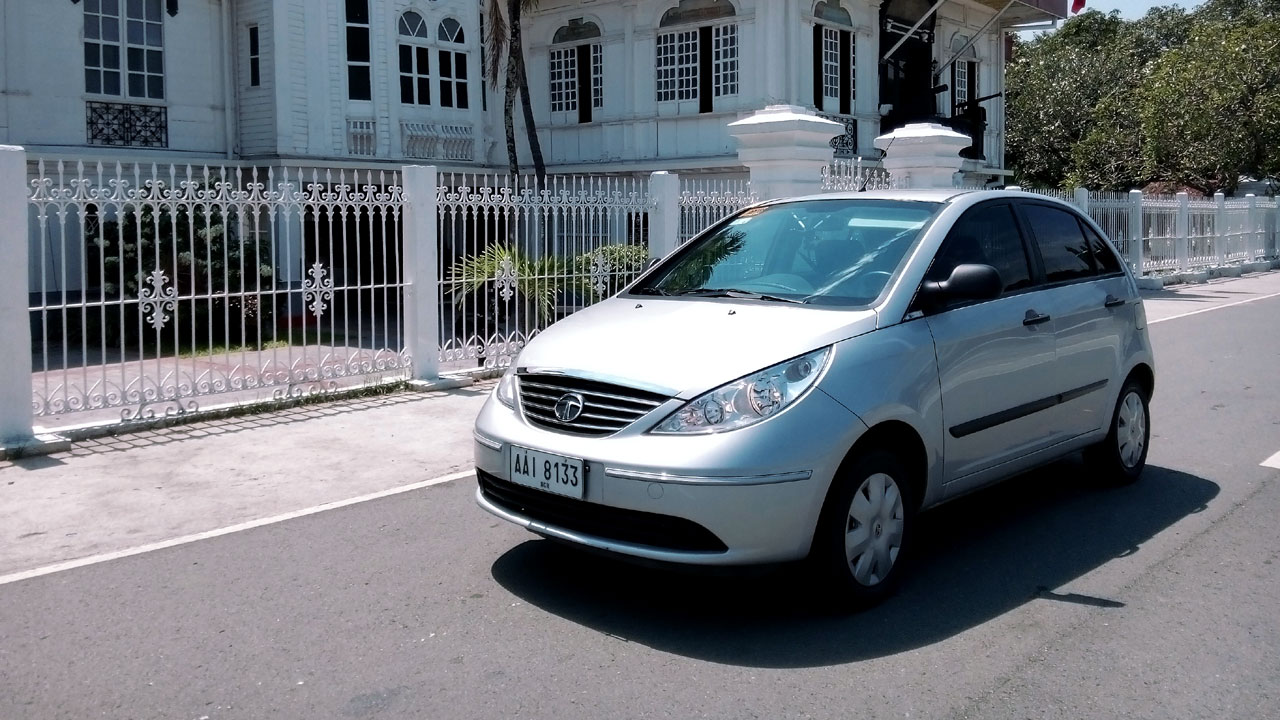
On the Tata Vista Ini with its 75ps 1.4L SAFIRE petrol burner, we discover that the engine from FIAT delivers rich torque at the low end (as expected on an 8-valve SOHC) but stands following the Rule of Twos, to address the wide ratio gap between first and second gears: get past the 20km/h and 2000rpm threshold for that up-shift into 2nd gear and you’ll be off to a smart, conventional climb to cruising speed.
To answer a reader’s question about the sound of the 3.0L CRDi VGT turbodiesel on Isuzu’s new mu-X and D-Max top variants, here’s the unplugged footage of us taking the D-Max LS-M 3.0L around the BRC track, taking the curves in earnest with a 5-speed manual gearbox.
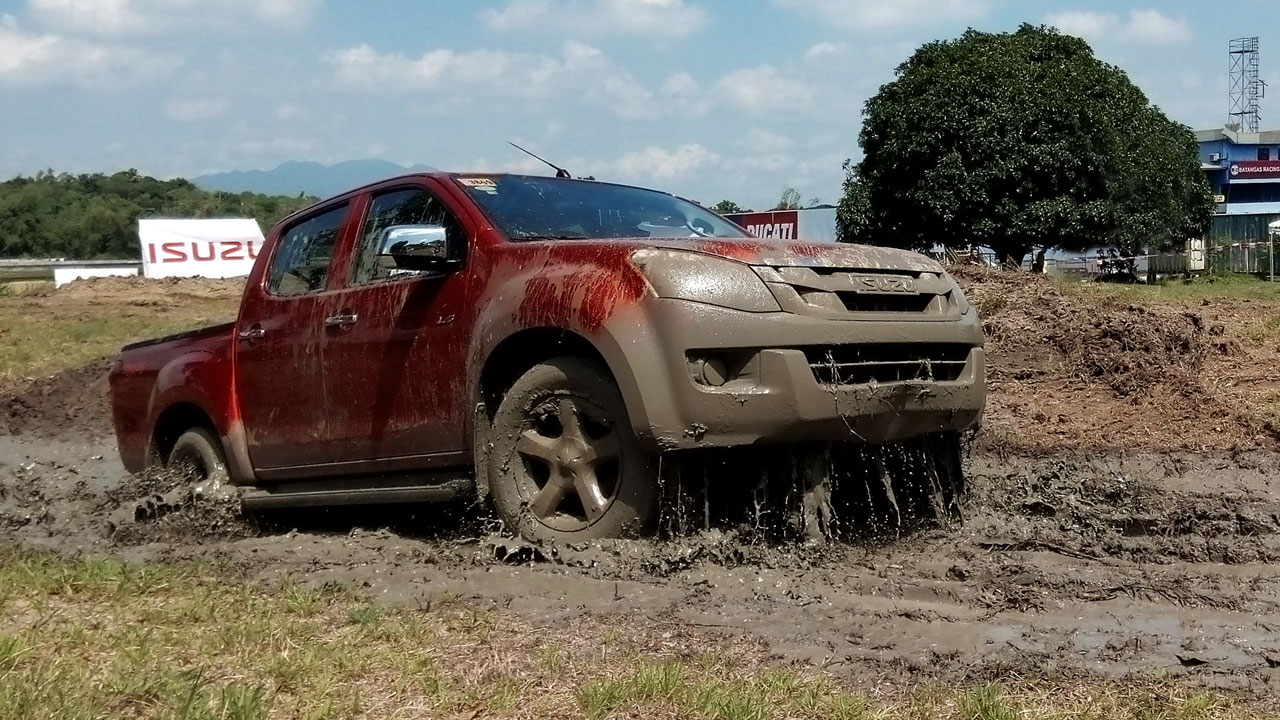
We try Isuzu’s off-road challenge with their just-introduced D-Max variant with the bigger 3.0L CRDi VGT turbodiesel. Delivering peak power and torque of 160hp @ 3200rpm and 280lb-ft @ 1800~2200rpm, the new 2,994cc engine adds 27hp and 44lb-ft to the numbers of the former top-spec 2.5L engine.
The diesel’s not so high top-end reigns back the horsepower equation, but down low where you’d be for off-road crawls, that 280lb-ft of torque is equivalent to the pull of a plus-250hp petrol engine. Hence the forced upshift into second gear for shallowing up the gear reduction on some of the obstacles–dialing back the torque multiplier for the tires to dig out more traction.
We try Isuzu’s off-road challenge with their just-introduced mu-X variant with the bigger 3.0L CRDi VGT turbodiesel. Delivering peak power and torque of 160hp @ 3200rpm and 280lb-ft @ 1800~2200rpm, the new 2,994cc engine adds 27hp and 44lb-ft to the numbers of the former top-spec 2.5L engine.
The diesel’s not so high top-end reigns back the horsepower equation, but down low where you’d be for off-road crawls, that 280lb-ft of torque is equivalent to the pull of a plus-250hp petrol engine. Hence the forced upshift into second gear for shallowing up the gear reduction on some of the obstacles–dialing back the torque multiplier for the tires to dig out more traction.
We hit the BRC tarmac to try out Isuzu’s just-introduced mu-X and D-Max variants with the bigger 3.0L CRDi VGT turbodiesel. Delivering peak power and torque of 160hp @ 3200rpm and 280lb-ft @ 1800~2200rpm, the new 2,994cc engine adds 27hp and 44lb-ft to the numbers of the former top-spec 2.5L engine.
Built on the Lancer sedan’s Daimler-Mitsubishi GS platform, the ASX also has the same top-spec 2.0L CVT powertrain, but is lighter and shorter atop a longer wheelbase. With the new reality of weather swings anytime and anywhere, this sporty crossover highrider makes a lot more sense to have handy.
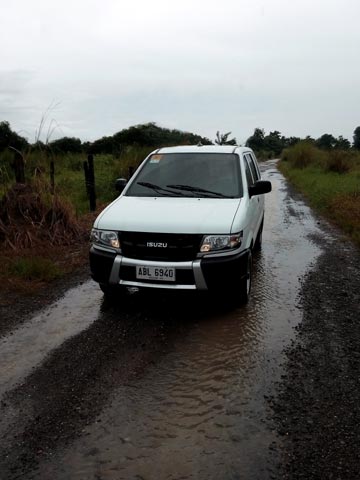
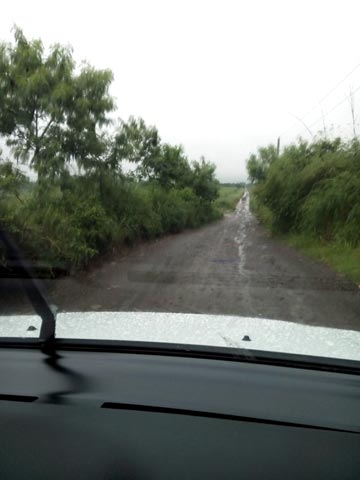
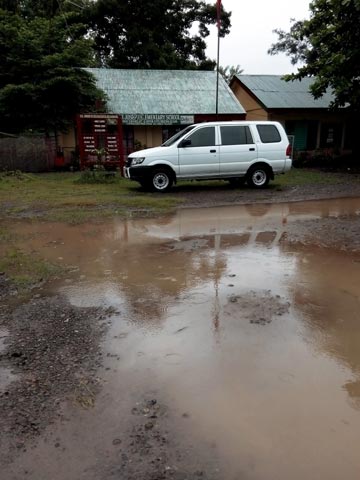
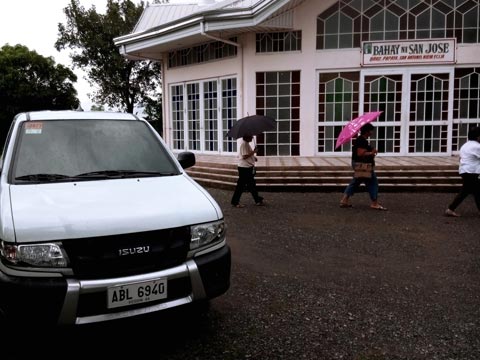
The Adarna Group Foundation had this two-part mission for Nueva Ecija. First, scout a route through rough roads to an elementary school on the eastern approaches to Gapan City, the place where they’d be bringing their Barangay Early Literacy Program (BELP) the following month. Second, bring volunteers to do BELP classes for the kids and caregivers at the Bahay ni San Jose Orphanage in San Antonio, west of Gapan.
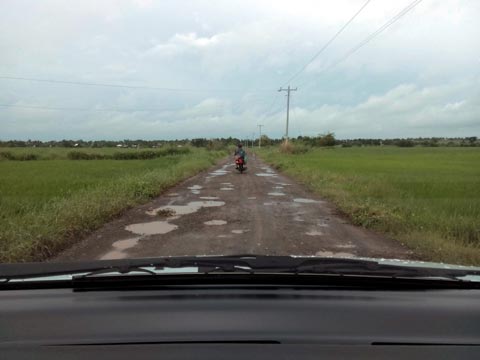
The drive would be a 260km loop through the near north and we needed a vehicle that could: (1) handle rough or broken roads, (2) carry as many as nine people along with a big tub filled with books and equipment, and (3) convey us comfortably enough to have people arrive rested and ready to teach animatedly. And I had a vehicle in mind, an institution by now, actually.
I had driven the top-spec Crosswind Sportivo last year for a story, the one with an automatic transmission, and I was impressed enough with it that I really wanted to see how any of its base models with a manual gearbox would compare. So I reached out to Isuzu Philippines once again and they readily responded, happy to help out.
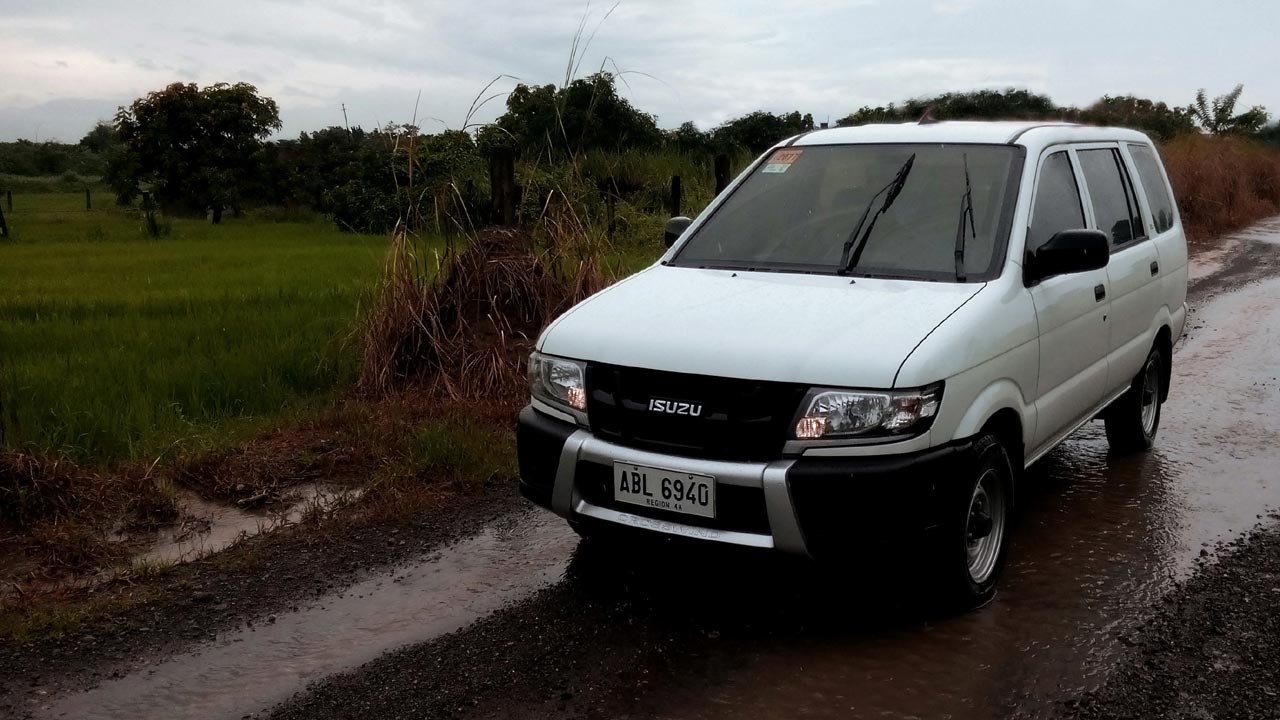
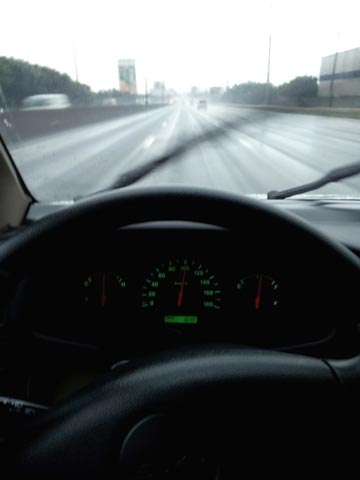
Early on August 24—a Monday, the day starting out very wet with Typhoon Ineng about to depart Philippine waters and head up to Japan—we rolled out for our first stop in Gapan City, snug in a ten-seat 2015 Crosswind XL.
heading out on rainswept NLEX
heading out on rainswept NLEX
heading out on rainswept NLEX
Bulacan, en-route to Gapan, Nueva Ecija
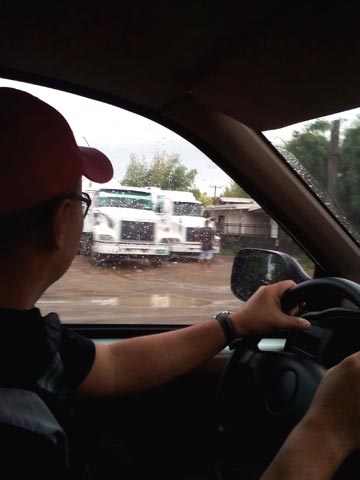
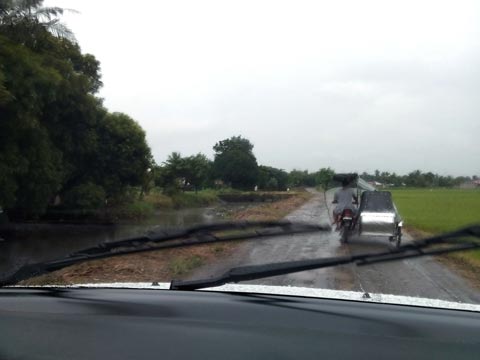
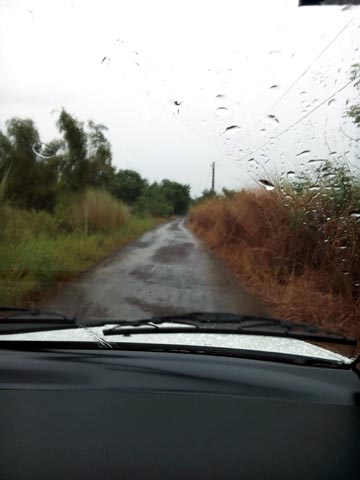
unnamed roads, Gapan outskirts
unnamed roads, Gapan outskirts
unnamed roads, Gapan outskirts
unnamed roads, Gapan outskirts
at St. Joseph Elementary, GPS coordinates plotted for September mission
at St. Joseph Elementary, GPS coordinates plotted for September mission
back on the road
short visit to a national shrine
short visit to a national shrine
short visit to a national shrine
heading East to San Antonio
heading East to San Antonio
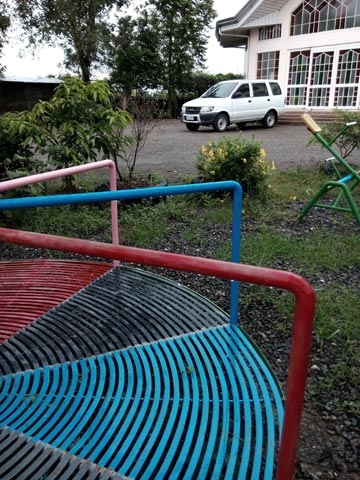
arrived for the day’s main event at Bahay ni San Jose
The hundred thousand
Crosswinds from across the years, they’re everywhere
Early this year, Isuzu Philippines announced having sold its 100,000th Crosswind. Think about it, after launching it initially as the Crosswind HiLander in 2004 and subsequently as simply the Crosswind in 2007, the more than 9,000 units they’ve sold on average for each of those 11 years since means that if you stack these all up, one on top of the other, they’d form a pillar 186km high—enough to put the topmost 14,000 Crosswinds into low earth orbit.
And from a satellite’s vantage point, if you line up those 100,000 Crosswinds bumper-to-bumper, it wouldn’t take any magnification to spot it from space, that 450km long column that could reach from Quezon City all the way to the northern tip of Luzon.
Finally, just to complete the spatial spectacle, if you put those 100,000 side-by-side and abreast, these would form a 170km wall wide enough to span Luzon’s breadth, from its western to eastern coasts, through what would become a border town San Fernando in Pampanga. That’s a lot of Crosswinds.
A replaceable but classic engine
Just before and still after it reached the 100,000 mark, there was talk that the venerable Crosswind is on the final stretch, that it’ll be retired soon because its diesel engine isn’t Euro IV compliant. That’s a rather short-sighted observation if you ask me.
Isuzu Philippines is also in the powerplant business, after all. It supplies diesel engines that are sought after by our own jeepney builders, and its technologies are innovative enough that these prompted giant Toyota to buy stake in their global parent. Is it really a stretch to imagine them updating to a Euro IV engine soon and also offering this as a retrofit for older Crosswinds out there?
But yes, the Crosswind’s inline-4, direct-injection turbodiesel is a hard act to follow. Though it’s only Euro II compliant, doesn’t yet have high-pressure common-rail direct injection, and mounts just a low-boost turbocharger, the Crosswind’s 4JA1-L, with well matched ratios on its manual MSG5K gearbox, delivers torque exactly where its needed for transporting heavy payloads, particularly on rough or hilly terrain.
Kicking in when it counts
While the rugged and fuel-efficient diesel packs torque roughly equivalent to that of a 140hp petrol engine, its nominal power is just 85hp because, well, because it’s a diesel. With longer strokes on those pistons to achieve almost double the compression ratio of petrol engines, diesel combustion is leveraged into much higher torque but with a tradeoff in terms of top revolutions. There’s lots of torque on the low end. It builds and peaks early, plateaus for a short stretch, then drops off as revs approach redline.
On the Crosswind, the torque is already substantial at a little over idle, say at around 1,200rpm, and peaks early at 2,000rpm. On a normally aspirated engine, torque would then start to decline perceptibly, the power equation then relying heavily on increasing revs to deliver peak horsepower. But on the current-model Crosswind, with the turbocharger effectively increasing engine displacement, compressing more fuel-air mix than normal in the cylinders, the turbo spools up and reaches its boost threshold at around 2,500rpm—just in time to take up the slack and bolster torque as it starts to wane on a non-turbo. The result is a relatively flat power curve as the engine reaches peak power output at 3,900rpm, and fuel efficiency that’s downright phenomenal on a heavy hauler. The best I measured on the Crosswind XL with its 5-speed manual transmission was 12km/l in moderate city traffic, and 14km/l on the highway with medium to heavy load-out.
The turbo is easily taken for granted, that’s how low its boost is, but it kicks in at exactly the right time. When you hit cruise and have time to observe your revs against speed, the turbo’s subtle benefit becomes apparent when you decide to go faster than a relaxed 80km/h and reach for 100km/h, or beyond. The engine sounds unstressed but still with its teeth firmly clamped on the bit, always pushing.
Exquisitely elegant in its application, the low boost turbo doesn’t widen the power-band much, but it does flatten it. Peak torque to peak power from 2,000rpm to 3,900rpm is the same as on a normally aspirated 4JA1. But the torque you feel while traversing that power band is really something else with the engine milking each erg of energy from burnt diesel. Unladen or heavy, the Crosswind easily handles a short-shifting regimen with upshifts triggered around 2000rpm at 15, 30, 45 and finally 60km/h to reach fifth gear. Acceleration isn’t immense, but it’s relentless, as you reach a moderate top speed on the order of 130km/h, this even with the Crosswind heavy with people or cargo.
Truck tough
First-generation HiLanders are still on the road, in good repair. More so are those successor Crosswinds from first-flight onwards that are still on mission, in the cities and the countryside. And just this year, the quintessential AUV got its second major facelift after the first one a decade ago. Compared to the Crosswind’s decade-spanning timescale, the updates on rival models look as frequent as those for smartphones and casual-dress sneakers.
Individual Crosswinds could be on the road, and the Crosswind model kept online and relevant, for a service lifespan that rivals that of military vehicles. And why not? I know you saw this coming a mile away: the Crosswind is built like a darned tank. I’ve said it before (though in a story with another publisher), and so say it again: the Crosswind comes across as two tons of truck in thick gauge steel. The only evidence of crumple zones are polymer bumpers, and those side shapers and fender flares on the up-market variants.
She’s heavy, with a curb weight at 1,600kg, but that comes with seating capacity for as much as 10 souls, and a payload nearer to a ton than just a half, its realistic gross weight certainly much more than Isuzu’s officially published 2,200kg.
Finessed down under
All that weight is sprung on a typical truck’s suspension that, like its engine, is far from what you’d expect it to be. The front has independent double wishbones and a stabilizer bar guiding the chassis’ motion over tough, compact torsion springs. And, while the rear is on those familiar semi-elliptical leaf springs, these ones come with a welcome twist.
In back is what they call a FlexRide MOVE suspension. What it does is put five leaf springs on each wheel where only the top, longest spring is actually bolted to the chassis. The middle three leaves are merely shackled at both ends to the top spring, to let the upturned ends slide against each other as the whole set compresses down under load. And the bottom spring, the shortest and the stiffest, is shackled only on its front end. This brings that fifth bottom spring into play only when the vehicle rolls through a major bump or is laden heavily enough to make the Crosswind go way down on its rear haunches. That fifth spring stiffens up the rear’s ride only when needed, hence the “Flex Ride.” The effect is a comfortable ride for when you bring the Crosswind around unladen, or a reinforced and steady one when you’re going heavy.
On the base XL variant with 185R14 Yokohama Super Van 356 truck tires, that high-walled rubber allows for a wide range of inflation options. Recommended max pressures are 28psi in front, 47psi in back. But on the drive to Nueva Ecija with loads varying from five to nine people, with stretches on prime highway tarmac as well as unpaved track, in both wet and dry conditions, I opted to balance control and traction (as well as comfort) with 26psi in front, 35psi in the rear. It worked out fine.
The Crosswind’s substantial weight, tires, treads, suspension and low end torque profile (to take grades gently) made me look good, helping me deliver a surprisingly smooth ride over broken, or frequently absent, pavement. The apparent robustness of the platform, its freedom from extraneous body roll and ambient squeaks, kept me relaxed and surefooted, insulated from the roughness that we undoubtedly would’ve felt if we had been in a flimsy, smaller-wheeled ride.
See the video, it wasn’t just okay, it was downright fun rolling over those holes and bumps.
A rolling box, like an APC
The Crosswind is from an age when internal volumes were kept straightforward and big. Look inside the cabin and you’ll get this sense of being in a simple box, all straight lines and contiguous space. The only significant interruption in the cabin’s cubic area comes from the rear wheel wells which are elegantly put under the foldable side facing seats in the last row. The floor is a flat continuous slab, its height enough to be flush over the rearwheel drive axle.
The best thing about the XL is the contiguous cargo volume you could free up by folding away the second and third row seating. Feel free to double-check me on this, but with all seats behind the front row stowed away, that space looks equal to the cargo bay of a pick-up truck. And on the XL variant, with low maintenance features that include hand-cranked windows, vinyl upholstery, textured linoleum matting, and easy acceptance of bare painted metal peeking between finer interior touches, the utilitarian space simply works.
Decades of Crosswinds
Back when AUVs had that Asian “A” to make a proud pragmatic point, and not to marginalize these in the global market, Indonesia’s Astra conglomerate was the first to roll out these hardy utes with curvy-edged full-pressed hard-bodies. First came the third generation Tamaraw (the Kijang in Indonesia) from Toyota Astra Motors in 1986. Then, five years later, out came the first generation HiLander (their native Panther) from Astra Isuzu Indonesia in 1991.
The models were groundbreaking, the first shaped-metal bodies designed in and for Southeast Asia. Those models that came before (recall the Ford Fiera, the early Toyota Tamaraw, and even the VW Sakbayan) were all fabricated with sheet metal bent to shape and welded together to form boxy, angular bodies.
The HiLander, the Crosswind’s first generation if you look past the name shift, was built shapely from the start, though still on a truck’s robust chassis, and after Astra had half a decade to work out what else and more they’d like to do with a Kijang-like vehicle. The result was a utility that was purpose-built for the region’s roads (or lack of these), our climate (hypothermia cold to blistering hot, low and flooded to high and dry), and with the payload capacity to carry the extended family or anyone’s cargo. Introduced in 1991 globally, the HiLander got to our shores in 1996 and stayed in production until 2004.
With its eight years on the line, the timescale really makes the HiLander look like the precursor, a “demonstrator” in military-speak, of the Crosswind, its operational successor. Already sixteen years in after it was introduced globally in 2000, though introduced here four years later in 2004, new Crosswinds could be rolling off the production line until its two-decade mark … could be even three, it’s happened before.
Rugged because it needs to be
There’s talk that Isuzu’s recent introduction of the mu-X, echoing what others say about that Euro II engine, spells the impending retirement of the rearwheel drive Crosswind’s line. In fact, Isuzu admits that the introduction of the mu-X heralded a significant reduction in sales of its bestseller Crosswind. But do note the difference in price structure.
While the Crosswind’s top-spec and sleeked up Sportivo variant lists at PhP1.195M, slightly above the PhP1.188M for the 4×2 base model of the mu-X, the million-peso range where these intersect is still substantially above the PhP0.794 for the base XL variant I’d driven. The XL makes no reference at all to SUVs, doesn’t dress up into one, the best analog being those vanilla white utilities we saw foreign aid organizations using in-country before the turn of the century. And, although last priority seating is on a vestigial bench ledge between the driver and front passenger seats, that 10-seater capacity is still the most I’ve seen done on anything short of a full-blown passenger van.
The mu-X, an SUV, works because it’s ruggedized, made tough and above things enough to navigate the rougher corners of the land. In contrast, the Crosswind is rugged because it has to work. There’s a difference. It was built for the average multitude who live near or in hinterland. And, after all these years, the Crosswind is still on mission.
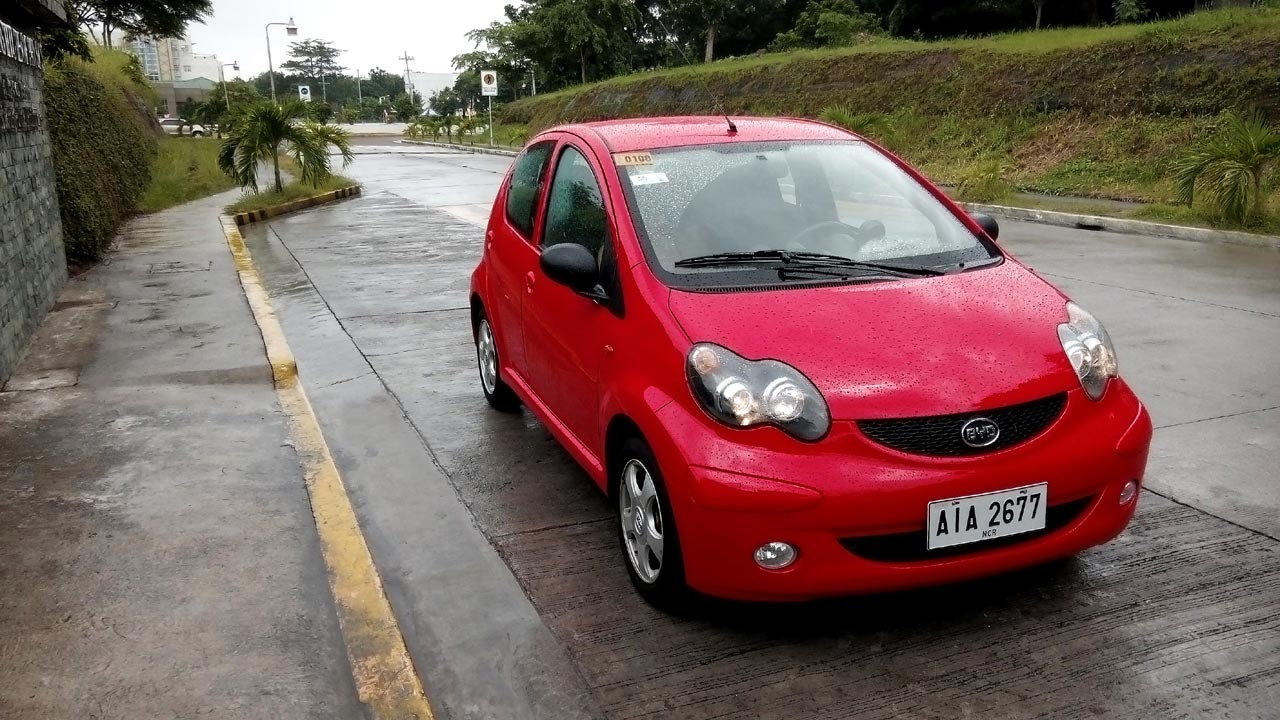
For their F-0’s AMT variant, what BYD did was bolt a Magneti Marelli kit onto the same 5-speed manual gearbox of the micro-hatchback’s MT variants. Like other carmakers in China (and also in India, by the way), BYD found that an automated manual transmission, an AMT, is a cost-effective way to, well, to automate most or some of the stickwork on a manual gearbox. It isn’t an automatic transmission built from the ground up, but rather a distinct module bolted onto a manual box, adding logic controllers and servos to work both the clutch and the gearshift.
There’s no clutch pedal to work with. All clutchwork is delegated to the electronic shifter, leaving just the brake and gas pedals. And, about that gas pedal, the AMT also overrides your throttle inputs as it works the clutch, letting up on the gas as it pulls back the clutch for a shift, then bringing the gas back to where you had it as it lets the clutch back in to engage the new gear.
Magneti Marelli AMT unit
It’s an entirely different experience compared to auto-shifts on a conventional AT where the fluid link of the torque converter allows shifting on the fly without any let up on the throttle, not even when stepping through gears in semi-auto mode. But it’s definitely a sequence that’s familiar to the stick savvy.
In forward drive, the F-0 AMT has three modes—A, S and M:
A for full automatic operation, the gearbox taking care of all shifting from first to fifth. From the N (neutral) starting position, sliding the stick down will spring it into the very center of the selector, putting F-0 in A.
S for a sportier sequence on the automatic shifting, the box keeping you in each particular gear longer, milking its torque advantage as you accelerate up. Clicking the S button while the F-0 is already in A puts it in sport mode. Clicking the button again toggles it back from S to A.
M for a manual mode that let’s you roll out in 1st or 2nd (for driving off in snow conditions) and sequentially shift up or down through all five gears. Coming out of N or R (reverse) puts you A by default. But then after, even with the car already moving, flicking the stick left and letting it spring back to the center will toggle you into M, and flicking it again puts you back in A.
in neutral
from neutral to normal AUTOMATED mode
click the button to toggle into and out of SPORT automated mode
shifting to REVERSE
flick left and let the stick spring back to center to toggle to and from MANUAL mode
flick up to shift up in M mode
flick down to shift down in M mode
Showed up by software
When I had driven the MT variant last year on a real world mission, an outreach drive as usual but for a different publisher, I found the F-0 thoroughly enjoyable (see the story: The BYD F0, on the job). The wheelbase’s rectangle is relatively short and wide, the overhangs on the body are minimal both front and back, and those wheels set nearly at its corners make for a very responsive city car that’s sized just right for zipping around the metropolis.
So, I thought I found a way to both eat and have the proverbial cake by nailing down a shift sequence to run the peppy hatchback as efficiently as possible. Noting that the F-0’s 67hp 998cc engine spools up very quickly with its three cylinders, revving up easily from under 1000rpm to almost 4000rpm with just normal pressure on the gas pedal, I asserted that minding the revs and up-shifting at 3000rpm as the micro-hatch hits 20, 40, 60 and 70km/h to reach 5th gear, would put it in it’s best fuel-saving groove.
But, as it turns out, I was wrong. Working with the same gear ratios as on the manual box, that 3000rpm shift-point I had pegged is where the AMT would have you in its more aggressive S mode, with shifts happening at a similar 20, 40, 60 and 80km/h. In contrast, in normal A mode, the F-0’s AMT programming defaults to extreme economy, its logic and fast electronic controller managing to deliver an even more frugal shift sequence.
No sir, 2000 is better
In A, the automated gearbox emulates how an eco-run master would short-shift for optimal fuel savings. Normal, easy pressure on the gas pedal gets you to shift points as soon as revs hit 2000rpm: up to 2nd gear by the time you hit 15km/h, then up to 3rd by 25, to 4th by 45, and finally up to 5th gear by the time you hit 60km/h. Obviously a max-conserve regimen to get to the top overdrive gear quickly and even at a low 60km/h that’s arguably the highest speed at which you can occasionally cruise in city traffic.
At 2,000rpm with its fairly flat power curve, the F-0’s BYD 371QA engine already delivers 86% or 57lb-ft of its peak torque of 66lb-ft at 4000rpm. It really is enough for getting you to the next shift point. The problem is, with the throttle so responsive on the MT variant, that 2000rpm comes and goes very quickly—difficult to hit when you’re minding a stick. But with the drive-by-wire controllers on the AMT kit, triggering things at 2000 is just routine of course.
My best on the MT variant was 16km/l. On the F-0 AMT, with full credit going to Magneti Marelli engineers, I saw that number being nudged up to almost 18km/l.
Still a clutch in there
If you remember that an AMT still has a clutch to manage, then its operation becomes predictable. I’m saying that’s a good thing. If you’re an old stick guy, like many of us are, you’ll be looking out for when and how the AMT box will be easing off and pushing in the clutch while it does its autonomous thing with the gearshift.
On rolling out, shifting from N down to A will put the F-0 in gear only if you’re stepping on the brakes at the time. If you forget this and, perhaps, put it in A not while stepping on the brakes but rather with the parking brake engaged, it won’t put you in gear. The stick selector will be in the center position where it should be but the dash display will show you as being still in N. Remember this and don’t panic when you might be coming off the handbrake instead of the brake pedal (like when you move again in stop-and-go traffic). Simply step on the brakes, then cycle the stick to N then back to A. That’ll put you in gear.
Now, with the car in gear, the dash display showing that telltale A, you’ll notice no urging forward like what you’d feel on a conventional AT with its torque converter already engaged. Reason is that the AMT’s program will start easing in the clutch only when you take your foot off the brake. Quite natural really, like what you’d do on a manual transmission.
But you can still use that old handbrake trick when rolling out from an uphill hang. Just do what you’d normally do after shifting the selector in drive while stepping on the brake. Engage the handbrake, step off the brake pedal, and then give it a little gas in A before disengaging the handbrake as well.
Jerky only if you’re passive
As the car accelerates and cycles through its upshifts, the AMT will execute each one as you yourself would if you had full control of the clutch and the gearshift. When it hits a shift point, it’ll override your throttle control, idling down the engine to prevent it racing as it eases back on the clutch. Only with the engine idled and the clutch disengaged will it then actually change gears. Afterwards, it’ll reengage the clutch then give you back full control of the throttle. Keeping your foot pressed down on the gas pedal through this evolution will cause what critics have called that “jerky” AMT acceleration.
With a gear shift completed, the gearbox will restore full throttle control, putting the engine revs instantly back where your foot on the gas tells the AMT to put it. What’s this like? Have you seen the movie Apollo 13, particularly the part when their first stage booster cuts out and the second stage suddenly comes on to take over? It’s like that. You’d feel a sudden absence of acceleration as the AMT starts into a shift, followed half a second later by its equally sudden return. But, again, that’s only if you keep pressing on the gas pedal the same way throughout the gear change.
If you visualize what you’d be doing on a manual gearbox and fall back on muscle memory, you can rely on instinct to ease off the pedal as soon as you sense the engine idling down in preparation for a gear shift, imagine that familiar “one-one thousand” second’s count, and bring back the gas gradually when and instead of thinking “thousand.” (Remember? It takes just a half and not a whole second.)
[youtube=http://www.youtube.com/watch?v=nxhsda0F1dI&w=480&align=right]And then there’s the option of simply putting things in M and going through old familiar motions for accelerating with a manual gearbox, only this time without having to worry about a clutch pedal. Also, with the AMT in M, gear shifts could actually happen faster. Instead of the engine starting to idle down only when the AMT triggers an upshift, accelerating in M mode means you can ease off the gas pedal before and in anticipation of your triggering an upshift yourself. The AMT won’t anymore have to wait for the engine to spool down before easing off the clutch, executing your gear shift command, and then again reengaging the clutch.
Economical to a fault
Economy-focused A mode on the AMT won’t give in to impulsive sprints, keeping you in the current gear even as you suddenly push harder on the gas pedal. On conventional automatics, the common response is a downshift for multiplied torque as the RPM spike translates this into horsepower. Not so with the AMT, not in A and neither in S mode.
If you think about it, it really is better to keep the AMT in the same gear, even when you need some sudden acceleration. Remember that any shift triggers disengaging the clutch while idling down the engine. Imagine what this would imply when you suddenly need some powerful acceleration. The AMT will oblige, ironically, by first throttling down the engine for the half second it needs to complete a gear change. Nope, not an ideal scenario.
Somewhat related to this, A mode will keep you in a particular gear as long as it keeps you moving along at the gear’s corresponding minimum speed, regardless of not being able to accelerate beyond it. This makes for some hair-raising episodes when you’re going uphill. An A mode’s short-shifting sequence, while good enough on level ground, could cause a sudden loss of critical gear reduction as you deal with a climb. Instead of speeding through a climb on a lower gear, an untimely up shift would likely keep you at a low speed, not letting you accelerate further for the duration of the uphill run … makes for a lot of horn-honking at your back.
Now, to deal with these shortcomings of the AMT when compared to conventional AT’s, it might’ve crossed your mind to keep it in S mode full-time. But notice that while this may pre-empt any problems in uphill climbs, it doesn’t really give you the the downshift option for those occasions when you need a burst of acceleration, occasions like on overtakes to get out from behind slower vehicles. So, I’d suggest going back to basics, going to M mode instead. Do a quick left flick on the selector to put the AMT in manual M mode, then a quick down flick to downshift.
Best practices using an AMT’s best programming
Notice how many times I went into the benefits of M above those of other modes? There’s the bit where I mention going with M to sidestep acceleration jerkiness. And there’s the part just above where I suggest M mode as being the answer for the AMT’s acceleration shortfalls. Admittedly, I started out thinking it’s best to just keep it in M, commanding the gear changes myself while still enjoying the break from having to work a clutch pedal.
But in the end, after logging about 250km on the F-0, I’d suggest keeping it in A mode instead. Just build on old muscle memory to learn a new set of instincts for easing off the gas pedal when the gearbox idles down the throttle and come back in with the gas only after it completes a gear change. This way, you reap all the fuel-saving benefits of the AMT while enjoying its clutchless operation. Consume less fuel than with a conventional AT while still enjoying its clutch automation, what’s not to like?
Stay in A, but be ready to flick things into M real quick. When you need powerful acceleration, instead of finger-hunting for the S switch, better to then finally go into M mode with an easy, sightless left flick on the big selector stick, followed by equally natural down flicks, and some subsequent up flicks, before again settling down to a cruise back in A with another, final left flick.
So, there it is: stay in A but still with a suggestion to at least use M occasionally. Why? It’s fun, for one, and it comes with the challenge to sharpen your stick skills even more. In M mode, you can pop out of gear and into neutral while rolling, sure, but you can’t get back into gear without coming to a full stop and keeping your foot on the brake. So you lose that old crutch of being able to coast along while you’re uncertain what gear you should be in. And this is good. A professional driving and race instructor, two of them actually, kept drilling me on the wisdom of staying in gear all the time. Driving the AMT in M mode, the absence of a clutch pedal being fortunate in more ways than one, trains you up to do just that.
We drive the Tata Super Ace chassis with passenger body, taking the compact, city-sized truck into the countryside to bring a busload of teaching volunteers on an outreach mission. Stable at speed and packing a heavy payload, she can easily reach beyond 100km/h on the highway. But where she really shines is on unpaved country roads where her capacity, and suspension, make the Super Ace a very neighborly hauler.
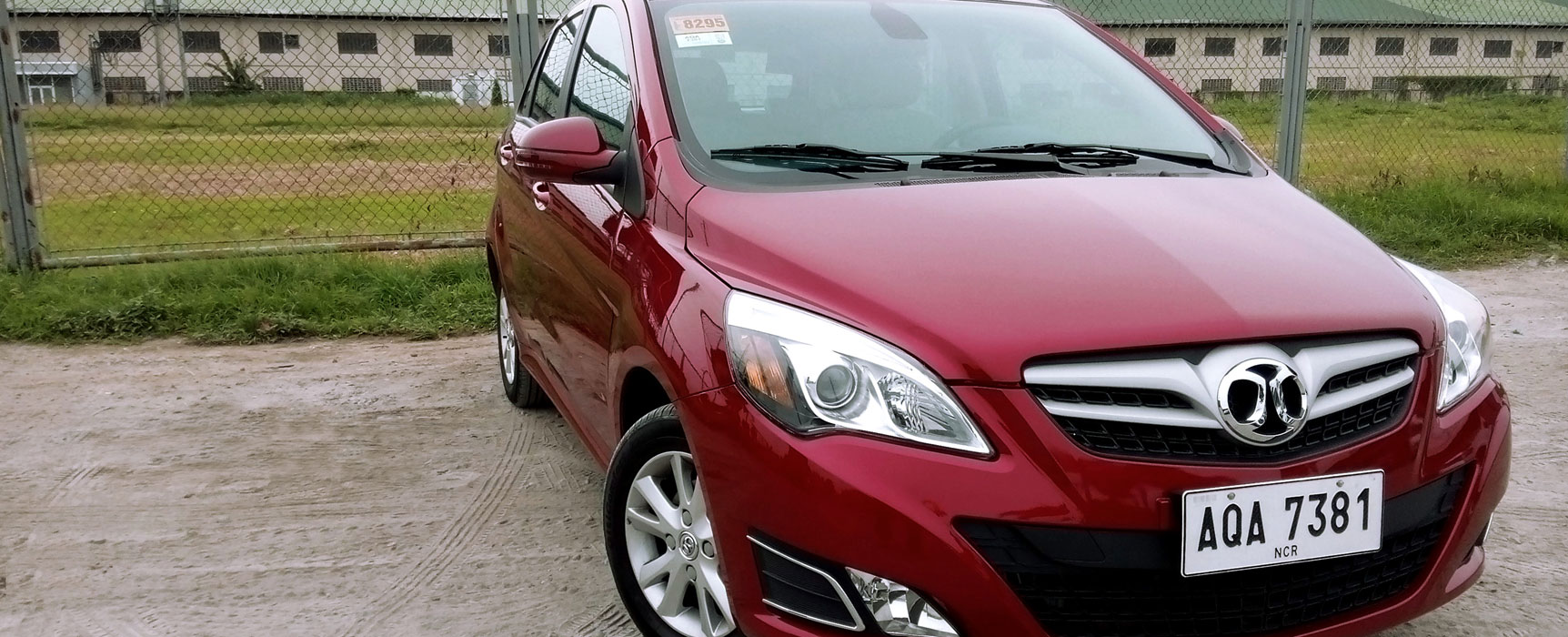
With its sub-compact size and decent cargo space, the BAIC A115 fits the up-market definition for a family’s proper-sized city car. But with vehicle dynamics that make it at home on the highway , the A115 ought to be let loose on road trips that’ll put even its powertrain to good use.
A form-factor sweet-spot
[youtube=http://www.youtube.com/watch?v=eHCArkCCj8c&w=480&align=right]The BAIC A115 hatchback feels exceptionally stable, with light or heavy load, at city or highway speeds. She feels tight and planted with just the driver on board, or with the entire family plus groceries or luggage, cruising in the city at the typical maximum 60km/h, or on the highway beyond 100km/h. And it all points to BAIC finding a sweet-spot in the dimensions of a hatchback built on a pedigreed vehicle platform that’s been used both for shorter and longer sub-compacts.
BAIC’s A1 line is built on the Z-platform developed jointly by Daimler AG and Mitsubishi for their global small car initiative back when they where allies (see our previous related story, The BAIC A1 series: how Daimler-Mitsubishi engineering lives on in a Chinese sub-compact). Daimler used the platform for its sporty Smart ForFour, Mitsubishi for its sub-compact Colt. And, when it became apparent that the hatchback could be more practical, friendlier to families with a larger boot space, Mitsubishi stretched the Colt’s rear overhang by 300mm, deepening the cargo area, to create the Colt Plus variant. In contrast, the BAIC A1 works with a straight top cabin with MPV proportions (though not a mini-van’s size) that’s just 113mm longer than the Colt, resulting in a practical hatchback that doesn’t bump up against station-wagon dimensions like the Colt Plus does.
Just right, in the right places
With a length that’s a hair’s thickness shy of four meters, a reassuring 62% of the A115’s body still sits atop the long 2500mm wheelbase with its 1460/1445mm front and rear treads. And most of the overhang is kept up front, away from the rear where it would’ve added to the force that could pendulum the car into oversteers, or could side swipe close-aside pedestrians and cars when doing a full turn.
The weight distribution on this middle child feels optimal. The typical front-weight bias on the front-engine, front-wheel-drive A115 is mitigated somewhat by the mass of that roomy cabin with max headroom all the way back to the rear dash. Judging by its official axle-loading figures, the hatchback has a front weight-bias of just 51:49 (actually, just 50.4:49.6). Plus, the car’s form seems not to let any wind get under its skirt, with tangible down-force created front and back by its down-turned and faceted hood, and its slightly tear-dropped roof-line ending in an integral rear wing.
A MIVEC under the hood
The BAIC A115 mounts the 1.5 liter inline-4 Mitsubishi 4A91 MIVEC engine with variable valve timing (VVT) logic that doesn’t put a premium on low-end torque but instead on mid to high-end sustained horsepower. The MIVEC engine’s power curve starts low but rises quickly to deliver peak torque of 107lb-ft at 4000rpm and 107hp at 6000rpm, and redlines starting at 6500rpm.
Just above idle with 1000rpm brings up just 48% of potential torque, 2000rpm brings a sudden rise to 83%, and 3000rpm to 94%. And, with a conventional 4-speed AT with widely spread gear ratios, that humpy power curve needs some management.
Four gears, all tall
A 4-speed AT compared to the 5, 6, and 7-speeds these days might bring on assumptions of the box not having an efficient overdrive gear for cruising. Not so with the A115’s 4-speed. All the gears are exceptionally tall, starting at 2.842:1 in first and hitting the 1.000:1 direct drive ratio early in third, with a 0.712:1 fourth gear ratio that’s even taller than those of most fifth gears with the typical 0.810:1.
An easy roll off with revs brought up to and then pegged at 2000rpm will see the A115 up-shifting at a familiar cadence: up to 2nd gear by 20km/h, to 3rd by 40, 4th by 60, and then this nudge that feels like half an up-shift at 80 when the lock-up clutch on the torque converter engages, creating a hard link between engine driveshaft and transmission gears. Think about it: the tall gearing means you’d hit the equivalent of the 4th gear on a manual transmission when you up-shift to 3rd at just 40km/h, and already reach extreme overdrive when you go up to 4th at just 60km/h on the conventional AT.
Torque converter, torque multiplier
But being tall and wide means that the gearing has to make the most of the slippage in the hydraulic torque converter to bring up some dynamic gear reduction on demand. Step back a bit and consider that torque converter, critical in more ways than one. With it, the engine’s impeller propels automatic transmission fluid against the transmission’s turbine, causing the latter to rotate.
An automatic can be stopped while in drive, or allowed to crawl, while the engine is still idling under 1000rpm. The reason is that fluid link between engine and transmission (a “fluid coupling” it’s actually called, but I’ve chosen “link” to lose the innuendo). If it had been a clutch with its hard contact against the pressure plate, the vehicle would’ve stalled. Instead, on an automatic, the impeller just keeps on rotating while the turbine is either braked or allowed to rotate to push the car forward.
Allowing the automatic to make the car crawl means the engine’s impeller would rotate as much as twice as fast as the transmission’s turbine, effectively creating gear reduction (though there are no gears) that multiplies torque to as much as twice its raw value. This is why the A115, in its optional “snow” drive mode, starts you off in 2nd gear: to keep the slippage internal, in the torque converter, and away from between your tire rubber and the road. (By the way, there’s also a “sport” mode available, to keep you accelerating in each gear longer … pretty much a standard algorithm, not the focus of this story.)
Aside from telling us, yes, its okay to habitually leave the selector in D while in stop-and-go traffic, this state of things means it’s also okay to rev up the engine a bit to get some dynamic, on-the-fly gear reduction into play. And this is all-important on the BAIC A115, again with its humpy power curve and that conventional AT with tall and widely separated gear ratios.
A powetrain that stands finessing
Surge up the revs a bit, inducing slippage to temporarily deepen gear reduction and deal with the sudden upshift to a much taller gear. Just wait as the vehicle’s momentum builds up and lets the transmission’s turbine eventually catch up to the engine’s impeller, thus shallowing and restoring the reduction back to that of the actual gear. It’s like having an auxiliary continuously variable transmission (CVT) before the main gearbox, if you think about it.
On the A115, if you want a stronger roll-out, go ahead and slightly surge up the revs to 2800-3000rpm while it shifts up through 1st and 2nd gears, then settle it down to the 2200-2500rpm range when you reach 3rd gear for the onset of cruise. If you like, keep it up even as you go through 80km/h, to prevent the lock-up clutch from kicking in, retaining that fluid gear reduction until you hit your desired cruising speed and reel things back in (at around 2000 to 2200rpm for a 100km/h cruise, depending on your load).
There’s one school of thought that proposes this “fast to cruise” technique to be more economical than a slow climb to 100km/h. In any case, it’s nice to see the trip computer’s actual consumption monitor go from 20 to just 5L/100Km (from 5 to as much as 20km/l, measured the more familiar way) as soon as you settle into a cruise.
Like the veterans do it
This rev surging takes practice—inherent tachymeter delay means you’ll be relying more on engine sound than on rpm readings, letting off the gas even before the needle finishes its climb to the surged revs level—but it makes for a more satisfying drive, maybe a more economical one, and perhaps more interestingly, it’s somewhat of a tradition among veteran Mitsubishi Lancer drivers.
The exact same powertrain, tuned identically, was once used on the 2006 Lancer EX. And on that big sedan that weighed about 200kg more than either the Mitsubishi Colt or the BAIC A115, drivers have learned to surge the accelerator a bit while the AT up-shifted through the lower gears. Imagine how much more fun those Lancer vets could have doing the surge on a lighter, nimbler hatchback that’s rock solid both in the city and in autobahn country.



 The drive would be a 260km loop through the near north and we needed a vehicle that could: (1) handle rough or broken roads, (2) carry as many as nine people along with a big tub filled with books and equipment, and (3) convey us comfortably enough to have people arrive rested and ready to teach animatedly. And I had a vehicle in mind, an institution by now, actually.



























 Just before and still after it reached the 100,000 mark, there was talk that the venerable Crosswind is on the final stretch, that it’ll be retired soon because its diesel engine isn’t Euro IV compliant. That’s a rather short-sighted observation if you ask me.
 low end. It builds and peaks early, plateaus for a short stretch, then drops off as revs approach redline.
 and the countryside. And just this year, the quintessential AUV got its second major facelift after the first one a decade ago. Compared to the Crosswind’s decade-spanning timescale, the updates on rival models look as frequent as those for smartphones and casual-dress sneakers.
 stabilizer bar guiding the chassis’ motion over tough, compact torsion springs. And, while the rear is on those familiar semi-elliptical leaf springs, these ones come with a welcome twist.
 when the vehicle rolls through a major bump or is laden heavily enough to make the Crosswind go way down on its rear haunches. That fifth spring stiffens up the rear’s ride only when needed, hence the “Flex Ride.” The effect is a comfortable ride for when you bring the Crosswind around unladen, or a reinforced and steady one when you’re going heavy.
 The best thing about the XL is the contiguous cargo volume you could free up by folding away the second and third row seating. Feel free to double-check me on this, but with all seats behind the front row stowed away, that space looks equal to the cargo bay of a pick-up truck. And on the XL variant, with low maintenance features that include hand-cranked windows, vinyl upholstery, textured linoleum matting, and easy acceptance of bare painted metal peeking between finer interior touches, the utilitarian space simply works.
 The HiLander, the Crosswind’s first generation if you look past the name shift, was built shapely from the start, though still on a truck’s robust chassis, and after Astra had half a decade to work out what else and more they’d like to do with a Kijang-like vehicle. The result was a utility that was purpose-built for the region’s roads (or lack of these), our climate (hypothermia cold to blistering hot, low and flooded to high and dry), and with the payload capacity to carry the extended family or anyone’s cargo. Introduced in 1991 globally, the HiLander got to our shores in 1996 and stayed in production until 2004.
 in price structure.

 There’s no clutch pedal to work with. All clutchwork is delegated to the electronic shifter, leaving just the brake and gas pedals. And, about that gas pedal, the AMT also overrides your throttle inputs as it works the clutch, letting up on the gas as it pulls back the clutch for a shift, then bringing the gas back to where you had it as it lets the clutch back in to engage the new gear.


 But, as it turns out, I was wrong. Working with the same gear ratios as on the manual box, that 3000rpm shift-point I had pegged is where the AMT would have you in its more aggressive S mode, with shifts happening at a similar 20, 40, 60 and 80km/h. In contrast, in normal A mode, the F-0’s AMT programming defaults to extreme economy, its logic and fast electronic controller managing to deliver an even more frugal shift sequence.
 At 2,000rpm with its fairly flat power curve, the F-0’s BYD 371QA engine already delivers 86% or 57lb-ft of its peak torque of 66lb-ft at 4000rpm. It really is enough for getting you to the next shift point. The problem is, with the throttle so responsive on the MT variant, that 2000rpm comes and goes very quickly—difficult to hit when you’re minding a stick. But with the drive-by-wire controllers on the AMT kit, triggering things at 2000 is just routine of course.
 On rolling out, shifting from N down to A will put the F-0 in gear only if you’re stepping on the brakes at the time. If you forget this and, perhaps, put it in A not while stepping on the brakes but rather with the parking brake engaged, it won’t put you in gear. The stick selector will be in the center position where it should be but the dash display will show you as being still in N. Remember this and don’t panic when you might be coming off the handbrake instead of the brake pedal (like when you move again in stop-and-go traffic). Simply step on the brakes, then cycle the stick to N then back to A. That’ll put you in gear.
 But you can still use that old handbrake trick when rolling out from an uphill hang. Just do what you’d normally do after shifting the selector in drive while stepping on the brake. Engage the handbrake, step off the brake pedal, and then give it a little gas in A before disengaging the handbrake as well.
 With a gear shift completed, the gearbox will restore full throttle control, putting the engine revs instantly back where your foot on the gas tells the AMT to put it. What’s this like? Have you seen the movie Apollo 13, particularly the part when their first stage booster cuts out and the second stage suddenly comes on to take over? It’s like that. You’d feel a sudden absence of acceleration as the AMT starts into a shift, followed half a second later by its equally sudden return. But, again, that’s only if you keep pressing on the gas pedal the same way throughout the gear change.
 Somewhat related to this, A mode will keep you in a particular gear as long as it keeps you moving along at the gear’s corresponding minimum speed, regardless of not being able to accelerate beyond it. This makes for some hair-raising episodes when you’re going uphill. An A mode’s short-shifting sequence, while good enough on level ground, could cause a sudden loss of critical gear reduction as you deal with a climb. Instead of speeding through a climb on a lower gear, an untimely up shift would likely keep you at a low speed, not letting you accelerate further for the duration of the uphill run … makes for a lot of horn-honking at your back.
 But in the end, after logging about 250km on the F-0, I’d suggest keeping it in A mode instead. Just build on old muscle memory to learn a new set of instincts for easing off the gas pedal when the gearbox idles down the throttle and come back in with the gas only after it completes a gear change. This way, you reap all the fuel-saving benefits of the AMT while enjoying its clutchless operation. Consume less fuel than with a conventional AT while still enjoying its clutch automation, what’s not to like?



 The weight distribution on this middle child feels optimal. The typical front-weight bias on the front-engine, front-wheel-drive A115 is mitigated somewhat by the mass of that roomy cabin with max headroom all the way back to the rear dash. Judging by its official axle-loading figures, the hatchback has a front weight-bias of just 51:49 (actually, just 50.4:49.6). Plus, the car’s form seems not to let any wind get under its skirt, with tangible down-force created front and back by its down-turned and faceted hood, and its slightly tear-dropped roof-line ending in an integral rear wing.
 The BAIC A115 mounts the 1.5 liter inline-4 Mitsubishi 4A91 MIVEC engine with variable valve timing (VVT) logic that doesn’t put a premium on low-end torque but instead on mid to high-end sustained horsepower. The MIVEC engine’s power curve starts low but rises quickly to deliver peak torque of 107lb-ft at 4000rpm and 107hp at 6000rpm, and redlines starting at 6500rpm.
 Just above idle with 1000rpm brings up just 48% of potential torque, 2000rpm brings a sudden rise to 83%, and 3000rpm to 94%. And, with a conventional 4-speed AT with widely spread gear ratios, that humpy power curve needs some management.
 An automatic can be stopped while in drive, or allowed to crawl, while the engine is still idling under 1000rpm. The reason is that fluid link between engine and transmission (a “fluid coupling” it’s actually called, but I’ve chosen “link” to lose the innuendo). If it had been a clutch with its hard contact against the pressure plate, the vehicle would’ve stalled. Instead, on an automatic, the impeller just keeps on rotating while the turbine is either braked or allowed to rotate to push the car forward.
 On the A115, if you want a stronger roll-out, go ahead and slightly surge up the revs to 2800-3000rpm while it shifts up through 1st and 2nd gears, then settle it down to the 2200-2500rpm range when you reach 3rd gear for the onset of cruise. If you like, keep it up even as you go through 80km/h, to prevent the lock-up clutch from kicking in, retaining that fluid gear reduction until you hit your desired cruising speed and reel things back in (at around 2000 to 2200rpm for a 100km/h cruise, depending on your load).
 This rev surging takes practice—inherent tachymeter delay means you’ll be relying more on engine sound than on rpm readings, letting off the gas even before the needle finishes its climb to the surged revs level—but it makes for a more satisfying drive, maybe a more economical one, and perhaps more interestingly, it’s somewhat of a tradition among veteran Mitsubishi Lancer drivers.