

The Philippines is now Uber country. On May 11, the government introduced the Transport Network Vehicle Service (TNVS) category. Covering vehicles that provide pre-arranged transport for compensation using online apps that link up prospective passengers with drivers, the TNVS classification applies to the likes of Uber as well as GrabTaxi, EasyTaxi and Tripda.
This is the first time that an explicit category has been implemented on a national level. All previous implementations elsewhere were done through city and local government regulation. Uber Senior Vice-President David Plouffe says the Philippine government’s move would “advance urban mobility, create new economic opportunity, and put rider safety first.” Economy and enterprise, these are the critical points for legitimizing Uber. Apparently, hopefully, Uber and government are on the same page.
Uber’s crowd-sourced transport fleet is divided into two categories: Uber Black counts SUVs such as the Toyota Fortuner, Mitsubishi Montero and Ford Evererest as part of their virtual inventory, while Uber X, the “low cost Uber” as they call it, singles out the Toyota Vios, Mitsubishi Mirage G4 and Honda City.
Under the new rules, only sedans, Asian utility vehicles (a.k.a. multi-purpose vehicles and minivans), vans, or similar vehicles can qualify, and only those that are seven years old or less. As such, the TNVS category lumps in non-sedans with vehicles in the Uber X economy class that features compact and sub-compact passenger cars, while leaving out the SUVs that are featured under the high-end Uber Black service class.
Uber folk are out to put family cars to work, or to acquire second cars that can pull double-duty as revenue-earners—a predictable outcome of the Uber trend. Now, what if that family or second car can be another thing as well, other than for personal commutes or for metered under-Uber service as it were? Like say something for big family vacations or a point-to-point charter service. Enter the MZ-45 WeVan from BAIC.

A sedan’s footprint under a van’s body
She’s big sister to the MZ40 we tested last March (see the story: BAIC’s MZ40 WeVan on an Outreach Drive to Dueg), adding 465mm in overall length, 220mm in wheelbase length and 90kg in curb weight to the smaller compact van. And yet, given all these, the MZ45 still has the modern and amazingly versatile gasoline engine that’s smaller than on any sub-compact intended for taxi duties, has both dimensions and weight to match the compactness of these fleet-service sedans, and has nearly double the seating capacity of any compact passenger car.
The BAIC MZ45 is almost 4cm shorter than the biggest taxi model on offer right now, the BYD F3 1.5L MT, yet it seats 9 to the compact sedan’s 5, and it costs PhP100k less. The MZ45 is just 8cm longer (about the width of your palm), albeit 200kg heavier, than the Toyota Vios Base MT, the most popular taxi model in the country, yet is driven by a slightly smaller 1.2L engine that matches the power and economy of the 1.3L on the sub-compact sedan, and costs just PhP6,000 more. And all these, again, with seating capacity that’s nearly double of either taxi model, that’s enough to transport what a pair of sedans would’ve and with only one chauffeur instead of two.
| Toyota | BAIC | BYD | |||
| Aspect | Unit | VIOS 1.3 Base MT | MZ45 Luxury 9 | F3 1.5 MT | |
| Dimensions and weight | |||||
| – | Length | mm | 4410 | 4495 | 4533 |
| – | Width | mm | 1700 | 1636 | 1705 |
| – | Height | mm | 1475 | 1912 | 1490 |
| – | Wheelbase | mm | 2550 | 2920 | 2600 |
| – | Turn radius | mm | 5.1 | 5.9 | 5.1 |
| – | Clearance | mm | 147 | 150 | 170 |
| – | Seating | pax | 5 | 9 | 5 |
| – | Curb weight | kg | 1060 | 1275 | 1200 |
| Engine | |||||
| – | Displacement | ltr | 1.3 | 1.2 | 1.5 |
| – | Valvetrain | VVT-i, 16V DOHC | CVVT, 16V DOHC | VVL, 16V SOHC | |
| – | Peak power | hp/rpm | 85/6000 | 86/6000 | 107/5800 |
| – | Peak torque | lb-ft/rpm | 90/4000 | 80/4400 | 107/4800 |
| List price | PhP | 592,000 | 598,000 | 698,000 | |
The MZ45 has four rows with 2+2+2+3 seating, front to back. The first row is of bucket seats for driver and front seat passenger, the second and third rows are each a two-seater bench with the aisle running down the right side, and the fourth row is an end-to-end three-seater bench that can be folded up to expand on (actually, create) luggage space. And, like on most any van models, the middle rows offer the most comfortable ride, while the rearmost is the bumpiest—best occupied only when the van is full, all other seats used and the vehicle’s rear springs dampened by a heavy load.

Although, unlike other compact vans with efficiency layouts, the MZ45 has the engine and driver’s seating position well behind the front wheels which are almost flush with the fascia. This makes for a comfortable ride in the front row as well (it being inside the van’s wheelbase span), and for this sedan-like steering and handling experience from the driver’s seat.
Threading the needle
 With its maxed out wheelbase under an otherwise compact body, the MZ45 is easy to drive and lithe enough to weave through traffic with composure. It’s visibly narrower than most anything else on the road but that long 2,900mm wheelbase does a lot for making the compact van rock-steady in turns and jinks. Even from a driver’s seat that’s about a meter above ground, there’s no pronounced roll when taking a turn at a good clip, not more than would’ve been felt on a lower slung sedan.
That narrow width still gives the MZ45 true three-abreast seating but keeps things tight enough that the whole of the vehicle’s frontage remains squarely in your field of view and its wing heft is predictable enough to make you “feel” its width in your shoulders. There’s a palpable link between your body kinetics and the motion of the van, the front body corners aren’t so remote that it takes a week of driving to start “wearing” the vehicle. All the better for navigating older inner city streets where road space is often encroached on by the likes of elevated train columns and the occasional sidewalk vendor.
 Once you get your frontage through a gap, that gap that’s smaller than what full-sized vans would need, it’s just a matter of timing to know when the rest of the long body has made it through, when it’s safe to start turning the wheel and not cause the tail-end on its overhang to swing out and sideswipe something. No case of cold sweats even when parking despite that reversing camera not being included as stock equipment.
I took the MZ45 with its 5.9m turn radius through the tight turns of a food-chain’s drivethrough, the kind where you see marks on the wall where lots of wide-bodies apparently missed the turn-in point and smacked the concrete. My transit with the narrow van: piece of cake, easy as pie.
Variable mileage
The MZ45 has a 1.2L petrol engine with continuous variable valve timing (CVVT) technology and a multi-point fuel injection system that deliver peak power and torque of 86hp at 6000rpm and 80lb-ft at 4400rpm, respectively. The specs are on the high end for a 1.2L engine, though on the lean side for a van body with a curb weight of 1275kg.

But they make the arrangement work, and rather elegantly for city driving, with relatively short gear ratios on its 5-speed manual transmission where the top fifth gear (not the fourth) is the one with the 1:1 direct drive ratio. The MZ45 (as observed also on its smaller MZ40 sibling) is conservatively geared to be a full-time hauler with some engineering choices deliberately made to keep a constant power reserve for carrying its full rated capacity.

With 5 people on board, roll-out is at 1200rpm and would peak at around 2500rpm before up-shifts at 10, 30, 50 and then at 70km/h to finally hit fifth gear. But with a full load of 9 passengers including the driver, roll-out revs climb up to 1500rpm and those shift-points become more conventional at 20, 40, 60 and then 80km/h to hit fifth, with engine turns peaking at 3000rpm right before the up-shifts. On the open road with a full load, maintaining an 80km/h cruise puts engine revs at 2700rpm, 90km/h at 3000rpm, and 100km/h at 3500rpm.
Keeping revs under 3000rpm seems to hold the variable valve timing on the 1.2L engine at its most efficient setting. But this 3000rpm ceiling is not always practicable in city driving where you’d have to be proactive to keep your place in lane. So, in day-to-day city driving with a light foot on the gas pedal when possible, you can expect fuel mileage of 9km/l with a full 9-passenger load, 12km/l with 5 people on board, and an excellent 15km/l when you’re all alone in the van, ferrying it to where you’ll be picking up passengers. Mileage on the MZ45 definitely varies with passenger load but is good enough, and predicable enough, to manage fuel costs—particularly when trying to keep these at a fraction of whatever revenues that the erstwhile driver/entrepreneur expects to earn from a paid run.
Mastering loads
Back then to the notion of using the MZ45 as an Uber ride, a chartered van, and a private family van: she can emulate the ride, drive and mileage of a sedan while still having the capacity of a business transport, and yes, definitely the legs and body for a fun family van … but how to load it for these different roles?


As an Uber ride, the MZ45 actually offers equivalent yet better seating than on a sedan. Fold up the fourth seating row to free up generous “trunk” space for luggage and this leaves the second and third row seating benches for all four passengers to ride in the middle of the wheelbase span—right in the sweet spot for a gliding ride and without the need for anyone to ride shotgun up front with the driver. All passengers even have the option of adjusting their seat backs for a more laid back ride, that’s something they wouldn’t be able to do in the back of a sedan.

As a full-on people carrier on those chartered-van jobs, unfold the rearmost bench and dust-off the front passenger seat and you’ll have seating for 8 passengers and their day-trip bags. For an overnight trip or a shuttle run to the airport, keep the rear-most bench folded up to create luggage space and you’d still have room for 5 passengers in addition to the driver.
And finally, for a fun and casual family trip, you’d have the ability to go informal and push the MZ45’s capacity to its limits. Sure, you might want to fold up the rearmost bench for luggage or groceries, but you can also bring the extended family along by deploying all seats, having everyone board the van first, and then piling the other stuff in after them and into the generous aisle space. You’d have to be both driver and loader in that case since everyone else would already be in the van while the luggage or groceries are still on the sidewalk … but what father would mind that job when, in return, he can bring the whole kit and caboodle?

Add-ons
The only factory-installed option I’d recommend is the step-board that they didn’t make standard since both the MZ40 and MZ45 are so versatile, these could be configured as rather comfortable cargo vans (they have the MZ40 “Comfort” cargo variant with a cavernous rear compartment bare of any benches).
 Although the MZ45 can be had with factory-installed jump seats on the second and third benches, I find that the lack of these options gives me more, well, options. These could expand seating capacity to 11, yes, but would then entail some anxious load planning. With standard payload maxed out at 675kg, the MZ45 has the capacity to seat 9 people even if all of them are full-grown adults. But, with the 11 seats you’d be able to fill with the optional jump seats installed, you’d then have to worry about the size and weight of each of those 11 passengers so as not to bottom-out the suspension.
For my money, I’d rather have seating at the standard 9, keep the aisle space free for some cowboy luggage loads, and incidentally, leave the ends of the rear benches unobstructed (no folded up jump seats getting in the way) for a classier feel when needed (you don’t see fold-out seats on executive jets now, do you?). Sure, the jump seats would max out its people carrier capacity, but without these I’d have more load options for those family trips that make owning and earning with the MZ45 really worthwhile. If it comes to it, I can have the kids sit all cozy and giggling on futons piled in the aisle.
All-in
 At this wedding last month, I noticed that several groups arrived in chartered UV Express vans—Toyota HiAces and Nissan Urvans, really big vans that they didn’t seem to be able to fill. And yet, the vans seemed practical for them. Practical even for my bunch because we had also arrived in an unmarked HiAce Commuter that our group had chartered despite not being able to fill all its seats. At the end of the day, it always makes sense to take one van instead of several sedans … it’s even more fun, with all of us being in the same space and able to chat as folks would normally want to.
Now that the Philippines has legitimized Uber as a new mode of public transport, it’s high time for a more creative take on the vehicle types that can be put to task by new entrepreneurs. The market is ready for bigger transports hired under new, legitimized modes. But, at the same time, these don’t have to be the traditional kind of big transports that would burden owners and the country’s road system overmuch.
 The new, TNVS category that legitimizes Uber also suggests an area for expansion by the popular online service. TNVS vehicles include not only sedans but also multi-purpose vehicles, minivans and full-sized vans. And yet, the economy-class Uber X service features only compact and sub-compact sedans, while the higher end Uber Black service speaks of premium SUVs. The new TNVS category is not explicit on the matter of SUVs and appears to close the door on the luxury Uber Black service, while also seeming to open another one for an intermediate category of oversized transport such as minivans and bigger. Call it Uber XL, a new category for hiring extra-large vehicles that can seat more than what sedans could, and at an appropriately higher rate than on Uber X.
 However, until Uber XL becomes a reality, the folks who’d want to rent out their vans will just have to do it as before, off-meter and on contracted fees. This isn’t true for a BAIC MZ45 owner. An MZ45 owner can rent out his van as a sedan equivalent under Uber X, taking on 4 passengers at a time and gaining regular customers who may eventually be interested in hiring the vehicle as a full-blown chartered van that’ll carry 8 (excluding the driver). Until another Uber category is introduced for mini and full-sized vans, there’s the BAIC MZ45 that could be useful every day both for business and for the family… a truly variable vehicle.








 onclusion:

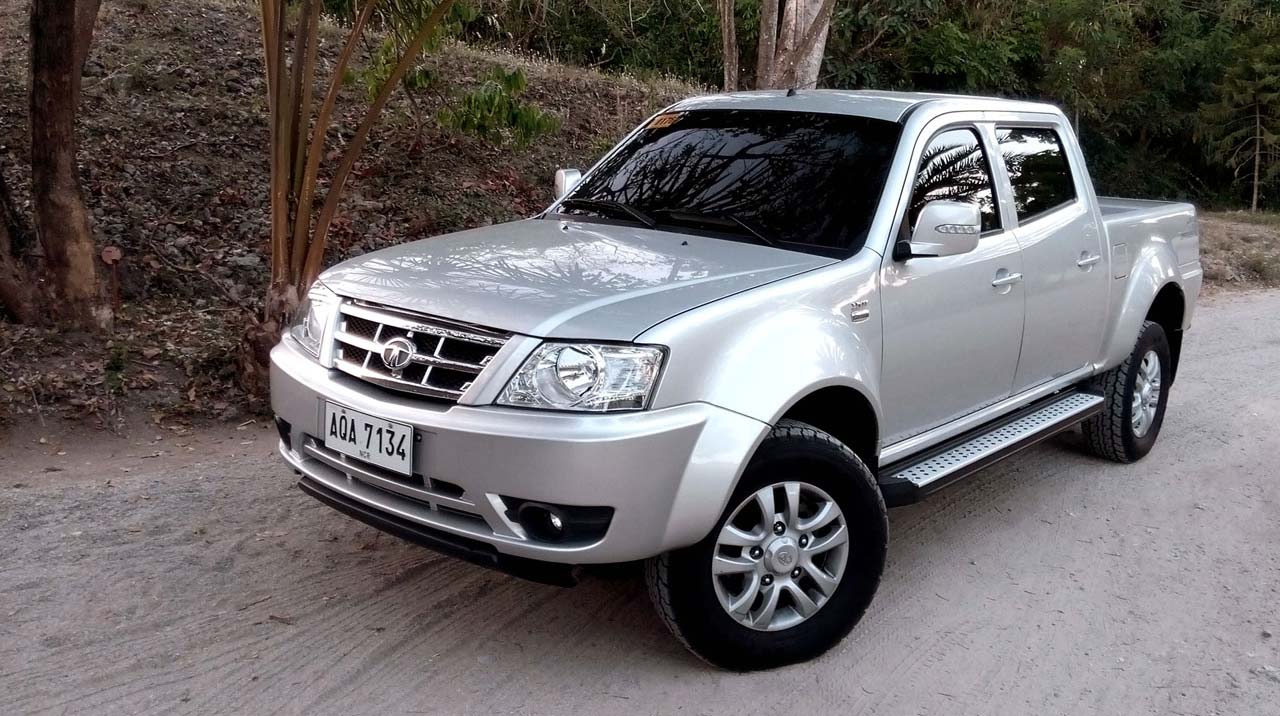
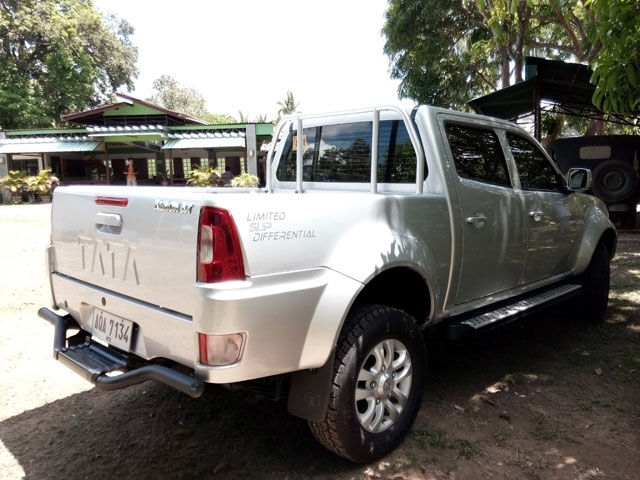
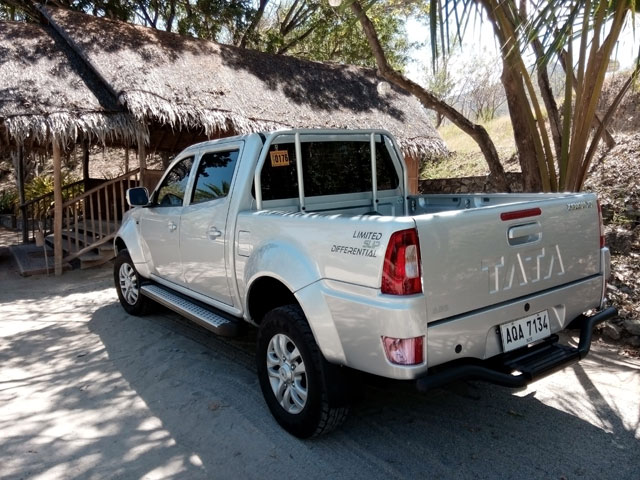
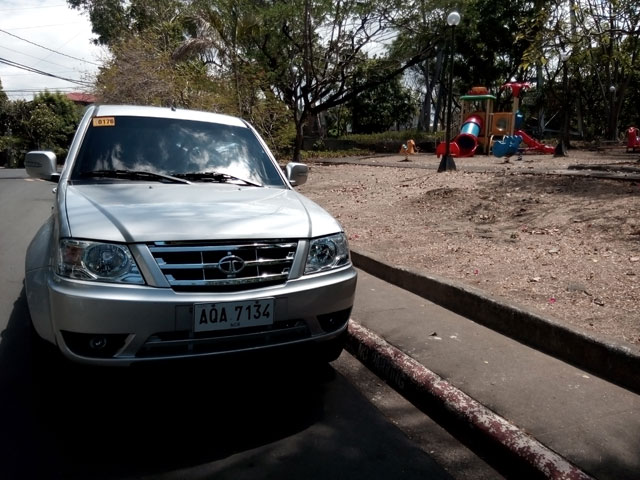
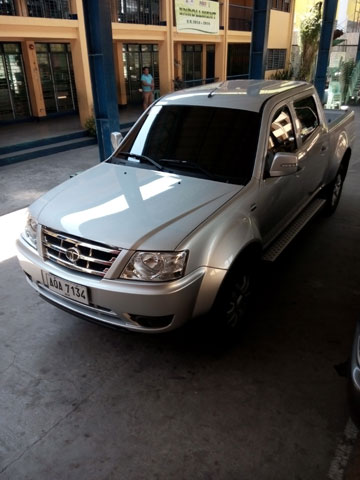
 Now, into this melee, comes Tata of India … and with just two variants. Identical in all respects except for the drivetrain, the Tata Xenon XT 4×2 and 4×4 variants both have conventional 5-speed manual gearboxes, large 16” alloy wheels, are trimmed for mid-range privateer tastes, and ride high with 210mm of ground clearance. It seems that instead of spreading their assets to probe and engage the whole breadth of the market, they’re taking aim at the market’s meaty middle.
 The Xenon’s suspension is old-school tough. Up front are independent double-wishbones sprung by thick torsion bars, in the back, the familiar parabolic leaf spring sets that can be made even stiffer with the addition of more staves (or rendered softer, if that’s your fancy, by taking out some). The coil springs that big brands now use up front, and on the Philippines-spec Navarra even in the back, make no appearance and leave the Xenon’s undercarriage MilSpec durable (torsion bars are the springs of choice on military trucks and main battle tanks).


 Matter-of-fact, with the flywheel storing momentum plus the variable nozzles keeping airflow and compression optimal in the turbocharger even at idle or low revs, you can drive the diesel in the smoothest way I know how: by engaging the clutch fully before even stepping on the gas, by throttling up again only when you have load on the engine, when shifting up after your initial roll-out. Don’t mind the engine revs going back down to idle during shifts. Although the engine won’t then have the energy state to leap instantly into full-burn flight, the variable geometry turbo will nevertheless keep things optimal.


 By April 2012, the BorgWarner-China joint venture was reporting a large and increasing demand for DCTs in the emerging automotive markets of both Europe and Asia. They estimated that the market for DCTs in China alone would grow from 0.6 million in 2012 to 2.7 million units by 2017, growing each year by 35%. Months later, in August 2012, after they had already launched their F5 sedan with the Ti+DCT package that took two years to develop, BYD both admitted that they had problems with supply of the DCTs for their popular vehicles and reported that they had already solved these. Though they didn’t elaborate on their solution, soon afterwards in November 2012 they announced that by the next year, BYD would be putting their own in-house developed DCTs in their vehicles. Then, in 2013, BYD started featuring their in-house developed DCT even on vehicles without high-end turbocharged engines.

 More efficient with the positive contact of the clutch instead of the hydraulics of a torque converter, a DCT must have the programming to discern when to engage or disengage either of its clutches. Unlike an AT that can rely on slippage to cushion both the torque from and the load on the engine, a DCT needs to actively manage the clutch-work, manage the clutch friction. The DCTs programming triggers when to engage the clutch on the first gear and when to transition to the other clutch for an up-shift, when to go back to the other clutch for another up-shift, and so on until the top gear is reached at cruising speed.

 On a day’s drive in the city, the L3 DCT turned in a figure of 11km/l with frequent prolonged stops burning fuel at a rate of 1ltr per hour being offset by the car’s noteworthy ability to move off again and accelerate decently with the engine never exceeding 2,200rpm—this, even with a full family load of two adults and three kids. With a long enough stretch of open road, that 2,200 rpm cap could bring the L3 up to 60km/h where you could settle back at 2,000rpm and remain in 5th gear. At those readings, at 60 in 5th and with 2,000, the trip computer would show current fuel consumption of just 5ltrs per 100km—the equivalent of 20km/l for those few seconds that you can remain at 60km/h on city streets.
 That smooth shifting indicates that the DCTs programming has good routines for toggling between the dual-clutches. But popping the selector out of D and into N, and then back again, while already at cruise, that shows how well the DCT emulates a human driver. Pop her into N to disengage the active clutch, then take your foot off the gas. The car will go free-wheeling and you’ll see the revs settle back down to the 800rpm idling level. All as expected.
 No wonder that the L3’s DCT has an uphill assist feature—it’s absolutely necessary after all, not just a gimmick. What is surprising is the sheer elegance of how the designers will have you activate it. If you’re stopped on an incline and needing to climb uphill, a tried and tested technique on manual gearboxes is to pull up the hand-brake to keep you stationary while you balance you’re clutch and throttle to put torque on the wheels and make them start pushing against the brake. This way, when you release the hand-brake, the car will immediately start inching up instead of down the incline.


 Seen in images without passengers to put it in scale, it’s easy to mistake the WeVan to be as small as the Suzuki SuperCarrry and the Daihatsu HiJet, both popular micro-vans characterized by small wheels and just a second seating row, no third. The WeVan might look to have the same proportions but is significantly larger, though with curiously narrow shoulders.
 The seating layout, though on thin but adequate padding, is generously spaced with deep leg areas as well as expansive seat cushions deeper than the average person’s thighbone is long. These dimensions made for a comfortable slouch if and when the drone of the road lulls you to sleep, as it did for my passenger volunteers both on the trip out and the one back.
 The floor covering is of vinyl, cheesy to some but a real plus for charter service operators and harried heads of families who have to give in to their passengers wanting to take meals on the road. And, of course, there’s always the option of throwing in some rugs for that cozy touch, and for improving the acoustics.
 And, on the hot day that the Saturday had turned out to be, the air-conditioning also made it easy to nod off. The WeVan’s relatively small engine was matched with an A/C compressor impressively strong enough to cool down the large cabin space, particularly with air being circulated through ducted vents with their own blower and controls for the rear.


 And we did! Even with eight people on board, the WeVan gradually accelerated to its published top speed of 130km/h, the engine revving to just over 4,000rpm, sounding throaty but not strained. The fully loaded van remained firm on pavement, no shimmies to alarm or even indicate that we were topped out, and with the wind noise from the outside not at all becoming intrusive.