Suzuki Philippines is putting their hopes of topping last year’s phenomenal 52 percent growth on the all-new Ciaz sub-compact sedan. It’s their first Asia-specific model in a segment resurged by new Uber- and Grab-prompted demand, and it’s the first car model they’ve ever launched with an organized test-drive for the press.
When the Ciaz was introduced in India with its huge two-million strong vehicle market, it stirred things up immediately. The new model was accepted so quickly, and in elegantly de-facto manner, that it picked up windfall demand from the long waiting lists of buyers made impatient by the slow delivery of other, already popular sedans. At the very least, the Ciaz’s entry benefited that market by forcing competitors to speed up production.
Now, with the Ciaz, Suzuki seems determined to cause a similar upheaval here (see ourspecial report). So much so that they’ve now done an organized test drive for representatives from the country’s leading banks. With the resurged demand for sedans hinging on the availability of financing, this latest initiative, another first for them, shows Suzuki making all the right moves with their all-new Ciaz.
Press Statement by Suzuki Philippines Incorporated, “The all-new Suzuki Ciaz captures hearts of test drivers” 2016:
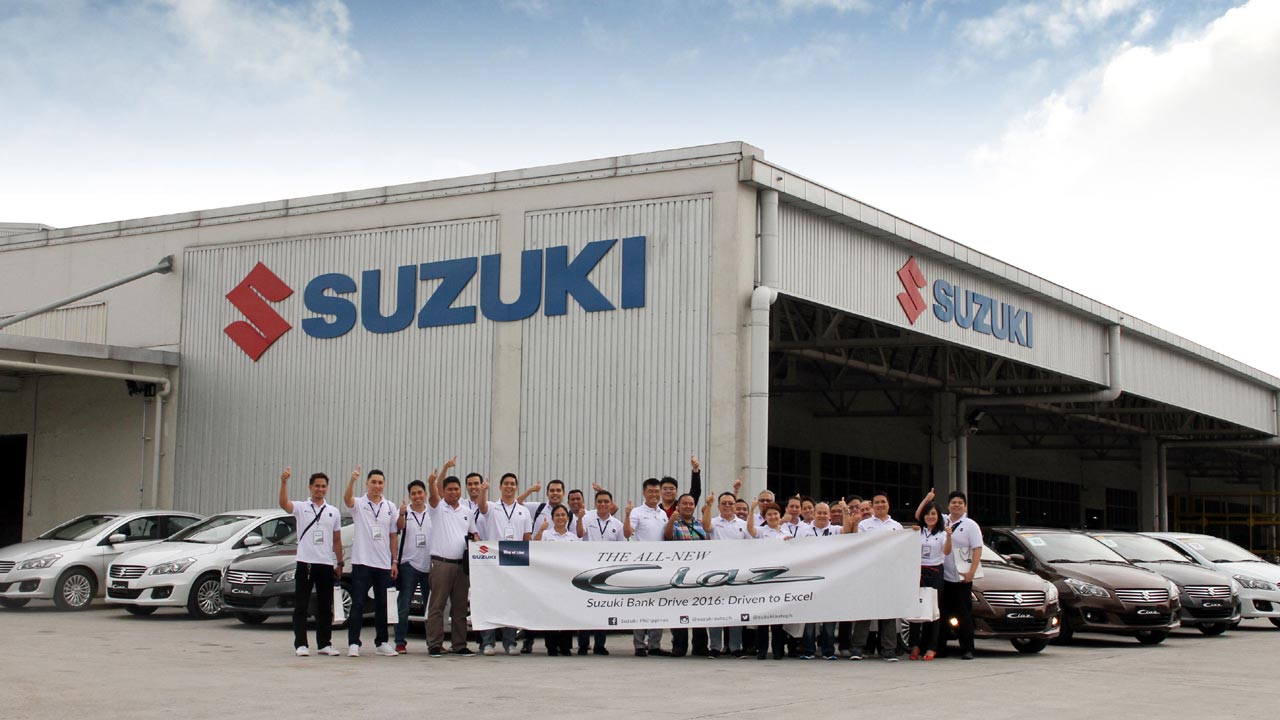
Manila, 05 July 2016—The all-new Suzuki Ciaz, launched in the country last April, has piqued the interest of thousands of car lovers who want to try the next-level comfort and road handling excellence of this subcompact sedan, prompting Suzuki Philippines to hold a test drive for bankers last May 31, 2016.
A total of 27 representatives from the leading names in the banking industry road tested the Ciaz which boasts of best-in-class fuel efficiency, a sporty yet elegant exterior design, and other advanced features.
Suzuki Philippines’ General Manager for Automobile Mr. Shuzo Hoshikura beams with pride over the apparent positive response of the market to the newest member of Suzuki’s B-segment vehicles. “Since the introduction of the all-new Ciaz in April this year, the number of inquiries and request for test drives we have been receiving about this sedan has pleasantly surprised us. With this overwhelming response, we believe that the Ciaz will be one of our bestsellers this year, and contribute significantly to the company’s continuous growth. We hope that with this model as well as all of our other best-loved vehicles, we will be able to top last year’s impressive 52% y-o-y growth,” Hoshikura said.
For more information about Suzuki Philippines and their automobiles, please visit http://suzuki.com.ph/auto/ and like them on www.facebook.com/SuzukiAutoPH, https://twitter.com/SuzukiAutoPH and follow on Instagram at @suzukiautoph.
Like we said, Suzuki is a brand to watch this year. At the recently concluded multi-carmaker fuel-eco run organized by the Department of Energy (DoE) and Petron,the all-new and bigger second-generation Celeriothat Suzuki introduced last year delivered the best efficiency among all gasoline engine cars. Not a surprise since the winning CVT variant of the Suzuki hatchback has the same JATCO CVT7 two-range continuous variable transmission thatgives the 1.2L Mitsubishi Mirage an exceptionally high overdrive gear ratio, and this one on the Suzuki’s slightly smaller 1.0L three-cylinder engine. While thenew Ciaz compact sedan they rolled out just last Marchturned in the best efficiency on a gasoline engine sedan, confirming that this exceptionally big sub-compact is the strong new Uber and Grab car contender that challenges the dominant position of the Toyota Vios.
Press Statement by Suzuki Philippines, Inc., “Suzuki Celerio and Ciaz get top honors at DOE-Petron Fuel Economy Run” 2016:
Manila, 21 June 2016—Suzuki Celerio, one of Suzuki Philippines’ best-selling cars, clinched the top spot for fuel efficiency in the gasoline engine category at the first-ever Euro 4 Fuel Economy Run organized by the Department of Energy (DOE) in partnership with Petron Corporation. Out of the 70 different vehicles from more than 20 different manufacturers that participated last May 27, 2016 in the 280-kilometer run, Celerio gave the best fuel economy performance in a pioneering event aimed at providing vital information on the fuel economy performance of vehicles and raising public awareness on the use of cleaner and more efficient Euro 4 fuels. All of the vehicles used Petron’s Euro-4 quality products.
The DOE, which intends to institutionalize a fuel efficiency labeling program using the results of this test drive as the benchmark, released the results of Euro 4 Fuel Economy Run early this June and recognized all participating car brands with certificates. The program is pursuant to DOE’s aim of expanding the Philippine Energy Standards and Labeling Program’s (PESLP) efforts to include more appliances, lighting systems, and light-duty motor vehicles to strengthen the country’s energy efficiency and conservation efforts.
Suzuki Celerio CVT emerged to have the best gasoline-powered engine after achieving 29.14km/L in the run which stretched from Angeles, Pampanga through the Subic-Clark-Tarlac Expressway (SCTEX) and Tarlac-Pangasinan-La Union Expressway (TPLEX) and back. Aside from the Celerio, the all-new Ciaz Manual Transmission (M/T) likewise topped the fuel-efficiency test in the gasoline sedan category, clocking in at 27.94km/L. Other Suzuki vehicles also participated in the exercise, including Celerio M/T (27.70), Ciaz GLX A/T (22.93km/L), Swift 1.2 (22.35km/L), and Ertiga GLX A/T (22.03km/L).
SPH General Manager for Automobile Shuzo Hoshikura shared, “We are truly proud of the achievement of our top favorite products, the Celerio and Ciaz. This is indeed a great testament to our commitment to bring the highest quality and most fuel efficient vehicles in the market. Recognitions like this inspire us to continue developing and manufacturing premium and reliable cars.”
Celerio features an A+ compact build which is based on the “small on the outside, big on the inside” concept. It sports the dynamic and easy-to-maneuver design Suzuki compact cars are known for, while offering spacious room for passengers, relatively huge luggage capacity and great fuel efficiency.
The newly rolled out subcompact Ciaz, on the other hand, blends sportiness that conveys the expectation of driving and a stunning feeling of elegance. Its name stands for “City from A to Z,” capturing the essence of Asia’s fast-growing metropolitan landscape. It is packed with best-in-class fuel efficiency and other advanced features coupled with a sporty, elegant exterior design and refined interiors.
For more information about Suzuki Philippines and their automobiles, please visit http://suzuki.com.ph/auto/ and like them on www.facebook.com/SuzukiAutoPH, https://twitter.com/SuzukiAutoPH and follow on Instagram at @suzukiautoph.
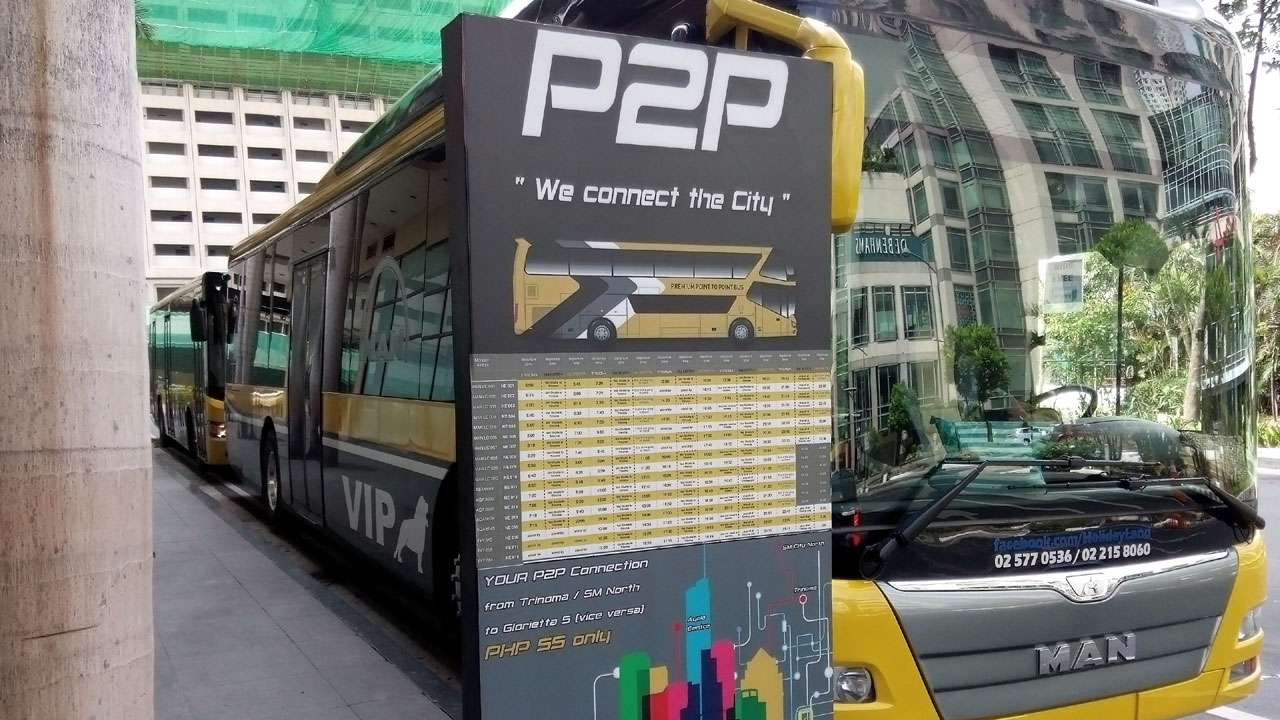
The point-to-point (P2P) premium bus service that operated temporarily during the last holiday season is back in operation, offering an upscale though roadbound alternative for commuters taking the MRT line from North EDSA in Quezon City to Ayala Avenue in Makati City, or vice-versa. It’s an express service with no stops between Trinoma Mall in Quezon City and Glorietta 5 in Makati, at terminals within view of the MRT North EDSA and Ayala Avenue stations, respectively.South-bound buses to Makati City depart from the Trinoma terminal from 5:00AM to 11:15PM daily. North-bound buses to Quezon City depart from the Glorietta 5 terminal from 5:45AM to 1:00AM the next day. Intervals between departures from either terminal range from 5 to 30 minutes (at some point as much as 60 minutes), depending on the time of day.
Location of Trinoma terminal at North EDSA, Quezon City
Compared to the P24.00 fare for the North EDSA to Ayala Avenue stretch on the MRT, the P2P bus costs P55.00 each way on weekdays, P40.00 on Saturdays, and P35.00 on Sundays and holidays. And, compared to the 30 to 45 minutes on the MRT, the bus ride on surface roads could take from one to one and a half hours, depending on your route direction and the time of day. Expect a slower transit during morning and evening rush hours.
Location of Glorietta 5 terminal in Ayala Center, Makati City
And yet, the upscale bus service could be worth it for folks seeking to avoid long queues on the MRT and who could use the longer bus ride to catch up on light work or get some recharging rest. The P2P bus service has shorter queues than on the MRT (even non-existent, for now) and offers tourist-grade reclining seats and climate control.
The Trinoma terminal is at the road between the mall and the MRT station, accessible through stairs going down from the MRT’s North EDSA terminal platform. The Glorietta 5 terminal is on the side opposite to the one facing Ayala Avenue.
The imperative to lower emissions on California’s inter-city freight routes is being addressed by the Siemens and South Coast Air Quality Management District (SCAQMD) project to complete a grid of overhead electric tracks on Interstate 710. With overhanging electric runners (much like those used for electric commuter trains) running along the route between the ports of Los Angeles and Long Beach, heavy to medium trucks plying the route can now have zero-emissions electric powertrains. To complete the system with a similar drayage solution (short freight carrying segments at the start or end of the delivery run), the SCAQMD now taps another company, BYD, for a demonstrator project that will utilize electrics for initial freight gathering or subsequent distribution in cities.
Press Statement by Solar Transport & Automotive Resources (STAR) Corp., “US taps first pure EV trucks from BYD,” 2016:
BYD, the global leader in cutting-edge rechargeable battery technology as well as traditional fuel-powered and new energy vehicles, has been tapped to participate in the South Coast Air Quality Management District (SCAQMD) zero-emission drayage truck development and demonstration project.
The State of California will award $23.6 million to the SCAQMD for the project in the hope of reducing key criteria pollutants and accelerating the commercialization of heavy-duty advanced, zero-emission technologies, in line with SCAQMD’s clean air plan.
The project will also serve as a statewide demonstration of 43 zero-emission battery electric and plug-in hybrid drayage trucks serving major California ports in the Bay Area, Sacramento, San Diego and San Joaquin Valley.
This is the first large-scale demonstration of zero-emission Class 8 trucks from manufacturers led by BYD. The companies selected for the undertaking have the engineering resources, manufacturing capabilities and distribution networks to support commercialization of advanced technologies related to moving freight to and from the ports. The project is also expected to provide emission reduction benefits in key areas of California with drayage truck activity.
“BYD is proud to work with the California Air Resources Board, South Coast Air Quality Management District and our fleet partners to advance clean, battery-electric transportation solutions in communities where it is needed most,” said Stella Li, president of BYD Motors. “BYD is a worldwide leader in battery technology and as the OEM providing the most battery electric trucks under this solicitation, I believe other fleets will take notice and recognize that battery-powered drayage trucks are reliable and available for wider deployment today. We look forward to celebrating the delivery of our first battery-electric drayage truck in the fall of this year.”
“This project will help put the very cleanest short-haul trucks to work where they are needed most, moving cargo from the state’s biggest ports to distribution centers and rail yards,” said ARB Chair Mary D. Nichols. “This is good news. It means cleaner air for all Californians, but especially those who live in neighborhoods next to these industrial facilities or along some of our state’s busiest trade corridors.”
“This unique collaborative effort will accelerate the commercialization of advanced zero emission truck technologies that are vital to improving air quality in communities near our busy freight corridors,” said Joe Buscaino, Los Angeles City Councilman and SCAQMD Board Member. “Cleaner truck fleets on our roadways are important for air quality and climate goals, and essential to protecting public health.”
In the Philippines, BYD vehicles are distributed by Solar Transport & Automotive Resources (STAR) Corp. For more information, visit www.byd.com.ph.
Built thick and rigid, and powered by a truck’s turbodiesel, the Tata Indigo subcompact sedan is the heaviest in its class. She sounds like a minibus gone throaty, but she’s fast, and she’s nimble. Her undercarriage engineering harks back to when front-wheel-drive was still a new, premium layout–something to make the most of with independent suspension in front, and in back. She’s what you’d look for when robustness matters more than mere refinement.
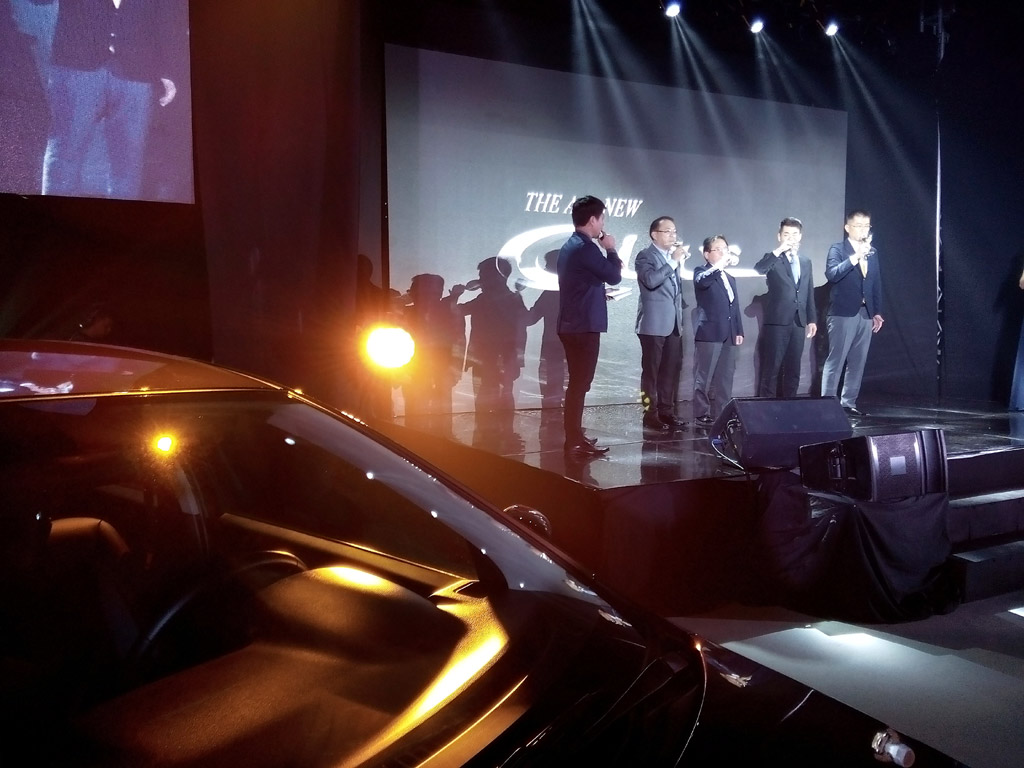
The all new Suzuki Ciaz compact sedan was formally launched at a press event this week, even while MIAS 2016 was still firmly in the news cycle. The new model is Suzuki Philippines’ first in the compact sedan category and marks their breakout from the small car niche that made them the growth leader in 2015 with a 52% year-on-year increase attributed mostly to passenger car sales (see our commentary to their press statement on this). Designed in Japan specifically for the Asian market, and introduced globally in 2014, the Ciaz has already made an impact in other emerging markets, particulary in India where Suzuki had dominated the market with their small car offerings as well. The significance of the new model intro was evident from the large audience turnout, with word on the character of the Ciaz already having gotten out after Suzuki Philippines’ media preview drive last month, the carmaker’s first such organized mass driving event for a car model (see our special report on the Ciaz preview). As promised by Suzuki Philippines at that event, after showroom displays to take in advanced orders in March, stocks are now in and April sees the full commercial launch of the all new Ciaz.
Press Statement by Suzuki Philippines Incorporated, “City Driving from A to Z: Suzuki’s latest Ciaz sedan brings innovation and next-level driving experience for Filipino drivers,” 2016:
Manila, 13 April 2016—Rolling in style just got more comfortable and fuel-efficient, as Suzuki Philippines today officially launches the much-awaited Suzuki Ciaz, a sub-compact sedan ideal for the sensible Asian market. The Ciaz comes in three model variants: the GL Manual Transmission, GL Automatic Transmission, and the premium GLX.
Last March 9 to 10, 2016, 30 motoring media members experienced next-level comfort and driving with Suzuki’s newest innovation through a pre-launch 235-km round-trip drive to and from Anilao, Batangas. The media experienced first-hand the automotive innovations of the Ciaz through the test drive, with stopovers at the Suzuki Auto Sucat, Total Service Station Sucat, Nuvali, Tagaytay, and the Aiyanar Beach and Dive Resort Batangas. This test drive showcased the capabilities of the Ciaz in handling stop-and-go traffic, highway driving stability, mountain pass handling and passenger comfort.
Ciaz is more than a snazzy name for a sleek new sub-compact: it stands for “City from A to Z,” capturing the essence of Asia’s fast-growing metropolitan landscape. The latest addition to Suzuki’s stable of reliable vehicles, the Ciaz is packed with best-in-class fuel efficiency and other advanced features coupled with a sporty, elegant exterior design and redefined interiors.
Driven to excel
The new Ciaz is made for those who are driven to excel. It is developed as an “authentic sedan” which combines a roomy comfortable cabin and a great driving performance with excellent fuel efficiency. All of this comes with a stylish design that will inspire pride of ownership.
Best-in-class fuel efficiency
With recent unpredictable fluctuations in gas prices, the typical Filipino driver in the market for a new car is always on the lookout for a model that promises impressive fuel economy.
One of the features contributing to the Ciaz’s impressive performance is the integration of transmission technology used in the Suzuki Ertiga. In the GL Automatic and GLX models of the Ciaz, the four-speed automatic transmission improves fuel-efficiency and optimizes driving performance.
The car’s body is also smartly designed and shaped to facilitate smoother airflow, which in turn contributes to fuel efficiency. The front and rear bumper corners, front grills, underbody, and trunk lid-end are the product of meticulous research and development to achieve optimal results.
Advanced features
The Ciaz also comes with a variety of advanced features that make driving a truly easy and enjoyable experience. The multimedia integrated audio unit comes with an Android touchscreen for the GLX, complete with Bluetooth and USB connectivity for personal devices such as tablets and smartphones. This innovative multimedia unit comes with wireless connectivity and preloaded applications, such as YouTube, Gmail, Facebook, and the Filipino driver’s go-to app, Waze.
Audio and hands-free connectivity control switches are also embedded in the steering wheel, which facilitates easy access to various tasks. Add these to the keyless push start system and remote, and the Ciaz delivers a hassle-free driving experience for busy urbanites.
Roomy Luxury
Bridging the gap between Suzuki’s compact models and standard sedans, the Ciaz combines the best of both worlds: great fuel efficiency and ample space. This sub-compact sedan has bigger door cutting, which increases the amount of rear seat leg space, headroom, and shoulder room.
Rounding out the spacious interiors is the equally spacious trunk, which has a luggage capacity of 495 liters, and can be closed with an electromagnetic latch and features a convenient boot light.
Optimum safety
At the core of the Suzuki Ciaz is the patented Total Effective Control Technology (TECT), which boosts driver and passenger protection through a light yet incredibly strong impact absorption system. An Anti-Brake Locking Technology is also in place, preventing the brakes from locking during instances of sudden braking. This technology distributes braking force efficiently to the front and rear wheels to prevent accidents.
With all these features, the Ciaz is a surprisingly affordable option for urban drivers. The three models clock in at the following price points:
– Ciaz GL Manual Transmission at P738,000.00
– Ciaz GL Automatic Transmission at P773,000.00
– Ciaz GLX at P888,000.00
For more information on the Suzuki Ciaz, please visit http://suzuki.com.ph/auto/ and like it on www.facebook.com/SuzukiAutoPH, https://twitter.com/SuzukiAutoPH and follow on Instagram at @suzukiautoph.
At the recently concluded Manila International Auto Show (MIAS), Tata Motors Philippines was intent on setting the record straight.
Speaking at the press brief, Tata Motors Head of International Business for Commercial Vehicles Mr. Rudrarup Maitra
Sounding exotic enough to be typecast as oriental—as originating from East or Southeast Asia—Tata has often been mistaken as coming from South Korea, Malaysia or China. But last April 7, at their MIAS opening day press show, they reached every corner of the large World Trade Center exhibit hall with the sound, if not the scenes, of their audio-visual presentation that declared Tata as a brand from India. Tata is the biggest local automotive manufacturer in India with sales of 494,000 units in 2015. Put in perspective, that number is 64% over and above the 300,000 vehicles sold in the Philippines last year.
Tata Ace “Rescue Boy” first-responder vehicle
Tata Motors Philippines exhibited nine vehicles at MIAS: six commercial vehicles and three passenger cars. Ironically, the mix reflects Tata’s automotive sales structure in India, their trucks/buses volumes outnumbering their passenger cars sales more than two to one. Of their nearly half million sales in 2015, 360,000 were in commercial vehicles and 134,000 in passenger cars—so, a truck maker, among the biggest in the world, and more recently a passenger car manufacturer.
From small to large, the six trucks showcased were several variants each of Tata’s Ace micro- and Super Ace light-trucks, their Xenon 4×4 pick-up, and their Prima heavy duty truck in tipper configuration. These surrounded the three passenger cars arrayed in the center of their MIAS pavilion: the compact Manza Aura sedan and Vista Ignis hatchback, both with newly developed body kits that could soon be introduced here, and the sub-compact Indigo sedan in taxi-cab livery.
The Tata Ace food truck
This is the third consecutive year that Tata Motors has participated in MIAS. Referring to the Ace micro- and Super Ace light-truck offerings, in particular, Tata Motors Head of International Business for Commercial Vehicles Mr. Rudrarup Maitra said: “MIAS 2016 is an excellent platform for Tata Motors to showcase our extensive line-up of offerings which have been specially designed keeping the Filipino customer in mind. The products on display today, offer maximum value for its customers and are built based on extensive customer feedback. With new-generation products like the currently showcased Prima and Super Ace, we at Tata Motors are geared to cater to the evolving needs of the Filipino customer. “
Exhibited were Ace micro-trucks in rescue and food truck configurations. The Ace Rescue Boy was developed to be a first responder vehicle featuring a patented roof boat system atop a passenger structure kept light with mostly aluminum components. In contrast, the Ace Food Truck’s rear body is constructed of rust-resistant stainless-steel that unfolds/expands into a spacious kitchen counter for secure transport and quick deployment into safe, stationary service. The variants are built with Ace cabs and chassis brought in direct from India and featuring a remarkable 702cc two-cylinder diesel engine that delivers 16hp through a rugged 4-speed manual gearbox.
The larger Super Ace light-truck offerings featured passenger rear bodies built by Centro to Tata Motors specifications. There was the passenger van, a high-riding, dual AC transport with jeepney-style side-facing seats that could accommodate 14 people in the rear, and the Ace in school bus configuration with a rear body featuring mandated front-facing seats and a curb-side door. The Super Ace light-truck is more of a mainstream inter-town transport with a rugged 1.4L turbodiesel with conventional yet also more reliable indirect fuel injection.
Kuya Kim speaks for Tata
The Tata Xenon XT 4×4 mid-size pick-up was exhibited with an aftermarket sports bar and roof mounted fog lamps to highlight how the solid utility vehicle may readily be rendered more aggressive, more sporty. To be launched this year is their Prima heavy truck in construction dump-truck configuration but which, in tractor-truck form, also figures in Tata’s T1 truck races in India.
Gracing the opening of the Tata Motors pavilion on day one of MIAS was Kim “Kuya Kim” Atienza who underscored how the carmaker’s history in rugged utility vehicles pervades even their newer, lighter truck and passenger car models. In his words, an equation: “Tibay, tiwala, Tata.”
Suzuki is a brand to watch this year. Last month, they reported record sales for 2015, delivering top year-on-year growth numbers of 52% that they’ve attributed mainly to their passenger car segments, particularly that of their recently up-sized Celerio hatchback. Now, after teasing it since last December with official statements and prime rush-hour billboards aimed at media and motorists alike, they’ve unveiled the Ciaz, their first sub-compact sedan for this market, with a first-ever mass test-drive event for the motoring press.
Introduced globally in 2014, the Ciaz is a new model line, a sub-compact sedan meant to fill that wide gap between their small car Alto, Celerio and Swift offerings, and the much larger, far more premium 2.4L Kizashi mid-size sedan they had fielded in the past. Although there was the SX4 sub-compact sedan that they introduced in other markets (the platform of the CX4 crossover being offered here), the EU-sourced design (developed by Suzuki in partnership with Fiat) imposed cost penalties that had boxed it out of this region’s markets.
On Suzuki’s first-ever mass test-drive event for the press
Enter the Ciaz, unveiled here with Suzuki’s first-ever press drive event held last week. It’s configured into two trim levels, the standard GL and the premium GLX, with GL’s coming with either a 5-speed manual transmission or a 4-speed automatic, and GLX’s just with the AT gearbox. It’ll be hitting showrooms this month for taking early reservations, with first deliveries happening in April.
The name standing for “[the] City, from A to Z,” Suzuki asserts the Ciaz to be their first sedan designed specifically for Asia. And the press drive (a 235km round-trip to and from Anilao, Batangas with the top-spec Ciaz 1.4L GLX AT) revealed the new model to be deliberately engineered for what apparently, in Suzuki’s estimation, is a very sensible Asian market.
Asian specifics
For several years now, the Maruti-Suzuki partnership has held onto its huge share (46% in 2015) of India’s 2.6M-vehicles passenger car market. They’ve been unassailable, although mainly just in the small passenger car segments. When the Ciaz was introduced there first, the response was so good that it picked up some windfall demand from the long waiting lists of buyers grown impatient with slow delivery of other, already popular sedans. If not for anything else, the Ciaz’s entry did benefit the Indian market by forcing competitors to ramp up production and get their cars to market faster—free-market competition at its best.
And the Ciaz’s features, its engineering, promises to cause more of the same even here, in the much smaller but disproportionately complex Philippine market. Here, with sedans that are anything but crossover in a market gone crossover-crazy, where that classic three-box form has been stretched in other ways for multi-role-utility and bad-roads-durability, the new Ciaz appears to hit all the new, sensible sweet-spots.
Multi-role and modern
With prices at P738K for its standard GL trim with manual gearbox, P773K for the GL with automatic gearbox, and P888K for the top spec GLX AT, is Suzuki positioning the Ciaz as an Uber or Grab car candidate (to rival the Toyota Vios, Hyundai Accent and Kia Rio)? That would be a big “YES” says Shuzo Hoshikura, General Manager for Automobile Suzuki Philippines.
Lunch stop at Tagaytay on the Suzuki Ciaz media drive to Anilao Batangas
Uber and Grab pitches have spurred buyers into becoming sedan owners, to have these become family cars in more ways than one. That old impulse buy no-no has been usurped by boilerplate business plans promising car ownership that pays for itself. Of course it’s a pipe dream that takes much driver-hours and risk-management to make happen, but it’s been compelling enough to force carmakers to informally screen their buyers, in a sense making them pause for some much needed introspection. In any case, the trend has resurged demand for sleek new sedans.
High off the ground
With road conditions being unreliable the further you go out of town or, ironically, deeper into the inner-city, the ownership math has become more complicated with climate change now the new reality. New vehicles are seen through a filter of foreboding, visualizing how these would fare on roads disappearing under floodwaters that eventually retreat but then leave potholes in their wake. It may ring paranoid but it’s something that car builders seem to pay attention too these days.
Things underneath have gotten bigger, all the better for handling distressed and distressing road conditions. Ground clearance numbers have gone back up to 1950’s levels; the Ciaz’s minimum ground clearance of 160mm appears to subscribe to hard earned doctrine (particularly from India) that specifies this as the minimum number for clearing rough-road hazards.
If they had gone up to 170 or 180mm, they’d be in high-rider country, even better for soft-roading jaunts, not so good, though, for keeping the car’s center of gravity low and for retaining a sedan’s trademark handling. That 160mm seems just right to keep the undercarriage clear of obstacles while staying low enough to also keep the wind from getting under its skirts. As it is, that gap under the front bumper is small enough not to defeat the aerodynamic down-force of the Ciaz’s sloped hood when the the everyday commuter is kicked up into a fast-mover.
Big rollers
The Ciaz has wheel options, depending on variant, for either 195/55R16 or 185/65R15 tires, yielding overall diameters of 621 and 622mm, respectively. This gives it wheel diameters second only to the 622 or 628mm available on the Mazda 2.
Final gear ratios on current-model drivetrains are being specified to accommodate wheel and tire combinations for diameters of at least 600mm. Besides the effect of making vehicles look more muscular, large wheels make for gentler transitions, call ’em steps, onto and back down from bumps, or down into and back on up from holes.
Driving over grossly misaligned seams in concrete slab roads, the Ciaz seems to shrug off the affront, emitting no more than a low dull thud where other cars had complained with reverberations that drummed on through the hood. The Ciaz’s aloofness should be credited as much to those big wheels as to its plush insulation.
Biggest, but also the lightest
At 4.49m long and 1.73m wide, the Ciaz has the biggest footprint in the sub-compact sedan category, a class it shares with the likes of the Toyota Vios and the Hyundai Accent. So it’s big on the inside because it’s big on the outside, no surprises there. And yet, the Ciaz being the largest in the bunch seems to not come with any penalties. It manages to remain the lightest with 1,010 to 1,040kg of curb weight, depending on the variant. This means it’s lighter though better powered than the mainstay Toyota Vios’ 1.3L variants.
To somewhat test the notion that maybe the Ciaz’s weight is the result of some creative cut-backs in metallurgy, I popped and tried to lift the hood with as few fingers as possible. Going by number of fingers to measure the density of the metal, two fingers being the least I’ve ever needed, the Ciaz’s bonnet took all five fingers on my right hand, needing my good arm to swing it up and fully open. The Ciaz, at least its hood, is into heavy metal.
Long, all-important wheelbase
What really takes the cake is that the Ciaz has the longest wheelbase among them all with 2.65m between front and rear axle centers (5cm longer than on its closest rival, 10cm longer than on the market leading Toyota Vios). That long span between front and rear axles means generous people space between intruding wheel shrouds. So, even with front seats slid back fully, legroom in back is generous enough to swallow up both grown ups and overgrown adults. Its turning radius, although enlarged by the long wheelbase, remains within city tolerances at 5.4m … sedan-like and still smaller than on minivans and SUVs.
Turning to things sporty, that long wheelbase translates into better stability in fast turns. Observe what Porsche has done with its active steering innovation. The automated system turns the rear wheels a few degrees into a turn at over 50mph, this to lengthen the wheelbase virtually. The result on their active-steering-equipped 911 GT3 is to shorten its best lap time by half a second. That’s how important a long wheelbase can be even when pushing back the limits under race conditions.
A common enough powertrain
In other markets, the Ciaz’s specs include options for 1.2L and 1.6L gasoline engines as well as a 1.3L Fiat-sourced turbodiesel, and for a modern CVT transmission. But here, Suzuki Philippines opted just for the 1.4 liter K14B inline 4 VVT gasoline engine with manual or automatic gearbox options. It simplifies matters, specifying a powertrain that’s already been proven both by their popular Swift hatchback and their award winning Ertiga MPV.
The Ciaz’s K14B delivers 92hp at 6000rpm and 96lb-ft at 4000rpm. Suzuki global says this engine version has a new cylinder head and piston crowns for better thermal efficiency to achieve an 11:1 compression ratio. Nonetheless, this new K14B shares a majority of its crankshaft and cylinder block parts with same-series engines in other Suzuki models. The same could be said of the manual or automatic transmissions mated to the engine. Same as in other models but with gear ratios specially tuned to the Ciaz’s power and mass mix.
All told, this would simplify the replacement parts inventories that Suzuki or third party vendors would be investing in, and would actually leverage the technical skills that Suzuki or other service providers already have to provide essential maintenance for the new sedan’s powertrain. This brings Suzuki closer to the long game of the big brands in the Philippine market, closer to marques like Toyota, Mitsubishi and Nissan.
Smooth and smart
These said about the Ciaz’s engine and transmission options being prudent choices for the logistics of keeping the new sedan in good repair, about these being common and therefore easily maintained components, I’d point out (and very quickly, too) that the powertrain has some exceptional attributes as well. For one, the torque converter on the Ciaz’s transmission has the smoothest uptake I’ve ever felt on an AT gearbox.
After popping the selector from D to N whenever I stop in inchworm traffic, I always step on the brake before putting it back into D in order to catch and dampen that trademark jerk of the torque converter engaging. On a whim, though, I tried the sequence on the Ciaz without stepping on the brakes and, well, there was no jerk. There was this gentle tug that quickly built up only after the sedan started to roll. It’s the kind of drive onset I’d credit to an auto-clutch set up, like with an AMT or on a DCT gearbox.
What’s more, I don’t think it’s because the torque converter has a high stall threshold that permits significant slippage as some form of fluid gear reduction. Rolling out and keeping revs pegged at 2000rpm will accelerate the Ciaz smartly up to an 80km/h cruise. No need for a rev surge to first bring revs up to something like 2500rpm before gradually bringing it down to 2000rpm as the car nears cruise. So, no, Suzuki doesn’t seem to have taken shortcuts with the AT gearbox, no exploitation of excessive slippage to gain more torque.
And the upshifts or kickdowns? Real smooth. The powertrain is demonstrably well matched to the Ciaz’s mass (this, even with a 4-speed automatic gearbox that any old-school stick guy would think a concession for convenience). She isn’t a sport anything, nope, but she’s a right smart mover. First and second gears on the AT gearbox felt conventional, not too short at all but rather, if anything, a little tall. Third and fourth? Yes, most definitely tall. The top gear has a seriously tall overdrive ratio that requires and triggers a kickdown if you stomp on the gas at speeds below 100km/h.
Path of least resistance
The Ciaz makes the most of a sedan’s long sleek silhouette, with lines blending gently upwards and down again to encompass the cabin bubble. Wind noise is minimal at 100km/h and air resistance seems to be well managed with the mediocre 1.4L power-plant turning at an acceptable 2250rpm with three people and luggage on board.
I got back-handed confirmation of the Ciaz’s sleek aerodynamics when we cracked open a rear window while we were at fast cruise. The break in the Ciaz’s otherwise smooth aerofoil shape caused significant turbulence, manifesting in this pulsating concussive force you could feel through your ear-drums, rhythmic percussion apparently being hammered in by shockwaves forming around the open window on the trailing end of the cabin. Open window, thrumming eardrums; closed window, not a peep. That’s how much wind resistance the Ciaz manages to slip blithely through when it’s all buttoned up.
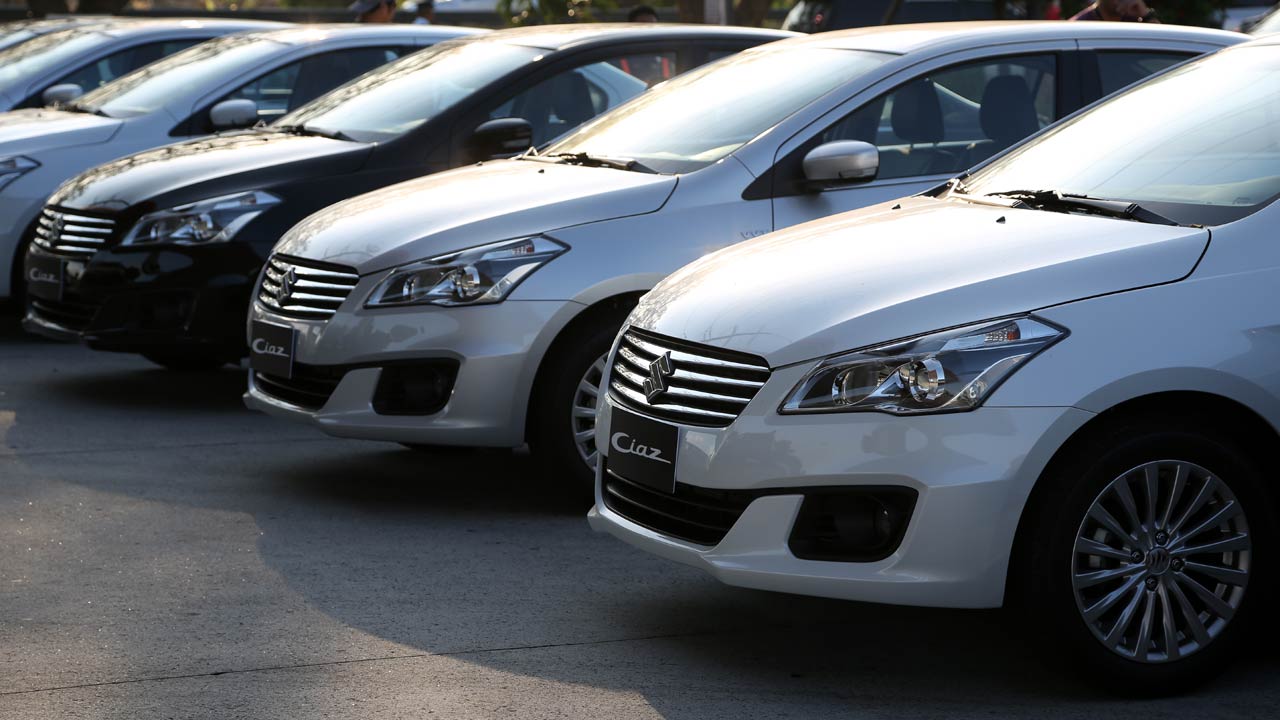
About styling, I’d say the Ciaz is handsome, and elegant. She isn’t overwrought with flourishes that have no apparent function, but instead has the lightest of touches to soften its edges, yet also has fun with false vents that give it a sporty air, making its business ends, both of them, edgy. It’s like being asked what the weather is like, on air, on Good Morning Vietnam: open a window and see for yourself, why dontcha. Just take a look at her in the pics. She’s a proper looking sedan, svelte and smooth on the necessary angles, no pointless features that’ll make her cloying and insipid after a few months, simple enough to eventually become a classic. And that alone could spell success in terms of resale value.
With this new model, Suzuki starts down a path that could make it as big and as mainstream as the popular, everyday sedans that the Ciaz now competes with. If Suzuki’s competitors don’t pay attention, the Ciaz’s pitch could be as frictionless as its aerodynamic body, slipping in and hitting the spots where the competition have left themselves exposed with design, engineering and business choices that are off the mark in today’s complex market.
The all-new third-generation model for the Honda Pilot, was launched by Honda Philippines in February 2016, a year after it had been unveiled at the Chicago Auto Show. With all units worldwide being manufactured exclusively in Lincoln, Alabama, Honda Philippines ships in the new Pilot straight from the US, their offering picked right off Honda’s catalogue for North America.
Honda Cars Philippines’ Toshio Kuwahara launching the third generation Pilot
Although the Pilot, from the very first generation to its third, has attained both critical acclaim and commercial success in the US, the premium mid-size SUV hasn’t been as popular in the Philippines. It’s in a niche above that of popular Toyota Fortuner, Mitsubishi Montero Sport, Isuzu Mu-X and Mazda CX-9 SUV models, though below luxury mid-sized offerings like the Lexus LX570. Yet this hovering between categories hasn’t lent the Pilot enough distinction to pop up on the radar of prospective buyers. If anything, the previous generations’ burly looks and premium though not-quite-luxury price points, had set the Pilot apart not from the competition but from other Honda models.
So, ironically, while the new Pilot comes loaded with an impressive array of engineering innovations, what is immediately notable about this third generation model is something that, on hindsight, was a long time in coming. For this iteration, this time around, the Pilot finally brandishes a design language that reveals its affinity with other things sporty, utile, and Honda … particularly in the Philippine setting.
Design Language
A three-row 8-seat mid-size SUV, the Pilot (badged the MR-V in the Middle East) is big brother to Honda’s popular two-row 5-seater compact CR-V. And yet, all this time, there’s been this disconnect between the two SUV models.
Large for a crossover in the Philippine market where traditional body-on-frame construction is prevalent among utility vehicles, sporty or otherwise, the Pilot actually blends in among the many unibody models in other markets. In fact, even in the Philippines, the Pilot’s gasoline engine, FWD or AWD drivetrain, and supple suspension under a unibody fuselage are similar to those of, should be familiar because of, Honda’s popular CR-V and their Odyssey mid-size MPV. It hasn’t been perceived that way, though, and all this time it’s been because of aesthetics.
1st generation Pilot
The Pilot’s size and angular build made it look out of place in Honda Philippines’ line up, prompting observers to file it away as esoteric, its boxiness making it interesting only to those wiling to go out-of-the-box. Introduced a year into the lifespan of the second-generation CR-V, the first-gen Pilot did look a bit like that 2002 redesign of the smaller SUV. But the similarities ended there. After the third-gen CR-V was introduced in 2007, the Pilot apparently went off on its own design fork entirely.
But the Pilot had actually inspired Honda’s development of the Ridgeline, their radical crossover redesign of the traditional pick-up truck format. So, in a twist of reverse-engineering, Honda had arrived at that place populated by most other brands that had common platforms underneath their pick-up truck and SUV models—reversed in this case because Honda’s crossover SUV came before the crossover sport-utility-truck, or SUT.
The Pilot and Ridgeline SUV/SUT tandem would’ve projected a powerful message—hitting well-known and closely-knit categories while pushing innovations in unibody engineering and application. No surprise that the models that ended up referencing each other’s designs were the Pilot and the Ridgeline, through the Pilot’s first and second generations and the Ridgeline’s several first-gen facelifts.
2017 Honda Ridgeline Sport Utility Truck
Problem is, Honda Philippines doesn’t carry the Ridgeline. On its own, without its truck sibling to back its pitch of innovative rethinking, the Pilot remained almost as much a stranger to this market. So, the seemingly standalone Pilot has been an acquired taste, a Honda only to bold aficionados. Now, finally, things are getting sorted out in a next-generation cascade.
The third generation 2016 Pilot references the design language of the fourth-gen 2012 CR-V which got a facelift only last year. And, the front fascia of the upcoming second generation Ridgeline SUT is now clearly influenced by both the Pilot and the CR-V. End of the day, and suddenly, all three siblings now look alike, and the Pilot, big-brother to the friendly neighbourhood CR-V, now looks the part … it’s finally back in good company despite third brother Ridgeline still not making it to these shores.
Engineering
The new Earth Dreams 3.5L V6 J35Y6 i-VTEC with direct fuel injection
The new Pilot again comes with Honda’s award-winning J-series 3.5L V6, though now with the new Euro4-compliant J35Y6 Earth Dreams engine delivering 280hp @ 6000rpm and 262lb-ft @ 4700rpm. The improvement over the 250hp and 253lb-ft of the previous generation’s J35Z4 engine is brought by the new computer-controlled direct fuel injection system (versus the old port injection set up) with multi-hole injectors that now complements the engine’s i-VTEC variable intake valve timing and lift system and its VCM variable cylinder deactivation mechanism. Based on US EPA tests, fuel economy is as you’d expect on a 3.5L V6 but slightly improved at 7.7km/l in city traffic and 11.05 on the highway with an AWD 6AT drivetrain.
2016 Honda Pilot AWD powertrain
The 2016 Pilot also features new drivetrain options: the new standard 6-speed AT gearbox replacing the previous generation’s 5-speed transmission, and the high-performance ZF 9-speed AT first used on the Honda Acura which is now also featured on the Pilot’s top-spec variants.
Gear
2015 Pilot 5AT
2016 Pilot 6AT
2016 Pilot 9AT
1st
2.697
3.359
4.713
2nd
1.606
2.095
2.842
3rd
1.071
1.485
1.909
4th
0.766
1.065
1.382
5th
0.612
0.754
1.000
6th
—
0.556
0.808
7th
—
—
0.699
8th
—
—
0.580
9th
—
—
0.480
Final Ratio
4.312
4.250
4.334
With first gear ratios on both the 6- and 9-speed gearboxes made deeper than those on the 5-speed transmission of the previous generation, it’s clear that the new torque converters have a lower stall speed, a lower tolerance for slippage between drive impeller and rotor. This explains Honda’s claim of earlier, more efficient clutch lock-up on the new generation’s transmission options.
The AWD drivetrain option features a new variable torque management system, Honda’s trademarked i-VTM4, for optimizing traction and tightening up fast turns. The system can vary torque mix between front and rear to mitigate tire spinning, and left to right to create yaw force for assertive cornering. All-weather performance is improved with a traction management system featuring normal / snow / mud / sand modes on AWD variants, and normal / snow modes on FWD models.
1st Gen
2nd Gen
3rd Gen
Wheelbase (mm)
2700
2774
2819
Length (mm)
4775
4862
4940
Width (mm)
1963
1994
1996
Height (mm)
1821
1803
1773
The new Pilot has a longer wheelbase, and is longer and wider overall though with slightly decreased height compared to the second generation model—similar to how that previous one compares to the first generation.
These said, even with the predictable upsizing from one generation to the next, the new Pilot is surprisingly lighter with curb weight trimmed by 150kg and brought down to under 2 tons at 1962kg, and still has a relatively small tuning radius of 5.7m.
Straight from US showrooms
All Pilot units are still manufactured exclusively at Honda’s sprawling facilities in Lincoln, Alabama (Honda Manufacturing Alabama). Shipped from there by Honda Philippines, the Pilot 3.5L EX-L AWD now on offer looks like it was simply picked from among the numerous variants displayed in US showrooms, but with some upscale options made standard on the Philippine market’s one and only Pilot configuration.
In the US, continued are the Pilot’s LX, EX, and EX-L trim levels, all with the new standard 6-speed gearbox, while a new Touring line and the continued Elite line form the top-tier which feature the 9-speed ZF AT. All told, the US line-up has 15 configurations coming off Honda’s just-in-time production lines.
To simplify, there are:
Two base LX variants with 6-speed transmissions and either FWD or AWD drivetrains.
Four mid-range EX variants with 6AT, either FWD or AWD, with or without Honda Sensing driver-assist tech suite.
Six upper mid-range EX-L variants with 6AT, FWD or AWD, with options for Navi, Honda Sensing or Rear Entertainment System packages.
Two top-end Touring variants with 9-speed ZF AT, either in FWD or AWD configuration, and with 20” wheels.
The top-spec Elite variant with 9-speed ZF AT, AWD, panoramic roof and 20” wheels.
And there’s a big price spread ranging from $30,145 for the base LX FWD, up to $46,570 for the top-spec Elite.
From this selection, Honda Philippines has picked the EX-L 6AT AWD with Honda Sensing package, plus some premium touches off the Elite variant—namely the Elite’s Blind Spot Information (BSI), Cross Traffic Monitor (CTM), and Multi-View Reverse Camera safety features, as well as the top variant’s driver’s seat two-position memory convenience feature. For now, Honda Philippines has no plans for also offering the Elite’s 9-speed ZF automatic gearbox.
New driver-assist technology
That Honda Sensing package they’ve throw in is a set of sensors and impressive driver-assist technologies that do not require any pre-existing infrastructure other than painted lane indicators on the road:
Lane Departure Warning (LDW) – detects lane drifting and triggers an alarm.
Lane Keeping Assist System (LKAS) – more active than LDW, this system triggers steering inputs if it detects you leaving the center of a marked lane.
Road Departure Mitigation (RDM) – for specific lane keeping scenarios where there is risk of drifting off the road entirely, this system alerts the driver with rapid steering wheel vibrations and could trigger steering and brake inputs to avert
Adaptive Cruise Control (ACC) – automated throttle control based on set speed and separation from other vehicles.
Collision Mitigation Braking System (CMBS) – a millimetre wave radar sensor monitors against unavoidable collisions and emits an alarm then, if necessary, applies brake pressure to mitigate the effect of inevitable impact.
Forward Collision Warning (FCW) – integrated with CMBS, this system adds optics, a camera atop the front windshield, to detect any risk of front collision, emits an alarm and, if necessary, applies brake pressure to avoid impact.
New price, new opportunities
SRP for the new Pilot EX-L AWD for the Philippine market now starts at P3.38M. With the previous generation’s SRP adjusted to P2.7M in current pesos to factor in this year’s forecasted USD exchange rate (up by 6 to 7% from last year), this means a price bump of P680,000. About P180,000 of this is may be for an increase in excise taxes made disproportionate by landed costs crossing the P2.1M threshold that the previous generation stayed under.
So, new buyers ought to be evaluating that net real increase in SRP of P500,000 against the major features of the new Pilot EX-L:
the more powerful though slightly more economical 280hp 3.5L V6 with new direct fuel injection,
the new 6-speed transmission with less slippage and earlier clutch lock-up,
the new AWD drivetrain with traction and turn enhancing torque vectoring
the bigger but lighter body on larger 18” wheel rims
the new traction management system featuring normal / snow / mud / sand modes
the new Honda Sensing driver-assist tech suite
Interestingly enough, if Honda Philippines had put the base LX trim on offer, buyers would be getting the old P2.6M price tag for the LX FWD variant and the old price adjusted for the new prevailing dollar rate of P2.7M for the LX AWD. These, based on the variance between US list prices for basic LX and high mid-range EX-L trim levels.
CR-V 4th generation
By settling for the LX trim, buyers would be foregoing conveniences such as the power tailgate and driver’s seat memory on the EX-L, refining touches like leather upholstery, and the traction management system and the Honda Sensing tech suite from the list above. They’d still have the new engine, new transmission, new AWD drivetrain with advanced torque vectoring, and the bigger though lighter body that now, for the first time, would clearly identify the Pilot as the CR-V’s big brother.
A base trim Pilot? Why not? After all, that new design language that unifies the Pilot and the CR-V could eventually become key in Honda Philippines’ marketing long game. They might eventually relent from putting their mid-size crossover SUV on a premium pedestal that separates it from the rest of Honda’s sport utility models and seek opportunities at lower price points (like the price points of the base trim LX), just as CR-V fans might now look at the Pilot as an upsized model smack in the middle of their upgrade path.
Set to launch next month and priced to move in the hotly contested compact MPV segment, the new BAIC M20 goes on an in-house, pre-launch test-drive to rustic Sagada through historic Kennon Road and Halsema Highway.
Introduced by BAIC Philippines last year in time for the 2015 awards testing season, the M20 MPV is now set to launch in March at prices from P548K to P578K. At price points significantly below those of the competition, and with class-busting dimensions that give it the largest seating capacity in the category, the M20 is likely to shake up the hotly contested compact MPV segment.
Last December, with the one evaluation unit they had shipped in for rounds on the test circuit, BAIC Philippines took their new M20 on a shakedown cruise, a midnight to mid-day drive to Sagada 400km north of Manila, and I went with them. On that long drive through NLEX, SCTEX, TPLEX, Kennon Road and Halsema Highway, the M20 delivered on what its specs promised.
Early in the drive, an informal fuel-eco run on NLEX from Petron Marilao to Petron Lakeshore, showed the M20 consuming just 1.5L of 95-test unleaded over a distance of 50.2km (based on the M20’s trip-meter). This translates to an impressive 33.5km/l on a max-conserve cruise with the engine turning at 2250rpm for 80km/h in 5th gear. (At 2250rpm, the engine had been delivering an estimated 99lb-ft or 89% of its peak torque though at mid-range, keeping power consumption to just 40hp or 38% of maximum.)
The M20 took Kennon aggressively, lingering in 2nd and sometimes hitting 3rd gear even on the steep stretches. Engine revs throughout the climb stayed within the M20’s peak power band, the 1.5L VVT engine producing peak torque of 106lb-ft from 3000 to 5000rpm.
On the winding curves of Kennon Road and Hanselma Highway, the M20’s long 2790mm (longer even than on larger MPVs like the Toyota Innova) kept the tall vehicle stable even through smart, 40 to 50km/h turns. And the M20’s body on frame construction atop 160mm of ground clearance made easy work of rough patches, particularly on unfinished or washed out segments of the access road linking Hanselma to Sagada.
And, finally, at Sagada itself with narrow twisting roads made even more crowded by numerous transports either chartered or plying regular routes to the popular destination, the M20’s precise, electrically boosted steering, was an excellent match for the compact MPV’s heft. With little or no give to the system, with any tug causing a steering change, the M20’s setup needs getting used to but the end result is a relatively compact mini-van that could weave politely amongst pedestrians and vehicles alike.
 A total of 27 representatives from the leading names in the banking industry road tested the Ciaz which boasts of best-in-class fuel efficiency, a sporty yet elegant exterior design, and other advanced features.

 Suzuki Celerio CVT emerged to have the best gasoline-powered engine after achieving 29.14km/L in the run which stretched from Angeles, Pampanga through the Subic-Clark-Tarlac Expressway (SCTEX) and Tarlac-Pangasinan-La Union Expressway (TPLEX) and back. Aside from the Celerio, the all-new Ciaz Manual Transmission (M/T) likewise topped the fuel-efficiency test in the gasoline sedan category, clocking in at 27.94km/L. Other Suzuki vehicles also participated in the exercise, including Celerio M/T (27.70), Ciaz GLX A/T (22.93km/L), Swift 1.2 (22.35km/L), and Ertiga GLX A/T (22.03km/L).
 South-bound buses to Makati City depart from the Trinoma terminal from 5:00AM to 11:15PM daily. North-bound buses to Quezon City depart from the Glorietta 5 terminal from 5:45AM to 1:00AM the next day. Intervals between departures from either terminal range from 5 to 30 minutes (at some point as much as 60 minutes), depending on the time of day.




 The larger Super Ace light-truck offerings featured passenger rear bodies built by Centro to Tata Motors specifications. There was the passenger van, a high-riding, dual AC transport with jeepney-style side-facing seats that could accommodate 14 people in the rear, and the Ace in school bus configuration with a rear body featuring mandated front-facing seats and a curb-side door. The Super Ace light-truck is more of a mainstream inter-town transport with a rugged 1.4L turbodiesel with conventional yet also more reliable indirect fuel injection.



 For several years now, the Maruti-Suzuki partnership has held onto its huge share (46% in 2015) of India’s 2.6M-vehicles passenger car market. They’ve been unassailable, although mainly just in the small passenger car segments. When the Ciaz was introduced there first, the response was so good that it picked up some windfall demand from the long waiting lists of buyers grown impatient with slow delivery of other, already popular sedans. If not for anything else, the Ciaz’s entry did benefit the Indian market by forcing competitors to ramp up production and get their cars to market faster—free-market competition at its best.


 Things underneath have gotten bigger, all the better for handling distressed and distressing road conditions. Ground clearance numbers have gone back up to 1950’s levels; the Ciaz’s minimum ground clearance of 160mm appears to subscribe to hard earned doctrine (particularly from India) that specifies this as the minimum number for clearing rough-road hazards.
 The Ciaz has wheel options, depending on variant, for either 195/55R16 or 185/65R15 tires, yielding overall diameters of 621 and 622mm, respectively. This gives it wheel diameters second only to the 622 or 628mm available on the Mazda 2.
 What really takes the cake is that the Ciaz has the longest wheelbase among them all with 2.65m between front and rear axle centers (5cm longer than on its closest rival, 10cm longer than on the market leading Toyota Vios). That long span between front and rear axles means generous people space between intruding wheel shrouds. So, even with front seats slid back fully, legroom in back is generous enough to swallow up both grown ups and overgrown adults. Its turning radius, although enlarged by the long wheelbase, remains within city tolerances at 5.4m … sedan-like and still smaller than on minivans and SUVs.

 All told, this would simplify the replacement parts inventories that Suzuki or third party vendors would be investing in, and would actually leverage the technical skills that Suzuki or other service providers already have to provide essential maintenance for the new sedan’s powertrain. This brings Suzuki closer to the long game of the big brands in the Philippine market, closer to marques like Toyota, Mitsubishi and Nissan.
 After popping the selector from D to N whenever I stop in inchworm traffic, I always step on the brake before putting it back into D in order to catch and dampen that trademark jerk of the torque converter engaging. On a whim, though, I tried the sequence on the Ciaz without stepping on the brakes and, well, there was no jerk. There was this gentle tug that quickly built up only after the sedan started to roll. It’s the kind of drive onset I’d credit to an auto-clutch set up, like with an AMT or on a DCT gearbox.
 And the upshifts or kickdowns? Real smooth. The powertrain is demonstrably well matched to the Ciaz’s mass (this, even with a 4-speed automatic gearbox that any old-school stick guy would think a concession for convenience). She isn’t a sport anything, nope, but she’s a right smart mover. First and second gears on the AT gearbox felt conventional, not too short at all but rather, if anything, a little tall. Third and fourth? Yes, most definitely tall. The top gear has a seriously tall overdrive ratio that requires and triggers a kickdown if you stomp on the gas at speeds below 100km/h.

 About styling, I’d say the Ciaz is handsome, and elegant. She isn’t overwrought with flourishes that have no apparent function, but instead has the lightest of touches to soften its edges, yet also has fun with false vents that give it a sporty air, making its business ends, both of them, edgy. It’s like being asked what the weather is like, on air, on Good Morning Vietnam: open a window and see for yourself, why dontcha. Just take a look at her in the pics. She’s a proper looking sedan, svelte and smooth on the necessary angles, no pointless features that’ll make her cloying and insipid after a few months, simple enough to eventually become a classic. And that alone could spell success in terms of resale value.


 So, ironically, while the new Pilot comes loaded with an impressive array of engineering innovations, what is immediately notable about this third generation model is something that, on hindsight, was a long time in coming. For this iteration, this time around, the Pilot finally brandishes a design language that reveals its affinity with other things sporty, utile, and Honda … particularly in the Philippine setting.
 A three-row 8-seat mid-size SUV, the Pilot (badged the MR-V in the Middle East) is big brother to Honda’s popular two-row 5-seater compact CR-V. And yet, all this time, there’s been this disconnect between the two SUV models.


 The Pilot and Ridgeline SUV/SUT tandem would’ve projected a powerful message—hitting well-known and closely-knit categories while pushing innovations in unibody engineering and application. No surprise that the models that ended up referencing each other’s designs were the Pilot and the Ridgeline, through the Pilot’s first and second generations and the Ridgeline’s several first-gen facelifts.


 To simplify, there are:
 And there’s a big price spread ranging from $30,145 for the base LX FWD, up to $46,570 for the top-spec Elite.
 Road Departure Mitigation (RDM) – for specific lane keeping scenarios where there is risk of drifting off the road entirely, this system alerts the driver with rapid steering wheel vibrations and could trigger steering and brake inputs to avert

 the bigger but lighter body on larger 18” wheel rims


 Early in the drive, an informal fuel-eco run on NLEX from Petron Marilao to Petron Lakeshore, showed the M20 consuming just 1.5L of 95-test unleaded over a distance of 50.2km (based on the M20’s trip-meter). This translates to an impressive 33.5km/l on a max-conserve cruise with the engine turning at 2250rpm for 80km/h in 5th gear. (At 2250rpm, the engine had been delivering an estimated 99lb-ft or 89% of its peak torque though at mid-range, keeping power consumption to just 40hp or 38% of maximum.)
 And, finally, at Sagada itself with narrow twisting roads made even more crowded by numerous transports either chartered or plying regular routes to the popular destination, the M20’s precise, electrically boosted steering, was an excellent match for the compact MPV’s heft. With little or no give to the system, with any tug causing a steering change, the M20’s setup needs getting used to but the end result is a relatively compact mini-van that could weave politely amongst pedestrians and vehicles alike.