
Suzuki is a brand to watch this year. Last month, they reported record sales for 2015, delivering top year-on-year growth numbers of 52% that they’ve attributed mainly to their passenger car segments, particularly that of their recently up-sized Celerio hatchback. Now, after teasing it since last December with official statements and prime rush-hour billboards aimed at media and motorists alike, they’ve unveiled the Ciaz, their first sub-compact sedan for this market, with a first-ever mass test-drive event for the motoring press.

Introduced globally in 2014, the Ciaz is a new model line, a sub-compact sedan meant to fill that wide gap between their small car Alto, Celerio and Swift offerings, and the much larger, far more premium 2.4L Kizashi mid-size sedan they had fielded in the past. Although there was the SX4 sub-compact sedan that they introduced in other markets (the platform of the CX4 crossover being offered here), the EU-sourced design (developed by Suzuki in partnership with Fiat) imposed cost penalties that had boxed it out of this region’s markets.

Enter the Ciaz, unveiled here with Suzuki’s first-ever press drive event held last week. It’s configured into two trim levels, the standard GL and the premium GLX, with GL’s coming with either a 5-speed manual transmission or a 4-speed automatic, and GLX’s just with the AT gearbox. It’ll be hitting showrooms this month for taking early reservations, with first deliveries happening in April.
The name standing for “[the] City, from A to Z,” Suzuki asserts the Ciaz to be their first sedan designed specifically for Asia. And the press drive (a 235km round-trip to and from Anilao, Batangas with the top-spec Ciaz 1.4L GLX AT) revealed the new model to be deliberately engineered for what apparently, in Suzuki’s estimation, is a very sensible Asian market.
Asian specifics
 For several years now, the Maruti-Suzuki partnership has held onto its huge share (46% in 2015) of India’s 2.6M-vehicles passenger car market. They’ve been unassailable, although mainly just in the small passenger car segments. When the Ciaz was introduced there first, the response was so good that it picked up some windfall demand from the long waiting lists of buyers grown impatient with slow delivery of other, already popular sedans. If not for anything else, the Ciaz’s entry did benefit the Indian market by forcing competitors to ramp up production and get their cars to market faster—free-market competition at its best.
And the Ciaz’s features, its engineering, promises to cause more of the same even here, in the much smaller but disproportionately complex Philippine market. Here, with sedans that are anything but crossover in a market gone crossover-crazy, where that classic three-box form has been stretched in other ways for multi-role-utility and bad-roads-durability, the new Ciaz appears to hit all the new, sensible sweet-spots.

Multi-role and modern
With prices at P738K for its standard GL trim with manual gearbox, P773K for the GL with automatic gearbox, and P888K for the top spec GLX AT, is Suzuki positioning the Ciaz as an Uber or Grab car candidate (to rival the Toyota Vios, Hyundai Accent and Kia Rio)? That would be a big “YES” says Shuzo Hoshikura, General Manager for Automobile Suzuki Philippines.

Uber and Grab pitches have spurred buyers into becoming sedan owners, to have these become family cars in more ways than one. That old impulse buy no-no has been usurped by boilerplate business plans promising car ownership that pays for itself. Of course it’s a pipe dream that takes much driver-hours and risk-management to make happen, but it’s been compelling enough to force carmakers to informally screen their buyers, in a sense making them pause for some much needed introspection. In any case, the trend has resurged demand for sleek new sedans.
High off the ground
With road conditions being unreliable the further you go out of town or, ironically, deeper into the inner-city, the ownership math has become more complicated with climate change now the new reality. New vehicles are seen through a filter of foreboding, visualizing how these would fare on roads disappearing under floodwaters that eventually retreat but then leave potholes in their wake. It may ring paranoid but it’s something that car builders seem to pay attention too these days.
 Things underneath have gotten bigger, all the better for handling distressed and distressing road conditions. Ground clearance numbers have gone back up to 1950’s levels; the Ciaz’s minimum ground clearance of 160mm appears to subscribe to hard earned doctrine (particularly from India) that specifies this as the minimum number for clearing rough-road hazards.
If they had gone up to 170 or 180mm, they’d be in high-rider country, even better for soft-roading jaunts, not so good, though, for keeping the car’s center of gravity low and for retaining a sedan’s trademark handling. That 160mm seems just right to keep the undercarriage clear of obstacles while staying low enough to also keep the wind from getting under its skirts. As it is, that gap under the front bumper is small enough not to defeat the aerodynamic down-force of the Ciaz’s sloped hood when the the everyday commuter is kicked up into a fast-mover.
Big rollers
 The Ciaz has wheel options, depending on variant, for either 195/55R16 or 185/65R15 tires, yielding overall diameters of 621 and 622mm, respectively. This gives it wheel diameters second only to the 622 or 628mm available on the Mazda 2.
Final gear ratios on current-model drivetrains are being specified to accommodate wheel and tire combinations for diameters of at least 600mm. Besides the effect of making vehicles look more muscular, large wheels make for gentler transitions, call ’em steps, onto and back down from bumps, or down into and back on up from holes.
Driving over grossly misaligned seams in concrete slab roads, the Ciaz seems to shrug off the affront, emitting no more than a low dull thud where other cars had complained with reverberations that drummed on through the hood. The Ciaz’s aloofness should be credited as much to those big wheels as to its plush insulation.
Biggest, but also the lightest
At 4.49m long and 1.73m wide, the Ciaz has the biggest footprint in the sub-compact sedan category, a class it shares with the likes of the Toyota Vios and the Hyundai Accent. So it’s big on the inside because it’s big on the outside, no surprises there. And yet, the Ciaz being the largest in the bunch seems to not come with any penalties. It manages to remain the lightest with 1,010 to 1,040kg of curb weight, depending on the variant. This means it’s lighter though better powered than the mainstay Toyota Vios’ 1.3L variants.
To somewhat test the notion that maybe the Ciaz’s weight is the result of some creative cut-backs in metallurgy, I popped and tried to lift the hood with as few fingers as possible. Going by number of fingers to measure the density of the metal, two fingers being the least I’ve ever needed, the Ciaz’s bonnet took all five fingers on my right hand, needing my good arm to swing it up and fully open. The Ciaz, at least its hood, is into heavy metal.
Long, all-important wheelbase
 What really takes the cake is that the Ciaz has the longest wheelbase among them all with 2.65m between front and rear axle centers (5cm longer than on its closest rival, 10cm longer than on the market leading Toyota Vios). That long span between front and rear axles means generous people space between intruding wheel shrouds. So, even with front seats slid back fully, legroom in back is generous enough to swallow up both grown ups and overgrown adults. Its turning radius, although enlarged by the long wheelbase, remains within city tolerances at 5.4m … sedan-like and still smaller than on minivans and SUVs.
Turning to things sporty, that long wheelbase translates into better stability in fast turns. Observe what Porsche has done with its active steering innovation. The automated system turns the rear wheels a few degrees into a turn at over 50mph, this to lengthen the wheelbase virtually. The result on their active-steering-equipped 911 GT3 is to shorten its best lap time by half a second. That’s how important a long wheelbase can be even when pushing back the limits under race conditions.
A common enough powertrain
In other markets, the Ciaz’s specs include options for 1.2L and 1.6L gasoline engines as well as a 1.3L Fiat-sourced turbodiesel, and for a modern CVT transmission. But here, Suzuki Philippines opted just for the 1.4 liter K14B inline 4 VVT gasoline engine with manual or automatic gearbox options. It simplifies matters, specifying a powertrain that’s already been proven both by their popular Swift hatchback and their award winning Ertiga MPV.

The Ciaz’s K14B delivers 92hp at 6000rpm and 96lb-ft at 4000rpm. Suzuki global says this engine version has a new cylinder head and piston crowns for better thermal efficiency to achieve an 11:1 compression ratio. Nonetheless, this new K14B shares a majority of its crankshaft and cylinder block parts with same-series engines in other Suzuki models. The same could be said of the manual or automatic transmissions mated to the engine. Same as in other models but with gear ratios specially tuned to the Ciaz’s power and mass mix.
 All told, this would simplify the replacement parts inventories that Suzuki or third party vendors would be investing in, and would actually leverage the technical skills that Suzuki or other service providers already have to provide essential maintenance for the new sedan’s powertrain. This brings Suzuki closer to the long game of the big brands in the Philippine market, closer to marques like Toyota, Mitsubishi and Nissan.
Smooth and smart
These said about the Ciaz’s engine and transmission options being prudent choices for the logistics of keeping the new sedan in good repair, about these being common and therefore easily maintained components, I’d point out (and very quickly, too) that the powertrain has some exceptional attributes as well. For one, the torque converter on the Ciaz’s transmission has the smoothest uptake I’ve ever felt on an AT gearbox.
 After popping the selector from D to N whenever I stop in inchworm traffic, I always step on the brake before putting it back into D in order to catch and dampen that trademark jerk of the torque converter engaging. On a whim, though, I tried the sequence on the Ciaz without stepping on the brakes and, well, there was no jerk. There was this gentle tug that quickly built up only after the sedan started to roll. It’s the kind of drive onset I’d credit to an auto-clutch set up, like with an AMT or on a DCT gearbox.
What’s more, I don’t think it’s because the torque converter has a high stall threshold that permits significant slippage as some form of fluid gear reduction. Rolling out and keeping revs pegged at 2000rpm will accelerate the Ciaz smartly up to an 80km/h cruise. No need for a rev surge to first bring revs up to something like 2500rpm before gradually bringing it down to 2000rpm as the car nears cruise. So, no, Suzuki doesn’t seem to have taken shortcuts with the AT gearbox, no exploitation of excessive slippage to gain more torque.
 And the upshifts or kickdowns? Real smooth. The powertrain is demonstrably well matched to the Ciaz’s mass (this, even with a 4-speed automatic gearbox that any old-school stick guy would think a concession for convenience). She isn’t a sport anything, nope, but she’s a right smart mover. First and second gears on the AT gearbox felt conventional, not too short at all but rather, if anything, a little tall. Third and fourth? Yes, most definitely tall. The top gear has a seriously tall overdrive ratio that requires and triggers a kickdown if you stomp on the gas at speeds below 100km/h.
Path of least resistance
The Ciaz makes the most of a sedan’s long sleek silhouette, with lines blending gently upwards and down again to encompass the cabin bubble. Wind noise is minimal at 100km/h and air resistance seems to be well managed with the mediocre 1.4L power-plant turning at an acceptable 2250rpm with three people and luggage on board.

I got back-handed confirmation of the Ciaz’s sleek aerodynamics when we cracked open a rear window while we were at fast cruise. The break in the Ciaz’s otherwise smooth aerofoil shape caused significant turbulence, manifesting in this pulsating concussive force you could feel through your ear-drums, rhythmic percussion apparently being hammered in by shockwaves forming around the open window on the trailing end of the cabin. Open window, thrumming eardrums; closed window, not a peep. That’s how much wind resistance the Ciaz manages to slip blithely through when it’s all buttoned up.
 About styling, I’d say the Ciaz is handsome, and elegant. She isn’t overwrought with flourishes that have no apparent function, but instead has the lightest of touches to soften its edges, yet also has fun with false vents that give it a sporty air, making its business ends, both of them, edgy. It’s like being asked what the weather is like, on air, on Good Morning Vietnam: open a window and see for yourself, why dontcha. Just take a look at her in the pics. She’s a proper looking sedan, svelte and smooth on the necessary angles, no pointless features that’ll make her cloying and insipid after a few months, simple enough to eventually become a classic. And that alone could spell success in terms of resale value.
With this new model, Suzuki starts down a path that could make it as big and as mainstream as the popular, everyday sedans that the Ciaz now competes with. If Suzuki’s competitors don’t pay attention, the Ciaz’s pitch could be as frictionless as its aerodynamic body, slipping in and hitting the spots where the competition have left themselves exposed with design, engineering and business choices that are off the mark in today’s complex market.


 Early in the drive, an informal fuel-eco run on NLEX from Petron Marilao to Petron Lakeshore, showed the M20 consuming just 1.5L of 95-test unleaded over a distance of 50.2km (based on the M20’s trip-meter). This translates to an impressive 33.5km/l on a max-conserve cruise with the engine turning at 2250rpm for 80km/h in 5th gear. (At 2250rpm, the engine had been delivering an estimated 99lb-ft or 89% of its peak torque though at mid-range, keeping power consumption to just 40hp or 38% of maximum.)
 And, finally, at Sagada itself with narrow twisting roads made even more crowded by numerous transports either chartered or plying regular routes to the popular destination, the M20’s precise, electrically boosted steering, was an excellent match for the compact MPV’s heft. With little or no give to the system, with any tug causing a steering change, the M20’s setup needs getting used to but the end result is a relatively compact mini-van that could weave politely amongst pedestrians and vehicles alike.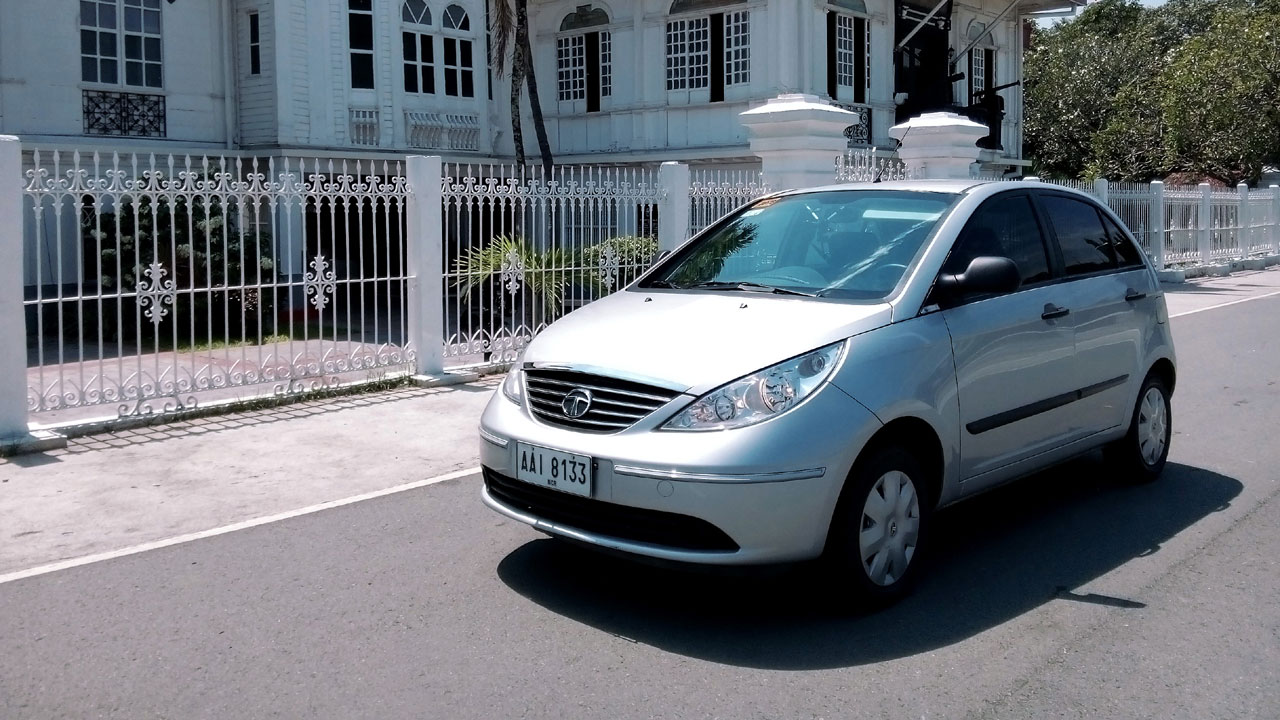

 The Vista Ini is the most basic of four hatchback and sedan variants, the four Vista and Manza variants available in the Philippine market. Here, there’s the Vista Ini base variant mounting a 75ps 1.4L Safire gasoline burner, and the top-end Vista Ignis with its 75ps 1.3L Quadrajet diesel. The Manza sedan has similar distinctions between a base and a top-end variant: the Manza Ini with 90ps 1.4L Safire gasoline engine, the Manza Aura with 90ps 1.3L Quadrajet diesel. See the table, Vista & Manza Variants, Philippine Market: put together, the four specific variants, combinations of hatchback/sedan types and gasoline/diesel engine options, describe a swinging price ladder (Vista to Manza to Vista to Manza) from P565K all the way up to P738K.

 All engine options are sourced from Fiat. The Vista’s gasoline fuelled Safires and diesel Quadrajets are from Fiat India Automobile, a joint venture between Tata Motors and the Italian company that has been more successful, so far, at supplying car and SUV engines in India rather than marketing the Fiat brand there. The Safire name is a derivative of Fiat’s original FIRE trademark which stands for “Fully Integrated Roboticized Engine.”
 So, what Tata did was give the Vista hatchback better city car torque by swapping out the DOHC 16-valve cylinder head and replacing it with an SOHC 8-valve. With peak torque numbers virtually equal at 84lb-ft on the 75PS and 85lb-ft on the 90, the seemingly less powerful engine actually has the better street-going profile with torque peaking much earlier and staying there from 3000 to 3500rpm. Ideal for stop-and-go city driving, even for driving on rough roads between cities, and, ultimately, for cruising with as little revs as possible. It’s an elegant way to tune the Manza sedan’s 1.4L 4-pot engine to be more responsive for the Vista hatchback. But others have thought the 75PS to be underpowered, and I know why.


 Just make the decision as you roll-out though. If it’s conventional you want, smart and consistent gas-engine acceleration all the way on a run, there’s this rule of twos you could use as a mantra: don’t hit 2nd gear until you’re at around 20km/h or have about 2000rpm.





 Though the airconditioning was challenged by the sun’s glare at high noon on the Gapan trip, this is easily remedied by drapes or medium to dark tinting on the windows. Additionally, while the long duct did much to get some cool air up to the very end of the cabin, some load balancing can be done with the adjustable vents—making openings progressively smaller, restricting air-flow, as these get nearer to the blower. The objective, of course, is to make sure there’s sufficient pressure to push the air up to the furthest point from the blower, up to the very end of the air-duct.
 The product of India’s relatively young auto-industry, the Super Ace seems to pitch third-world sensibilities to a global market. It’s a study in doing things a little differently, and making it work—making it work well enough to be adapted into the multi-cab jeepney-style people-carrier / heavy-hauler that’s popular in our market.
 And, while its dimensions make it look like a downsized commuter for the inner city, out in the countryside where multi-cabs roam aplenty is where the Super Ace really comes home. The long and cushiony wheelbase sprung on a rugged suspension makes it an easy drive on rough roads forgotten between election campaigns. The Super Ace seemed easy on the eyes for those hardy motorists we passed, unassuming and small enough to be downright sociable among tricycles that carry more people than a sedan could, and among other multi-cabs expected to ferry entire clans.


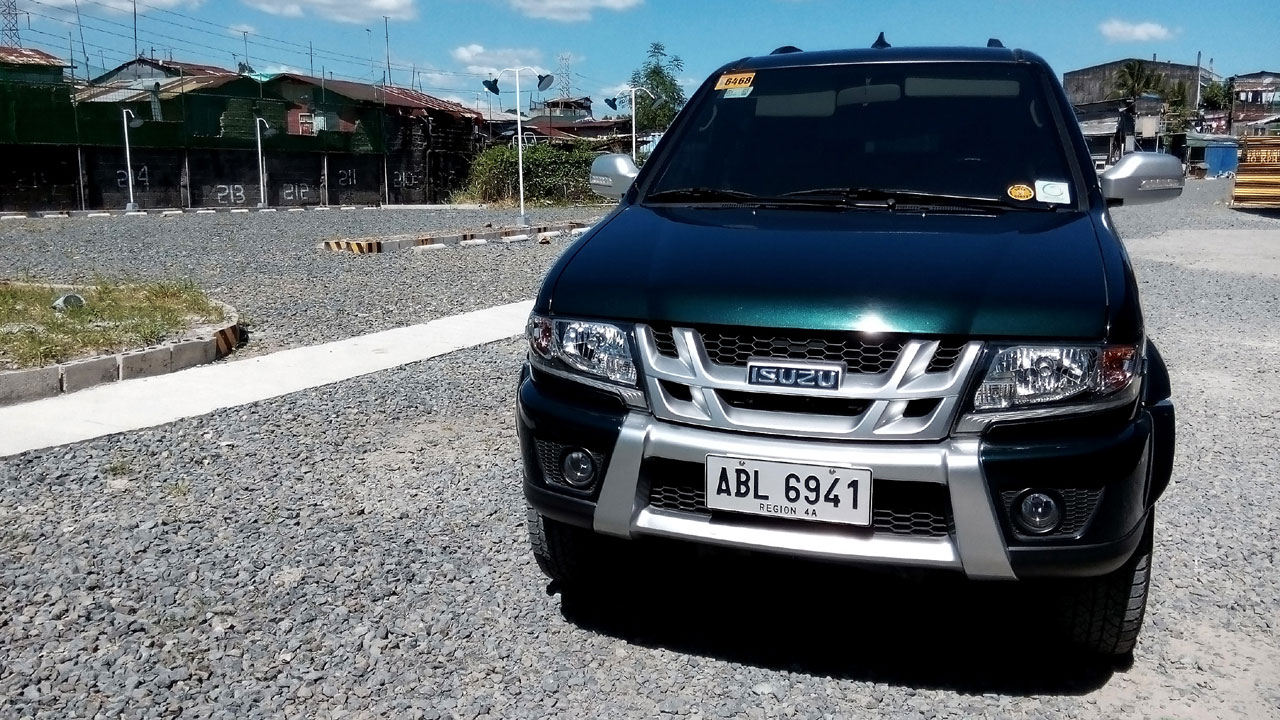

 We dive deep into the details of the JATCO-sourced automatic transmission on Crosswind XUV and Sportivo variants, and come back up with a notion on how to get acceleration that’s closer to how you’d feel it with a stick-shift.
 Now, instead of lamenting this state of things in the torque converter, that hitherto black box that makes stop-and-go traffic crawls far more tolerable, the slippage can be exploited to let you stroke the accelerator. This would be the equivalent of feathering the clutch and stroking the gas pedal to surge up revs on a manual gearbox. Instead of stomping on the gas pedal, give it a two or a three-count pump, quickly charging the flywheel with enough inertia to counter and overcome that of a slow-cruising Crosswind.
 In geek speak: because the torque converter has a high-stall ratio, because it permits and harnesses a lot of slippage, those shallow throttle pumps will speed up the flywheel and impeller in spurts to cavitate the transmission fluid and not yet incur hydraulic resistance. In other words: the pumps let you “slip” in a rev up in quick stages.


