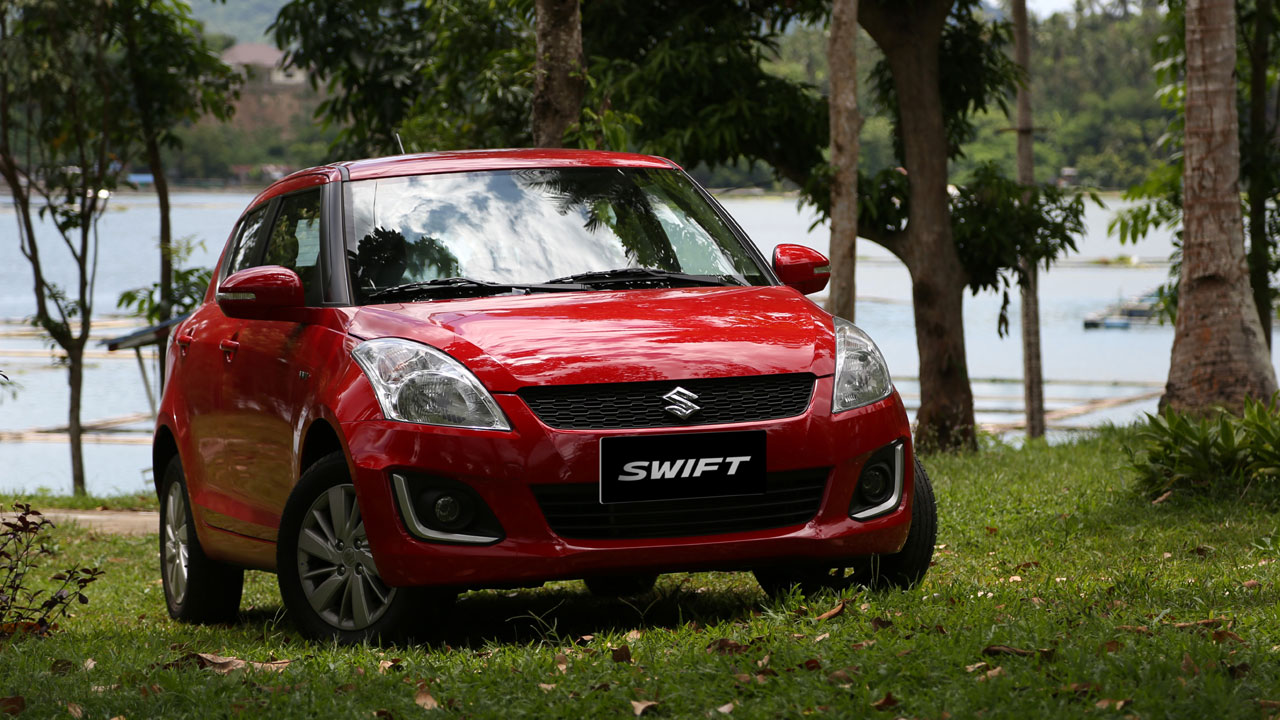
With the Swift’s smallest engine yet, and riding higher with big cushiony tires, its 1.2L version might seem to hurt the hatchback’s stellar standing, but it doesn’t, not in the least.
The Swift looks small the same way the current-model MINI is, which isn’t, not anymore. It’s all in the proportions and what Suzuki is known for: compact, subcompact, even smaller than subcompact automobiles. Spot a Swift on the road, her rather un-small size becomes obvious beside other, efficiently proportioned cars, more so if you spy her beside the smaller Celerios and Altos from the Suzuki stable.
In the Suzuki line-up of small and even smaller cars, the Swift is both upscale and big. Her defining form was laid out in 2004, on her second-generation model, and Suzuki knew well enough not to mess with a good thing when they rolled out the third-gen evolution in 2010.

Her lines are elegant enough to eventually become classic, her hatchback form making her look smaller than she really is. The Swift is shaped into a ground-effect half-shell, that dome of a hood flaring into a cabin made rakish by up-sloping character lines and tapering to the rear to render the whole body into an aerodynamic teardrop.
Swift’s street cred
With its volume whittled down to the rear, it of course has a small boot—just 211 liters in capacity but expandable by collapsing the rear seats. That’s just the predictable tradeoff on a hatchback cut out for sportier stuff. For the Swift’s handling is a given, its responsiveness well known among her followers. Good and fun on the twisties.
 The wheels are pushed to the corners of a trunkless body with very little overhang, the Swift’s length dominated by that long 2.43m wheelbase. What overhang lingers is mostly in front where the extraneous weight is pushed into turns by the steered wheels, not trailing behind the rear wheels where centrifugal force would act on it more and possibly cause lift-off oversteer. At close to 70 percent of its wheelbase, the Swift’s width puts the wheels on wide tracks, splayed out well to keep her grippy and upright through those fast turns.
No surprise that the Swift has gone further in other markets with more powerful engines mounted on sportier variants, and further in engineering with the hatchback’s platform stretched out and built up into the three-row wagon that is the popular Ertiga MPV. What did surprise was when they came up with this high-riding 1.2L version for our market instead.
The Indian connection
What seemed like Suzuki’s attempt to recast the Swift as an economy hatchback, their adding this 1.2L version to the 1.4L one they started out with in the market, actually traces back to an astute move for the India market. Maruti-Suzuki, the Indian-Japanese partnership has 45 percent of India’s huge 2 million unit automobile market, and that is where the Swift 1.2L was introduced to get the hatchback into the country’s Sub-4 tax category.

Under the Sub-4 category, all vehicles measuring less than four meters and mounting petrol engines displacing 1200cc or less are subject to reduced excise taxes of just 12 percent. And that tax break matters enough to have global leader Toyota trying to develop a new Sub-4 car and, at the same time, lobbying the Indian government to cancel the category and the tax advantages it affords their competitors.
 Other than its left-hand drive configuration, the Swift 1.2L here matches India specs so closely, it even features the same ground clearance—raised from the 1.4L’s 140mm up to the Indian 1.2L’s 170mm. (Clearances of 160mm or more are typical in India where roads could be much rougher than those we have here.)
And, although we ourselves don’t have a Sub-4 tax category, the downstream effect seems to bring major savings to Suzuki Philippines, savings that are telegraphed to buyers with Swift 1.2L variants being priced lower than those of the Swift 1.4L by more than P100k. But have those savings come at too much of a cost? With a less powerful engine and higher center of gravity, is the Swift 1.2L still worthy of the popular badge? Yes, apparently so.
Still swift
Delivering 87hp @ 6000rpm and 114NM @ 4000rpm, this Swift’s 1.2L K12M engine gives up 9 percent in horsepower and 15 percent in torque to that of the 1.4L K14B. That’s enough of a downgrade to raise concern, better nominal fuel economy or not, considering the Swift’s around 1,000kg of curb weight. And, on the 1.2L AT variant we tested, matters are compounded by pumping losses inherent in all automatics.
 But on the Swift 1.2L AT, the automatic gearbox is so well tuned to that smaller engine, the slightly lower torque seems well compensated for by proportionate, well matched slippage in the transmission’s hydraulic torque converter. Slippage happens when the impeller driven by the engine’s flywheel rotates faster than the turbine that it pumps hydraulic fluid to, the turbine which in turn drives the transmission. That slippage may seem inefficient but it actually multiplies torque (and is not the cause of an AT’s pumping losses, not in itself). Think of it as dynamic gear reduction that self-adjusts as the turbine and impeller eventually match rotation rates. On the Swift 1.2L AT, that slippage is working the whole time you’re accelerating, becoming more apparent whenever you stomp on the gas.
 With the engine at idle, the Swift 1.2L eagerly rolls out as soon as you let off the brake. Slowly increasing throttle then will bring assertive acceleration at around 2250rpm, eventually bringing you to a cruise with shift points at 20, 50 and 80km/h. Settle down at 80km/h and clutch lock-up will soon kick in, that hydraulic action between impeller and turbine being replaced with this hard physical contact that then eliminates slippage. You can then ease off the gas to maintain cruise with 2000rpm—note that 250rpm increment from the 2250rpm you were using with hydraulic conversion still going on.
 Go faster and you’ll notice revs going relatively high, the 1.2L’s need for more gear reduction becoming obvious. But the engine’s variable valve timing (VVT) valvetrain seems to compensate well, making the fuel mix lean enough to deliver impressive consumption numbers of 16km/l while cruising at 100km/h with 2500rpm, 19km/l at 90km/h with 2250rpm, and 20km/l at 80km/h with 2000rpm.
If you punch it for an overtake while at cruise, the transmission does a prompt kickdown out of 4th gear overdrive, zooming you up quickly to 140km/h, the lock-up clutch disengaged and engine revs quickly climbing to 5000rpm. With the engine revved up that much, the slippage-amplified torque is made apparent by this relentless acceleration.

Still a Swift
With that kind of performance, the 1.2L is spirited enough to demand good handling. And on the 1.2L, even with a higher center of gravity, the Swift’s famous handling is still there, mostly intact. Although there’s pronounced wind noise above 100km/h, the Swift is rock steady at high speed. There’s no denying the fact that the higher ground clearance lets more air get under the front spoiler.
 But the reduction in aerodynamic down-force seems marginal enough not to erode the Swift’s ground-hugging weight. In fact, the slight reduction in down-force, making the Swift somewhat lighter at high speed, seems to contribute to its impressive fuel economy
Contributing to that higher ground clearance are 185/65 tires mounted on 15” alloy rims. These are the biggest wheels they’ve put on a Swift, their 621mm as big as on the rugged Toyota Avanza sub-compact MPV. High ground clearance and these big wheels make easy work of rough roads–the height above ground giving you confidence in negotiating uneven surfaces, those big cushiony tires easing onwards past holes and bumps.

The door sticker says 29psi max pressure on all tires. This means the Swift’s weight on those big tires is manageable enough to allow tire pressures of under 30psi, and that weight is distributed evenly enough to put equal loading on the hatchback’s front and rear axles. With judicious tire pressure adjustments, the high-walled tires can be inflated up to 29psi for smooth highways, or slightly lower for everyday mixed terrain. With two guys on board, the Swift 1.2L rode well and evenly on tires inflated to just 28psi, fighting nicely against body roll and wayward steers in fast curves reaching 80km/h.

It was a risky thing for Suzuki to have offered the Swift 1.2L. Over here, there isn’t the tax break that overtly justifies its downsized engine nor the Indian context for country roads ground clearance. But because it retains that healthy power reserve and trademark handling, while also offering its tall big-wheeled stance and significantly lowered price points, the Swift 1.2L has definitely been a risk well taken.


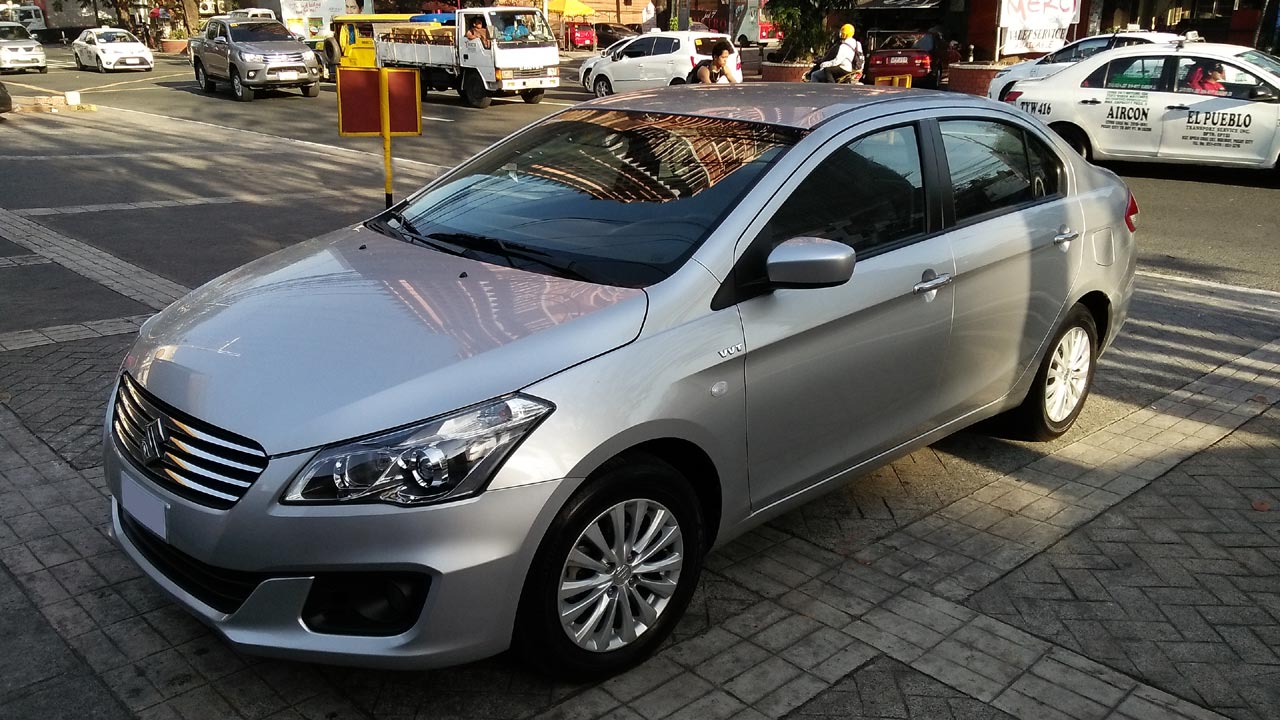
 You can start by rolling her out like a diesel. Put her in gear and, with your foot off the gas, slowly let off the clutch pedal (letting the clutch plate ease onto the pressure plate) until you feel that initial bite. That’s when you press on the gas and further ease off the clutch pedal at the same time. The engine that can be quick to rev otherwise will then have all its revolutions pushing the sedan forward before you step on the gas in earnest, thus keeping revs down to under 1500rpm.
 Then after, even still with just 1500rpm, the impulse to short-shift to save fuel in crawling city traffic is easy to give into. Topping out at 1500rpm, I could shift to second gear at 10, then to third at 25, then fourth at 40 and then finally to overdrive 5th gear at 50 km/h. And all these even with a full passenger load. The result was a quiet drive (onset of throatiness happens at 2000rpm) and fuel savings on city sorties that can impact the entire nation’s bottom-line.



 Introduced late in 2015, the new Celerio turns the badge into a plus-sized A-segment hatchback with uncompromised seating for five adults and a weekender’s worth of luggage space with its best-in-class 254-liter cargo compartment. It’s now longer by 10cm with a proportionate lengthening of the wheelbase by 9cm, and it boasts of better headroom with a height increase of 7cm.
 Supple enough for both comfort and for keeping all four wheels planted, the suspension feels robust enough, the ground clearance sensible enough, for confidently taking on those occasional softroad challenges. And the wheels mount sedan-sized 165/65 R14’s—good feet under a light sub-compact, good enough but also shrouded by roomy fenders that can take wider rubber if you feel like tweaking those tires.
 On the automatic gearbox variant, the powertrain is completed with a two-range JATCO CVT7, the same continuously variable transmission used on the Mitsubishi Mirage CVT variant. The CVT7 adds an auxiliary gearbox between the CVT’s pulleys and the shaft to turn the drive wheels. With this auxiliary gearbox and its low and standard gear ratios, the pulleys meant to have continuously varying diameters are kept compact while still delivering a generously wide range of gear ratios starting with a deep bottom ratio of 1:4.07 in the low range, and going up to an exceptionally tall overdrive ratio of 1:0.55 in the standard range.
 As on most automatic gearboxes, conventional or CVT, the Celerio’s JATCO CVT7 uses a hydraulic torque converter to connect engine to transmission. Torque converters both tolerate and exploit slippage—tolerated because it’s a physical fact, there being slippage when you’re pumping fluid from an impeller to a rotor to transmit torque, and exploited because that slippage causes gear reduction that in turn multiplies torque. And that slippage is eventually eliminated with a lock-up clutch that creates hard contact between the torque converter’s pumping elements. Lock up happens late in the cycle, particularly on conventional automatic gearboxes, kicking in when the vehicle has reached cruise, after shifting all the way up to top gear.
 The Celerio’s JATCO solution is elegant: since the torque converter feeds into a continuously variable system (no distinct gears, no shift shock), the CVT7 gearbox triggers the lock-up clutch early on, as early as during roll out, in fact. To bring it into play, use this Rule of Twos as described in our related story,
  Go gentle on the throttle for those crucial seconds on roll out and you’ll be able to step on the gas however you like afterwards, and this while being treated to the Celerio’s surreal alter ego. With an engine that offers rich torque early on, that’s quiet until you want it to be otherwise, and with no slippage in the system to induce the dreaded rubber-band effect, this gamed Celerio will make you think Suzuki had somehow added an electromotor under the hood … she’ll be that zippy, and quiet.


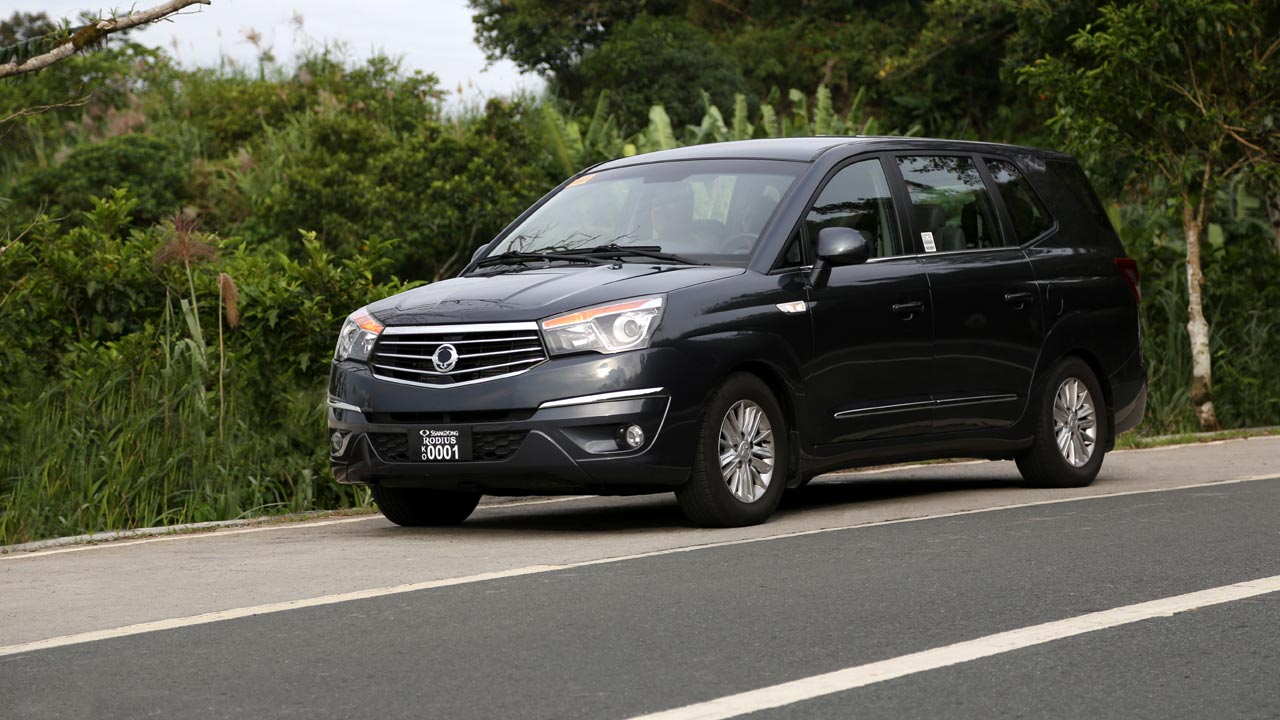

 But instead, the Rodius features this compact rear drive unit (RDU) that’s commonly used for giving basic front-wheel-drive (FWD) crossovers an all-wheel-drive option. From the longitudinally mounted engine up front, the driveshaft that runs underneath the cabin to the back connects to an RDU box which in turn transmits torque to the rear wheels through secondary shafts mounting universal joints on both ends. There’s no rigid beam between the wheels.
 And this explains the Rodius’ four wheel drive (4WD) variant, unique among MPVs. To outfit her with part-time 4WD they simply add a drive unit for the front (it may already be in there, this latent transaxle just waiting for shaft connections to the front wheels).
 The 2.0L SV200 brandishes the rich torque of an engine obviously tuned for power. Behind its humdrum 151hp @ 3400~4000rpm, there’s impressive torque of 360NM @ 1500~2800rpm. That’s equivalent to the torque of a 3 liter 265hp gasoline engine. Although the diesel’s low revs handicap keeps it from the high revs to make it equate to the same horsepower, it has a diesel’s distinction of making 52 percent of that torque available at the low end, 190NM already on tap even with the engine still just above idle.
 Working the gears is a shift mechanism that’s so smooth, with a lock-up clutch that kicks in early, with triggers that are so intuitive, it’s like having a veteran stick man in there doing the shifts for you. Gear ratios on the 5G-Tronic closely match those of manual five-speed gearboxes, with ratios slightly taller to indicate minimal slippage in the hydraulic converter driving the transmission (they didn’t need to resort to slippage to multiply torque, the 2.0L turbodiesel being powerful enough, apparently). And going through these familiar ratios is controlled electronically by the gearbox’s artificial intelligence (AI) module. You read it right: there’s an AI in there that at first imposes an ideal shift schedule but then adapts it to your driving style as you, and it, go along.
 The Rodius has this sense of snugness to her, no slack tolerated in engineering that’s well put together. With the efficient mass of a modern unibody and the comfort and responsiveness of a fully independent suspension under that, the Rodius manages to bring back that well grounded RWD feel that we had been missing lately on big FWD MPVs such as the Honda Odyssey and Kia Carnival.
 This second generation Rodius introduced in 2013 puts straighter character lines, a sharp faceted look, and a keener, more aggressive face on the successor of a dowdy first-generation model that earned the derision of many. Yet, ironically, with a cabin spacious enough to take three or four rows of seating, and despite its unique 4WD option on an MPV, the comparatively low prices for Rodius variants ranging from PhP1.29 to PhP1.59 million, depict it as maybe being this lumbering behemoth that’s just been dressed up premium. But this MPV’s second generation reboot features solid fundamentals that counter this notion nicely, reminding us that prices are kept relatively low because of recently enforced tariff breaks for South Korean imports.

