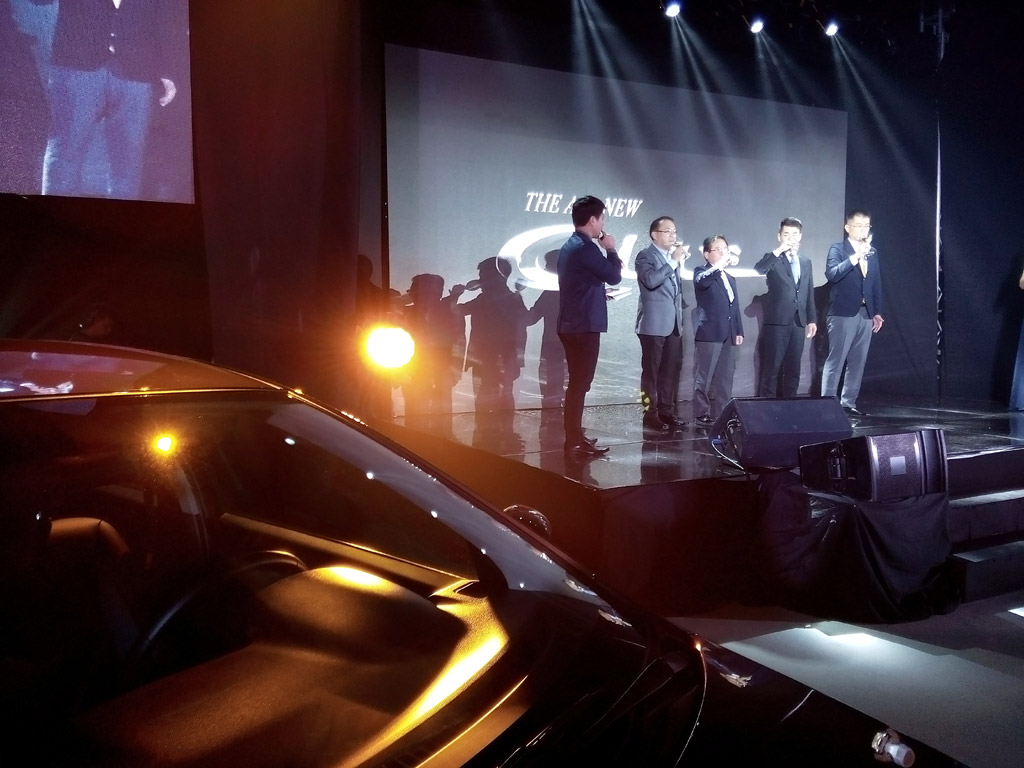
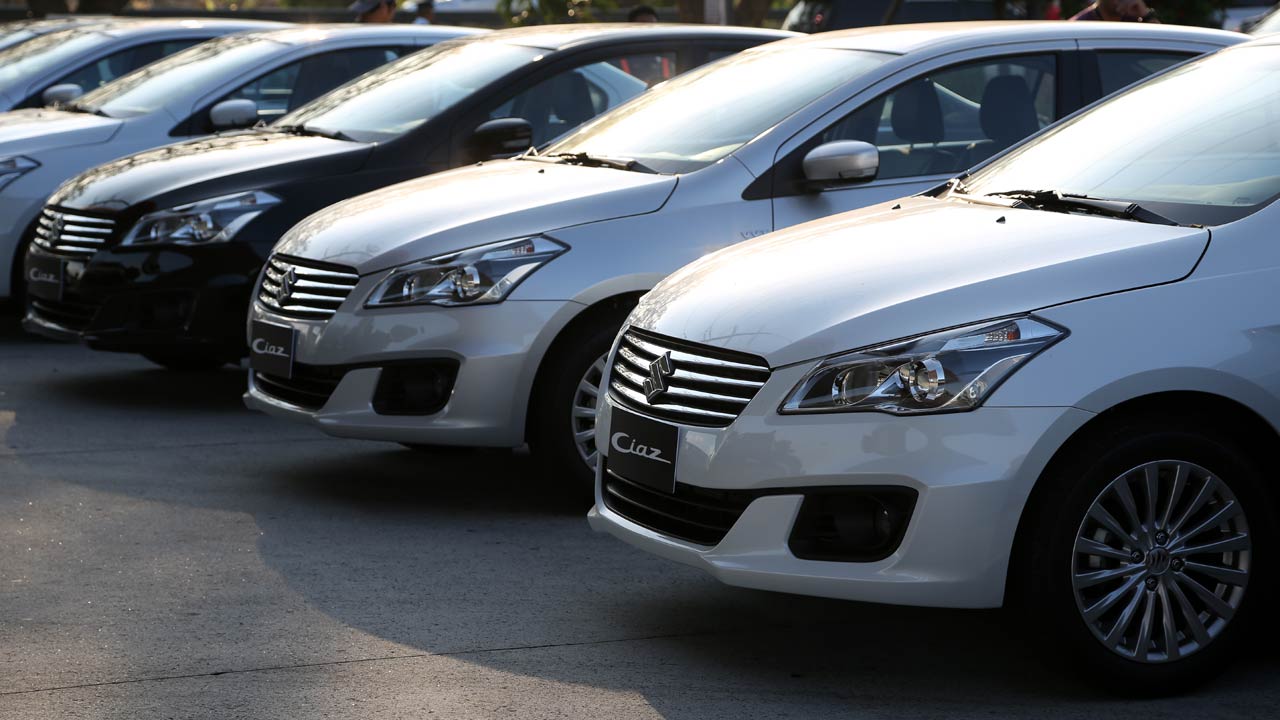
The all new Suzuki Ciaz compact sedan was formally launched at a press event this week, even while MIAS 2016 was still firmly in the news cycle. The new model is Suzuki Philippines’ first in the compact sedan category and marks their breakout from the small car niche that made them the growth leader in 2015 with a 52% year-on-year increase attributed mostly to passenger car sales (see our commentary to their press statement on this). Designed in Japan specifically for the Asian market, and introduced globally in 2014, the Ciaz has already made an impact in other emerging markets, particulary in India where Suzuki had dominated the market with their small car offerings as well. The significance of the new model intro was evident from the large audience turnout, with word on the character of the Ciaz already having gotten out after Suzuki Philippines’ media preview drive last month, the carmaker’s first such organized mass driving event for a car model (see our special report on the Ciaz preview). As promised by Suzuki Philippines at that event, after showroom displays to take in advanced orders in March, stocks are now in and April sees the full commercial launch of the all new Ciaz.
Press Statement by Suzuki Philippines Incorporated, “City Driving from A to Z: Suzuki’s latest Ciaz sedan brings innovation and next-level driving experience for Filipino drivers,” 2016:
Manila, 13 April 2016—Rolling in style just got more comfortable and fuel-efficient, as Suzuki Philippines today officially launches the much-awaited Suzuki Ciaz, a sub-compact sedan ideal for the sensible Asian market. The Ciaz comes in three model variants: the GL Manual Transmission, GL Automatic Transmission, and the premium GLX.
Last March 9 to 10, 2016, 30 motoring media members experienced next-level comfort and driving with Suzuki’s newest innovation through a pre-launch 235-km round-trip drive to and from Anilao, Batangas. The media experienced first-hand the automotive innovations of the Ciaz through the test drive, with stopovers at the Suzuki Auto Sucat, Total Service Station Sucat, Nuvali, Tagaytay, and the Aiyanar Beach and Dive Resort Batangas. This test drive showcased the capabilities of the Ciaz in handling stop-and-go traffic, highway driving stability, mountain pass handling and passenger comfort.
Ciaz is more than a snazzy name for a sleek new sub-compact: it stands for “City from A to Z,” capturing the essence of Asia’s fast-growing metropolitan landscape. The latest addition to Suzuki’s stable of reliable vehicles, the Ciaz is packed with best-in-class fuel efficiency and other advanced features coupled with a sporty, elegant exterior design and redefined interiors.
Driven to excel
The new Ciaz is made for those who are driven to excel. It is developed as an “authentic sedan” which combines a roomy comfortable cabin and a great driving performance with excellent fuel efficiency. All of this comes with a stylish design that will inspire pride of ownership.
Best-in-class fuel efficiency
With recent unpredictable fluctuations in gas prices, the typical Filipino driver in the market for a new car is always on the lookout for a model that promises impressive fuel economy.
One of the features contributing to the Ciaz’s impressive performance is the integration of transmission technology used in the Suzuki Ertiga. In the GL Automatic and GLX models of the Ciaz, the four-speed automatic transmission improves fuel-efficiency and optimizes driving performance.
The car’s body is also smartly designed and shaped to facilitate smoother airflow, which in turn contributes to fuel efficiency. The front and rear bumper corners, front grills, underbody, and trunk lid-end are the product of meticulous research and development to achieve optimal results.
Advanced features
The Ciaz also comes with a variety of advanced features that make driving a truly easy and enjoyable experience. The multimedia integrated audio unit comes with an Android touchscreen for the GLX, complete with Bluetooth and USB connectivity for personal devices such as tablets and smartphones. This innovative multimedia unit comes with wireless connectivity and preloaded applications, such as YouTube, Gmail, Facebook, and the Filipino driver’s go-to app, Waze.
Audio and hands-free connectivity control switches are also embedded in the steering wheel, which facilitates easy access to various tasks. Add these to the keyless push start system and remote, and the Ciaz delivers a hassle-free driving experience for busy urbanites.
Roomy Luxury
Bridging the gap between Suzuki’s compact models and standard sedans, the Ciaz combines the best of both worlds: great fuel efficiency and ample space. This sub-compact sedan has bigger door cutting, which increases the amount of rear seat leg space, headroom, and shoulder room.
Rounding out the spacious interiors is the equally spacious trunk, which has a luggage capacity of 495 liters, and can be closed with an electromagnetic latch and features a convenient boot light.
Optimum safety
At the core of the Suzuki Ciaz is the patented Total Effective Control Technology (TECT), which boosts driver and passenger protection through a light yet incredibly strong impact absorption system. An Anti-Brake Locking Technology is also in place, preventing the brakes from locking during instances of sudden braking. This technology distributes braking force efficiently to the front and rear wheels to prevent accidents.
With all these features, the Ciaz is a surprisingly affordable option for urban drivers. The three models clock in at the following price points:
– Ciaz GL Manual Transmission at P738,000.00
– Ciaz GL Automatic Transmission at P773,000.00
– Ciaz GLX at P888,000.00
For more information on the Suzuki Ciaz, please visit http://suzuki.com.ph/auto/ and like it on www.facebook.com/SuzukiAutoPH, https://twitter.com/SuzukiAutoPH and follow on Instagram at @suzukiautoph.
Suzuki is a brand to watch this year. Last month, they reported record sales for 2015, delivering top year-on-year growth numbers of 52% that they’ve attributed mainly to their passenger car segments, particularly that of their recently up-sized Celerio hatchback. Now, after teasing it since last December with official statements and prime rush-hour billboards aimed at media and motorists alike, they’ve unveiled the Ciaz, their first sub-compact sedan for this market, with a first-ever mass test-drive event for the motoring press.
Introduced globally in 2014, the Ciaz is a new model line, a sub-compact sedan meant to fill that wide gap between their small car Alto, Celerio and Swift offerings, and the much larger, far more premium 2.4L Kizashi mid-size sedan they had fielded in the past. Although there was the SX4 sub-compact sedan that they introduced in other markets (the platform of the CX4 crossover being offered here), the EU-sourced design (developed by Suzuki in partnership with Fiat) imposed cost penalties that had boxed it out of this region’s markets.
On Suzuki’s first-ever mass test-drive event for the press
Enter the Ciaz, unveiled here with Suzuki’s first-ever press drive event held last week. It’s configured into two trim levels, the standard GL and the premium GLX, with GL’s coming with either a 5-speed manual transmission or a 4-speed automatic, and GLX’s just with the AT gearbox. It’ll be hitting showrooms this month for taking early reservations, with first deliveries happening in April.
The name standing for “[the] City, from A to Z,” Suzuki asserts the Ciaz to be their first sedan designed specifically for Asia. And the press drive (a 235km round-trip to and from Anilao, Batangas with the top-spec Ciaz 1.4L GLX AT) revealed the new model to be deliberately engineered for what apparently, in Suzuki’s estimation, is a very sensible Asian market.
Asian specifics
For several years now, the Maruti-Suzuki partnership has held onto its huge share (46% in 2015) of India’s 2.6M-vehicles passenger car market. They’ve been unassailable, although mainly just in the small passenger car segments. When the Ciaz was introduced there first, the response was so good that it picked up some windfall demand from the long waiting lists of buyers grown impatient with slow delivery of other, already popular sedans. If not for anything else, the Ciaz’s entry did benefit the Indian market by forcing competitors to ramp up production and get their cars to market faster—free-market competition at its best.
And the Ciaz’s features, its engineering, promises to cause more of the same even here, in the much smaller but disproportionately complex Philippine market. Here, with sedans that are anything but crossover in a market gone crossover-crazy, where that classic three-box form has been stretched in other ways for multi-role-utility and bad-roads-durability, the new Ciaz appears to hit all the new, sensible sweet-spots.
Multi-role and modern
With prices at P738K for its standard GL trim with manual gearbox, P773K for the GL with automatic gearbox, and P888K for the top spec GLX AT, is Suzuki positioning the Ciaz as an Uber or Grab car candidate (to rival the Toyota Vios, Hyundai Accent and Kia Rio)? That would be a big “YES” says Shuzo Hoshikura, General Manager for Automobile Suzuki Philippines.
Lunch stop at Tagaytay on the Suzuki Ciaz media drive to Anilao Batangas
Uber and Grab pitches have spurred buyers into becoming sedan owners, to have these become family cars in more ways than one. That old impulse buy no-no has been usurped by boilerplate business plans promising car ownership that pays for itself. Of course it’s a pipe dream that takes much driver-hours and risk-management to make happen, but it’s been compelling enough to force carmakers to informally screen their buyers, in a sense making them pause for some much needed introspection. In any case, the trend has resurged demand for sleek new sedans.
High off the ground
With road conditions being unreliable the further you go out of town or, ironically, deeper into the inner-city, the ownership math has become more complicated with climate change now the new reality. New vehicles are seen through a filter of foreboding, visualizing how these would fare on roads disappearing under floodwaters that eventually retreat but then leave potholes in their wake. It may ring paranoid but it’s something that car builders seem to pay attention too these days.
Things underneath have gotten bigger, all the better for handling distressed and distressing road conditions. Ground clearance numbers have gone back up to 1950’s levels; the Ciaz’s minimum ground clearance of 160mm appears to subscribe to hard earned doctrine (particularly from India) that specifies this as the minimum number for clearing rough-road hazards.
If they had gone up to 170 or 180mm, they’d be in high-rider country, even better for soft-roading jaunts, not so good, though, for keeping the car’s center of gravity low and for retaining a sedan’s trademark handling. That 160mm seems just right to keep the undercarriage clear of obstacles while staying low enough to also keep the wind from getting under its skirts. As it is, that gap under the front bumper is small enough not to defeat the aerodynamic down-force of the Ciaz’s sloped hood when the the everyday commuter is kicked up into a fast-mover.
Big rollers
The Ciaz has wheel options, depending on variant, for either 195/55R16 or 185/65R15 tires, yielding overall diameters of 621 and 622mm, respectively. This gives it wheel diameters second only to the 622 or 628mm available on the Mazda 2.
Final gear ratios on current-model drivetrains are being specified to accommodate wheel and tire combinations for diameters of at least 600mm. Besides the effect of making vehicles look more muscular, large wheels make for gentler transitions, call ’em steps, onto and back down from bumps, or down into and back on up from holes.
Driving over grossly misaligned seams in concrete slab roads, the Ciaz seems to shrug off the affront, emitting no more than a low dull thud where other cars had complained with reverberations that drummed on through the hood. The Ciaz’s aloofness should be credited as much to those big wheels as to its plush insulation.
Biggest, but also the lightest
At 4.49m long and 1.73m wide, the Ciaz has the biggest footprint in the sub-compact sedan category, a class it shares with the likes of the Toyota Vios and the Hyundai Accent. So it’s big on the inside because it’s big on the outside, no surprises there. And yet, the Ciaz being the largest in the bunch seems to not come with any penalties. It manages to remain the lightest with 1,010 to 1,040kg of curb weight, depending on the variant. This means it’s lighter though better powered than the mainstay Toyota Vios’ 1.3L variants.
To somewhat test the notion that maybe the Ciaz’s weight is the result of some creative cut-backs in metallurgy, I popped and tried to lift the hood with as few fingers as possible. Going by number of fingers to measure the density of the metal, two fingers being the least I’ve ever needed, the Ciaz’s bonnet took all five fingers on my right hand, needing my good arm to swing it up and fully open. The Ciaz, at least its hood, is into heavy metal.
Long, all-important wheelbase
What really takes the cake is that the Ciaz has the longest wheelbase among them all with 2.65m between front and rear axle centers (5cm longer than on its closest rival, 10cm longer than on the market leading Toyota Vios). That long span between front and rear axles means generous people space between intruding wheel shrouds. So, even with front seats slid back fully, legroom in back is generous enough to swallow up both grown ups and overgrown adults. Its turning radius, although enlarged by the long wheelbase, remains within city tolerances at 5.4m … sedan-like and still smaller than on minivans and SUVs.
Turning to things sporty, that long wheelbase translates into better stability in fast turns. Observe what Porsche has done with its active steering innovation. The automated system turns the rear wheels a few degrees into a turn at over 50mph, this to lengthen the wheelbase virtually. The result on their active-steering-equipped 911 GT3 is to shorten its best lap time by half a second. That’s how important a long wheelbase can be even when pushing back the limits under race conditions.
A common enough powertrain
In other markets, the Ciaz’s specs include options for 1.2L and 1.6L gasoline engines as well as a 1.3L Fiat-sourced turbodiesel, and for a modern CVT transmission. But here, Suzuki Philippines opted just for the 1.4 liter K14B inline 4 VVT gasoline engine with manual or automatic gearbox options. It simplifies matters, specifying a powertrain that’s already been proven both by their popular Swift hatchback and their award winning Ertiga MPV.
The Ciaz’s K14B delivers 92hp at 6000rpm and 96lb-ft at 4000rpm. Suzuki global says this engine version has a new cylinder head and piston crowns for better thermal efficiency to achieve an 11:1 compression ratio. Nonetheless, this new K14B shares a majority of its crankshaft and cylinder block parts with same-series engines in other Suzuki models. The same could be said of the manual or automatic transmissions mated to the engine. Same as in other models but with gear ratios specially tuned to the Ciaz’s power and mass mix.
All told, this would simplify the replacement parts inventories that Suzuki or third party vendors would be investing in, and would actually leverage the technical skills that Suzuki or other service providers already have to provide essential maintenance for the new sedan’s powertrain. This brings Suzuki closer to the long game of the big brands in the Philippine market, closer to marques like Toyota, Mitsubishi and Nissan.
Smooth and smart
These said about the Ciaz’s engine and transmission options being prudent choices for the logistics of keeping the new sedan in good repair, about these being common and therefore easily maintained components, I’d point out (and very quickly, too) that the powertrain has some exceptional attributes as well. For one, the torque converter on the Ciaz’s transmission has the smoothest uptake I’ve ever felt on an AT gearbox.
After popping the selector from D to N whenever I stop in inchworm traffic, I always step on the brake before putting it back into D in order to catch and dampen that trademark jerk of the torque converter engaging. On a whim, though, I tried the sequence on the Ciaz without stepping on the brakes and, well, there was no jerk. There was this gentle tug that quickly built up only after the sedan started to roll. It’s the kind of drive onset I’d credit to an auto-clutch set up, like with an AMT or on a DCT gearbox.
What’s more, I don’t think it’s because the torque converter has a high stall threshold that permits significant slippage as some form of fluid gear reduction. Rolling out and keeping revs pegged at 2000rpm will accelerate the Ciaz smartly up to an 80km/h cruise. No need for a rev surge to first bring revs up to something like 2500rpm before gradually bringing it down to 2000rpm as the car nears cruise. So, no, Suzuki doesn’t seem to have taken shortcuts with the AT gearbox, no exploitation of excessive slippage to gain more torque.
And the upshifts or kickdowns? Real smooth. The powertrain is demonstrably well matched to the Ciaz’s mass (this, even with a 4-speed automatic gearbox that any old-school stick guy would think a concession for convenience). She isn’t a sport anything, nope, but she’s a right smart mover. First and second gears on the AT gearbox felt conventional, not too short at all but rather, if anything, a little tall. Third and fourth? Yes, most definitely tall. The top gear has a seriously tall overdrive ratio that requires and triggers a kickdown if you stomp on the gas at speeds below 100km/h.
Path of least resistance
The Ciaz makes the most of a sedan’s long sleek silhouette, with lines blending gently upwards and down again to encompass the cabin bubble. Wind noise is minimal at 100km/h and air resistance seems to be well managed with the mediocre 1.4L power-plant turning at an acceptable 2250rpm with three people and luggage on board.
I got back-handed confirmation of the Ciaz’s sleek aerodynamics when we cracked open a rear window while we were at fast cruise. The break in the Ciaz’s otherwise smooth aerofoil shape caused significant turbulence, manifesting in this pulsating concussive force you could feel through your ear-drums, rhythmic percussion apparently being hammered in by shockwaves forming around the open window on the trailing end of the cabin. Open window, thrumming eardrums; closed window, not a peep. That’s how much wind resistance the Ciaz manages to slip blithely through when it’s all buttoned up.
About styling, I’d say the Ciaz is handsome, and elegant. She isn’t overwrought with flourishes that have no apparent function, but instead has the lightest of touches to soften its edges, yet also has fun with false vents that give it a sporty air, making its business ends, both of them, edgy. It’s like being asked what the weather is like, on air, on Good Morning Vietnam: open a window and see for yourself, why dontcha. Just take a look at her in the pics. She’s a proper looking sedan, svelte and smooth on the necessary angles, no pointless features that’ll make her cloying and insipid after a few months, simple enough to eventually become a classic. And that alone could spell success in terms of resale value.
With this new model, Suzuki starts down a path that could make it as big and as mainstream as the popular, everyday sedans that the Ciaz now competes with. If Suzuki’s competitors don’t pay attention, the Ciaz’s pitch could be as frictionless as its aerodynamic body, slipping in and hitting the spots where the competition have left themselves exposed with design, engineering and business choices that are off the mark in today’s complex market.
Volkswagen has just unveiled the Ameo, a compact sedan designed specifically for the India market. Debuted on February 2 and showcased the day after at Auto Expo 2016 in New Delhi, the Ameo could be a game-changer for Volkswagen in India as well as in other small-car dominated markets.
Volkswagen Polo sedan
Based on their popular Polo sedan but with a notchback trunk to trim overall length down to less than 4 meters, the Ameo features either a 1.2L petrol engine with multi-point injection or a 1.5L TDI diesel. Those key specs put the Ameo, unlike the full sized Polo sedan on which it is based, in India’s small car category for preferential 12% excise tax rates. The sedan is an intuitively up-market form-factor compared to tiny-trunked though sporty-looking hatchbacks that otherwise dominate the roads. And premium brand Volkswagen has managed to put a short sedan in a pricing sweet spot for India where 72% of last year’s over 2 million vehicles sold we’re in the small car category.
Judging by Toyota’s reaction, a game changer
The tax benefits redounding to lower price points are significant since the next bracket, the one in which the longer Polo sedan belongs, jacks excise up drastically to 20%. The wide spread in tax rates is significant enough to have prompted world leader Toyota, as reported by Motorbeam.com last year, to ask the Indian government to remove tax breaks for sub-4 meter vehicles. Their argument: the regulations in India give automakers less opportunity for exports. The claim appears self-serving considering that Toyota itself doesn’t have a sub-4 meter sedan to offer and, observers reckon, is still three years from rolling out a model that they’re currently developing for this category.
Suzuki DZire notchback sedan
Moreover, Toyota’s justification using the export buzzword is rebutted by the performance of Maruti Suzuki, the Indian-Japanese joint-venture that’s the long-standing market leader in India with 45% market share by year-end 2015 (peaking at 50% mid-year). Their top-selling Swift sub-compact hatchback and Swift DZire sub-4 meter sedan have found good market even here where 1.2L petrol-engine variants subsequently introduced by Suzuki Philippines (thereby quietly introducing India’s sub-4 meter category to the country) contributed to their turning in top growth numbers for 2015. Even while the Philippine market showed growth biased towards light commercial vehicles, Suzuki saw a 52% increase in year-on-year sales with 2015 deliveries coming mainly from their mini and sub-compact passenger cars line up (see our story, “Suzuki Philippines is 2015 growth leader with passenger car sales that defy trend for light commercial vehicles”). The Indian government has not granted Toyota’s request.
Toyota Etios Liva hatchback
Latest 2015 figures put Volkswagen in close second place to Toyota globally, the former’s 9.93 million in unit sales already at 98% of the latter’s 10.08 million. But the German brand is a relative newcomer to India where it has just a 2% market share to show against Toyota’s 6.5%. This is the one market where it could tap game-changing growth. Now, with the Ameo set to roll out of showrooms by mid-year 2016, Volkswagen will be fielding both the new sub-4 sedan and their Polo hatchback against the Etios Liva, also a hatch and Toyota’s one and only model in India’s small car category until they roll out their short sedan in 2018. It’s an open field where number two Volkswagen can double team number one Toyota, and in a game that could spill over into other territories.
Indian economies of scale bring de-facto Philippine tax breaks
Unlike the specific taxation behind the 4-meter length and small-engine displacement limits of India for a preferential 12% rate, the Philippines uses an ad valorem structure that levies increasing rates on escalating portions of a vehicle’s import or production cost. For Philippine excise taxes on motor vehicles, 2% is used for the first P600K. If the vehicle costs more than P600K, 20% is used for the next P500K. If the cost is more than the P1.1M of the two lower brackets combined, 40% is used for the next P1.0M. If the cost is even more than the P2.1M of the three brackets combined, 60% is used on the excess. These actually depict a lower tax burden than in India. Excise taxes would hit the 12% equivalent of India’s small car category only when those costs approach P1.2M each.
In the Philippine tax environment, it was Suzuki that pioneered a niche for India-market notchbacks that, at the very least, minimizes excise tax. What Suzuki Philippines broke into was a pricing niche for small hatchbacks and sedans that tops off just above that recurring P600K mark. The Swift hatchback 1.2L and Swift DZire 1.2L notchback they brought in (both with engines curiously downsized from the original 1.4L with which the popular Swift was first launched and is still retained in an up-range variant) are obviously like the Volkswagen Ameo—specially configured to fit India’s small car category.
While these do not benefit from any particular Philippine tax break, the specially configured variants do come from having Indian tax incentives that result in sales volumes which keep prices down by sheer economies of scale. Other words, it’s the pricing that’s kept low by successful India sales that get these vehicles the Philippine equivalent of a tax break. It’s like getting hotcakes at half price because neighbors already got things discounted with a large, wholesale purchase.
Philippine niche for India-market notchbacks
The result: P638K for the Swift 1.2L M/T hatchback with P111K savings off the original variant mounting a 1.4L engine (which doesn’t fit India’s small car profile), and an even lower P568K for the Swift DZire 1.2L M/T short sedan which has no other engine option but the one that keeps it in the sub-4 meter category. At prices that stay near or under the P600K SRP level even after covering ship-in costs and mark-ups, excise tax rates are kept down at the lowest 2%, nearly eliminating the bloat it otherwise could put on the list price.
Honda Brio Amaze notchback sedan
The situation has created an opportunity for other carmakers, later entrants, also willing to engineer products for the sub-4 meter category (instead of lobbying to abolish its tax benefits). Honda’s Brio Amaze notchback sedan was introduced in India with a 1.2L petrol engine, keeping it in the sub-4 meter category and pitting it against the top-selling Swift DZire 1.2L. By most accounts, Honda’s notchback has been showing well.
Subsequently, in 2014, Honda Philippines brought over the Brio Amaze, although with a larger 1.3L i-VTEC engine, focusing on performance despite causing a departure from the 1.2L engine that had gotten it a tax break in India. Nevertheless, volumes on the components common to the India- and Philippine-spec models appear to let Honda hit that pricing sweetspot with an SRP of just P629K for the basic E variant with manual gearbox. And if they choose to bring in the 1.2L variant later, like Suzuki did, this could introduce another, significantly lower price-point, like it had for Suzuki.
Point is, India-market notchbacks are already in the Philippines, have been here for several years already, even if the market hasn’t perceived these as such but rather as rakish sedans with trunks truncated for sporty aesthetics. And now, with premium German brand Volkswagen having reworked and shortened their popular Polo sedan to become an India-market notchback, the niche has transcended the esoteric, been made overt and apparent by the world’s second largest marque gunning for top spot.
Another notchback for the Philippine mix?
Volkswagen will be pricing the Ameo very competitively for the Indian market. Ex-showroom prices in India ranging from the equivalent of P422K to P562K have been reported.
Philippine-spec vehicles are typically priced at around 150% of the Indian counterpart models, whether sourced from India or off-shore suppliers. This means that if the opportunities prove compelling enough both for Volkswagen global and Volkswagen Philippines alike, they could bring in the Ameo at an offer price starting at P633K.
That’s a surprising notional SRP for an up-market city-sized short-sedan complete with modern staples such as a full-fledged infotainment system, power windows and locks, rearview camera, cruise control, dual airbags, ABS and electronic stability control. A surprising price particularly for a Volkswagen that’s acclimatized for the Philippines with what looks like the same high, 170mm ground clearance of the Suzuki Swift hatchbacks and sedans for negotiating the rough inter-city roads and high speed-bumps in India. A surprising price for Volkswagen with their current lowest priced model, the Polo sedan 1.6L A/T listed P200K higher at P840K. A surprising price for the recently returned European Volkswagen marque that’s premium enough to command a P4.29M price for its SUV top Touareg model. Basically, that notional P633K for the new Ameo is a surprising price for a Volkswagen, period.
Toyota Vios sub-compact sedan
Still, it’s just a notion. But think of how a P633K Volkswagen Ameo can upset the status quo not only in its role evolved for India where driving conditions are apparently worse and more diverse than in the Philippines, but also in a market other than India where arch rival Toyota doesn’t have a counterpart model and instead has the Vios sedan as the closest thing to one.
The Vios, Toyota Philippines’ best-selling model showcased for its track-ready handling in much publicized one-make races, with its near single-minded focus on a ground-hugging ride having committed it to the low, 147mm of ground clearance that causes the occasional underbody scrapes even with just two on board. And lastly, the slightly larger, sub-compact Vios sedan with its less finely trimmed 1.3L J M/T base variant selling for a near-equivalent P630K.
Having spotlighted the India-market notchbacks already in the Philippines and their unique draw amongst region-wide third-world sensibilities, the Ameo should be coming to Volkswagen Philippines showrooms, and coming soon. This is too good an opportunity, even for Volkswagen global, to pass up.
Suzuki Philippines formally launched the second generation Celerio hatchback last Tuesday. Introduced globally at the 12th Auto Expo in Greater Noida, India, last year in February, this larger iteration signals global Suzuki Motor’s commitment to a sub-segment that first gained traction in some emerging markets but is now universal enough for the carmaker to use the Celerio name in all countries where the model is being offered.
At the August 5 launch, Suzuki Philippines President Hiroshi Suzuki saying: “We are very excited to showcase our A+ compact design to the Filipino market.”
Year-end 2015 update: Celerio bags CotY in basic subcompact category
The second generation Suzuki Celerio introduced last August has bagged the 2015 Car of the Year (CotY) award in the basic subcompact category. Recognition comes from the Car Awards Group, Inc. (CAGI), the organization of motoring journalists that’s been doing mass-reviews yearly since 2004. Formal awarding was done last November at a gala event at Fontana Leisure Parks & Casino at Clark Field, Pampanga, coming at the end of weeks-long testing for all vehicle categories popularly known as the CotY testfest.
Of the 2015 CotY win, Suzuki Philippines General Manager for Automobile Shuzo Hoshikura said: “As a pioneer manufacturer of compact vehicles, we are truly grateful for this acknowledgement, which recognizes our continuous pursuit to come up with top quality vehicles that would fit the growing needs of the automotive market. We are dedicating this award, and other recognitions we received this year, to our valued customers who have been our inspiration in developing and manufacturing premium and reliable cars.”
During the launch, Suzuki Philippines President Hiroshi Suzuki said: “We are very excited to showcase our A+ compact design to the Filipino market.” The A-segment in itself is not a strictly defined category but has been used on smaller sub-compacts with lengths of 3.7m or less. Such a broad range allows carmakers to use the A label, along with its positive connotations, for all vehicles ranging from Japan’s trademark Kei cars to sub-compact city cars.
Before the Celerio model was introduced into the Suzuki line-up, there was a noticeable gap on the bigger end of the A-segment, between the Kei-sized 3.4m long Alto and the 3.8m Swift sub-compact hatchback. A gap that has been felt not as much in Suzuki’s native Japan (where the Alto retains a strong draw despite diminished tax benefits on Kei cars), but more in emerging markets like India where the Maruti Suzuki joint-venture is the biggest carmaker with more than half of overall market share.
An emergent niche
Current generation 3.4m long Suzuki Alto
The smaller 3.4m Alto for the Philippine market is actually the Indian version that Maruti Suzuki first introduced in 2000 based on the facelifted fifth-generation from Suzuki Motor in Japan—which, looking further back, is an evolution of the Suzuki Fronte once marketed here in the 1980s.
Maruti Suzuki has had years of experience with the Alto line, instead of keeping pace with Japan’s further evolution of the 3.4m Alto, they stretched the lifespan of each model generation. While Japan subsequently developed a sixth generation Alto in 2004 and a seventh in 2009, all with lengths of 3.4m (to be exact, 3.395m), Maruti Suzuki stayed with their fifth generation platform, though also introducing their own version’s second generation with new bodywork just last year. Instead of more Alto generations, Maruti Suzuki invested its efforts in a bigger A-segment offering, creating their A-Star concept car which, in Car and Driver’s estimation, upstaged the like-sized Splash concept developed jointly by Suzuki Japan and Edmond Opel AG when both cars were shown at the Geneva auto show in February 2008.
2008 A-Star concept car
2008 A-Star / export Alto / Celerio production model
Maruti Suzuki quickly adapted the A-Star concept into a production model based on the Alto platform’s 2,360mm wheelbase but with wider treads, an overall length of 3.5m, and the bigger 998cc engine offered on the Alto’s top-spec K10 variant. In the same year, by December 2008, they introduced the new model, naming it the A-Star—after its concept car origin—but only in India, the new 3.5m long production model was confusingly still called the Alto in upscale export markets. And, in countries where Suzuki was already offering the 3.4m Alto, that new model took the name Celerio.
2007 Suzuki Splash concept car
The rival concept developed by Suzuki Japan and Opel also made it to production in 2008, re-branded as the Opel Agila in Germany, named the Suzuki Splash for European markets, and even joining Maruti Suzuki’s India market line-up as the Ritz. Also based on the Alto platform’s 2,360mm wheelbase, the Splash production model was made much bigger than its concept, longer even than the A-Star concept and Celerio production model, with an overall length of 3.7m. Assembled in Hungary by Magyar Suzuki, and in India by Maruti Suzuki, the Splash hasn’t yet had a generation update. In comparison, while its first generation was manufactured only in Haryana, India, the Celerio now has a second generation with several Suzuki sites in Asia tooled for its manufacture.
Expanded production, bigger dimensions
At the launch, Suzuki Philippines General Manager for Automobile Shuzo Hoshikura
“The previous Celerio was from India, this new one is from Thailand,” says Suzuki Philippines General Manager for Automobile Shuzo Hoshikura. Left unsaid was the fact that the shift in supply comes with the expansion of the Celerio’s production lines, adding Suzuki Motor Thailand to that of Maruti Suzuki in India.
Hoshikura explains that based on customer feedback generally expressing how the zippy Celerio platform could be bigger, roomier, Suzuki moved to upsize the second generation model into the A+ sub-segment. That plussed “A” reference is ironically appropriate since the 2008 first generation’s basis in the A-Star concept car was followed by the 2014 second generation’s initial articulation in Maruti Suzuki’s A:Wind concept first shown at the Thailand International Motor Expo in November 2013.
2013 Suzuki A:Wind concept car
The A:Wind, like the A-Star before it, was quickly adapted into the second-generation Celerio production model, this time based on the Suzuki MR Wagon platform’s longer 2,425mm wheelbase, though again with wider treads and an overall length of 3.6m. The new Celerio is still powered by the 998cc K10B engine but made 9kg lighter and now offered with a CVT automatic gearbox.
The tale of the tape between the first and second generation Celerio shows significant up-ticks in dimension, but with rational engineering to pare down the weight. Longer by 100mm on a proportionately stretched 2,425mm wheelbase; taller with a 70mm increase in height, and deeper with a 5mm decrease in ground clearance; and coming with a model-defining increase in cargo space from 110liters to a best-in-class 254liters, the new Celerio still manages to weigh in at the same 860kg, though with the heavier CVT, and even 30 less at 830kg with the same 5-speed manual gearbox, of its former self.
Joining the big-league mainstream
Notwithstanding Suzuki’s reference to a bigger A+ sub-segment, the new Celerio’s size really just puts it squarely against the top-selling Toyota Wigo. Same length at 3.6m; the Celerio slightly narrower by 20mm which might mean better city maneuverability, and offset by headroom that’s 20mm taller; the same 4.7m turning radius but with the Suzuki hatch possibly more responsive with a wheelbase that’s 90mm shorter and reportedly sprung on a “Swift-based” suspension platform; bigger cargo space with a 254 liter volume that beats even the 235 liters of the longer 3.7m Mitsubishi Mirage hatch; an engine with the same 998cc displacement of the Wigo’s but with 3hp and 3lb-ft more output at 67hp and 66lb-ft peak power and torque; and with lower consumption promised by a friction-mitigating VVT versus the Wigo’s conventional, non-dynamic valvetrain, as well as a CVT automatic option versus the Toyota hatch’s conventional torque converter 4-speed AT. Even their origins from global brand subsidiaries in emerging markets are similar, the Celerio coming from India’s Maruti Suzuki, the Wigo from Indonesia’s Astra Daihatsu.
For the Suzuki Celerio to come close to Toyota Wigo sales volumes, even with its bigger new generation model, remains a tall order. Hoshikura says that Suzuki Philippines has sold 5,800 units of the first generation Celerio since it was introduced in this market. A far cry from the 9,062 units reported for the Wigo for 2014 alone, yes, but the main draw of the Toyota marque has been the economies of scale and longevity that have made their models cheaper to maintain and that have imbued these with higher resale values, and these factors don’t apply as much to the Wigo which Toyota sourced from subsidiary Daihatsu to enter the micro-hatch segment only in 2013.
Healthy competition
Toyota Wigo G 1.0
If there’s any carmaker out there that could challenge Toyota in the micro-hatch segment—just as Mitsubishi has done here in the compact SUV class with their Montero, and as Ford has in pick-ups with their Ranger, or even as Volkswagen has done just recently, a slight lead putting them at the top and finally unseating Toyota on the global stage—Suzuki, particularly its Maruti Suzuki subsidiary, seems to be it. With the basic A -segment already covered by their smaller and much lower priced Alto (P388k versus the Wigo’s lowest base price of P468), Suzuki has positioned the Celerio with trim levels and prices that brazenly challenge the Wigo’s main-tier manual and automatic G variants, leaping over the Toyota hatch’s base E variant and ignoring its dressed up topline TRD version.
Even without the P20k discounts they are now offering for early reservations, Suzuki puts new Celerio prices at P507k for the MT variant and P542 for the CVT. While these prices would’ve both been just P4k lower than the counterpart MT and AT Wigo G prices at initial market levels, the price delta is now a significant P14k less for Celerios after Toyota’s 2015 price updates. This Suzuki challenge, I don’t think Toyota saw it coming.
New Celerio in Sunshine Yellow
Digressing a bit onto Toyota’s view of the field, will rivalry from Suzuki or any other challenger cause them to lower their prices? With the giant’s long-running stand of projecting premium “made in Japan” value, they could instead replace their micro-hatch offering with the Toyota-designed new generation Aygo, putting themselves in a higher price-point bracket with a more upscale micro that sports a design language unmistakably the same as that of their bigger Yaris, Vios and Altis models. Or, they could pull out of the micro-hatch segment altogether. Either way though, the thousands of Wigo owners they now have are likely to react negatively. So yes, maybe a price decrease is the more likely response, at least initially.
By now, our market must already be as globally sensitive as the rest of the world. We suspect that top-tier brands are likely no longer manufactured or even designed in home countries that had once resonated with promises of exceptional quality and shine. Carmakers themselves give back-handed acknowledgement to this by highlighting how particular high end models are still assembled and shipped over from the US, Japan, Germany and the like.
Suzuki Philippines, while not really obscuring the fact that the Celerio is a Maruti Suzuki creation, seems not to make the most of opportunities to highlight this. But there’s this symmetry, this elegance to emerging market models being manufactured by emerging market subsidiaries. At the very least, the designers must share our sensibilities, our appetite for stretching the utility and bolstering, if not creating, the prestige of an efficient, environmentally friendly and unmistakably classy micro-hatchback.
And, for the savvy, there’s the realization that with models coming from emerging markets that stretch the lifespan of each generation to save on tooling between upgrades, there’s the very real benefit of there already being a large pool of replacement parts manufacturers whose product could then be stocked by automotive aftermarket traders at lower risk, and lower carrying costs.
Proof of the pudding
But proof of all these good things maybe happening, as the old saw goes, is in the eating. The new Celerio to be shipped from, by now, Thailand’s veteran automaking production lines, will have to deliver on the promise.
The new Celerio’s best-in-class 254 liter cargo space
It’s not just a plus but an imperative that the Celerio manifest the benefits that Suzuki Philippines President Hiroshi Suzuki further asserted at Tuesday’s launch: “You will all be amazed with the architecture of this model, particularly its best-in-class luggage capacity, superb ease and comfort in driving, and outstanding fuel efficiency. We are confident that this all-new Suzuki Celerio will set a new standard for its kind.”
The new Celerio comes in eight sensuously labelled colors. There are the four in distinguished monochromatic shades: Snow White Pearl, Star Silver Metallic, Mineral Grey Metallic, and Super Black Pearl. There are the other four in vibrant young hues: Ablaze Red Pearl, Cerulean Blue, Sunshine Yellow, and familiar Raspberry Pink. And they’ve brought in advanced demo units for each color, all with the new CVT automatic option.
Obviously, the new Celerio is a developing story. And, while the color options are exceptional in their breadth, what matters more is that Suzuki has brought in quite a number of advanced demo units with at least eight new Celerios on which industry observers can validate their assertions.
At the August 5 launch (left to right): Suzuki Philippines Managing Director Norminio Mojica, President Hiroshi Suzuki, and General Manager for Automobile Shuzo Hoshikura
So, If we don’t get to test it ourselves soon, just keep Googling and you should be able to find a hands-on review sooner than later. Or visit a Suzuki showroom yourself and maybe schedule a test drive, feel it out and see if the Suzuki Celerio really is the giant-killer that it can be.






 For several years now, the Maruti-Suzuki partnership has held onto its huge share (46% in 2015) of India’s 2.6M-vehicles passenger car market. They’ve been unassailable, although mainly just in the small passenger car segments. When the Ciaz was introduced there first, the response was so good that it picked up some windfall demand from the long waiting lists of buyers grown impatient with slow delivery of other, already popular sedans. If not for anything else, the Ciaz’s entry did benefit the Indian market by forcing competitors to ramp up production and get their cars to market faster—free-market competition at its best.

 Things underneath have gotten bigger, all the better for handling distressed and distressing road conditions. Ground clearance numbers have gone back up to 1950’s levels; the Ciaz’s minimum ground clearance of 160mm appears to subscribe to hard earned doctrine (particularly from India) that specifies this as the minimum number for clearing rough-road hazards.
 The Ciaz has wheel options, depending on variant, for either 195/55R16 or 185/65R15 tires, yielding overall diameters of 621 and 622mm, respectively. This gives it wheel diameters second only to the 622 or 628mm available on the Mazda 2.
 What really takes the cake is that the Ciaz has the longest wheelbase among them all with 2.65m between front and rear axle centers (5cm longer than on its closest rival, 10cm longer than on the market leading Toyota Vios). That long span between front and rear axles means generous people space between intruding wheel shrouds. So, even with front seats slid back fully, legroom in back is generous enough to swallow up both grown ups and overgrown adults. Its turning radius, although enlarged by the long wheelbase, remains within city tolerances at 5.4m … sedan-like and still smaller than on minivans and SUVs.
 All told, this would simplify the replacement parts inventories that Suzuki or third party vendors would be investing in, and would actually leverage the technical skills that Suzuki or other service providers already have to provide essential maintenance for the new sedan’s powertrain. This brings Suzuki closer to the long game of the big brands in the Philippine market, closer to marques like Toyota, Mitsubishi and Nissan.
 After popping the selector from D to N whenever I stop in inchworm traffic, I always step on the brake before putting it back into D in order to catch and dampen that trademark jerk of the torque converter engaging. On a whim, though, I tried the sequence on the Ciaz without stepping on the brakes and, well, there was no jerk. There was this gentle tug that quickly built up only after the sedan started to roll. It’s the kind of drive onset I’d credit to an auto-clutch set up, like with an AMT or on a DCT gearbox.
 And the upshifts or kickdowns? Real smooth. The powertrain is demonstrably well matched to the Ciaz’s mass (this, even with a 4-speed automatic gearbox that any old-school stick guy would think a concession for convenience). She isn’t a sport anything, nope, but she’s a right smart mover. First and second gears on the AT gearbox felt conventional, not too short at all but rather, if anything, a little tall. Third and fourth? Yes, most definitely tall. The top gear has a seriously tall overdrive ratio that requires and triggers a kickdown if you stomp on the gas at speeds below 100km/h.
 About styling, I’d say the Ciaz is handsome, and elegant. She isn’t overwrought with flourishes that have no apparent function, but instead has the lightest of touches to soften its edges, yet also has fun with false vents that give it a sporty air, making its business ends, both of them, edgy. It’s like being asked what the weather is like, on air, on Good Morning Vietnam: open a window and see for yourself, why dontcha. Just take a look at her in the pics. She’s a proper looking sedan, svelte and smooth on the necessary angles, no pointless features that’ll make her cloying and insipid after a few months, simple enough to eventually become a classic. And that alone could spell success in terms of resale value.


 In the Philippine tax environment, it was Suzuki that pioneered a niche for India-market notchbacks that, at the very least, minimizes excise tax. What Suzuki Philippines broke into was a pricing niche for small hatchbacks and sedans that tops off just above that recurring P600K mark. The Swift hatchback 1.2L and Swift DZire 1.2L notchback they brought in (both with engines curiously downsized from the original 1.4L with which the popular Swift was first launched and is still retained in an up-range variant) are obviously like the Volkswagen Ameo—specially configured to fit India’s small car category.
 Subsequently, in 2014, Honda Philippines brought over the Brio Amaze, although with a larger 1.3L i-VTEC engine, focusing on performance despite causing a departure from the 1.2L engine that had gotten it a tax break in India. Nevertheless, volumes on the components common to the India- and Philippine-spec models appear to let Honda hit that pricing sweetspot with an SRP of just P629K for the basic E variant with manual gearbox. And if they choose to bring in the 1.2L variant later, like Suzuki did, this could introduce another, significantly lower price-point, like it had for Suzuki.
 Philippine-spec vehicles are typically priced at around 150% of the Indian counterpart models, whether sourced from India or off-shore suppliers. This means that if the opportunities prove compelling enough both for Volkswagen global and Volkswagen Philippines alike, they could bring in the Ameo at an offer price starting at P633K.
 The Vios, Toyota Philippines’ best-selling model showcased for its track-ready handling in much publicized one-make races, with its near single-minded focus on a ground-hugging ride having committed it to the low, 147mm of ground clearance that causes the occasional underbody scrapes even with just two on board. And lastly, the slightly larger, sub-compact Vios sedan with its less finely trimmed 1.3L J M/T base variant selling for a near-equivalent P630K.
 Having spotlighted the India-market notchbacks already in the Philippines and their unique draw amongst region-wide third-world sensibilities, the Ameo should be coming to Volkswagen Philippines showrooms, and coming soon. This is too good an opportunity, even for Volkswagen global, to pass up.


