Quick note: the Super Carry’s tiny diesel, powerful enough for hills and highway

Anyone would be sceptical about the Super Carry’s remarkably small 0.8L two-cylinder diesel, even with its output boosted to 32hp / 75Nm by an inter-cooled turbocharger. As compact as it is, the Suzuki micro-truck can still weigh 1600kg when loaded. That’s over a ton and half that needs pushing. Is a 32hp diesel really enough of a powerplant? We we’re sceptical too, but that was before we took her down the Tagaytay-Talisay road with a six passenger loadout … and brought her back up again. Repeat: brought her back up again.

The Tagaytay-Talisay road brings vehicles from mountain down to lakeside in just 15 minutes, that’s how severe its grades are, and it offers the option of not having to go back up and through Tagaytay to get back to Manila. There’s the option of going through Talisay and on through to the Star tollway for a flat return trip. That flatlands fallback wasn’t necessary, though, not on the surprising Super Carry.

Going back up to Tagaytay

With a diesel’s long stroke leverage, the small engine’s torque was always there, pushing the Super Carry with a six-passenger half-load. There were inevitable stints in first gear, speed topping out at 20km/h whenever steep grades robbed us of momentum, but the Super Carry would climb relentlessly, bringing us back to Tagaytay’s altitude with just a few minutes more than it would have taken a sedan with a perky powerplant.

And, while heading back north to Manila, the Super Carry showed that its dinky diesel is powerful enough to merit holding back on the flats. The micro-truck’s accelerator pedal is a drive-by-wire affair with a built-in speed governor. Although stomping on the pedal in either 4th or 5th gear brings healthy acceleration that feels like it could bring you to 90 or 100km/h, respectively, the speed governor steps in to close the throttle back up to maintain a 86~88km/h maximum (actually 80km/h as monitored by GPS tracking).

The Super Carry’s drive-by-wire accelerator module

Clearly, the Super Carry’s small turbodiesel is powerful enough to take Tagaytay from Talisay (even Baguio through Kennon, for that matter) and to merit speed-governing for the sake of safety and of efficiency (magic words in fleet managers’ ears). If not for anything else, the speed governor that’s backhanded proof of the small diesel’s sufficiency also brings cruise-control convenience: step on the pedal as hard as you like, the throttle will still open up just enough to maintain a max-conserve and radar-safe speed of 80km/h.

Quick note: the Suzuki Super Carry makes you feel like a ten-foot trucker

Suzuki’s Super Carry is just about the most common model exemplifying Japan’s pioneering Kei Truck concept. That’s true at least here in the Philippines where a decade’s absence of brand new units was hardly felt with the continued influx of surplus units from other markets.  Its engineering DNA is clearly Japanese and driving the new Super Carry, reintroduced spanking new by Suzuki Philippines, shows how they got their trademark micro-truck specs exactly right. 

It’s as if they took a good mainstream truck, solid and stubby, measured its essentials, and then scaled these features down faithfully to a fraction of their original mass.  Astonishingly, because of its wheelbase geometry, an actual truck’s well articulated suspension system, and even those stock 155 R13 tires underneath, the Super Carry is as stable on its haunches as are full-fledged workhorses that weigh two or three times as much.

The Super Carry retains large truck equilibrium so well, she’s easily steered even with just the gear reduction of an unpowered steering column.  Quite appropriate since the truck’s scaled down mass means a typical, average-sized driver on a Super Carry would have muscle power like that of a giant’s behind the wheel of a conventionally sized truck.

And now, this impression of being a ten-foot tall trucker on a solid light- or medium-duty truck is finally completed by the Super Carry’s unique diesel engine.  The 793cc two-cylinder turbodiesel, quite remarkable in itself, makes the Super Carry perform the way it should with torque so rich you could launch even without stepping on the gas pedal—just like a serious hauler should.

Quick note: the Suzuki Ciaz short-shifts like a carpooling champ

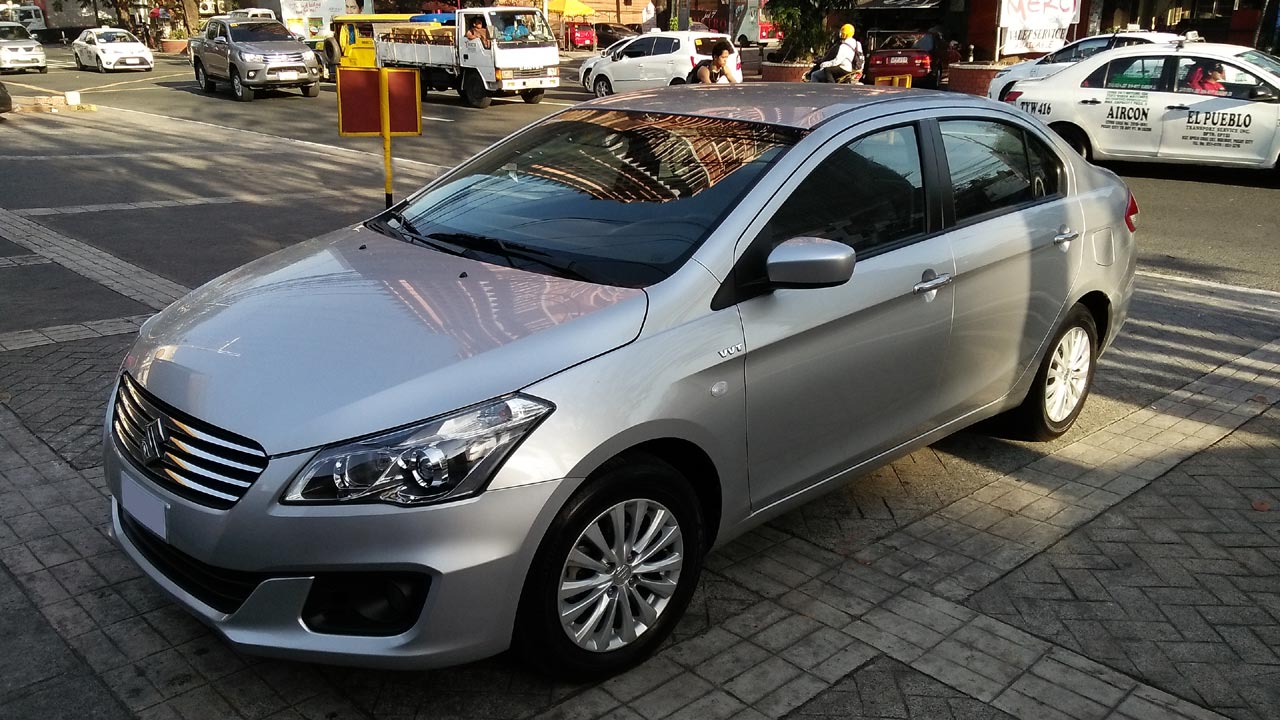
Get past the impressive trim on this base model—get used to it as the new normal, actually—and you’ll be more impressed with the Ciaz GL M/T’s powertrain that mates the small but VVT-equipped 1.4L K14B Suzuki engine with the nicely balanced ratios on a manual gearbox topped with an exquisitely positive stick-shift.

img20170223074202You can start by rolling her out like a diesel. Put her in gear and, with your foot off the gas, slowly let off the clutch pedal (letting the clutch plate ease onto the pressure plate) until you feel that initial bite. That’s when you press on the gas and further ease off the clutch pedal at the same time. The engine that can be quick to rev otherwise will then have all its revolutions pushing the sedan forward before you step on the gas in earnest, thus keeping revs down to under 1500rpm.

img20170223075050Then after, even still with just 1500rpm, the impulse to short-shift to save fuel in crawling city traffic is easy to give into. Topping out at 1500rpm, I could shift to second gear at 10, then to third at 25, then fourth at 40 and then finally to overdrive 5th gear at 50 km/h. And all these even with a full passenger load. The result was a quiet drive (onset of throatiness happens at 2000rpm) and fuel savings on city sorties that can impact the entire nation’s bottom-line.

Imagine getting to fourth gear by 40km/h and being able to stay there, lingering at a 1:1.00 direct drive ratio even if your speed drops down by as much as 5km/h, and cruising along with less than 1500rpm that gets you realtime mileage of 13km/l … to repeat, at 40km/h! The number gets to an astounding 20km/l, far as the trip computer is concerned, if you’re lucky enough to hit a fast moving patch and bring it to an overdrive fifth gear, city cruising at 50km/h with under 1500rpm.

Suzuki hits the mark with the Celerio CVT

Suzuki hit the sweet spot with their second-generation Celerio, upsizing its value proposition with the new hatchback’s roomy dimensions, and updating its refined powertrain with a continuously variable transmission (CVT) that’s easily gamed into delivering remarkable hybrid-like performance.

2t5c3425

Bigger but still nimble

2t5c3452Introduced late in 2015, the new Celerio turns the badge into a plus-sized A-segment hatchback with uncompromised seating for five adults and a weekender’s worth of luggage space with its best-in-class 254-liter cargo compartment. It’s now longer by 10cm with a proportionate lengthening of the wheelbase by 9cm, and it boasts of better headroom with a height increase of 7cm.

Those stretched dimensions now tracing straighter character lines seem to have brought more efficient options for making the unibody rigid enough. At 830kg, the new Celerio weighs slightly less than its previous generation model—to the tune of 30kg when comparing base variants. And weight savings did not come from thinning down the metal, this much is clear. The second-gen Celerio is thick-gauged enough to make it slightly heavier than the same-sized Toyota Wigo at 800kg, and the larger Mitsubishi Mirage at 820kg.

Handling and comfort are well balanced. She’s poised when cornering, the steering remains precise and body roll is managed well enough to keep the driver in confident stasis while steering and shrugging of G’s. The bigger dimensions leading to a longer wheelbase and wider tracks might even have improved the Celerio’s sporty demeanor.

img20161106114753Supple enough for both comfort and for keeping all four wheels planted, the suspension feels robust enough, the ground clearance sensible enough, for confidently taking on those occasional softroad challenges. And the wheels mount sedan-sized 165/65 R14’s—good feet under a light sub-compact, good enough but also shrouded by roomy fenders that can take wider rubber if you feel like tweaking those tires.

Quiet power

They kept the engine from the last generation Celerio, and with good reason. The K10B engine, with three inline cylinders displacing just 1.0L, delivers a surprisingly wide powerband and flat torque curve. Torque reaches useful strength long before the published peak of 90NM at 3500rpm. On rollout, there’s already 65NM on tap, or 72 percent of peak, at just 1000rpm. Then, for accelerating, bringing it to 2000rpm keeps things smart enough, putting out 80NM, or 88 percent of peak, and with the engine still at a quiet purr. From there on, torque reaches peak at 3500rpm, and stays above 90 percent until 6000rpm. The engine gets throaty only at around 3000rpm, comfortably above the turns you’ll need for smart acceleration in city driving.

img20161106111136On the automatic gearbox variant, the powertrain is completed with a two-range JATCO CVT7, the same continuously variable transmission used on the Mitsubishi Mirage CVT variant. The CVT7 adds an auxiliary gearbox between the CVT’s pulleys and the shaft to turn the drive wheels. With this auxiliary gearbox and its low and standard gear ratios, the pulleys meant to have continuously varying diameters are kept compact while still delivering a generously wide range of gear ratios starting with a deep bottom ratio of 1:4.07 in the low range, and going up to an exceptionally tall overdrive ratio of 1:0.55 in the standard range.

With this configuration, there’s low range gear reduction to multiply torque for fully loaded and/or uphill situations, and high range overdrive to turn the Celerio into a low-revving highway cruiser. Predictably, in the organized mass fuel-eco test conducted by the Department of Energy and by Petron last May, the Celerio CVT variant got top numbers overall with combined highway and city mileage pegged at 29.4km/l.

Game gearbox

In the face of the common complaint against CVT’s, about the rubber-band effect that typically plagues continuous variable transmissions, the Celerio offers an excellent workaround that could get the hatchback to performing as close to a hybrid as you can get without it being, you know, an actual hybrid. (Read on for a lighter take on how this can be, but see our related story, Gaming the Celerio CVT, for a deeper look into the mechanics of what we discovered).

img20161106110002As on most automatic gearboxes, conventional or CVT, the Celerio’s JATCO CVT7 uses a hydraulic torque converter to connect engine to transmission. Torque converters both tolerate and exploit slippage—tolerated because it’s a physical fact, there being slippage when you’re pumping fluid from an impeller to a rotor to transmit torque, and exploited because that slippage causes gear reduction that in turn multiplies torque. And that slippage is eventually eliminated with a lock-up clutch that creates hard contact between the torque converter’s pumping elements. Lock up happens late in the cycle, particularly on conventional automatic gearboxes, kicking in when the vehicle has reached cruise, after shifting all the way up to top gear.

While slippage is left to occur, it’s what actually causes that unpleasant rubber-band effect in CVTs. With hefty throttle, the torque converter’s slippage multiplies torque that quickly tapers off as the driven rotor catches up with the impeller’s revs. This complicates the task of the CVT’s controller, putting it behind the curve as it hunts for ideal gear ratios and corresponding pulley diameters. Result is momentary excess torque at insufficient speed, the engine roaring too much for the amount of force it delivers (that rubber-band stretching before coming back taught again).

2t5c3455The Celerio’s JATCO solution is elegant: since the torque converter feeds into a continuously variable system (no distinct gears, no shift shock), the CVT7 gearbox triggers the lock-up clutch early on, as early as during roll out, in fact. To bring it into play, use this Rule of Twos as described in our related story, Gaming the Celerio CVT: roll out by just stepping off the brake pedal and then easing in the gas to bring revs up to 2000rpm, no higher, and then wait for about 2 seconds. That much gas for that long will get you to 20km/h where you’ll notice revs dropping to 1500rpm. That’s your cue, the lock-up clutch is in and you now have hard, no-slip contact in the torque converter.

2t5c3429Go gentle on the throttle for those crucial seconds on roll out and you’ll be able to step on the gas however you like afterwards, and this while being treated to the Celerio’s surreal alter ego. With an engine that offers rich torque early on, that’s quiet until you want it to be otherwise, and with no slippage in the system to induce the dreaded rubber-band effect, this gamed Celerio will make you think Suzuki had somehow added an electromotor under the hood … she’ll be that zippy, and quiet.

And, beyond defeating that slippage and its rubber-band effect with this workaround, there’s also the option to come back out of clutch lock-up with a shift from standard down to low range on the CVT7 to contrive a fast-twitch kickdown where there shouldn’t be any, not on a CVT. (See our story on gaming the Mitsubishi Mirage CVT and find the parameters for doing this contrived kickdown safely on the larger hatchback that features the same JATCO gearbox.)

img20161106105436

For all comers

At a friendly P549K for an eco-friendly fuel miser, drive her right and the Celerio CVT is the closest you’ll come to experiencing a hybrid without it being, you know, an actual hybrid, and at the fraction of the price.

2008 A-Star / Alto / Celerio production model
The previous generation Celerio

Nevertheless, there are fans who lament the upsizing upgrades that, in their view, make the Celerio less sporty, no longer a pocket rocket. But the engineering is pretty much intact, made more elegant on a hatchback broken out of its small car niche and brought closer to the mainstream big leagues.

The numbers show it: the Celerio was Suzuki’s main growth driver in 2016, delivering an increase of 134 percent over the previous year’s older model sales (see their news release). And, what really should matter to all fans, both old and new, is that the young Celerio line is growing up but remains as sporty as when it had started out … you just have to look deeper to see it.

img20161106112845

Gaming the Celerio CVT

On Suzuki’s Celerio CVT (continuously variable transmission) variant, what would seem a drawback is something that’s stock on all continuous variable transmissions. But, rather remarkably, it’s something that can be worked around, particularly on the Celerio’s JATCO CVT7 gearbox.

2t5c3424

jatco-cvt-7-slides-400Transmission trade-off

The usual complaint against CVT’s is that rubber-band feel of the electronics searching for the ideal gear ratio when accelerating with heavy revs. It manifests with the engine momentarily producing audibly strong revs although without transmitting the commensurate torque to the drive wheels. And yet, that effect is actually caused by intentional slippage in what connects engine to CVT.

Just downstream of the engine is a hydraulic torque converter that uses fluid force pumped from an impeller into a rotor (like two propellers face to face, one blowing at the other) to transmit torque to the core of the CVT gearbox. As expected, there’s slippage in the system, the speed of the impeller typically being faster than that of the rotor that it pumps fluid into, but it’s not merely tolerated.

img20161106110002That slippage is also intended to multiply torque, with multiple revolutions of the impeller to a single one for the rotor translating into actual, albeit somewhat abstract, gear reduction. In fact, there’s liberal slippage in some transmissions (indicated as having high stall speeds) to harness this fluid amplification of torque.

On the compact CVT7 gearbox driving the light Celerio hatchback, this slippage does seem to be kept at a minimum, but it’s still there. And, while this is going on in the torque converter, the core of the gearbox is where pulleys connected by steel belt have their diameters automatically expanded or contracted to continuously vary the gear ratios. Varying pulley diameters to drum up ideal gear ratios already takes finite time, with algorithms still having to act through mechanical servos. And, that perpetual hunt for ideal ratios becomes more complex when coping with surging or receding torque caused by slippage in the torque converter.

img20161106111136Other words, that rubber band effect? It’s caused by slippage in the torque converter changing the parameters even while the electronics are in the process of implementing ideal gear ratios. This analysis of the problem is lengthy, sure, but it’s also the exercise that Suzuki must have endured to have chosen the JATCO CVT7 gearbox for the Celerio. Because, as it turns out, when they made the pulleys more compact by adding an auxiliary two-range gearbox on the CVT7, the dynamics of driving smaller discs, and the serendipity of not having to step through discrete gears (as on a conventional AT), gave JATCO a way to eliminate slippage as soon as the driver makes it superfluous.

Slippage in torque converters is eventually eliminated when the impeller and rotor revolutions come close to matching up and a clutch kicks in to lock one to the other, but this lock-up clutch is typically activated late in the cycle—as on conventional automatic transmissions, only when the vehicle has already reached top gear, after slippage has cushioned all those up-shifts. But, on the JATCO CVT7, since the torque converter feeds into a continuously variable system—no distinct gears, no shift shock—the gearbox triggers the lock-up clutch as soon as the revolutions on impeller and rotor come close to matching up. And, on the CVT7, that can happen as early as on roll-out.

2t5c3433

Gaming the gearbox

The solution then, as it’s made available on the CVT7, is to throttle gently until the lock-up clutch kicks in—the gentler you are on the gas, the sooner the lock-up. Use this Rule of Twos: roll out by just stepping off the brake pedal and then easing in the gas to bring revs up to 2000rpm, no higher, and then wait for about 2 seconds. That much gas for that long will get you to 20km/h where you’ll notice revs dropping to 1500rpm. That’s your cue, the lock-up clutch is in and you now have hard, no-slip contact in the torque converter.

2t5c3452After that short 2 second wait, feel free to put in as much gas as you want. Go stronger with 2500rpm after the 2 second wait and you’ll get distinctly smart acceleration, promptly reaching 100km/h and levelling off to 2000rpm for an easy highway cruise. Go higher and the engine starts to get throaty around 3000rpm. Floor it and the Celerio’s drive-by-wire system will intervene, making throttle up assertive but still somewhat gradual, to accelerate well beyond 100km/h with the revs regulated to a 6000rpm maximum.

Of course, the JATCO CVT7 is remarkable not only because of this feature for early clutch lock-up. There’s the option to even come back out of lock-up with a shift from standard down to low range to contrive a fast-twitch kickdown where there shouldn’t be any, not on a CVT. (See our story on gaming the Mitsubishi Mirage CVT and find the parameters for doing this contrived kickdown safely on the larger hatchback that features the same JATCO gearbox.)

Easy economy

But, bringing things back to urban realities, if you settle for bringing revs back to 2000rpm after that 2 second wait (after that drop to 1500rpm with the lock up clutch kicking in), you’ll soon get to a city cruising speed of 60km/h that can then be sustained with just 1500rpm, there with the Celerio delivering max-conserve figures that are off the scale (beyond the instrumentation’s 30km/l max indication).

img20161106110235

Using this Rule of Twos while generally staying under 2500rpm, I got mileage of 12km/l through 100km of moderate traffic in the city, 10km/l when dealing with heavy traffic that slowed travel to an average of 15km/h. This is still consistent with the 29.14km/l that made the Celerio CVT the top scorer on the mass fuel-eco test conducted by the Department of Energy (DoE) and Petron last May over a test course that included a fair stretch of NLEX.

Quick note: the hybrid-sensation on a Suzuki Celerio

Drive her right and the CVT variant of the second-gen Suzuki Celerio is the closest you’ll come to experiencing a hybrid without it being, you know, an actual hybrid.

Exploiting that early clutch lock-up on the Celerio’s JATCO CVT7 gearbox mitigates the typical “rubber-band” feel of continuous variable transmissions. And, with the sub-compact hatchback’s 1.0L 3-cylinder K10B engine delivering peak torque so early, waiting those few seconds for lock-up before getting assertive on the gas pedal will deliver this pleasant disconnect between a nice surge in force and the engine still running quietly under 2500rpm.

Good torque even with silent running and the smooth shiftless feel of a sensibly driven CVT, you’d think they somehow snuck in an electromotor under the hood.

Suzuki redefines the multi-cab

Just months after the model was introduced globally, Suzuki Philippines brings back to their showrooms the Super Carry of long-running multi-cab fame. This time, it’s with a powertrain that’ll cause double takes among the street savvy and even with those who’ve thought of upgrading beyond their surplus-sourced mini trucks. For the new Super Carry mounts a two-cylinder 793cc intercooled turbodiesel, a unique engine that’s been proving itself roadworthy in tough real world conditions. Since last year, its been used in India on the diesel variant of Suzuki’s popular Celerio sub-compact hatchback.

Press Statement by Suzuki Philippines, Inc., “Suzuki Philippines brings new line in the Utility Commercial Vehicle segment with all-new Super Carry,” 2016:

suzuki-executives-with-the

Manila, 27 October 2016—Today,  Suzuki Philippines (SPH), the pioneer manufacturer of compact vehicles, officially launched the all-new Super Carry at the Megatent Events Venue in Quezon City.

Bringing in additional line up in the utility commercial vehicle segment, an emerging segment with 11% percent year-on-year growth, SPH aims to cater to the needs of small to medium-sized businesses.

“Super Carry is brought to the Philippine market with the objective of improving business processes and operations especially among small and medium sized businesses which comprise more than 90 percent of the overall in the country” said Mr. Shuzo Hoshikura, Suzuki Philippines General Manager for Automobile.

“We seek to help more businesses flourish and reach their maximum potential and what better way is there than through this reliable workhorse,” he continues.

Following the ever-growing number of MSMEs in the country are corresponding implications. Among these are the daily inconveniences brought by the pressing need for transport vehicles such as heavy traffic, increasing fuel costs, uneven road conditions and worsening pollution.

Built to endure the toughest of conditions, this utility commercial vehicle is designed to address such issues. Equipped with strength, high quality performance, superior loading capacity and a Euro-4 certified Diesel engine, Super Carry is really meant to serve as a perfect fit for any kind of business’ requirements in a manner that truly cares for the environment.

High performance

Offering superior loading capacity with an area of 3.25 sqm and a maximum capacity of 735 kg, Super Carry is equipped with a light steering wheel and a low turning radius of 4.3M which allows effortless driving no matter how heavy the cargo is and ensures easy maneuverability even in tight areas.

It features latest automotive technologies – the 793cc, 2-cylinder and DDis Euro-4 diesel engine with 5 speed manual transmission, and a peak power of 32 HP @ 3,500 RPM and torque of 75 NM @ 2,000 RPM – making the vehicle more cost efficient and eco-friendly than others of the same caliber. It consumes a mere liter of diesel for an average distance of 22.07 km which makes going around for errands less costly and more practical.

The new engine is also equipped with an Engine Control Module or ECM that monitors its condition during servicing and ensures continuous peak performance. It complies to the latest regulations on emissions standards and exhibits lower emissions than Euro-2 engines at 68 percent less particulate matter emissions, 57 percent less nitrogen oxides emissions, and 50 percent less carbon monoxide emissions, for a more environment-friendly driving.

Comfort & Convenience

The designers of the Super Carry gave careful thought to the comfort and convenience of the driver and passengers and enhanced both via the vehicle’s spacious interior and cabin features.

With the driver seat adjustable up to 90mm coupled with the extended portion of the passenger seat, there is enough legroom and space for the driver to lie down and combat fatigue in between long drives.

The cabin also features numerous cubbyholes, trays, pockets and storage spaces for documents, food items and other necessities.

Underneath the seats are thick glass fiber heat shields for better insulation. The bulb/balloon type weather strip in the Super Carry also lessens noise, vibration and harshness (NVH).

To add to the driving comfort, its pedals, gear shift knob and instrument panels are all ergonomically positioned.

The vehicle’s rear window is also bigger and can readily be opened with an ergonomically placed locking mechanism. This allows a large amount of air to flow inside the cabin when needed.

Safety & security

Fitted with theft prevention measures, Super Carry features a lock-on fuel tank cap, a secured spare tire mounting bracket, and battery with provision of lock.

Inside the cabin, the seats are equipped with a 3-point Emergency Locking Retractor (ELR) seatbelt.

The Super Carry ensures superior braking performance via a front ventilated disk brake for better heat dissipation, plus drum brakes on the rear featuring Load Sensing Proportioning Valves (LSPV) for stabilized braking in different load conditions.

Sealing the deal are the high tensile and galvanized chassis materials used in the Super Carry. The galvanized materials provide more resistance to rust while high tensile materials limit intrusion inside the cabin.

Its integrated sheet metal body front panel enhances body quality and rigidity, as well as, ensures the driver’s safety. This is complemented up front with a bigger windscreen for better driver visibility.

Accessories

The Super Carry has a 1 Din Audio Unit with Built-In speaker featuring AM/FM Tuning, USB/SD Interface, Auxiliary input and LCD display will make driving the Super Carry more enjoyable.

This Super Carry in four different body types with the new APV Utility Vehicle (UV) with Dual Aircon will surely bring any business to new heights!

The Super Carry Truck Php479,000
The Super Utility Van (UV) Php565,000
The Super Carry Cargo Van (CV) Php529,000
The Super Carry Jeepney Body (JB) Php550,000
The APV Utility Van w/ Dual Aircon (UV) Php630,000

img20161027114535

For more information  on the Suzuki Super Carry,  please visit http://suzuki.com.ph/auto/ and like it on www.facebook.com/SuzukiAutoPH, https://twitter.com/SuzukiAutoPH and follow on Instagram at @suzukiautoph.

Suzuki Swift 1.2L AT: smaller engine, taller stance, still Swift

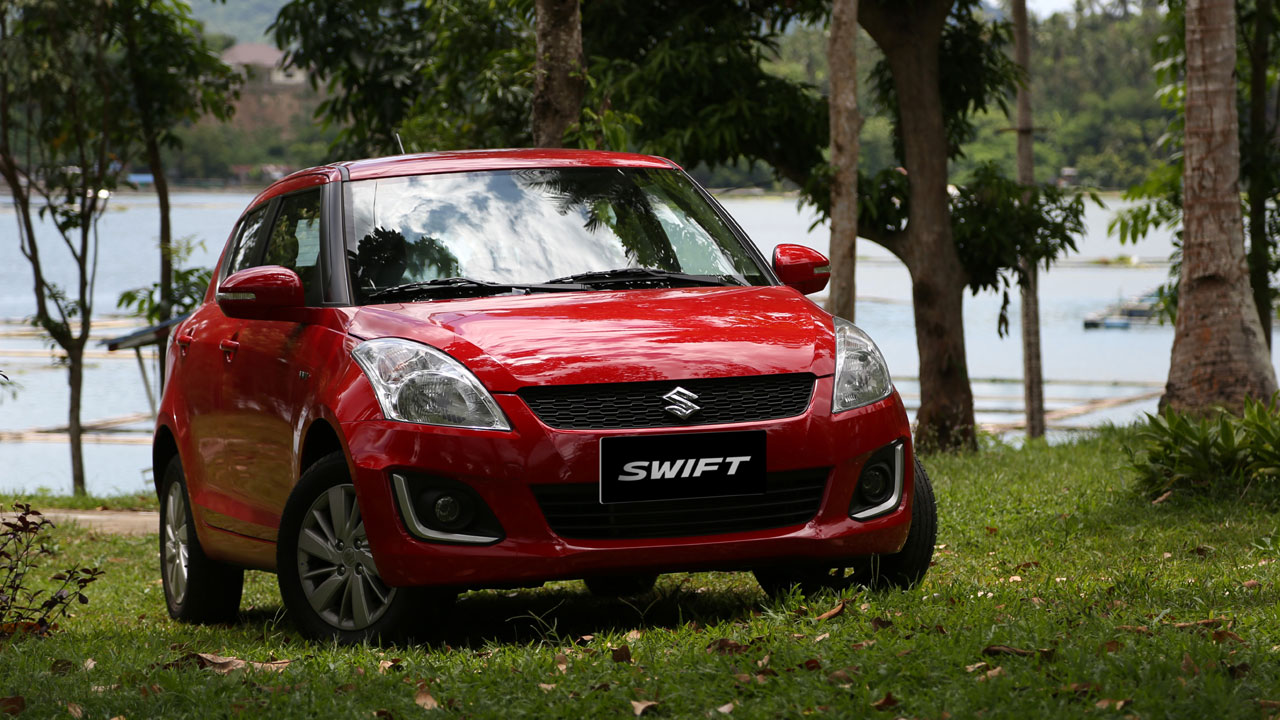
With the Swift’s smallest engine yet, and riding higher with big cushiony tires, its 1.2L version might seem to hurt the hatchback’s stellar standing, but it doesn’t, not in the least.

The Swift looks small the same way the current-model MINI is, which isn’t, not anymore. It’s all in the proportions and what Suzuki is known for: compact, subcompact, even smaller than subcompact automobiles. Spot a Swift on the road, her rather un-small size becomes obvious beside other, efficiently proportioned cars, more so if you spy her beside the smaller Celerios and Altos from the Suzuki stable.

In the Suzuki line-up of small and even smaller cars, the Swift is both upscale and big. Her defining form was laid out in 2004, on her second-generation model, and Suzuki knew well enough not to mess with a good thing when they rolled out the third-gen evolution in 2010.

2t5c1478

Her lines are elegant enough to eventually become classic, her hatchback form making her look smaller than she really is. The Swift is shaped into a ground-effect half-shell, that dome of a hood flaring into a cabin made rakish by up-sloping character lines and tapering to the rear to render the whole body into an aerodynamic teardrop.

Swift’s street cred

With its volume whittled down to the rear, it of course has a small boot—just 211 liters in capacity but expandable by collapsing the rear seats. That’s just the predictable tradeoff on a hatchback cut out for sportier stuff. For the Swift’s handling is a given, its responsiveness well known among her followers. Good and fun on the twisties.

2t5c1487-croppedThe wheels are pushed to the corners of a trunkless body with very little overhang, the Swift’s length dominated by that long 2.43m wheelbase. What overhang lingers is mostly in front where the extraneous weight is pushed into turns by the steered wheels, not trailing behind the rear wheels where centrifugal force would act on it more and possibly cause lift-off oversteer. At close to 70 percent of its wheelbase, the Swift’s width puts the wheels on wide tracks, splayed out well to keep her grippy and upright through those fast turns.

No surprise that the Swift has gone further in other markets with more powerful engines mounted on sportier variants, and further in engineering with the hatchback’s platform stretched out and built up into the three-row wagon that is the popular Ertiga MPV. What did surprise was when they came up with this high-riding 1.2L version for our market instead.

The Indian connection

What seemed like Suzuki’s attempt to recast the Swift as an economy hatchback, their adding this 1.2L version to the 1.4L one they started out with in the market, actually traces back to an astute move for the India market. Maruti-Suzuki, the Indian-Japanese partnership has 45 percent of India’s huge 2 million unit automobile market, and that is where the Swift 1.2L was introduced to get the hatchback into the country’s Sub-4 tax category.

2t5c1509

Under the Sub-4 category, all vehicles measuring less than four meters and mounting petrol engines displacing 1200cc or less are subject to reduced excise taxes of just 12 percent. And that tax break matters enough to have global leader Toyota trying to develop a new Sub-4 car and, at the same time, lobbying the Indian government to cancel the category and the tax advantages it affords their competitors.

img20160519122654Other than its left-hand drive configuration, the Swift 1.2L here matches India specs so closely, it even features the same ground clearance—raised from the 1.4L’s 140mm up to the Indian 1.2L’s 170mm. (Clearances of 160mm or more are typical in India where roads could be much rougher than those we have here.)

And, although we ourselves don’t have a Sub-4 tax category, the downstream effect seems to bring major savings to Suzuki Philippines, savings that are telegraphed to buyers with Swift 1.2L variants being priced lower than those of the Swift 1.4L by more than P100k. But have those savings come at too much of a cost? With a less powerful engine and higher center of gravity, is the Swift 1.2L still worthy of the popular badge? Yes, apparently so.

Still swift

Delivering 87hp @ 6000rpm and 114NM @ 4000rpm, this Swift’s 1.2L K12M engine gives up 9 percent in horsepower and 15 percent in torque to that of the 1.4L K14B. That’s enough of a downgrade to raise concern, better nominal fuel economy or not, considering the Swift’s around 1,000kg of curb weight. And, on the 1.2L AT variant we tested, matters are compounded by pumping losses inherent in all automatics.

2t5c1492But on the Swift 1.2L AT, the automatic gearbox is so well tuned to that smaller engine, the slightly lower torque seems well compensated for by proportionate, well matched slippage in the transmission’s hydraulic torque converter. Slippage happens when the impeller driven by the engine’s flywheel rotates faster than the turbine that it pumps hydraulic fluid to, the turbine which in turn drives the transmission. That slippage may seem inefficient but it actually multiplies torque (and is not the cause of an AT’s pumping losses, not in itself). Think of it as dynamic gear reduction that self-adjusts as the turbine and impeller eventually match rotation rates. On the Swift 1.2L AT, that slippage is working the whole time you’re accelerating, becoming more apparent whenever you stomp on the gas.

2t5c1510With the engine at idle, the Swift 1.2L eagerly rolls out as soon as you let off the brake. Slowly increasing throttle then will bring assertive acceleration at around 2250rpm, eventually bringing you to a cruise with shift points at 20, 50 and 80km/h. Settle down at 80km/h and clutch lock-up will soon kick in, that hydraulic action between impeller and turbine being replaced with this hard physical contact that then eliminates slippage. You can then ease off the gas to maintain cruise with 2000rpm—note that 250rpm increment from the 2250rpm you were using with hydraulic conversion still going on.

img20160519123733Go faster and you’ll notice revs going relatively high, the 1.2L’s need for more gear reduction becoming obvious. But the engine’s variable valve timing (VVT) valvetrain seems to compensate well, making the fuel mix lean enough to deliver impressive consumption numbers of 16km/l while cruising at 100km/h with 2500rpm, 19km/l at 90km/h with 2250rpm, and 20km/l at 80km/h with 2000rpm.

If you punch it for an overtake while at cruise, the transmission does a prompt kickdown out of 4th gear overdrive, zooming you up quickly to 140km/h, the lock-up clutch disengaged and engine revs quickly climbing to 5000rpm. With the engine revved up that much, the slippage-amplified torque is made apparent by this relentless acceleration.

img20160519124515

Still a Swift

With that kind of performance, the 1.2L is spirited enough to demand good handling. And on the 1.2L, even with a higher center of gravity, the Swift’s famous handling is still there, mostly intact. Although there’s pronounced wind noise above 100km/h, the Swift is rock steady at high speed. There’s no denying the fact that the higher ground clearance lets more air get under the front spoiler.

img20160519124556But the reduction in aerodynamic down-force seems marginal enough not to erode the Swift’s ground-hugging weight. In fact, the slight reduction in down-force, making the Swift somewhat lighter at high speed, seems to contribute to its impressive fuel economy

Contributing to that higher ground clearance are 185/65 tires mounted on 15” alloy rims. These are the biggest wheels they’ve put on a Swift, their 621mm as big as on the rugged Toyota Avanza sub-compact MPV. High ground clearance and these big wheels make easy work of rough roads–the height above ground giving you confidence in negotiating uneven surfaces, those big cushiony tires easing onwards past holes and bumps.

2t5c1436

The door sticker says 29psi max pressure on all tires. This means the Swift’s weight on those big tires is manageable enough to allow tire pressures of under 30psi, and that weight is distributed evenly enough to put equal loading on the hatchback’s front and rear axles. With judicious tire pressure adjustments, the high-walled tires can be inflated up to 29psi for smooth highways, or slightly lower for everyday mixed terrain. With two guys on board, the Swift 1.2L rode well and evenly on tires inflated to just 28psi, fighting nicely against body roll and wayward steers in fast curves reaching 80km/h.

2t5c1424

It was a risky thing for Suzuki to have offered the Swift 1.2L. Over here, there isn’t the tax break that overtly justifies its downsized engine nor the Indian context for country roads ground clearance. But because it retains that healthy power reserve and trademark handling, while also offering its tall big-wheeled stance and significantly lowered price points, the Swift 1.2L has definitely been a risk well taken.

2t5c1409

Suzuki keeps bringing in firsts with their all-new Ciaz

Suzuki Philippines is putting their hopes of topping last year’s phenomenal 52 percent growth on the all-new Ciaz sub-compact sedan.  It’s their first Asia-specific model in a segment resurged by new Uber- and Grab-prompted demand, and it’s the first car model they’ve ever launched with an organized test-drive for the press. 

When the Ciaz was introduced in India with its huge two-million strong vehicle market, it stirred things up immediately. The new model was accepted so quickly, and in elegantly de-facto manner, that it picked up windfall demand from the long waiting lists of buyers made impatient by the slow delivery of other, already popular sedans.  At the very least, the Ciaz’s entry benefited that market by forcing competitors to speed up production.

Now, with the Ciaz, Suzuki seems determined to cause a similar upheaval here (see our special report).  So much so that they’ve now done an organized test drive for representatives from the country’s leading banks.  With the resurged demand for sedans hinging on the availability of financing, this latest initiative, another first for them, shows Suzuki making all the right moves with their all-new Ciaz.

Press Statement by Suzuki Philippines Incorporated, “The all-new Suzuki Ciaz captures hearts of test drivers” 2016:

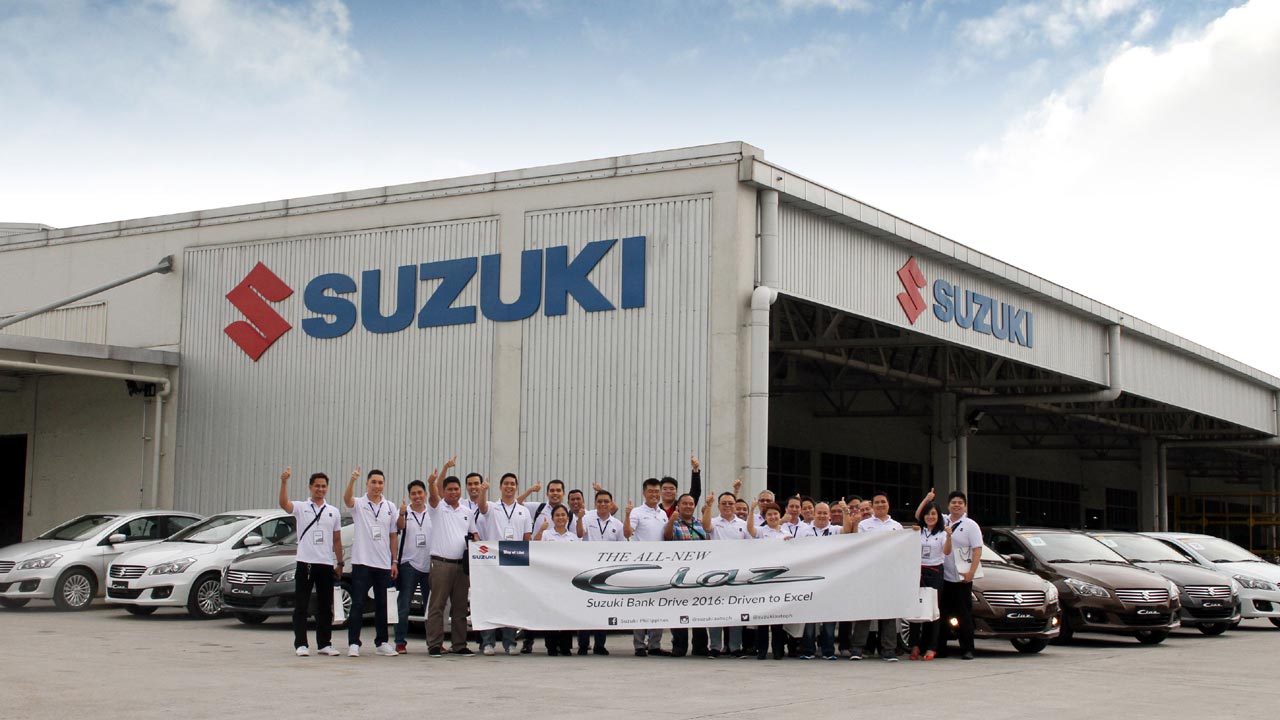
Manila, 05 July 2016—The all-new Suzuki Ciaz, launched in the country last April, has piqued the interest of thousands of car lovers who want to try the next-level comfort and road handling excellence of this subcompact sedan, prompting Suzuki Philippines to hold a test drive for bankers last May 31, 2016.

2T5C0542A total of 27 representatives from the leading names in the banking industry road tested the Ciaz which boasts of best-in-class fuel efficiency, a sporty yet elegant exterior design, and other advanced features.

Suzuki Philippines’ General Manager for Automobile Mr. Shuzo Hoshikura beams with pride over the apparent positive response of the market to the newest member of Suzuki’s B-segment vehicles. “Since the introduction of the all-new Ciaz in April this year, the number of inquiries and request for test drives we have been receiving about this sedan has pleasantly surprised us. With this overwhelming response, we believe that the Ciaz will be one of our bestsellers this year, and contribute significantly to the company’s continuous growth. We hope that with this model as well as all of our other best-loved vehicles, we will be able to top last year’s impressive 52% y-o-y growth,” Hoshikura said.

For more information about Suzuki Philippines and their automobiles, please visit http://suzuki.com.ph/auto/ and like them on www.facebook.com/SuzukiAutoPH, https://twitter.com/SuzukiAutoPH and follow on Instagram at @suzukiautoph.

Suzuki’s new Celerio hatchback and Ciaz sedan top DOE-Petron fuel economy rankings

Like we said, Suzuki is a brand to watch this year. At the recently concluded multi-carmaker fuel-eco run organized by the Department of Energy (DoE) and Petron, the all-new and bigger second-generation Celerio that Suzuki introduced last year delivered the best efficiency among all gasoline engine cars. Not a surprise since the winning CVT variant of the Suzuki hatchback has the same JATCO CVT7 two-range continuous variable transmission that gives the 1.2L Mitsubishi Mirage an exceptionally high overdrive gear ratio, and this one on the Suzuki’s slightly smaller 1.0L three-cylinder engine. While the new Ciaz compact sedan they rolled out just last March turned in the best efficiency on a gasoline engine sedan, confirming that this exceptionally big sub-compact is the strong new Uber and Grab car contender that challenges the dominant position of the Toyota Vios.

Press Statement by Suzuki Philippines, Inc., “Suzuki Celerio and Ciaz get top honors at DOE-Petron Fuel Economy Run” 2016:

Manila, 21 June 2016—Suzuki Celerio, one of Suzuki Philippines’ best-selling cars, clinched the top spot for fuel efficiency in the gasoline engine category at the first-ever Euro 4 Fuel Economy Run organized by the Department of Energy (DOE) in partnership with Petron Corporation. Out of the 70 different vehicles from more than 20 different manufacturers that participated last May 27, 2016 in the 280-kilometer run, Celerio gave the best fuel economy performance in a pioneering event aimed at providing vital information on the fuel economy performance of vehicles and raising public awareness on the use of cleaner and more efficient Euro 4 fuels. All of the vehicles used Petron’s Euro-4 quality products.

The DOE, which intends to institutionalize a fuel efficiency labeling program using the results of this test drive as the benchmark, released the results of Euro 4 Fuel Economy Run early this June and recognized all participating car brands with certificates. The program is pursuant to DOE’s aim of expanding the Philippine Energy Standards and Labeling Program’s (PESLP) efforts to include more appliances, lighting systems, and light-duty motor vehicles to strengthen the country’s energy efficiency and conservation efforts.

New-Suzuki-Celerio-BS-(1)Suzuki Celerio CVT emerged to have the best gasoline-powered engine after achieving 29.14km/L in the run which stretched from Angeles, Pampanga through the Subic-Clark-Tarlac Expressway (SCTEX) and Tarlac-Pangasinan-La Union Expressway (TPLEX) and back. Aside from the Celerio, the all-new Ciaz Manual Transmission (M/T) likewise topped the fuel-efficiency test in the gasoline sedan category, clocking in at 27.94km/L. Other Suzuki vehicles also participated in the exercise, including Celerio M/T (27.70), Ciaz GLX A/T (22.93km/L), Swift 1.2 (22.35km/L), and Ertiga GLX A/T (22.03km/L).

2T5C0542SPH General Manager for Automobile Shuzo Hoshikura shared, “We are truly proud of the achievement of our top favorite products, the Celerio and Ciaz. This is indeed a great testament to our commitment to bring the highest quality and most fuel efficient vehicles in the market. Recognitions like this inspire us to continue developing and manufacturing premium and reliable cars.”

Celerio features an A+ compact build which is based on the “small on the outside, big on the inside” concept. It sports the dynamic and easy-to-maneuver design Suzuki compact cars are known for, while offering spacious room for passengers, relatively huge luggage capacity and great fuel efficiency.

The newly rolled out subcompact Ciaz, on the other hand, blends sportiness that conveys the expectation of driving and a stunning feeling of elegance. Its name stands for “City from A to Z,” capturing the essence of Asia’s fast-growing metropolitan landscape. It is packed with best-in-class fuel efficiency and other advanced features coupled with a sporty, elegant exterior design and refined interiors.

For more information about Suzuki Philippines and their automobiles, please visit http://suzuki.com.ph/auto/ and like them on www.facebook.com/SuzukiAutoPH, https://twitter.com/SuzukiAutoPH and follow on Instagram at @suzukiautoph.