Volkswagen newsmakers on mall tour this weekend

After last week’s game changing debut of Volkswagen models sourced from China (and priced for Asia) for the very first time, the Volks folks are now ready to have their new Santana and Lavida sedans, and their new Tiguan Mk.I crossover SUV, scrutinized and scrutineered by the motoring public. Tomorrow and on Sunday, get up close and personal with the Volkswagen newsmakers they’ll be exhibiting at the Glorietta Activity Center in Makati and at the Eastwood Mall Atrium in Quezon City.

Press Statement by Volkswagen Philippines, “Newly launched Volkswagen models go on weekend mall tour on May 26-27,” 2018:

Volkswagen Philippines, which just launched its five groundbreaking models: the Santana MPI M/T Trendline, the Lavida 230 TSI DSG Comfortline, the Tiguan 280 TSI DSG Comfortline, the Santana GTS MPI A/T Comfortline, and the Lamando 280TSI DSG Highline last May 18 at the Shangri-La at the Fort, now takes its newest vehicles closer to the public via a mall tour this weekend of May 26 and 27.

From 9 a.m. to 10 p.m., mallgoers at the Glorietta Activity Center in Makati City will get to see up close the Santana MPI M/T Trendline, the Lavida 230 TSI DSG Comfortline, and the Tiguan 280 TSI DSG Comfortline. Shoppers at the Eastwood Mall Atrium in Libis, Quezon City will also see these three new vehicles on display from 11 a.m. to 10 p.m. (May 26) and from 10 a.m. to 10 p.m. (May 27). And from 10 a.m. to 10 p.m., Cebuanos will also get to see these three new models at The Gallery of Ayala Center Cebu.

Volkswagen Lifestyle items will be given to customers who will make inquiries, or book a test drive.

The Santana, which was among the 10 best-selling models in China in 2017, is powered by a 1.4-liter Multi-Point Injection (MPI) 4-cylinder gasoline engine mated to a 5-speed manual transmission, with maximum power output of 90 Ps at 5,500rpm and maximum torque of 132 Nm at 3,800rpm. For ride comfort and stability, the Santana features electronic power steering, front McPherson Independent Suspension, and rear composite torsion beam semi-independent suspension. Safety highlights include ISOFIX anchorage points (mounting fixture for two child seats on rear seat bench), Anti-lock Braking System (ABS), and wireless doorlock with immobilizer. Available exterior colors are Polar White, Reflex Silver, Pepper Grey and Deep Black with an SRP starting at P686,000.

The Lavida, which is still one of the best selling sedan Volkswagen model, is equipped with a 1.4-liter Turbocharged Stratified Injection (TSI) 4-cylinder gasoline engine with BlueMotion Technology mated to a 7-speed Direct Shift Gearbox (DSG) transmission, capable of 130 Ps of power at 5,000 rpm and 225 Nm of torque at 1,400 to 3,500 rpm. The interior features and comfort amenities include leather seat material, cruise control, Climatronic air conditioning, and sunroof. Safety highlights include the Electronic Stabilisation Program (ESP) with Brake Assistant, ABS, Electronic Differential Lock and Anti Slip Regulation (ASR), hill hold control, Push Start, and Front and Rear Park Distance Control (PDC). Available exterior colors are Polar White, Reflex Silver, Deep Black, Limestone Grey, Sunset Red, and Opalsilver Metallic with an SRP starting at P1,171,000.

The Tiguan, which has comfortably maintained its position as segment leader, has a 1.4-liter TSI 4-cylinder gasoline engine with BlueMotion Technology mated to a 6-speed DSG transmission. Maximum power output is 150 Ps at 5,000 rpm, while maximum torque is at 250 Nm at 1,750 to 3,000 rpm. Its interior features and comfort amenities include Vienna leather seat material, 2-zone Climatronic airconditioning, Panoramic sunroof, 8 speakers, and driver power 12-way seat adjustment. Safety systems include ISOFIX anchorage points, ESP, ABS, brake assistant, ASR, EDS, EDTC, hill hold control, and rear PDC with acoustic warning signal. Available exterior colors are Polar White, Titanium Beige, Hunting Brown, and Deep Black with an SRP starting at P1,648,000.

The warranty coverage for all these five new models are comprehensive. Aside from the 3 years or 100,000-km general warranty, whichever comes first, Volkswagen Philippines also offers a 3-year warranty for paint and another 3-year warranty for through-corrosion of the main steel body structure.

The periodic maintenance service (PMS) interval schedule for these new models is also structured for its owners convenience. The PMS interval is once a year, or every 10,000 kms, whichever comes first. This is more convenient and more cost-efficient compared to the industry-standard 5,000-km PMS interval.

Beyond the vehicles value-for-money specifications, features, and the warranties and PMS intervals, the five new models unveiled open new chapters to the continuously evolving relationship between Filipinos and Volkswagen, making the world-class auto brand much more accessible than ever to the Filipino car-buying public.

Automotive excellence and heritage unique to Volkswagen are now within reach of the hardworking, daring Filipino. And when these cars eventually bring you to the verge of your own personal breakthrough, thats when you know that with Volkswagen, Your Drive Just Got Better.

The Santana MPI M/T Trendline, Lavida 230 TSI DSG Comfortline, and Tiguan 280 TSI DSG Comfortline are available at all eight Volkswagen Philippines dealerships: Volkswagen BGC at 938 28th Street City Center, Bonifacio Global City, Taguig City; Volkswagen Quezon Avenue at 1229 Quezon Avenue, Quezon City; Volkswagen Alabang at Caltex along Alabang-Zapote Road, Madrigal Business Park, Ayala Alabang, Muntinlupa City; Volkswagen Greenfield District Service Center at 833 Sheridan Street, Barangay Highway Hills, Mandaluyong City; Volkswagen Pampanga at McArthur Highway, Dolores, City of San Fernando, Pampanga; Volkswagen Cebu at A. Soriano Avenue, North Reclamation Area, Cebu City; Volkswagen Iloilo (upper ground level of SM Iloilo along Benigno Aquino Sr. Avenue), and Volkswagen Bacolod (along Araneta Street, Singcang, Bacolod City, Negros Occidental).

For more information, log on to www.volkswagen.com.ph
BAIC joins jeepney modernization push with biggest Class 1 prototype so far

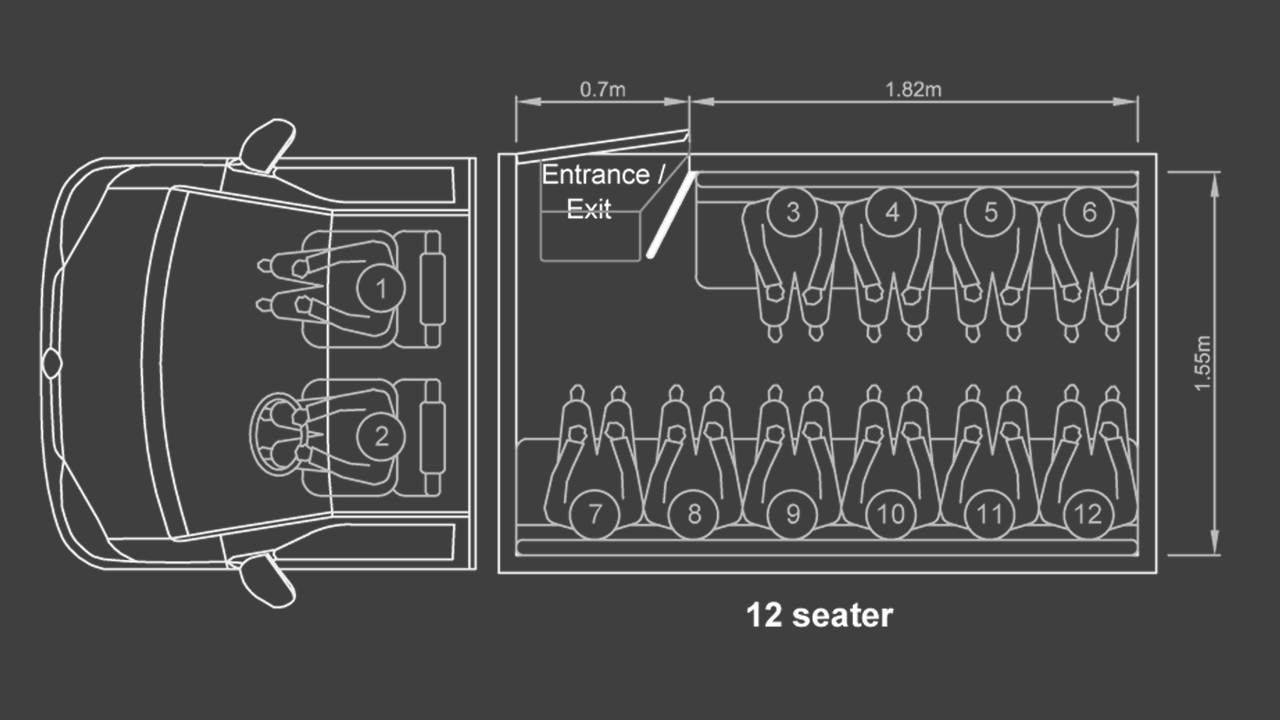
BAIC Philippines unveiled their Kalayaan jeepney prototype last month, putting it on display at the Land Transportation Office’s 106th anniversary motor show last month and, in so doing, announcing their participation in the country’s public utility vehicle modernization initiative. Based on BAIC’s Freedom compact truck and meant to be a compact commuter for short routes on crowded city streets, the 12-seat Kalayaan is the biggest prototype in the Class 1 category so far. Before the Kalayaan, the Suzuki’s 10-seat Super Carry jeepney prototype dominated the category.

Still in prototype stage with an Almazora-built body that looks to be from the same template as that on the Suzuki Super Carry, the Kalayaan’s 810kg payload can conceivably be made to seat even more, up to 14 people including the driver. Adding to the two seats in the front cabin, the rear body seating capacity can be increased to an even dozen if allowances are reduced from 40cm- down to 35cm-wide seating for each passenger, and the rear door is narrowed down from 70 to 65cm wide (to accommodate more side-facing seating on the door’s side).

Suzuki Origins

Interestingly enough, Japanese-Suzuki origins are starting to look commonplace in the Class 1 jeepney category. Before the Kalayaan came along, the Class 1 category was dominated by Suzuki Philippines’ 10-seat Super Carry jeepney. And, that Suzuki Super Carry truck platform actually comes from another Suzuki joint venture, this one from the Maruti-Suzuki partnership in India.

Both prototypes are built on Suzuki platforms evolved further by joint-ventures outside of Japan. And, predictably, both the BAIC and Suzuki platforms feature very similar rear bodies built by Almazora, though with the Kalayaan having the advantage of single-body construction with the rear box being welded to the front cabin.

In contrast, where the Suzuki Super Carry is a slightly enlarged version of the 9th-generation Carry micro-truck with it’s cab-over cabin (driver position atop front wheels), the BAIC Kalayaan’s platform is the Carry Extra–a significantly scaled up version of the Carry’s 10th-generation with that edition’s distinctive semi-forward cabin (driver behind front wheels). This explains the difference in payloads and dimensions that result in one having 10 seats, the other having 12.

The Kalayaan is based on BAIC’s Freedom compact truck that’s in turn sourced from the BAIC Group’s Jiangxi-Changhe joint venture with Suzuki Automobile of Japan. Notably, the Kalayaan is powered by a license-built Suzuki K14B-A inline 4 petrol burner, an engine from the same series as that of the Suzuki Ertiga MPV and Ciaz sedan.

<SOURCE> Press Statement by BAIC Philippines, “BAIC Philippines introduces biggest Class 1 modern jeepney prototype so far,” 2018:

BAIC Philippines, seller of rugged body-on-frame people movers like the MZ40 WeVan, MZ45 Transporter and M20 compact MPV, has officially joined the public utility vehicle (PUV) modernization initiative with their 12-seat Kalayaan jeepney. Making its first public appearance at the Land Transportation Office 106th anniversary motor show last month, the Kalayaan prototype puts an Almazora-built body on the rear deck of a Freedom compact truck–what BAIC Philippines President George Chua asserts to be the “smart man’s pick-up.”

The Kalayaan is the biggest prototype in the Class 1 category so far. Intended as compact transport for short routes on crowded inner-city roads, the Kalayaan can seat 12 people, including the driver and a front-seat passenger, with 10 people in the rear cabin afforded generous 40cm wide seating on side-facing benches. Based on the Kalayaan’s useful 810kg payload and going by the PUV modernization program’s narrower 35cm wide seating standard, the modern Class 1 inner-city jeepney can actually seat one to two more passengers in the rear.

Built by BAIC’s Changhe joint-venture with Suzuki Motors of Japan, the Kalayaan featues a license-built Suzuki K14B-A 1.4 liter gasoline engine delivering peak numbers of 94hp at 6000rpm and 115Nm at 3200rpm. The Kalayaan’s cleaner burning Euro 4 compliant gasoline engine could be advantageous on the short, crowded inner-city routes it’s meant to serve. And, the engine’s conventional valve-train, eschewing the K14B’s variable valve timing (VVT) option, could translate to easier, less complicated maintenance.

The Kalaayan jeepney benefits from a semi-forward cabin layout that enhances its handling as well as its engine-cooling characteristics. Putting the driver behind the front wheel axle line (instead of on it like on cab-over trucks) makes for a more stable and comfortable driving position. The engine is set back to an under-seat location, improving the vehicle’s front-rear weight balance. And the water-cooling radiator is kept up front under the hood and in normal airflow’s direct path, keeping the system separate and less affected by the engine heat-source–a definite plus on hot and crowded inner-city routes.

Another distinction of the Kalayaan jeepney is its body-on-frame single-body construction. Unlike modular two-box implementations with the front cabin and the rear body separately bolted down to the chassis-frame, the Kalayaan features front and rear cabin compartments that are welded together into a single body. This contributes to the body’s overall rigidity, making the Kalayaan resistant to body twisting and delivering greater stability that’s critical on the modern jeepney with its mandatory high ceiling and consequently higher center of gravity.

BAIC Philippines Vice President for Marketing Honeymae Limjap says the 12-seat Kalayaan jeepney was developed explicitly to list at around P600k in its base configuration. She adds that operators can expect to spend another P50k for the CCTV cameras, GPS tracker and BEEP payment system being mandated for modernized jeepney franchises.

For us folks once again, Volkswagen

If you recall the time when Ayala Corporation’s Fernando Zobel became the elegant and surprisingly hip model for those Swiss-made but cheap Swatch wristwatches, then the sight of him driving Volkswagen’s newly introduced Santana sedan serves as swift reminder of how that German marque’s direct translation asserts them to be the People’s Car champion.

Last Friday, at an elegant evening event auspiciously attended by leaders of global engineering giant Robert Bosch GmbH as well as those of Ayala Corporation’s other automotive brands such as Isuzu and Honda, Volkswagen Philippines launched five new models that, as they put it, “redefine how the world-renowned German marque in the Philippines will develop and expand its local presence.”

Now, five years after Volkswagen AG had appointed Ayala Corporation as sole distributor to the Philippines in May 2013, after half a decade of marketing models that both brandished and seemed burdened with premium, up-market prices, the country is receiving models designed for and manufactured in Asia, and that are finally priced for emerging markets. The Ayala group’s Arthur Tan (president and CEO of their AC Industrials subsidiary) says that now, five years later, these five new models make them “faithful to the original intent of Volkswagen to offer cars that are accessible to the people.”

Introduced last Friday were Shanghai Volkswagen’s Santana, Lavida and Lamando sedans, and the Santana GTS hatchback–all designed initially for the China market and built on globally standardized Volkswagen platforms. The fifth model introduced was the face-lifted first-generation Tiguan which they continue to manufacture in the China market despite the second generation model having already been introduced here as well as other markets globally. First to become available at all Volkswagen dealers starting last weekend were the Santana sub-compact and Lavida compact sedans, and the Tiguan crossover SUV. The Santana’s GTS sub-compact hatchback version and the large Lamando sedan will be on offer come November.

According to Shanghai Volkswagen first vice president David Powels, the Philippines is the first country ever to receive models from their production lines in China. The timing is understandable with the China market’s unparalleled economies of scale finally being complemented with preferential tariff rates this year under the completed implementation of the ASEAN-China Free Trade Agreement.

Tiguan 1.4L TSI compact crossover SUV, already available at P1,648,000

The ironic new Tiguan’s first generation origin (hidden as it is behind its current-theme facelift) is easily overshadowed by its P1,648,000 price tag that makes it over P600,000 cheaper than the P2,259,000 second-generation Tiguan they had on offer before (and until now, actually, with both models still being featured at the volkswagen.com.ph online showroom). At that price, the new Tiguan which features the same Euro 5 compliant 1.4 liter turbocharged gasoline engine as on the previous, more expensive Tiguan, now squares off firmly against premium compact crossover SUVs such as the Honda HR-V and Mazda CX-3.

Lavida 1.4L TSI compact sedan, already available at P1,171,000

On the other hand, the new Lavida compact sedan’s P1,171,000 price pits it squarely against the Altis of global leader Toyota with its P941,000 to P1,451,000 price range. This while the Lavida features a sportier powertrain, its 1.4 liter turbocharged gasoline engine with stratified injection mated to a Direct Shift Gearbox (DSG, their brand of dual clutch transmission) trumping the Altis’ naturally aspirated 1.6 or 2.0 liter engines being mated to less rugged continuous variable transmissions or CVTs.

Santana 1.4L MPI MT sub-compact sedan, already available at P686,000

The new base-model Santana sub-compact sedan is the actual gem, the very point of this new spear that Volkswagen Philippines is bringing to the fight. Built on the Volkswagen Group’s A05+ platform (the same underpinnings as that of the popular Polo), the Santana brandishes a spartan configuration behind trademark Volkswagen and generally European touches. The Santana with a 1.4 liter naturally aspirated gasoline engine mated to a 5-speed manual gearbox is slightly larger than the market-leading Vios while listing at an astounding P686,000 that lances right through the P629,000 to P791,000 price range of the 1.3 liter manual gearbox variants of Toyota’s popular sub-compact sedan.

Santana GTS sub-compact hatchback, available in November

Volkswagen Philippines’ sudden and extensive competitiveness could have clay feet because of the China connection, but any skepticism about build quality, fair or otherwise, is directly addressed by their unprecedented claim of 10,000km (twice the industry standard) between PMS visits. Ruggedness is presumed and even further guaranteed with the options for a 3-year paint warranty and a 3-year warranty against corrosion of main steel structures, these over and above the standard 3-year or 100,000km general warranty.

Lamando compact sedan, available in November

What about Volkswagen’s other vulnerability, about their reserved design language that’s kept intact among the China-sourced models? This design that’s criticized as not being young enough by them, the young? At the launch, when Fernando Zobel drove in and unveiled the all-important Santana, he matter-of-factly and wordlessly underscored how critics are missing the point entirely, underscored how it takes an iconic and deeply storied brand like Volkswagen to pull off a design like Volskwagen’s.

It takes a brand like Volkswagen to offer up a design that’s bare of frivolous flourishes, that doesn’t stoop to pandering pantomimes of jet-fueled or fire-breathing things, and turns this simplicity into ageless elegance. Remember? It was the Volkswagen Beetle in the 1960s that bucked the trend and pulled the rug out from under those huge land-yachts with their ironic tail fins and gas-guzzling V8s.

Quick note: Isuzu Philippines’ new Blue Power truck lines keep pace with other markets

Despite other markets having more (or less) advanced emission standards, Isuzu Philippines keeps their new “Blue Power” line of Euro 4 haulers in synch globally with updated cabinwork such as those on their new N-series models. The cabins are bigger on the light duty trucks, now virtually as large and as roomy as those on their F-series medium-duty haulers.

In neighboring, and bustling, Hong Kong, FedEx favors the new N-Series with the same upsized cabin as we now have here, although powered by a Euro 5 engine

Suzuki previews next generation Dzire notchback sedan at MIAS 2018

Compact-car expert Suzuki Philippines joins the Manila International Auto Show (MIAS) for the first time and teases a new Dzire sedan that leaves its Swift roots behind and now features an economical auto-shifting gearbox.

Seeking to keep up their strong showing in 2017, CAMPI member Suzuki Philippines joins the popular annual MIAS tradeshow that’s now running at the World Trade Center until Sunday, April 8. On exhibit, along with their Ertiga MPV and Ciaz compact sedan mainstay bestsellers, are their all-new Vitara crossover SUV and next generation Dzire sub-compact sedan. Just now being previewed and still to be introduced formally this year, the third-generation Dzire represents a subtle yet major departure from the current model short sedan.

Still a sub-4 meter notchback sedan (so configured to fit a popular tax niche in India where the Dzire was originally developed by the Maruti-Suzuki partnership) this new model is now based on the HEARTECH platform of their sub-compact Baleno hatchback. This, in contrast to the current, second-generation Dzire that was developed off the underpinnings of the sporty Swift hatchback.

5th-gen Suzuki Baleno hatchback

The new, 2017 model-year Dzire looks more of a sedan, despite that notch of a trunk, with her proportions being stretched and hunkered down onto a svelte torso. And, this evolution in platform from the Swift’s sporty form to the Baleno’s filled out family-friendly layout is matched with a sensible engineering change in the drivetrain.

To replace the current Dzire’s auto-shifting feature on the top-end GL variant is the new model’s Auto Gear Shift (AGS) system, a.k.a. an Automatic Manual Transmission (AMT). Actually less sophisticated than the 4-speed conventional automatic gearbox of the previous Dzire model, this AMT variant basically takes the Dzire’s manual transmission variant and removes the manual clutch pedal and mechanical stick shift, replacing these with an electro-mechanical Magneti Marelli auto-shifting module.

When using full auto mode, the driver delegates clutch- and stick-work to the algorithms and solenoids of Magneti Marelli robotics. In manual mode, the driver takes control of the shifts (or, at least, requests these from the module) while still leaving the automatics in charge of the clutch-work. (The setup takes some getting used to, is closer in feel to a manual transmission rather than an automatic. To understand the dynamics of such a set up, see our review of the BYD F-0 AMT.)

Magneti Marelli bolt-on electro-mechanical AMT module

Undeniably, an AMT is less sophisticated than a conventional 4-speed AT with its planetary gears and hyrdraulic torque converter. The good news is that this is reflected in the sticker price of the new Dzire. Where the current Dzire GL with 4-speed AT lists at P718k, the next-gen model with its AMT auto-shifting variant will have an SRP that’s under P700k, reportedly.

<SOURCE> Press Statement by Suzuki Philippines, “Suzuki Philippines joins the Manila International Auto Show 2018,” 2018:

Manila, Philippines (April 6, 2018) – Suzuki Philippines (SPH), the country’s pioneer compact car distributor, marks a new milestone as it joins the Manila International Auto Show (MIAS) for the first time last April 5 at the World Trade Center, Pasay City.

MIAS, the country’s biggest annual motoring event, serves as an avenue for showcasing the latest automotive, bicycle, rickshaw and spare parts from various brands. The show is known for hosting exhibits, activities and product reveals of the local auto industry’s leading players.

According to SPH Vice President and General Manager for Automobile Shuzo Hoshikura, the four-day event opens opportunities for SPH to further its goal of strengthening the brand’s foothold in the country.

“We want to build on the momentum we achieved early this year. While our expansion and sales efforts prove to be effective, we remain active in looking for platforms that can help us broaden the reach of the Suzuki brand in the country, and joining MIAS showed promising potential to fulfil that objective,” shared Hoshikura.

To celebrate SPH’s inaugural participation in MIAS, the brand displayed its award-winning and best-selling vehicles such as the all-new Vitara, 2017 CAGI Car of the Year awardee under the Subcompact Crossover Category; Ciaz, Best Fuel Economy Rate awardee of the DOE Eco Run 2017 and Best Personal Commuter awardee of the 12th C! Magazine Awards; and Ertiga, Suzuki’s popular life utility vehicle. The Suzuki Hayabusa from the Motorcycle Division and Suzuki outboards from the Marine Division were also showcased to present the brand’s other product lines.

SPH also provided a preview of the soon-to-launch Suzuki Dzire with Auto Gear Shift technology upgrade. Designed to deliver better engine performance and smoother driving, the enhanced sedan enables versatility through the combined fuel efficiency of manual gearbox and convenience of automatic transmission. It also sports an elegant look that’s perfect for millennials and Gen Z.

“It would be a waste if we did not seize the chance for the public to witness the newest in our product lineup. Although the official launch is still later this year, we opted to display the new Suzuki Dzire to show everyone that we indeed stay true to the promise of bringing the latest of our technological innovations to the Filipino people,” added Hoshikura.

Ertiga influencer Kelly Misa and Vitara influencer Mikael Daez were present during SPH’s program on the first day of the show. They were joined by the Suzuki Safety Scouts, the kiddie ambassadors of the Suzuki brand, who invited other young attendees to be part of their troop that promotes Suzuki’s road safety advocacy.

Hoshikura emphasized that beyond extending to the Filipino market its latest product upgrades and quality service, Suzuki is committed to the duty of contributing to achieving a safe and secure environment for everyone.

“The customers have always been at the core of all our pursuits. Fueling our passion of providing only the best-value vehicles is the vision of creating a responsible driving community because a good lifestyle is not just about style but also, and more importantly, life or quality of life, and such is the Suzuki Way of Life,” said Hoshikura.

For more information, please visit http://suzuki.com.ph/auto/ and like it on www.facebook.com/SuzukiAutoPH, https://twitter.com/SuzukiAutoPH and follow on Instagram at @suzukiautoph.

GAZ introduces military-grade 4×4 medium truck at MIAS 2018

“The Russian deuce-and-a-half,” spoken in a North-American accent, is how a middle-aged caucasian visitor described the tall GAZ SK 3308 being exhibited at MIAS. With the nickname, he was referring to the US armed forces’ own iconic 2.5 ton payload all-terrain troop and cargo carrier.

As promised during the brand’s launch of their GAZelle Next oversized van platform last month, and bowing to the brand’s global reputation for rugged all-terrain military vehicles, top Russian automaker GAZ now introduces their iconic 3308 at the ongoing Manila International Auto Show (MIAS) being held at the World Trade Center (WTC) until Sunday, April 8.

First established almost nine decades ago, GAZ (which stands for Gorkovsky Avtomobilny Zavod or the Gorky Automobile Plant, translated into English) started out as the Russian communist government’s cooperative effort with the Ford Motor Company in 1929.

The 3308 does indeed have the telltales of a spartan and immensely capable military truck. The 4×4 undercarriage with leaf-sprung drive axles front and back is built rugged to the point of making the vehicle take up 63 percent of its 6350kg gross and maximum loaded weight (yielding a 2360kg payload at a 37 percent load factor for people and cargo).

That “deuce-and-a-half” nickname might as well refer to its price with the SK 3308 reportedly being introduced here at a surprising P2.5M.

And, all that mass rides on 12.00R18 balloon tires that are outfitted with on-the-fly tire pressure regulators that enable the driver to adjust the tires’ contact footprints–softer pressure for larger footprints on rough/slippery surfaces, harder pressure for smaller footprints on smooth pavement.

<SOURCE> Press Statement by Gazelle Motors Corp., “All-wheel-drive GAZ SK 3308 4×4 Truck to track its course in Manila through Gazelle Motors Corporation,” 2018:

MANILA, Philippines–The GAZ SK 3308 4×4 Truck – GAZ Group’s all-wheel-drive medium truck – is expected to begin tracking its course in the Philippines’ automotive industry.

Unveiled at the 2018 Manila International Auto Show, the GAZ SK 3308 4×4 Truck runs on a 134-horsepower and 4.43-liter turbocharged YaMZ-534 diesel engine and coupled to a 5-speed manual transmission – is considered to be one of the most powerful trucks in its class.

The GAZ SK 3308 4×4 Truck is also equipped with power steering, a comfortable two-seat cabin, easy-to-reach controls, a tire pressure control system and mechanically driven winch. The GAZ SK 3308 4×4 Truck vehicle chassis are widely used to place various special add-ons for a wide range of activities.

Given its engine’s power, the GAZ SK 3308 4×4 Truck could loads of up to 2 tons and boasts of its rich history of transporting both military personnel and equipment in Russia and its 4×4 configuration helps enable the GAZ SK 3308 4×4 Truck to carry goods and people regardless of the terrain.

“Known for its all-terrain qualities in Russia makes the GAZ SK 3308 4×4 Truck ideal to be used in the country particularly by either government agencies or private socio-civic organizations in bringing relief to Filipinos affected by natural disasters,” Dr. Fernando L. Martinez, Gazelle Motors Chairman and Chief Executive, said.

He added, “Road conditions do not matter to the powerful truck. The GAZ SK 3308 4×4 Truck could run on paved roads, asphalt, dirt, off roads and could even cross river streams, if and when needed.”

The GAZ SK 3308 4×4 Truck is popular among the armed forces of many countries, and resource and geology companies that operate in deserts, jungle and mountainous areas, to say nothing of forest and countryside regions.

Gazelle Motors Corporation was incorporated after the cooperation agreement was signed between GAZ Group and Eastern Petroleum in September last year. The partnership between Eastern Petroleum Group of Companies and Gaz Group of Russia was initiated during President Rodrigo R. Duterte’s visit to Moscow, Russia in May last year.

Based on the cooperation agreement, Eastern Petroleum Group of Companies has the exclusive right to distribute and conduct after-sales services of GAZ Group Light Commercial Vehicles Llc.’s light commercial, medium and heavy-duty vehicles in the Philippines.

Russian automaker GAZ brings in minibuses for PHUV public jeepney modernization program

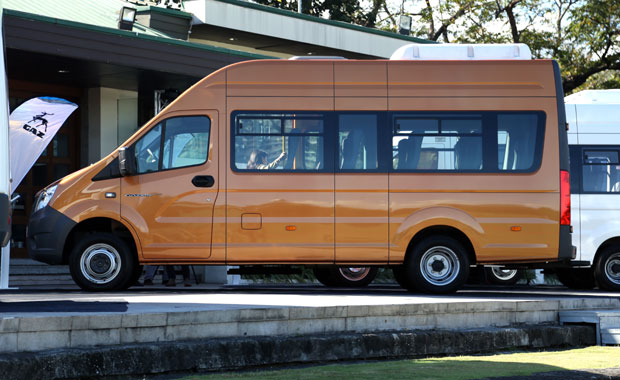
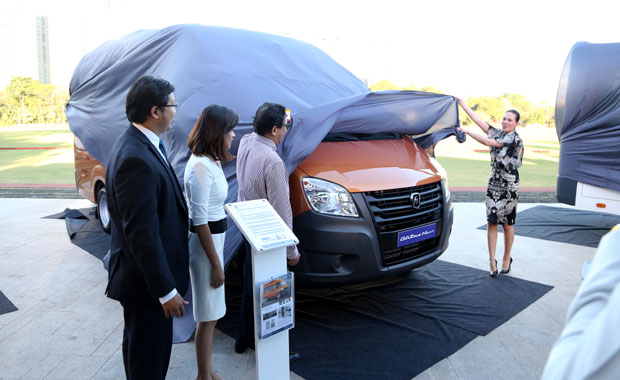
GAZ, the Cold War’s giant automaker for the million-man armies of the former USSR and the rest of the Eastern Bloc, now brings their GAZelle Next oversized vans and minibuses to the Philippines, pitching their Cityline model in particular for the government’s public utility jeepney modernization program.

Next evolution

First established almost nine decades ago, GAZ (which stands for Gorkovsky Avtomobilny Zavod or the Gorky Automobile Plant, translated into English) started out as the Russian communist government’s cooperative effort with the Ford Motor Company in 1929. Now, even after Perestroika and Glasnost in the 1990’s, GAZ continues to be Russia’s biggest automaker after prudently having discontinued their passenger car lines and focusing instead on trucks, buses and military vehicle production.

Introduced in 2015, the GAZelle Next is the latest evolution of their original GAZelle Business and smaller GAZelle Sobol lines which first rolled out in the 1990’s after Perestroika reforms. And, those original GAZelle Business and Sobol models, have been credited with facilitating the growth of small- and medium-scale enterprises in what is now Russia and its surrounding Confederation of Independent States or CIS.

While previous GAZelle Business and Sobol lines featured homegrown, Russian-built GAZ engines, the new Next line seems more prepared for a discerning global market with U.S.-branded Cummins ISF 2.8L turbodiesels that are up to Euro 4 and Euro 5 standards.

Next vans and Next Cityline buses

The large, 6.4m long GAZelle Next vans and minibuses are in the same class as the Mercedes-Benz Sprinter and the Volkswagen Crafter, and can seat as many as 17 people–16 passengers plus the driver. These mount the Cummins ISF2.8s4R148 delivering peak power of 150hp @ 3400rpm, peak torque of 330Nm @ 1800~2600rpm. The GAZelle Next vans are rated for a top speed of 130km/h but are most efficient at city cruising speeds with mileage numbers of 11.76km/l at 60km/h and a slightly degraded 9.7km/l at 80km/h.

GAZelle Next van

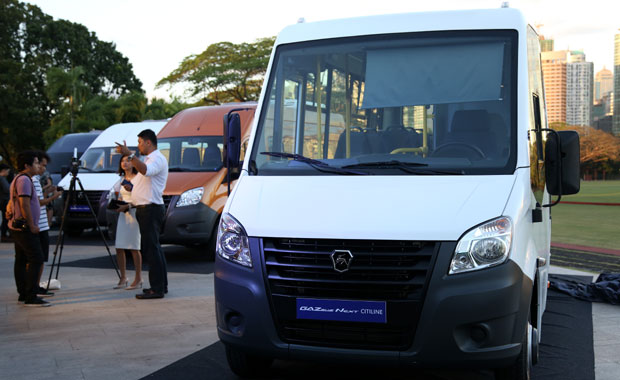
The specially configured GAZelle Next Cityline city commuter with its tall windows and curbside doors front and back, was kept shorter at 6m but also wider than the standard Next vans to mount seating rows of four abreast. It seats a total of 19 people–18 passengers plus the driver–and all in front-facing seats. The Cityline has a slightly tuned down diesel compared to standard Next vans, its Cummins ISF2.8s4R129 delivering peak power of 130 hp @ 3200rpm, peak torque of 295Nm @ 1600~2700rpm. Predictably, it has a lower top speed of 110km/h but the diesel detuning renders the bigger, heavier Cityline as efficient as its standard Next counterparts with mileage of as much as 11.76km/l at typically top city speeds of 60km/h.

GAZelle Next Cityline minibus

GAZ Philippines

The GAZelle Next vans and GAZelle Next Cityline buses are just the first GAZ models that’ll be brought here by Philippine distributor Gazelle Motors Corporation, a subsidiary of major industry player Eastern Petroleum. GAZ Group SVP for Sales and Marketing Christian Kremer said that, “the start of sales of multi-functional, reliable and eco-friendly GAZelle Next minibuses is the first stage of our entrance in the Philippine market, which is interesting from both points of view – commercial sales and in terms of participation in a large-scale state program of public transport modernization.” Kremer added, “I am sure that together with such a strong partner as Gazelle Motors Corp., we will be able to quickly and confidently develop in this market.”

Gazelle Motors Chairman and CEO Dr. Fernando Martinez said that they are pitching the GAZelle Next models, the Cityline in particular, as replacements for public jeepneys under the Class 1 category of the government’s modernization initiative. While the original Class 1 specification was for 10 to 14 seat transports for short city routes of around 5km, this has recently been expanded into sub-classes 1a and 1b.

GAZelle Next Cityline minibus

With this expansion, 10- to 14-seaters in sub-class 1a are supplemented with 15- to 20-seaters in sub-class 1b. It’s to the latter that Cityline minibuses look ideally matched with its capacity for 18 passengers and the driver in front-facing seats, plus the standing headroom for several more passengers in the aisle, and all these even without yet trying to reconfigure it with more efficient side-facing seats. Dr. Martinez asserted that, “the Philippines will benefit from advanced technology from Russia with respect to reliable and competitively-priced vehicles,” adding that “comfort” is one of the major benefits they intend to deliver to common commuters.

Dr. Martinez estimates that with substantial tariffs totaling 32% on Russian imports somewhat offset by around P185k in government subsidy, per unit, they could price the GAZelle Next Cityline at around P1.3M. For sales and servicing, he points to Gazelle Motors’ 5 dealer centers across the country, and to their 35 accredited service centers nationwide through local partners Rapide and Payless.

Isuzu launches this year’s D-Max and Mu-X limited editions

After last year’s X- and Black-series limited issue variants for their D-Max pickup and Mu-X SUV, respectively, and their early launch last September of their Blue Power models with up-rated and updated Euro 4 engines, Isuzu keeps up their diesel-driven market-leading momentum with new top-of-the-line limited editions of their popular sport utilities. Last Friday, at events for media and for their dealership network, Isuzu rolled out their big guns anew, introducing the D-Max X-series for 2018,  and their new Mu-X Luxe line.

Based on the lighter, soft-roading 4×2 top-end LS variants of the D-Max and Mu-X, these new limited issues are clearly meant for up-market urban motorists. This year’s D-Max X-series functions as a dress-up demonstrator, showing how the popular workhorse truck can be slicked up with spoilers, body fairings and exclusively-designed, locally-crafted 18″ black alloy rims with distinct red trim. In contrast, the Mu-X Luxe, as the top variant of their last remaining three-row utility (after the retirement this year of their classic Crosswind AUV line), has been refined further for the role of urban family runabout.

With her exceptionally stable running gear left refreshingly rugged (with none of the softening inflicted on other popular SUVs turned urban people movers), this Mu-X Luxe edition brandishes a stand-out color scheme.  Isuzu Marketing Head Joseph Bautista says that the Mu-X Luxe’s Spinel red marks only the second time that Isuzu global allowed the use of the color that’s traditionally reserved for royalty in the Asian region (the first time was last year, with the D-Max 2017 X-series’ Venetian red).

At the Mu-X Luxe’s cargo carrying business end, the tailgate has been outfitted with a next generation opening/closing servo that’s been hardened against folks who don’t know about this feature. If well-meaning helpers inadvertently try to open/close the tailgate manually, the system goes into neutral, disengaging gears and solenoids which could otherwise be damaged.  A nice, subtle yet robust touch for lightening Dad’s or Mom’s workload on those everyday drives.

<SOURCE> Press Statement by Isuzu Philippines Corporation (IPC), “SPORTY & LUXURIOUS: Isuzu introduces latest variants of D-MAX and mu-X,” 2018:

Isuzu Philippines Corporation (IPC) recently launched two new limited edition variants to add excitement to the existing line-up of its Isuzu D-MAX and Isuzu mu-X models.

On February 23, IPC displayed the latest edition of the Isuzu D-MAX X-Series which serves as the model’s offering to the younger market segment; alongside is the new mu-X Luxe which as the name suggests is the most well-appointed mu-X variant to date.

“Keeping our line-up fresh is the key to the very demanding market, especially for the pick-up and SUV segment. To keep up with the competition, we are offering two new variants which are designed to exude the more aggressive and luxurious side of the D-MAX and mu-X models,” said IPC President Hajime Koso.

2018 D-MAX X-Series

Dressed to be more edgy, the 2018 edition of the D-Max X-Series now has a black radiator grille with red Isuzu logo, a front and rear skirt lined with a deep red accent which not only adds to its looks but also assist in the vehicles over-all aerodynamics.

More on the exterior, the X-Series also has a color-keyed sleek cargo spoiler, matte black roof rails and red fog lamp garnish. To top off its look, the X-Series now has a black 18-inch alloy wheels with a matching red lip accent.

Inside the cabin, the X-Series has a rocker plate with illuminated red Isuzu logo and additional multiple USB ports for driver and passenger convenience.

New mu-X ‘Luxe’

Meanwhile, the mu-X also sees a new addition to its line-up with the new mu-X ‘Luxe’ which brings together superior features that delivers a statement and status of a premium SUV.

The luxury edition mu-X is equipped with Power Lift Tailgate which opens and closes with a touch of button – for a hassle-free cargo loading. For added styling, light gray fender flares are installed which doubles as a protective feature to deflect rocks and debris away from the vehicle’s body.

Adding to its already premium interior, mu-X Luxe has a new blue illuminated scuff plate and 3D surround sound system to complete the over-all luxurious experience while driving or riding the new mu-X Luxe.

Engine, Color & Pricing

Available only on a 4×2 drivetrain, both the D-MAX X-Series and mu-X Luxe runs on the ever-reliable 4JJ1-TCX 3.0L Blue Power Diesel engine that is EURO 4 complaint and is capable to produce 177 PS maximum power and 380 N-m maximum torque.

New Suzuki Vitara now a sub-compact crossover SUV shipped in from Hungary

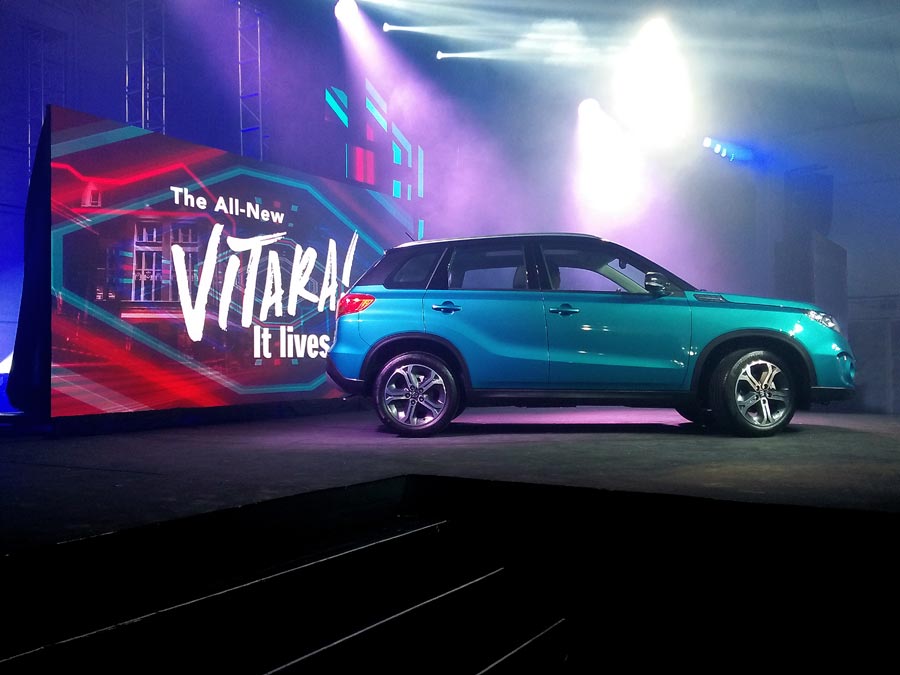
Priced to move against well entrenched rivals, the newly unveiled fourth-generation Suzuki Vitara comes with many firsts that make it a genuine bargain. No longer a compact SUV built traditionally with rear-wheel-drive geometry and body-on-frame construction, the new Vitara is now a slightly smaller and more modern crossover. And, although its developed for Europe, was designed in Europe, and is imported from Europe, the new Vitara’s price range is significantly lower than that of the previous generation model, and in fact has base and mid-range variants that are priced under the all-important PhP1 million mark.  

Manila, 09 November 2017–Suzuki brings the fourth generation Vitara to the Philippine market, unveiling the new model with an official launch event at the Metrotent Convention Center in Pasig City last Thursday.  In the audience were the motoring press as well as Suzuki dealers, bank partners and the officers of the Vitara Club of the Philippines.  While this launch would of course mean the replacement of the previous generation model in the Philippine market, this hasn’t been the case globally.  The fourth generation Vitara was introduced more than three years ago in October 2014 at the Paris Motor Show and has since been offered in other markets simultaneously with the previous model which they continued to call the Grand Vitara, thereby distinguishing her from the newer one.

The new generation Vitara is slightly smaller and much sleeker, now more of a city-dweller’s robust high-rider rather than a rugged light-duty off-roader. And, with list prices for her base GL and mid-range GL+ variants that are under P1 million, the new Vitara is both sized and priced to compete squarely against popular Ford Ecosport, Honda BR-V and Nissan Juke models. In this class of popular sub-compact crossover SUV’s, the Vitara’s distinction (a surprising one given its mid-range price tag) is that it’s not only designed in and for Europe, it’s also sourced from there, brought here as completely built up (CBU) units from Hungary, of all places.

Signs of the new Vitara’s European origins are noticeable once you’re clued in.  Absent are the ornate contours that evoke ownership aspirations in emerging markets. Instead, the Vitara’s neat and straight character lines suggest a more utile role for the small SUV in upscale European markets.

Vitara VIN sticker showing Magyar Suzuki origin

And, designed as it is in and for Europe, the latest generation is the first one in the Vitara’s nearly three-decade history that’s done as a crossover.  From the Grand Vitara’s more traditional front-engine/rear-drive layout and body-on-frame construction, the new Vitara now embraces modern SUV sensibilities with a 10 percent reduction in size and over 30 percent reduction in engine displacement and power, as well as a similar decrease in weight.

Developed by Magyar Suzuki, their manufacturing subsidiary in Esztergom in northern Hungary, and built on the underpinnings of their SX-4 compact SUV, the new Vitara now works with the familiar front-engine/front-drive and unibody recipe of sporty crossovers.  The slightly smaller integrated body and frame, and the more compact transaxle drivetrain, combine to make the new sub-compact crossover SUV Vitara lighter by half a metric ton, dropping its curb weight from over 1,500kg down to just around 1,000kg.

The new Vitara’s M16A 1.6L naturally aspirated gasoline engine with VVT valvetrain

While the new Vitara has two other upscale engine options in other markets–a 1.4L turbocharged gasoline engine, or a 1.6L turbocharged diesel–the Philippine market gets only the base 1.6L normally aspirated M16A gasoline engine with a variable valve timing (VVT) system.  Although the new engine is dramatically downsized from the Grand Vitara’s old 2.4L J24B, the numbers work out with the 34 percent reduction in engine displacement resulting in only a 31 percent decrease in power and torque that’s compensated for by a 32 percent decrease in curb weight in the new Vitara crossover. Also, although the new Vitara has their trademark ALLGRIP four-wheel-drive option in other markets, the all-terrain drivetrain will not be offered here where the previous generation, rear-driven Vitara was offered only in 4×2 configuration as well.

About the new Vitara, Suzuki Philippines’ Automobile Division General Manager Shuzo Hoshikura said: “equipped with the longest, and widest dimension in its class with the best turning radius performance, the features of the new Vitara are aimed at providing the best value in terms of design, performance and fuel efficiency.”

The new fourth generation Vitara … a cozy two-row sub-compact crossover

The fourth generation Vitara is manufactured by Magyar Suzuki in Hungary and by Changan Suzuki in Chongqing, China.  Surprisingly, instead of sourcing the new Vitara from nearby Changan Suzuki, Suzuki Philippines is importing units directly from Magyar Suzuki all the way in eastern Europe.

And, despite the lack of tariff incentives and what must be higher shipping costs, the new Vitara variants are priced very competitively (even aggressively, as  a matter of fact).  The top-spec Vitara GLX is priced at PhP1.048 million while the mid-range GL+ lists at PhP0.938 million.  The base GL variant is to be priced even lower but at an SRP that’s still to be determined by Suzuki Philippines.  Prices for the new Vitara are significantly less than those of the previous generation Grand Vitaras which listed at from PhP1.160 to PhP1.216 million.

When asked how they can keep prices relatively low given the model’s European origins, Hoshikura emphasized that the prices quoted are introductory.  He wanted it clearly known, good as the prices are, these are still just initial figures that are temporary and could change in the future.  It’s the kind of statement you could expect in the last few months of the year when sales traditionally peak (and this year peak strongly in anticipation of upcoming excise tax reforms).

MOMO-equipped team wins hilly 1000km Australian race

In the land down under, in Southeastern Australia, the MOMO-backed Reynolds-Youlden team won the Bathurst 1000 race held on the Mount Panorama racing circuit in Bathurst, New South Wales.  Like the Monaco and Singapore Formula One race courses, the Mount Panorama circuit is a street course.  And, although not an endurance race like the Bathurst 12-hour event (the other race held at the Mount Panorama circuit), the Bathurst 1000 nevertheless pushes both man and machine for 161 laps on a course that has174 meters difference between its lowest and highest points, at its steepest challenging racers with a 1:6.13 uphill grade. 

Mount Panorama Circuit (illustration by Will Pittenger, https://commons.wikimedia.org/wiki/User:Will_Pittenger)

Press Statement by Fuel Autotek Philippines, “MOMO-Backed Team of David Reynolds and Luke Youlden Win Bathurst 1000!” 2017:

The MOMO-equipped Erebus Motorsport duo of David Reynolds and Luke Youlden have won a chaotic and rain-hit 2017 Bathurst 1000.

Luke Youlden (left) and David Reynolds (right) with the Bathurst 1000 Trophy

Starting off the front row, the #9 Commodore was amongst the front-runners all day, proving quick in wet and dry conditions, however it wasn’t until the final laps that it all played to their favour.

Reynolds sat fourth on the final restart with just 16 laps to thecheckeredflag, and capitalized on other’s errors to catapult into the top spot. It was a faultless run from both drivers to the very end of lap 161.

It was much the same for Dale Wood and Chris Pither in the GB Galvanizing Holden, who propelled from position 21 to 4th by the end of the 1000-kilometre marathon.

The pair both dominated proceedings in the wet to sit just outside the top ten with 30 laps to go.

As the sun came out, their pace didn’t stop; the #99 Holden only just missing the podium and eventually crossing the finish in fourth.

The result marks Erebus Motorsport’s best team result, and first win since their switch to Holden over 18 months ago.

An exhausted David Reynolds was elated to close out the biggest victory yet in his racing career, and paid tribute to the Erebus Motorsport team.

“It feels really, really good. As a team we have worked extremely hard over the last year and a half to get to this point, it’s been a massive whirlwind experience. I owe everything to Betty, Barry and Al, it’s not just Luke and I, there’s an entire team of talented people behind us.”

The team at FUEL AUTOTEK, supplier of equipment such as MOMO driver and crew suits, race gloves and the steering wheels fitted to both Erebus VF Commodores, could not be prouder.

“We hope the new owners enjoy David Reynolds’ champagne-soaked bright red MOMO GT Pro race boots” after the Bathurst winner performed his trademark ‘Shoey’ on the top step of the podium and tossed his boots into the crowd. “We are ecstatic to have played a small part in the victory and the celebration!” beamed FUEL AUTOTEK Marketing Manager Scott Crosher.

After a short turnaround this week, David Reynolds and the Erebus Motorsport team will contest the final endurance event of the season, the Vodafone Gold Coast 600, which takes place October 22-29.

The Bathurst 1000 victory marks the second time in 2017 a MOMO-backed team has won a high profile race at the iconic Mount Panorama circuit after the Maranello Motorsport team won the Bathurst 12 Hour earlier this year.