

Priced to move against well entrenched rivals, the newly unveiled fourth-generation Suzuki Vitara comes with many firsts that make it a genuine bargain. No longer a compact SUV built traditionally with rear-wheel-drive geometry and body-on-frame construction, the new Vitara is now a slightly smaller and more modern crossover. And, although its developed for Europe, was designed in Europe, and is imported from Europe, the new Vitara’s price range is significantly lower than that of the previous generation model, and in fact has base and mid-range variants that are priced under the all-important PhP1 million mark.

Manila, 09 November 2017–Suzuki brings the fourth generation Vitara to the Philippine market, unveiling the new model with an official launch event at the Metrotent Convention Center in Pasig City last Thursday. In the audience were the motoring press as well as Suzuki dealers, bank partners and the officers of the Vitara Club of the Philippines. While this launch would of course mean the replacement of the previous generation model in the Philippine market, this hasn’t been the case globally. The fourth generation Vitara was introduced more than three years ago in October 2014 at the Paris Motor Show and has since been offered in other markets simultaneously with the previous model which they continued to call the Grand Vitara, thereby distinguishing her from the newer one.


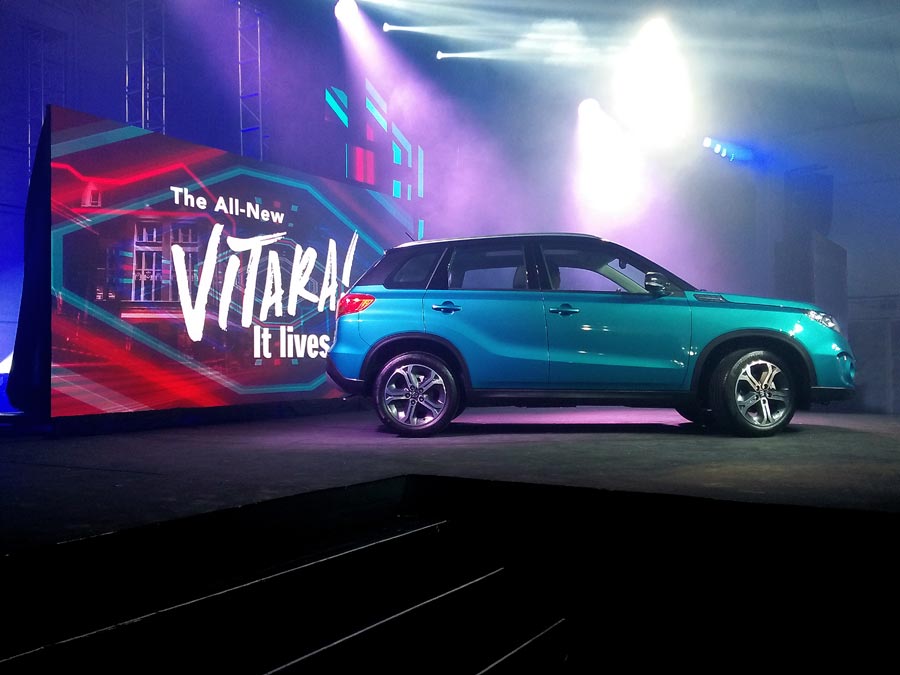


The new generation Vitara is slightly smaller and much sleeker, now more of a city-dweller’s robust high-rider rather than a rugged light-duty off-roader. And, with list prices for her base GL and mid-range GL+ variants that are under P1 million, the new Vitara is both sized and priced to compete squarely against popular Ford Ecosport, Honda BR-V and Nissan Juke models. In this class of popular sub-compact crossover SUV’s, the Vitara’s distinction (a surprising one given its mid-range price tag) is that it’s not only designed in and for Europe, it’s also sourced from there, brought here as completely built up (CBU) units from Hungary, of all places.

Signs of the new Vitara’s European origins are noticeable once you’re clued in. Absent are the ornate contours that evoke ownership aspirations in emerging markets. Instead, the Vitara’s neat and straight character lines suggest a more utile role for the small SUV in upscale European markets.

And, designed as it is in and for Europe, the latest generation is the first one in the Vitara’s nearly three-decade history that’s done as a crossover. From the Grand Vitara’s more traditional front-engine/rear-drive layout and body-on-frame construction, the new Vitara now embraces modern SUV sensibilities with a 10 percent reduction in size and over 30 percent reduction in engine displacement and power, as well as a similar decrease in weight.
Developed by Magyar Suzuki, their manufacturing subsidiary in Esztergom in northern Hungary, and built on the underpinnings of their SX-4 compact SUV, the new Vitara now works with the familiar front-engine/front-drive and unibody recipe of sporty crossovers. The slightly smaller integrated body and frame, and the more compact transaxle drivetrain, combine to make the new sub-compact crossover SUV Vitara lighter by half a metric ton, dropping its curb weight from over 1,500kg down to just around 1,000kg.

While the new Vitara has two other upscale engine options in other markets–a 1.4L turbocharged gasoline engine, or a 1.6L turbocharged diesel–the Philippine market gets only the base 1.6L normally aspirated M16A gasoline engine with a variable valve timing (VVT) system. Although the new engine is dramatically downsized from the Grand Vitara’s old 2.4L J24B, the numbers work out with the 34 percent reduction in engine displacement resulting in only a 31 percent decrease in power and torque that’s compensated for by a 32 percent decrease in curb weight in the new Vitara crossover. Also, although the new Vitara has their trademark ALLGRIP four-wheel-drive option in other markets, the all-terrain drivetrain will not be offered here where the previous generation, rear-driven Vitara was offered only in 4×2 configuration as well.
About the new Vitara, Suzuki Philippines’ Automobile Division General Manager Shuzo Hoshikura said: “equipped with the longest, and widest dimension in its class with the best turning radius performance, the features of the new Vitara are aimed at providing the best value in terms of design, performance and fuel efficiency.”

The fourth generation Vitara is manufactured by Magyar Suzuki in Hungary and by Changan Suzuki in Chongqing, China. Surprisingly, instead of sourcing the new Vitara from nearby Changan Suzuki, Suzuki Philippines is importing units directly from Magyar Suzuki all the way in eastern Europe.

And, despite the lack of tariff incentives and what must be higher shipping costs, the new Vitara variants are priced very competitively (even aggressively, as a matter of fact). The top-spec Vitara GLX is priced at PhP1.048 million while the mid-range GL+ lists at PhP0.938 million. The base GL variant is to be priced even lower but at an SRP that’s still to be determined by Suzuki Philippines. Prices for the new Vitara are significantly less than those of the previous generation Grand Vitaras which listed at from PhP1.160 to PhP1.216 million.

When asked how they can keep prices relatively low given the model’s European origins, Hoshikura emphasized that the prices quoted are introductory. He wanted it clearly known, good as the prices are, these are still just initial figures that are temporary and could change in the future. It’s the kind of statement you could expect in the last few months of the year when sales traditionally peak (and this year peak strongly in anticipation of upcoming excise tax reforms).
One thought on “New Suzuki Vitara now a sub-compact crossover SUV shipped in from Hungary”
Comments are closed.