BAIC Philippines opens flagship showroom after building nationwide network of sellers and servicers

Now almost three years in the country, BAIC Philippines finally opens their flagship showroom after first focusing on fundamentals and having already established a network of dealerships and service centers nationwide. And, after the market’s positive response to their bargain priced utility vehicles, they now also launch a new line of light trucks, among which is the Freedom mini-truck that’s remarkably suited to the role of family workhorse.

Press Statement by BAIC Philippines, “BAIC Philippines opens flagship showroom, launches light truck models,” 2017:

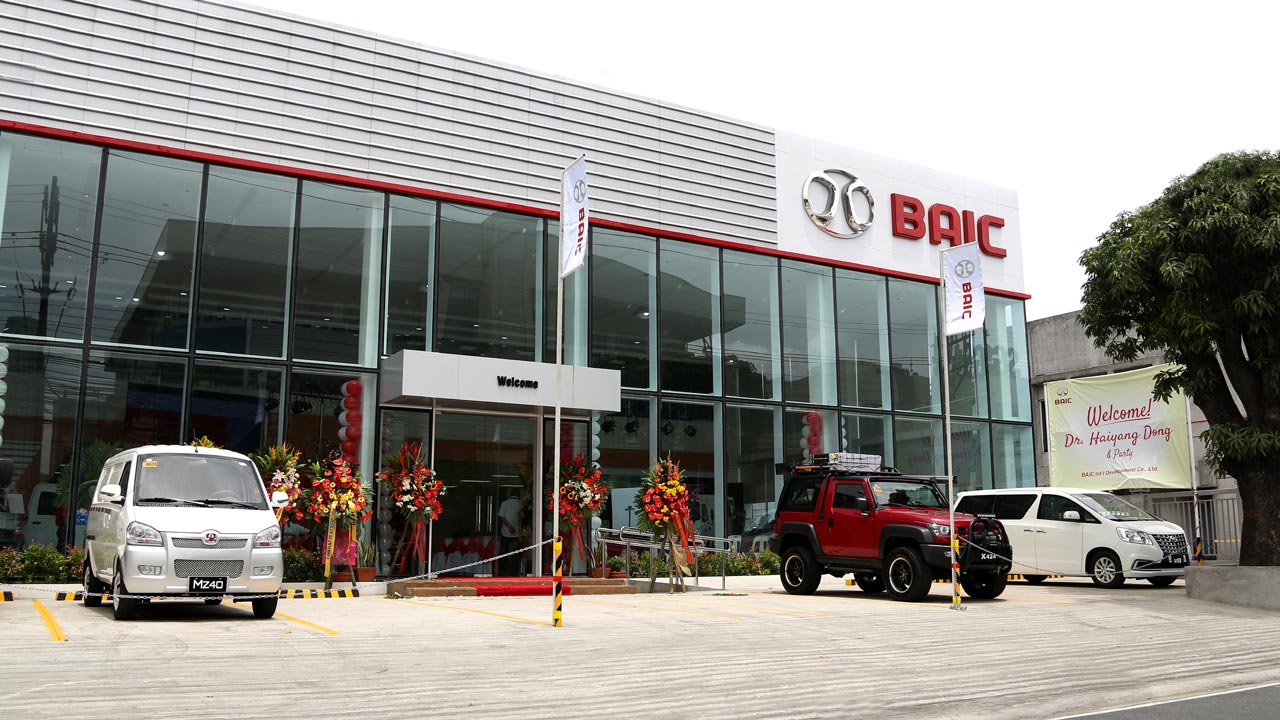
BAIC Philippines formally opened their flagship showroom in Makati City last July 14 and made the new facilities the backdrop for the official unveiling of their new Bayanihan H5 light truck and Freedom compact truck models. The flagship showroom in a new, purpose-built building now speaks of BAIC Philippines’ continued commitment to this market, while the new Bayanihan H5 and Freedom trucks show their intent to keep providing up-to-date, affordable and versatile vehicles to Philippine customers.

Flagship to a fleet of showrooms and service centers

The inauguration of the flagship facilities comes with the automotive brand already having 8 dealers and 22 accredited service centers in Luzon, Visayas and in Mindanao.  A division of Universal Motors Corporation (UMC), BAIC’s Philippine distributor Bayan Automotive Industries Corporation (Bayan Auto) was launched almost three years ago at the 2014 Philippine International Motor Show.

Ceremonial ribbon-cutting by Mr. George Chua, president and CEO of BAIC Philippines, and Dr. Haiyang Dong, president and CEO of BAIC International Development Co., Ltd..

The new showroom stands in the country’s premier business district at 2232 Don Chino Roces Avenue in Makati City. The two-storey building has 1,200 square meters of floor-space featuring a 12-vehicle street-front showroom, a plush customer lounge, multiple sales offices, an after-sales services reception area, and the executive suites.  Well attended by business partners, customers, members of the motoring press, and by BAIC global brand dignitaries, the inauguration was officiated by Mr. George Chua, president and CEO of BAIC Philippines, and was graced with the participation of Dr. Haiyang Dong, president and CEO of BAIC International Development Co., Ltd..

The event was a milestone in many ways with Mr. Chua saying, “close to 3 years ago when we first introduced the BAIC Brand in the Philippines … we were confident that with the long and strong history of UMC and partnership with the dynamic and global outlook of BAIC, failure was not an option.”  Adding to the significance of the occasion, Dr. Dong revealed that, “the Philippines is a key market and a potential hub to service the ASEAN market.”

Mindful focus on Euro 4, lowest taxed haulers

“Establishing a new brand is indeed a challenge and doing so in a highly competitive market like the Philippines requires more than experience, financial resources and luck,” says Mr. Chua. “We realize that for us to succeed we must have the right product at the right price.”

Bayanihan H5 cab and chassis

Citing the county’s clean air act which mandates January 1, 2018 as the deadline for all new vehicles to be Euro 4 compliant, and the tax reform program that calls for a significant increase in vehicle excise taxes, Mr. Chua observed that these make “ownership of new vehicles more difficult and possibly out-of-reach for many of our countrymen.”

With these compelling factors in mind, BAIC Philippines has officially launched their Bayanihan H5 cab and chassis and Freedom compact truck, both with SRPs that put these squarely in the lowest taxed tier of the new vehicle excise tax structure.  The Bayanihan H5 is the only model in the light truck category that offers a ton-and-a-half of payload on a roomy 10-foot rear deck and is powered by an up-to-date Euro 4 compliant turbodiesel.  The Bayanihan H5 lists at P598,000 in basic cab-and-chassis form with built up variants that will feature dropside flatbed, aluminum van and passenger rear bodies—the last, also with an option for dual-type air-conditioning.

Double-cab Freedom compact truck

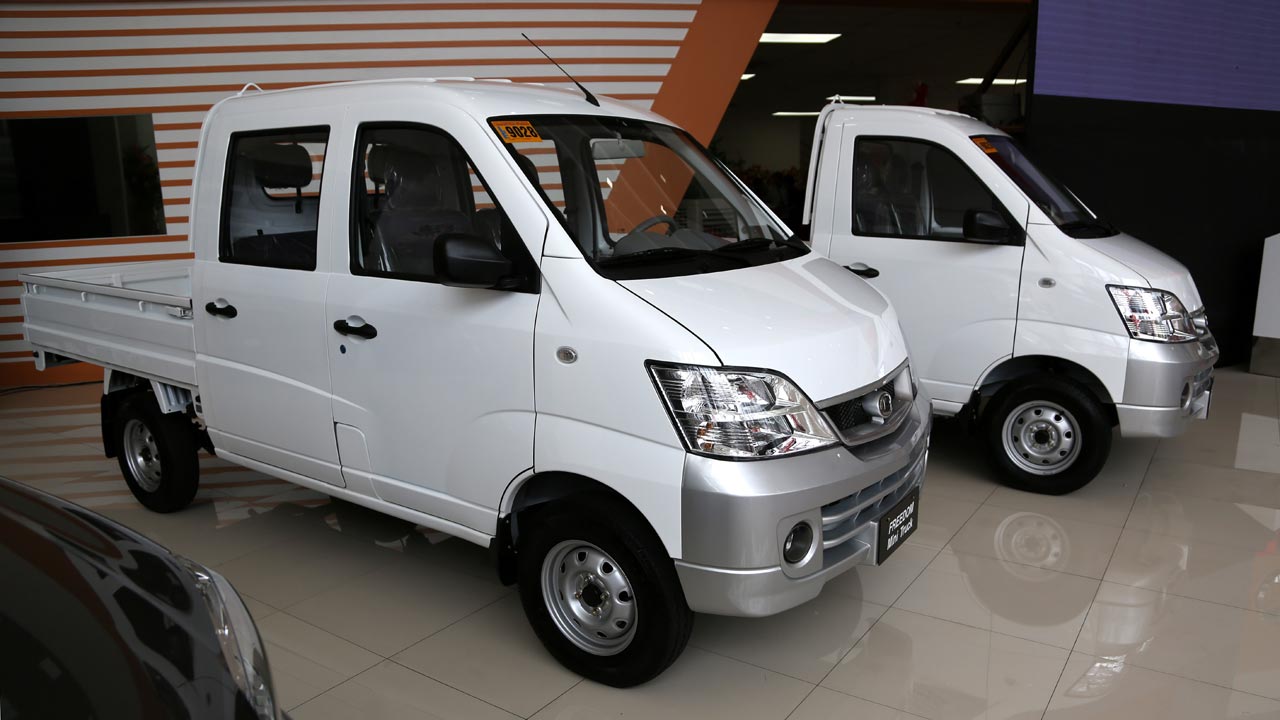
Completing BAIC Philippines’ small hauler line-up is the new Freedom offered in pickup truck layouts with a dropside flatbed cargo bed in back and either a single- or double-cab up front.  SRP for the single-cab variant is P458,000, the double-cab’s is P488,000. With its Euro 4 compliant 94hp and 115Nm 1.4L gasoline engine, and almost a ton of payload, the Freedom offers surprisingly mainstream capabilities yet at competitive prices. And the double-cab variant in itself is a rare enough offering in the light truck category, at least as far as new vehicles are concerned.  In Mr. Chua’s estimation, these features put together make the Freedom, “the affordable, smart man’s pickup!”

More to come from BAIC

Mr. Chua reveals that, in addition to the Bayanihan H5 light truck and Freedom compact truck, BAIC Philippines is looking to introduce a new model among their MPV offerings.  Although other details are still under wraps, Mr. Chua says the distinction of the new multi-purpose-vehicle vis-a-vis their popular M20 MPV will be an automatic gearbox for driving convenience in the country’s notorious traffic jams.
New BAIC mini-truck could become big family mainstay

BAIC Philippines launched their Freedom mini-truck during the inauguration of their flagship showroom in Makati City just last Friday. Offered cargo flatbed configurations, the BAIC Freedom is available in single- and double-cab variants, and priced at P458k and P488k, respectively … and rather surprisingly. That mini-truck tag and those prices that put it squarely against the Suzuki Super Carry and Tata Ace (vehicles commonly known here and abroad as miniature trucks), all these have the effect of reinforcing the image of the Freedom as being a bare-bones scaled-down something. But, get to see the Freedom in the flesh, even try her on for size, and it’s clear that she exceeds the boundaries of the mini-truck category.

The Freedom measures around 4.5m in length (the single-cab at 4.400m, the double at 4.565m), much longer than the 3.8m of the Suzuki and Tata models. This up-sizing translates into greater capacity with the Freedom having payloads of 990kg on the single-cab variant and 905kg on the double. At close to one ton of payload, the Freedom brandishes a significant margin over the 735kg of the Super Carry and the 800kg of the Ace. The Freedom’s cargo bay is much longer, to the tune of more than 0.3m when comparing single-cab variants. On the double-cab variant, the cargo bay is similarly longer than those on sporty mid-size double-cab pickups.

A surprising plus: the Freedom mounts a Euro 4 compliant 94hp 1.4L Suzuki K14B-A engine (from the same, well-proven series that powers the Suzuki Ertiga MPV and Ciaz sedan). That Suzuki mill hasn’t been outsourced but manufactured in-house instead, and legitimately, by the Freedom’s original manufacturer. Coming to this market by way of the global BAIC Group of China, the Freedom is manufactured by Jiangxi Changhe Suzuki Automobile Co. (Changhe), the light commercial vehicle manufacturer that’s in a joint venture with Suzuki Motor Corporation of Japan. Changhe became a subsidiary of the BAIC Group in 2013 when the big conglomerate acquired 70% controlling stake. (In the China domestic market, the model is differently branded but similarly badged as the Changhe Freedom Mini-Truck.)

And, finally, that double-cab option on the Freedom is a game-changing rarity in its category (not counting those on small, surplus multi-cabs). With the option for sedan-like seating for five passengers combined with her close to mainstream dimensions and full-grown engine (an engine that’s aircon-ready, no less), the Freedom stands an excellent chance of becoming widely accepted as a common family pickup truck. Not like the high-riding and sleeked-up pickups from the big brands that figured in the truck wars last year, but something that’s less sport and more utility, something that’s more of a truck.  Sure, the Freedom is less pretty, more of your money invested in function, damned little of it in form, but that also speaks to character, makes a fair statement about the owner, doesn’t it?

Quick note: BAIC’s new base-model micro-bus

Meet the BAIC MZ45 Transporter. She seats 11 adults in 4 rows, is powered by a torquey 1.2L Euro 4 petrol engine, and has the high-clearance body-on-frame build that makes her at home on city streets and countryside roads. (The MZ45’s platform is rugged and smooth-riding enough to be also configured as a municipal ambulance.)

This new, P548k base-model rendition is spartan in comparison to the MZ45’s Comfort and Luxury variants but it does have that extra blower array in the rear that ensures the dual AC’s effectiveness up to the rearmost seats.

She’s aptly named and could’ve been badged either as the Transporter or the Commuter–that’s how optimized she is for the people-mover role.
Family-run PBC Car Adapt makes cutting-edge wheelchair transport solutions more accessible to Filipinos

Transport is an ordeal to the wheelchair-bound. They can be independent, they struggle to be independent, in many cases had been fully independent before affliction or old age had assailed them. But the few centimeters putting a vehicle’s cabin on a different plane from pavement is what always brings them back to needing the intimate kindness of others.

There’s the innate altruism, of course, there’s always someone willing to help, some family member, friend, or even the occasional bystander suddenly beset with the impulse to assist although seldom having the knowledge how to. That isn’t really the problem. In fact, ironically and unfairly to those who would volunteer to help, it’s the readiness of good souls to help that’s the rub. Already disabled, them needing to be carried into and out of a vehicle, their presumption of such help, further and repeatedly hobbles their dignity.

This continuing ordeal for a mother was what pushed her children to set up PBC Car Adapt, Inc. in November 2003. Thrice weekly she had to go to hospital for therapy. A minimum of three times a week and each way, she braved having to be carried onto and off a vehicle seat, casually separated from a wheelchair that had become her legs.

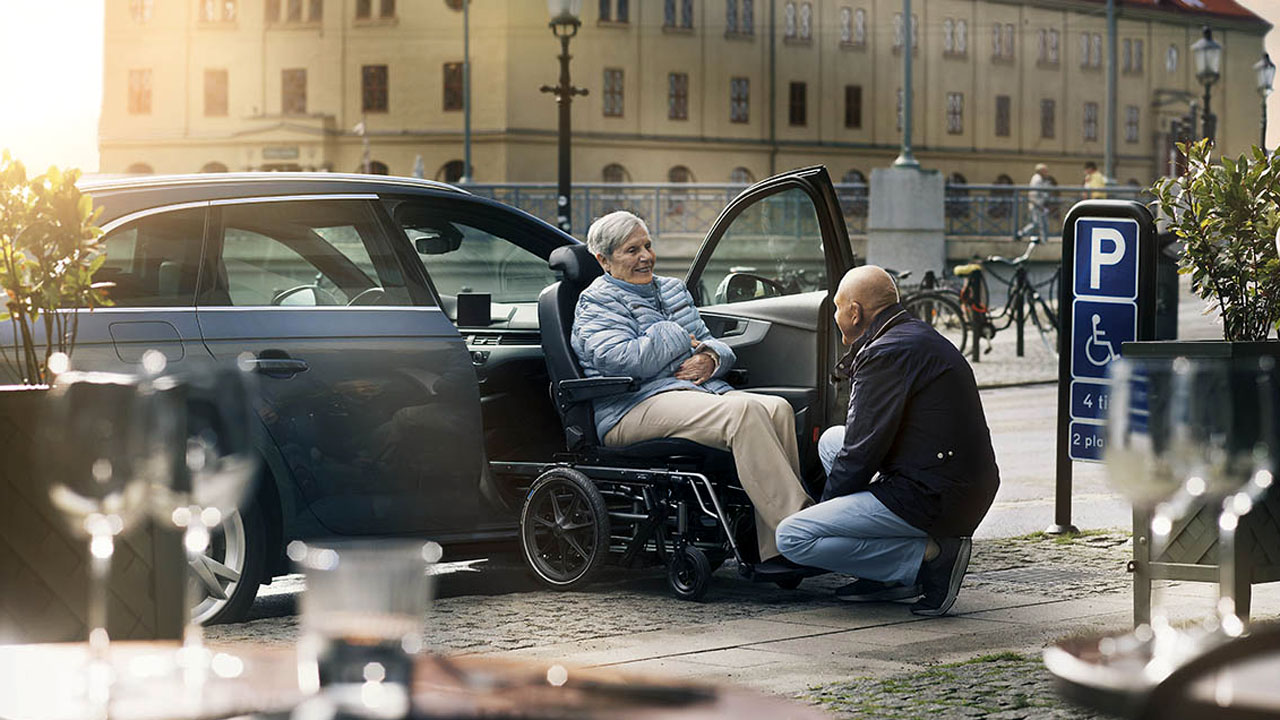
The family found a solution, a system that objectified the process, replacing servile help with servo mechanics. The Carony wheelchair system offered a way to automate their mother’s boarding and disembarking from a vehicle, turning it into a pushbutton affair, empowering her with the ability to push that button herself.

The system centers on a modular wheelchair, its chair meant to be disengaged from the wheel chassis, and lifted and swivelled into or out of a vehicle. The chair-bound passenger no longer has to be separated from what is engineered to be a portable yet safe and comfortable car seat. And the system is brand-neutral—it could be installed in any number of automotive makes and models, in compact or larger vehicle types from sedans to SUVs.

The problem was that they couldn’t simply buy the gear off-the-shelf. They could purchase the equipment, sure, but it had to be installed in a vehicle by an exclusive distributor. At the time, there were no such distributors here and their only option was to buy both the vehicle and the wheelchair system abroad, have these mated there, and import the entire finished product into the country.

Fortunately, the family had the means but not the frivolousness to even consider such a course of action. Instead, with full appreciation of how the Carony wheelchair system could be as valuable to others as it was for them, they gave body to their conviction, incorporated PBC Car Adapt, and themselves became that elusive distributor that they needed to be here,  in-country.

They became the country distributor of Carony systems-maker Autoadapt of Sweden, making the Philippines only the second country in Asia, after Japan, to have gained this distributorship. Now, almost 14 years down the road, their product line up already includes equipment to make vehicles operable by paraplegic drivers, fitting these out with hands-only boarding and driving systems.

You could visit their source’s website at autoadapt.com to see the solutions they provide, or point your browser at pbccaradapt.ph and see how they’ve registered their domain name but haven’t gone all-in commercial with online retail. But if the wheelchair systems they carry sound to you like tangible solutions for a particular someone’s everyday ordeal, we suggest that you simply call their Quezon City office at +632 881 6664 or +632 455 5929.

Look for managing partner Juliet “Jet” Quiemel, daughter to the lady who started them down this road, or for Christine, the buoyant daughter and granddaughter to them both. Call and ask them about how they’ve matter-of-factly championed the cause of the disabled all these years. And, if you decide to get their help, say that you heard of them through Real World Drive and tell them that we endorse to you the modest referral fee they offered us … take it as a small discount, with our compliments.

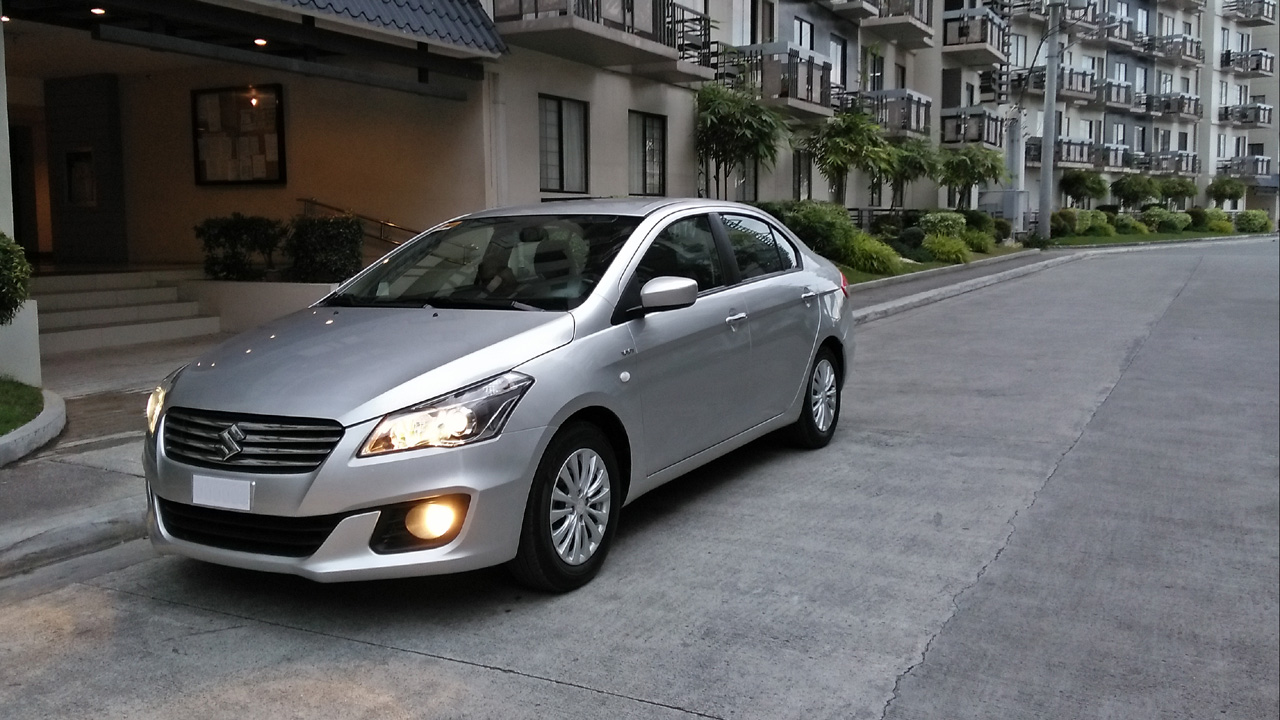
A year in sees the Ciaz hitting its feisty groove

It’s easy to see where Suzuki Philippines is coming from, now portraying the Ciaz as the road-warrior’s perfect mount, for city-slicker and country-bumpkin alike. The Ciaz’s dimensions bump up against the very edge, pushing that “sub-compact” form and comfort to the max. The early-torquing 1.4L petrol engine can be short-shifted up to reach its fuel saving 4th gear at 40km/h and up to 5th at just 50km/h. And its best-in-class wheelbase keeps things stable in turns and on straightaways while its tall stance lets it float above rough road hazards common in the city as well as in the countryside.

We called it more than a year ago, how the Ciaz is herself a fighter: “If Suzuki’s competitors don’t pay attention, the Ciaz’s pitch could be as frictionless as its aerodynamic body, slipping in and hitting the spots where the competition have left themselves exposed with design, engineering and business choices that are off the mark in today’s complex market.”

Press Statement by Suzuki Philippines, Inc., “Ciaz, Perfect for the Road Warrior,” 2017:

Today’s dynamic work environment demands more than sharp wit. To be at the top of the game, professionals need to be able to squeeze as much as they can in an eight-hour workday. This means scuttling to and from meetings, corporate events and office errands while still having some time for lunch dates and personal obligations.

Determined to help young professionals keep up with their fast-paced lifestyle, pioneer compact car manufacturer Suzuki Philippines has rolled out the Ciaz, a subcompact sedan that delivers fuel efficiency and a smooth driving experience for today’s road warriors.

Driven to deliver

The worsening traffic congestion in Metro Manila is making driving a daily challenge. With more vehicles plying the streets every day and road constructions and floodings added to the equation, getting to one’s destination on time is no mean feat.

The Ciaz, powered by best-in-class fuel efficiency and advanced features, is most suitable for city driving, braving the traffic and moving around cramped areas. With its superior engine performance that does not compromise the environment, millennials will sure look forward to riding this chic sedan!

A joy to drive

Reflecting elegance with a sporty touch, the multi-awarded car model is designed with redefined interiors tailored to today’s younger generation. The Ciaz boasts a roomy comfortable cabin and advanced features, including an integrated multimedia unit with an Android touchscreen. The GLX variant has audio and handsfree connectivity in the steering wheel and keyless push start system.

Available in three variants – the GL Manual Transmission, GL Automatic Transmission and the premium GLX – the Ciaz has grabbed considerable market share since its release in the first quarter of 2016. It won Best in Fuel Rating under the Sedan-Gasoline Category at the Department of Energy’s Euro Fuel Eco Run, Best Subcompact Car for the Car of the Year Awards by the Car Awards Group Inc. (CAGI) and Best in Value for Money at the Auto Focus Media’s Choice Awards under the Compact Sedan category.

For more information on the Suzuki Ciaz, visit http://suzuki.com.ph/auto/, like it on https://twitter.com/SuzukiAutoPH and follow on Instagram at @suzukiautoph

Quick note: Indigo does 11.25km/l in mixed city, highway and RACE mode

After 190km of several days’ practice in heavy city traffic; 90km on a ferry drive to the Subic staging point that had us in an hour-long traffic jam on NLEX followed by a blistering catch up sprint on SCTEX; and then the 170km STV Auto Rally run between Zambales and Bataan that included a spirited climb up Mt. Samat; those 450km of diverse driving modes burned 40liters of run-of-the-mill diesel fuel.

That’s an average of 11.25km/l and a cost of around P2.50 per kilometer. Not bad for all the use we got out of her.

Kitty Hawk Flyer proves manned flight possible on all-electric drone-copter platform

WWW, 24 April 2017—Google co-founder Larry Page has revealed the Kitty Hawk Flyer, tweeting a YouTube video showing its prototype being flown by outdoorsman and freelance writer Cimeron Morrissey. The prototype Kitty Hawk Flyer is an all-electric single-passenger octocopter that’s classified an ultralight, does not require a pilot’s license to operate, and can be flown only for recreation in uncongested areas, only over fresh water lakes and rivers. Developed by the Zee Aero division of the Kitty Hawk Corporation, the actual production model is promised to have a different look and feel from the prototype, and to go on sale by the end of this year.

With expectations raised by the involvement of Page, particularly with his work on Google’s self-driving car initiative, what has been spun up as his “flying car” project has delivered a vehicle that’s been described as coming up short on its promise. The significance of the Kitty Hawk Flyer is, after all, overshadowed by the announcement of other, bigger vehicles coming out soon in commercial numbers—air cars spec’d out to carry numerous passengers on road-bound city commutes and airborne intercity hops. In comparison to these commuter solutions that aim to become Jetsons-inspired futuristic mainstays, the Flyer presents as a, well, as a toy.

[youtube=http://www.youtube.com/watch?v=1MSeoJ4z_hY&w=380&align=right]

But, the thing about it that’s in plain sight, what obscures its role in shaping what private airborne transport can become, what makes it fly under the radar, so to speak, is what makes the Kitty Hawk Flyer’s manned flight a game changer. Bigger contenders, those that seem to fit the “flying car” template better, work off century-old engineering. These still use internal combustion engines to produce propeller-driven thrust, and fixed- or auto-rotating wings to generate lift. In contrast, with the Kitty Hawk Flyer, it may look like a seat was just grafted onto a scaled up drone, but it’s the first personal flyer concept evolved from this fairly new, multi-copter platform that’s being used, so far, only for unmanned flight.

Better context for appreciating the Kitty Hawk Flyer would be the jetpack. Futurists of the past had played with this personal, liquid-fuel rocket pack. It had its fair share of Hollywood appearances, in James Bond and off-beat race flicks, but the jetpack had endurance measured in seconds and could be flown only by stunt doubles, by brave and expert expendables. Now comes the Kitty Hawk Flyer with relatively mundane electric fans replacing the ignition of exotic rocket fuel, and with flight time extended to practical and useful minutes.

With the last century’s jetpack, there was little incentive to bridge and exploit that gap between a personal rocket and a full-blown orbital booster. The authorities can’t be expected to tolerate fire-spouting projectiles sending folks on personal trips tracing criss-crossing ballistic trajectories. But now, with the Kitty Hawk Flyer looking like commonplace drones and driven by non-volatile electrics, there’s no hint of the fantastic in the notion of larger, more serious electric multi-copters eventually coming online for near future commuters.

Car Awards top picks on display at TransSportShow 2017

Manila, 21 April 2017—Top picks of the Car Awards Group, Inc. (CAGI) in 2016 are on display at the 26th TransSportShow event being held at the SMX Convention Center from April 20 to 23 this week. Exhibited are the Honda Civic RS Turbo sedan and the Isuzu D-Max 4×2 pickup, last year’s winners of CAGI’s Car of the Year (COTY) and Truck of the Year (TOTY) titles, respectively.

CAGI president Ronald de los Reyes expressed the group’s gratitude to the event organizers and said: “This is a chance for us to display the victors from last year after a thorough screening process. It’s one way for the public to know that citations given to these vehicles aren’t just ordinary awards.”

The title winners had topped CAGI’s list of over 70 vehicles scrutinized in 2016 with the assistance of Carmudi Philippines, Ayala Land and auditing firm KPMG. CAGI itself is a non-stock / non-profit corporation, an organization of motoring journalists who’ve come together to annually test for and identify the best vehicles in the market.

For these annual COTY and TOTY competitions, the group’s methodology is uniquely two-fold: instrumented tests capture quantitative indices on vehicles’ real world acceleration, braking and handling characteristics; while CAGI’s cadre of journalist jurors get behind the wheel for qualitative evaluation of vehicle aesthetics, ergonomics, comfort and driving dynamics.

Their participation at TransSportShow 2017 is part of CAGI’s advocacy program for this year, their exhibition this month to be followed by talks hosted by various car dealerships in May and June.

Medium-duty FVM with Nippon-Freuhauf wing van body launched at Isuzu Truck Fest

Manila, 21 April 2017—Market leader Isuzu Philippines Corporation (IPC) kicked off their annual Truck Fest at the SMX Convention Center in Pasay City yesterday, this year putting the spotlight squarely on the work of long time body building partners including Almazora Motors Corporation, Kyoei Kogyo Philippines Corporation (KPC) and Centro Manufacturing Corporation. Launched at the event which runs from April 20 to 23—taking center-stage and, in fact, configured as the event’s elevated stage—was Isuzu’s FVM top medium-duty truck with the new Nippon-Freuhauf wing van body that’s now license-built here by Centro.

Isuzu has been the top truck brand in the Philippines for 17 consecutive years, with 36% growth last year showing them continuing their gains in 2015 when they finally topped the heavy-duty tractor heads segment as well. Now, with IPC highlighting the quality and diversity of applications built on their solid-frame truck chassis, the company seems prepared to defend their leadership in detail and across all categories, from light- to heavy-duty haulers.

IPC marketing head Joseph Bautista said that wing van bodies have wide and surprising applications here with some being used as mobile showrooms in the countryside by appliance retailers, and that the newly launched Nippon-Freuhauf wing van body for the Isuzu FVM is built to the same specs as those fitted out on trucks for the Japanese domestic market. The rear body engineered by pioneering wing van manufacturer Nippon-Freuhauf of Japan, and built under license by Centro at their Bulacan factory, is constructed with light yet high-grade aluminum and features hydraulically operated wing sections that open up at the touch of a button.  The hydraulic actuators for the wing sections are tested to withstand over 20,000 operating cycles, said Centro senior sales manager Vic del Rosario.

Mr. del Rosario pointed to cargo loading/unloading efficiency as being the reason that among the ubiquitous surplus trucks on the country’s transport grid, the Land Transport and Franchising Board (LTFRB) estimates that 300,000 are outfitted with wing van bodies. He further said that among these surplus wing van trucks, the LTFRB reports that around 90,000 are over 15 years old and that 3,000 have already failed to have their franchises renewed under the government’s initiative to effect the replacement of trucks that have reached that 15-year age limit. Centro’s production of wing-van bodies starts today and these counts in terms of truck units and lifespans give context to their major undertaking to build these bodies for Isuzu on a 50-units per month assembly line laid out to Nippon-Freuhauf specifications.

Nippon-Freuhauf wing van assembly line at Centro Marilao plant (photo compliments of Centro)

Caltex updates transaction flow with Visa payWave, launches “Drive Away a Millionaire” promo

Manila, 20 April 2017—The Caltex service stations of brand marketer Chevron Philippines, Inc. (CPI) are now equipped for Visa payWave contactless payment transactions. Featuring payWave readers, Caltex stations now offer customers the option to pay for transactions of up to P2,000 using their Visa payWave credit or debit cards.  Adhering to Near Field Communication (NFC) standards, Visa payWave cards are meant to remain in the hands of the cardholder throughout the transaction, requiring him or her to simply wave the card within four centimetres of a portable Visa payWave reader to execute payment.

The payWave system is asserted to be as secure as other NFC systems, the wireless handshake being so tight-beamed that it prevents unauthorized scans while the card remains in the hands of the cardholder, never having to be brought to a stationary swipe reader.  Visa payWave cardholders stand to benefit from faster transactions as well with the elimination of traditional steps for card-swiping and signature or PIN authentication (only in instances where the transaction amount exceeds P2,000 will the cardholder need to sign or key in a PIN).

According to Stuart Tomlinson, Visa country manger for the Philippines and Guam:  “As the global payments leader, Visa always wants to reduce friction in the payment process. We are excited to partner with Chevron Philippines once again to bring seamless customer experience to motorists. Visa payWave is much quicker, more secure and more convenient than cash.”

CPI country chairman Peter Morris said: “Motorists gassing up using Visa payWave will definitely be able to experience quicker service in our forecourts. Motorists can transact securely and with ease, knowing that they remain in control of their card at all times.” Morris added that, “to excite consumers to try our latest innovation, we’re also holding a promotion that’s sure to give added value to their fuel purchase.”

Visa and CPI are kicking off their payWave partnership with the Drive Away a Millionaire promo (per DTI-FTEB Permit No. 4157, series of 2017) that will run from April 21 to July 31, 2017. It’s a raffle promo where customers using Visa payWave to purchase Caltex fuel at participating service stations will be entitled to raffle entries for a chance to win the grand prize of Visa card credit worth P1M, or three second-prizes of P100,000 each in Caltex’s Starcash credit.

For every P500 increment paid using Visa payWave, the customer will get three raffle entries, while any Visa transaction done conventionally earns the customer one entry. There are also instant door prizes with lucky motorists getting P50 discounts on their fuel purchase.

The raffle schedule for the Drive Away a Millionaire promo is as follows:

Raffle Draw Date Covered Period Prizes
1st raffle draw | May 26, 2017 April 21, 2017 12:01 a.m. to May 20, 2017 11:59 p.m. 1 winner of 1-year Caltex fuel supply in the form of StarCash worth P100,000
2nd raffle draw |June 30, 2017 April 21, 2017 12:01 a.m. to June 20, 2017 11:59 p.m. 1 winner of 1-year Caltex fuel supply in the form of StarCash worth P100,000
3rd raffle draw and Grand draw | August 11, 2017 April 15, 2017 12:01 a.m. to July31, 2017 11:59 p.m 1 winner of 1-year Caltex fuel supply in the form of StarCash worth P100,000

1 winner of P1million Visa card credit