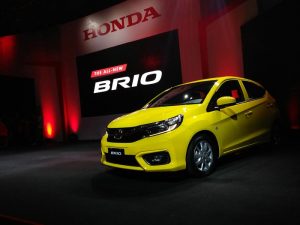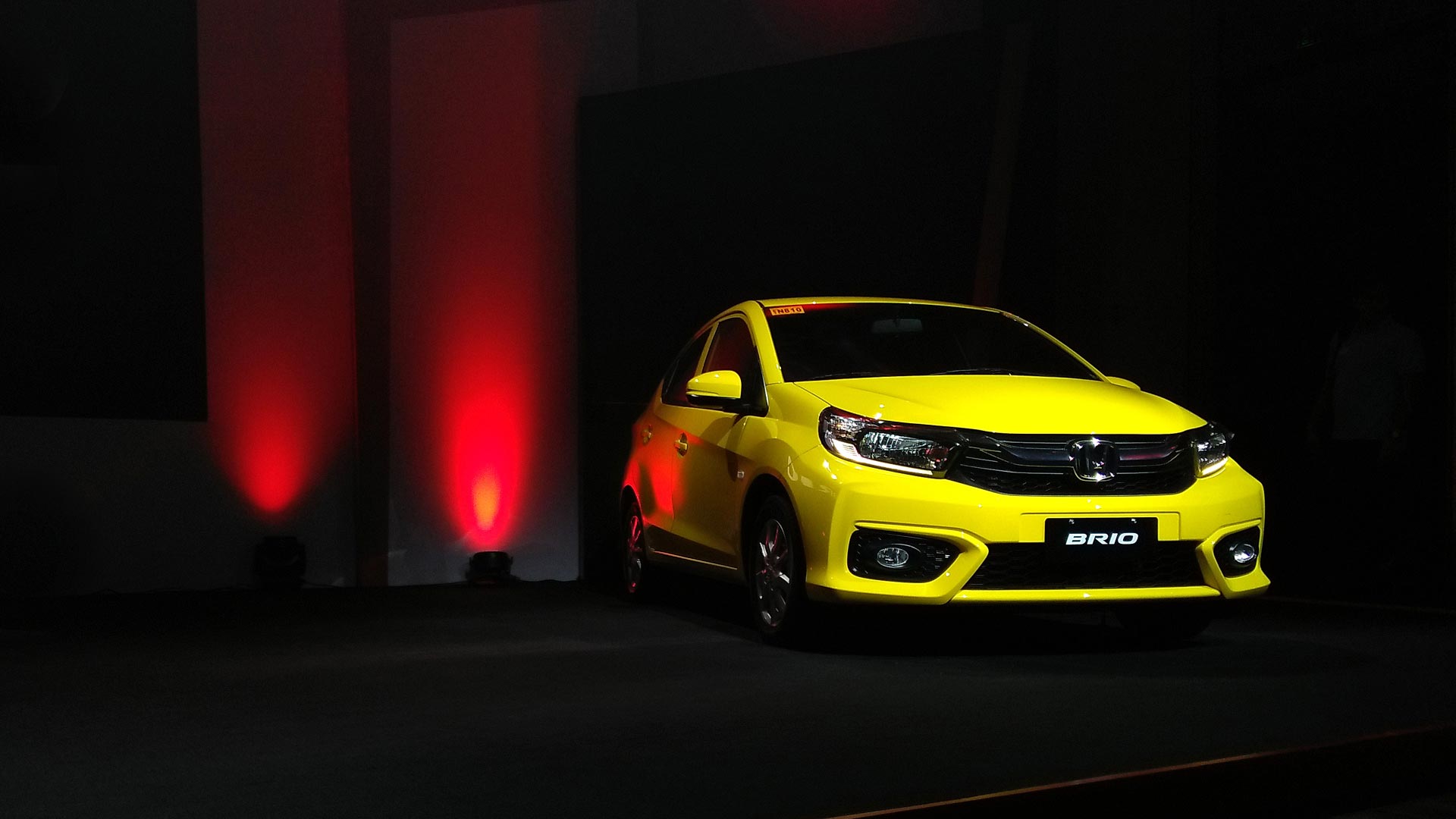
Honda’s new 2nd-gen Brio now largest in class, priced to rival more traditional favorites

Honda Philippines’ new, second generation Brio bumps up the model’s utility, preserves its sporty disposition, and dials back its introductory price for a surprising pivot back to their People’s Car beginnings.  The new Brio leapfrogs the badge from sporty-though-stubby to long-yet-lithe, from smallest to the largest among popular A-segment hatchbacks, and they’ve launched it with intro pricing that pits it directly against market leaders the Toyota Wigo and the Mitsubishi Mirage, among others.

When first introduced here in 2014, the Brio defaulted to a sport role with its standard 1.3 liter 4-cylinder 98hp i-VTEC engine setting it apart from offerings in other markets which reserved this for top-end sport edition variants and instead had the 1.2 liter 4 cylinder 88hp engine for its standard street configurations.  And that old first generation 1.3 liter Brio was priced accordingly into a premium bracket with SRPs ranging from P642k to P801k.

With Honda Philippines’ official launch of the new second generation Brio, the badge goes onto a longer model that’s now just about the largest in its class but with a powerplant that’s sensibly downsized back to Honda’s standard 1.2 liter engine for all other markets.  The new, smaller engine gives away 10hp of power and 17Nm of torque to the former 1.3 liter 98hp mill but, with peak figures of 88hp at 6000rpm and 110Nm at 4800rpm, the new and more miserly 1.2 liter L12B i-VTEC engine with its distinctive variable valve lift and timing valvetrain still delivers the best numbers in the sub-compact hatchback category. And, now, five years into its market life, and after other Honda as well as other carmakers’ models have gotten the market used to continuously variable transmissions (CVTs) as modern AT alternatives, the new Brio pairs its small but powerful 1.2 liter i-VTEC with a CVT gearbox with complete Drive, Sport and Low modes.

The new Brio which adds 6cm to its wheelbase and 20.5cm to its length, stays agile with the second shortest wheelbase underneath the longest body in its class. And, instead of being all-sport from the get go, the new Brio now has a top-spec RS variant priced at P727k (or P732k if with a black-top two-tone paint-scheme) and standing as flagship to its lineup that starts with a basic 1.2 S MT configuration, the only one with a 5-speed manual gearbox and now offered at a startling P585k for two months until this June.  The sub-P600k starting price puts it in the same bracket as that of the Toyota Wigo and undercuts that of the Mitsubishi Mirage, but with neither one of these more popular and smaller hatchbacks having an engine in the same class as the Brio’s–this, even with the downsizing to a 1.2 liter i-VTEC.

<SOURCE> Press Statement by Honda Cars Philippines, Inc. (HCPI), “Honda Launches the All-New 2019 Honda Brio in the Philippines, Now Made Sportier with a New RS Variant,” 2019:

23 April 2019 – Honda Cars Philippines, Inc. (HCPI), Honda’s automobile unit in the Philippines, is pleased to introduce the All-New 2019 Honda Brio as Honda’s entry to the A-Segment passenger car category in the Philippines. This is a response to customers who aspire to own and experience Honda’s signature sporty and practical characteristics in an affordable package.

DEVELOPMENT CONCEPT

Now on its 2nd generation, The All-New Brio was developed based on the grand concept “Proud Over Class”. The grand concept stemmed from the intention to improve aspects of the vehicle that its users need. With this, the All-New Brio was developed to be one-class above its segment with significant improvements specifically with its dimensions.

PACKAGING

Given its compact exterior dimensions, the All-New Brio now gets an additional 60mm of extended wheelbase and 90mm of extended cargo area as compared to its predecessor. This allows the All-New Brio to have a larger interior space that can accommodate a bigger rear seat for a spacious rear passenger cabin and bigger trunk space that can easily accommodate large items while maintaining a compact body size for easier maneuverability.

The All-New Brio boasts a very spacious interior feel. Given the extended wheelbase, the rear passenger legroom now provides a more comfortable rear cabin space with added legroom compared to its predecessor. As for the cargo space, the All-New Brio also manages to feature a well accommodating 258 Liters of cargo space with the rear seats up thanks to its additional extended cargo area. Given its hatchback body style, cargo capacity can be increased to 710 liters with the rear seats folded down. This flexible interior space allows the All-New Brio to carry various cargo given its compact body size.

DYNAMIC AND MATURE EXTERIOR

The All-New Brio boasts a dynamic and mature exterior styling aligned with the “Proud Over Class” grand concept. This aims to provide a sleek and sporty profile emphasizing low center of gravity and wide stance for Honda’s A-Segment hatchback. The All-New Brio sports a strong sporty front fascia that blends with its character lines featuring a Honeycomb Front Grille and Multi-Reflector Halogen Headlights with LED Parking Light Guides, which contributes to a wider look and strong sense of motion with a sporty expression.

At the rear, the All-New Brio now features a new tailgate as compared to the large glass panel found in its predecessor. This allows the All-New Brio to maintain an excellent rear visibility and provide improved body rigidity, which helps improve stiffness of the body structure while providing safety for passengers. In addition, new Rear Combination Lamps with Rear Reflectors are also found at the back of the All-New Brio. The large external red lenses of the tail and brake lights expand to the edge of the vehicle, emphasizing the Brio’s rear wide stance. The All-New Brio sits on 14-inch alloy wheels for 1.2 V CVT variant offering a sporty feeling with its triple dynamic design complimenting the All-New Brio’s sleek and sporty stance.

INTERIOR DESIGN

Interior Design of the All-New Brio revolves around the direction of “COMFORT, HARMONIZE and HIGH QUALITY” which is expressed in its space as well as the high quality interior materials that provide a sporty yet comfortable interior feel. A number of technology features has also found its way to Honda’s new subcompact Hatchback. For added convenience, the All-New Brio now features Manual Air Conditioning with Digital Display. For the in-car entertainment, two different audio head unit options can be found at the center of the All-New Brio: a 7-inch touchscreen audio system for the 1.2 V CVT, and a 1-Din Audio head unit for the 1.2 S MT. The two audio systems, despite their difference both provide a more intuitive entertainment functionality as then allow passengers to connect their devices via Bluetooth connectivity for audio streaming or connect their devices via USB port connection, which would allow various multimedia devices to be controlled through the audio systems.

ALL-NEW BRIO RS

With its popularity as a sport compact car in the Southeast Asian Market, The RS variant was developed to express Honda’s Sporty Spirit based on the Small RS Concept previewed last 2018. The RS variant aims to enhance the sporty exterior design of the All-New Brio, which represents Honda’s vision of a small sporty car. The All-New Brio RS features an aggressive sporty exterior design with its RS Design Piano Black Front Grille, RS Design 15-inch Alloy Wheels, RS Design Side Sill Garnish and Rear Bumper Garnish, and Tailgate Spoiler. All of these added features give the All-New Brio a more enhanced sporty exterior look.

Complementing the enhanced sporty exterior, the interior of the All-New Brio RS also emphasizes Honda’s sporty image. Inside, the variant’s RS Design Interior with Orange Accents is highly emphasized on both dashboard and door trims. Paired with Black Fabric Seats with Orange Accents, this gives the driver and passenger a sportier and high-quality appearance. Further enhancing the overall passenger experience, the All-New Brio RS also features a 7-inch touchscreen audio system with Bluetooth and USB connectivity for audio streaming. However, compared to the other variants, the All-New Brio RS features a 6-speaker audio set up inclusive of additional two tweeters which allows a more enhanced audio experience.

Completing the sporty image of the All-New Brio RS, a 2-Tone Black Top RS variant featuring the RS exclusive Phoenix Orange Pearl color found in other Honda RS models, will be available together with other colors for the 1.2 RS Black Top CVT Variant.

POWERTRAIN

Powering the All-New Brio is a new 1.2 Liter 4-cylinder SOHC i-VTEC engine that produces a maximum power of 90 ps at 6,000 rpm and 11.2 kg-m of torque at 4,800 rpm. This is mated to a Continuously Variable Transmission (CVT) developed based on Honda’s Earth Dreams Technology. The engine and transmission combined provide a smooth, powerful off-the-line acceleration and efficient fuel economy for Honda’s new small hatchback. For those who prefer driving a Manual Transmission, a
5-Speed Manual Transmission option will be available for the 1.2 S MT Variant.

SAFETY

In terms of safety, the All-New Brio boasts a Four Star ASEAN NCAP safety rating as it comes equipped with the essential active and passive vehicle safety features. Honda’s G-CON technology enhances impact absorption for the added protection of passengers in an event of a collision. In addition, all variants of the All-New Brio will get Dual Front Driver and Front Passenger SRS Airbags and Anti-lock Braking System (ABS) as standard. All of these give the driver and passengers peace of mind while on the road.

The All-New Brio will be available at all 38 Honda dealerships nationwide and will be available in five (5) colors:

    • Phoenix Orange (New color; exclusive for 1.2 RS Black Top CVT)
    • Carnival Yellow (New color; 1.2 RS Black Top CVT and 1.2 V CVT only)
    • Rallye Red (1.2 V CVT and 1.2 S MT only)
    • Modern Steel Metallic (1.2 RS CVT, 1.2 V CVT and 1.2 S MT)
    • Taffeta White

And as a treat to our customers, Honda will be offering the All-New Honda Brio at the following Special Introductory Suggested Retail Prices until June 2019:

    • 2 RS Black Top Navi CVT: Php 732,000
    • 2 RS Navi CVT: PHP 727,000
    • 2 V CVT: PHP 646,000
    • 2 S MT: PHP 585,000

For more information on the All-New Brio and other Honda products, visit any of the authorized Honda Car dealerships today or you may visit the Honda Cars Philippines, Inc. official website at www.hondaphil.com.

Honda Philippines launches all-new 7-seater turbodiesel CR-V

The new fifth-generation CR-V sports many firsts. She’s slightly bigger though not as big looking as you’d think now that she’s been purpose-built to be a three-row 7-seater.  And the Asian market edition,  specifically, is heavy with i-DTEC turbodiesel variants, making her Honda Philippines’ first-ever diesel. 

Big enough in size and capacity to no longer be the compact SUV it’s been historically, and with that relatively diminutive though remarkably torquey 300Nm 1.6L turbodiesel under the hood, the new CR-V now competes with mid-size and mainstream sport utilities. 

And, with categories counting for much when putting SRPs in context, this latest CR-V is an occasion for many an amazed double-take.  For example, instead of its former rival the Toyota RAV-4, the new CR-V now goes up against the RAV’s big brother Fortuner.

With the latest generation of top-selling mid-size SUVs like the Fortuner putting somewhat anachronistic emphasis on ride comfort, revealing how market expectations have caused these rugged people-movers to evolve into premium passenger vehicles, the new sport utilities have wandered into territory where Honda has always lived (Honda’s dedication to crossed-over unibody builds sees it not having a single traditional body-on-frame model). And now, Honda seems to have remembered their Miyamoto Musashi (or maybe their Sun Tzu) as they welcome their rivals to the neighborhood with their first-ever 7-seater turbodiesel CR-V.

<SOURCE> Press Statement by Honda Cars Philippines, “Honda launches its first 7-seater Diesel SUV, the All-New CR-V,” 2017:

Manila, 8 August 2017–Honda Cars Philippines, Inc. (HCPI), Honda’s automobile business unit in the Philippines, unveils the much-anticipated All-New CR-V, the first ever diesel model in Honda’s local lineup. As the growing demand of the Filipino market of an all-around comfortable SUV, the fifth generation All-New CR-V is designed with a new and efficient diesel engine complemented by a bold and sophisticated exterior styling that matches its premium and comfortable interior. All of these improvements of the All-New CR-V aim to provide our consumers exceptional driving performance and ride quality.

Honda will offer the All-New CR-V in three 7-seater diesel variants (SX Diesel 9AT AWD, S Diesel 9AT, and V Diesel 9AT) and a 5-seater gasoline variant (2.0S CVT).

Advanced Diesel Turbo Drivetrain

To serve and function as an all-around comfortable SUV, the 7-seater variants of the All-New CR-V are powered by a fuel efficient 1.6-liter DOHC i-DTEC Diesel TURBO engine developed under Earth Dreams Technology that produces a maximum power of 120PS at 4,000rpm and peak torque of 300Nm at 2,000rpm. The downsized diesel turbo engine is mated to a new 9 Speed Automatic Transmission with Electronic Gear Selector and Paddle Shifters that produces a powerful yet cleaner and more efficient output. The new gearbox also offers a number of real-world benefits to consumers. Low gear ratio ensures a quick and powerful launch while the high gear ratio gives lower engine speed at cruising speed giving the car lower noise level and better fuel consumption.

On the other hand, Honda retains its 2.0-liter SOHC i-VTEC engine offering to the Philippine Market exclusively for the 5-seater variant. The 2.0-liter SOHC i-VTEC engine produces a maximum output of 154PS at 6,500rpm and peak torque of 189Nm at 4,300rpm and is mated to a new Continuously Variable Transmission (CVT) developed under Earth Dreams Technology for better fuel efficiency.

The chassis was also engineered from the ground up to provide a more agile and confident handling. Its wider front and rear track combined with front MacPherson strut and rear multi-link suspension promotes a more responsive turn-in and cornering. An enhanced Real Time All-Wheel-Drive (AWD) system will be available for the top-of-the-line SX Diesel 9AT AWD variant. This allows the power and torque to be distributed across all four wheels, allowing the driver to have maximum traction and stability on any road condition.

To top of these improvements, the All-New CR-V’s ground clearance was raised to 208mm for the SX Diesel 9AT AWD variant while other variants stand at 198mm, giving the All-New CR-V superior versatility and all-weather confidence and control.

Modern, Functional, and Dynamic Exterior

The redesigned exterior of the All-New CR-V comes with a dynamic and aggressive design that surely meets the aesthetic requirement of the Filipino market. Revolving around its exterior concept of “Modern Functional Dynamic”, the sharp-lined front grille reflects an aggressive, yet sportier look that is further complemented by signature Honda Full LED headlights. New High Beam Support System is now available for the SX Diesel 9AT AWD variant which enables the All-New CR-V to automatically change from low to high beam in dark driving conditions.

The wide and muscular fenders, tailgate spoiler, and headlight integrated Guide Type LED Daytime Running Lights (DRL), gives the All-New CR-V its modern and dynamic stance. Furthermore, a Panoramic Sunroof, Power Tailgate, and Auto Rain Sensing Wipers are exclusively available to the SX Diesel 9AT AWD variant giving it a more luxurious feel together with ease of use of the vehicle. 18-inch Aluminum Alloy Wheels for the SX Diesel 9AT AWD, S Diesel 9AT, and 2.0S CVT variants complete the overall exterior look of the All-New   CR-V.

Premium and Comfortable Interior

Complementing the bold and sophisticated exterior styling, the interior of the All-New CR-V is built on a foundation of smart utility design with 7 seats, comfortable fit, and high tech intuitive controls. Upscale features, black leather seating, and premium accents for all variants give the All-New CR-V a more luxurious feel.

The All-New CR-V offers impressive space and comfort featuring a cabin designed to comfortably accommodate up to 7 passengers. Upon entry, a highly informative Full Color Thin Film Transistor (TFT) Instrument Cluster that come standard across all variants welcomes the driver. The driver seat of the top-of-the-line variant (SX Diesel 9AT AWD) is fitted with an Electronic 8-way power adjustment with 4-way power Lumbar support that gives the most comfortable seat configuration for every driver. The second row seats of the 7-seater diesel variants features a 60:40 Split Rear seat configuration that slides and recline for an easy ingress and egress of the passengers at the third row. Air conditioning vents and two USB charging ports at the center console are also available for added comfort and convenience. Moreover, the third row seat of the 7-seater diesel variants comes with 50:50 Split Reclining seats and additional conditioning vents with independent controls are available to comfortably seat its passengers.

Furthermore, the All-New CR-V’s unparalleled cargo capacity can handle a variety of cargo requirements, depending on the customer’s needs. The 7-seater diesel variants’ flexible seat configuration can accommodate 472Liters of cargo space with the third row seats tumbled and 967Liters of cargo space with both the second and third row tumbled. The 2.0S CVT variant on the other hand can comfortably accommodate 5 passengers with 522Liters of cargo space behind the rear seats.

Keeping its passengers comfortable and entertained, the All-New CR-V SX Diesel 9AT AWD, S Diesel 9AT, and 2.0S CVT variants are equipped with a 7-inch Touch Screen Display Audio system. This system offers an intuitive operation for multimedia and hands-free telephone functionality, and Multi-View Reverse Camera Display with Dynamic Guidelines. In addition, SX Diesel 9AT AWD and S Diesel 9AT variants’ 7-inch Touch Screen Display Audio packs a Navigation feature and additional controls for its Intelligent-Dual Zone Automatic air conditioning system.

Uncompromising Safety and Honda SENSING

With the class leading performance and top-class interior, driver and passenger’s safety remains a top priority as the All-New CR-V is equipped with Electronic Parking Brake (EPB) with Auto Brake Hold, Agile Handling Assist (AHA), Driver Attention Monitor, Driver and Passenger Airbags, Vehicle Stability Assist (VSA), Hill Start Assist (HSA), Anti-Lock Braking System (ABS) with Electronic Brake Distribution (EBD), Emergency Stop Signal (ESS), Multi-View Reverse Camera with Dynamic Guidelines, and Low Tire Pressure Warning system.

Additional convenience and safety features such as LaneWatch Camera, Side Airbags, Side Curtain Airbags, and Walk Away Auto Lock feature will also come in standard for the SX Diesel 9AT AWD, S Diesel 9AT, and 2.0S CVT variants.

To further ensure the safety of its passengers, the SX Diesel 9AT AWD variant is equipped with a state of the art Honda SENSING technology. It is a suite of safety and driver assistive technologies where it aids the driver to prevent or effectively respond to dangerous driving situations. It features an Adaptive Cruise Control (ACC), Low Speed Follow (LSF), Collision Mitigation Braking System (CMBS), Lane Keep Assist System (LKAS), Road Departure Mitigation (RDM), Forward Collision Warning (FCW), and Lane Departure Warning (LDW).

Starting August 9, 2017, all 36 Honda Car Dealerships will start accepting reservations for the All-New CR-V. The 5-seater gasoline variant is readily available nationwide while deliveries for the 7-seater diesel variants will start by end of September 2017. The All-New CR-V will come in 6 colors at the following suggested retail prices:

Colors Available:

– Passion Red Pearl (New Color – SX Diesel 9AT AWD and S Diesel 9AT only)

– Lunar Silver Metallic (SX Diesel 9AT AWD and S Diesel 9AT only)

– Dark Olive Metallic (New Color – All variants)

– White Orchid Pearl* (All variants)

– Modern Steel Metallic (All variants)

– Crystal Black Pearl (All variants)

*Additional Php 20,000 for the White Orchid Pearl color

Suggested Retail Prices:

– SX Diesel 9AT AWD (7-Seater) – Php 2,049,000

– S Diesel 9AT (7-Seater) – Php 1,759,000

– V Diesel 9AT (7-Seater)- Php 1,569,000

– 2.0S CVT (5-Seater) – Php 1,539,000

With the All-New CR-V’s advanced technological features together with its modern, functional, and dynamic exterior, its top class 7-seater cabin, and uncompromising safety, the 7-seater Diesel SUV can surely offer the most rewarding drive any customer is looking for.

For more information about the All-New CR-V, log on to www.hondaphil.com or visit any Honda Car Dealership to see the extraordinary today.

Special Report: the elegantly disruptive Honda Mobilio

When they launched the Mobilio, globally in 2014 and in this market in 2015, it finally filled a glaring gap in Honda’s product line-up.  Here, at last, was a three-row people-mover from Honda Cars Philippines which previously had only five-seat sedans, hatchbacks and SUVs under the substantially high price points of their premium US-spec’d Odyssey MPV and Pilot SUV offerings. 

The mini-MPV Mobilio looks diminutive beside the previous-generation, US-spec’d full-sized Odyssey

The Mobilio mini-MPV has seven seats, an efficiently powerful i-VTEC engine, and, most surprisingly, the size and price point to closely match those of Honda’s popular City sedan.  With those three seating rows making it far more useful, the Mobilio retains cargo space equivalent to that of the City’s trunk when the third row is folded and yet weighs only 67kg more, is 5cm shorter, and has the same 118hp 1.5L i-VTEC engine as on the sub-compact sedan.

Not surprisingly, the Mobilio quickly made it to many wish lists as 3,000 reservations went on the books within three months of its launch.  Honda’s new seven-seat form-factor has already spawned the BR-V, the Mobilio-derived SUV they launched globally in Indonesia in January 2016 and then very quickly introduced here, uncharacteristically quick after just a few months, last September.  The BR-V, by going into the SUV hunting grounds that Honda has been favoring of late, brings the carmaker the distinction of being the only brand with a three-row sport utility with prices that start under P1M.

Together, the utilitarian Mobilio and BR-V three-row models bump up against the price points of the City sedan and Jazz hatchback, yes, but ironically also reinforce the image of these like-priced five-seaters as being relatively premium.  In 2015, the Mobilio’s maiden year here, the City’s sales remained strong, still bringing in half of Honda Philippines’ volumes for record-breaking sales growth even after the mini-MPV was launched. And, given the Mobilio’s (and BR-V’s) origins, this effect seems serendipitous if not brilliantly intentional.

From small beginnings

It’s hard to miss the Mobilio mini-MPV being based on the Brio, their relatively new A-segment micro-hatchback.  On the outside, the fascia are equivalent in character, and, on the inside, the dashboards are veritable clones.

What they did was capitalize on the compactness of their current generation i-VTEC engines—with DOHC (double overhead cams) replaced by SOHC (single cams) that’s been contrived to still drive those two pairs of valves on each cylinder—which render the hood space of the Brio still roomy enough to take on a bigger engine. With the larger, more powerful 1.5L L15Z1 i-VTEC under the hood, they lengthened the Brio platform by 77cm, turned it into a four-pillar wagon, stretched the wheelbase back by 30cm, and raised the ceiling to make the cabin nearly 12cm taller.  That additional headroom they used to make the seating more upright, thereby lessening the depth of each seating row, and allowing them to add that defining multi-purpose rear bench.

Among the cargo rears of mini-MPV’s like the Suzuki Ertiga and Toyota Avanza, the Mobilio’s seems to be the only one big enough to stow a wheelchair even with passengers in all three seating rows.

Because they couldn’t stretch the wheelbase back further, the third seating row is nestled between the rear wheel shrouds, giving the Mobilio a seven- instead of an eight-seat capacity —two in front, three in the middle, two in the narrowed down rear.

Nevertheless, the space design is so elegant, with decent legroom on all three rows (though with six-foot passengers being more comfortable in the first two), there’s still enough leftover cargo space for all seven passengers to have a decent amount of weekend luggage.   If more cargo space is needed, you could revert the Mobilio to station-wagon duty and fold away that third seating row to turn the 223-liter default space into a 521-liter cavern.

That significant rear luggage area that remains even with all seats deployed is also a reassuring reminder of the Mobilio’s asserted compliance with Honda’s G-Con safety standards.  Standing for G-force control, the rating looks comprehensively adapted on the Mobilio with that luggage area also serving as a credible crumple buffer in the event of a rear-end collision.

From go-kart to minivan

Slightly shorter than the City, the Mobilio tempts you to demand more than the sedan-like handling that’s enough of a distinction for other MPV’s. Instead, with her Brio roots, you’d naturally expect the Mobilio to retain some of that small hatchback’s hallmark traits—and the Brio with her wide stance, 98hp 1.3L i-VTEC engine and responsive steering, has this reputation of being as nimble as a go-kart.

Now, while the Mobilio certainly isn’t a cornering demon, it does a good job of fighting body roll in fast turns.  Although there’s some relative under-steer that needs managing, the pay-off is that the Mobilio holds up well, staying upright when you go into spirited curves. Much of that stability comes from the long wheelbase, that long moment arm that also, vertically, dampens road shocks for front and middle row passengers.

With 189mm of ground clearance the Mobilio is herself a serious runabout, nonchalant about pavement, easygoing on rough roads

The other factor that makes the Mobilio an intuitive handler is her weight distribution.  The door sticker recommends a maximum of 32psi up front and in the back with a medium load, indicating a 50:50 distribution with five passengers and luggage on board.  Only in the case of a full passenger loadout do they recommend upping the rear tires to 43psi (while keeping the fronts at 32).  Clearly, the otherwise well balanced Mobilio is burdened with a rearward weight bias only when her MPV role is invoked.

And that rear bias, quite elegantly, makes the ride in the rearmost seats quite tolerable, if not comfortable, particularly when you do some judicious tire pressure adjustments.  We found that going up to only 36psi on the rear tires (instead of the recommended 43) was just right for third row riding comfort, and for keeping the tires soft enough to enhance traction at the back (to mitigate the risk of lift-off over-steer on those hard turns).

The Mobilio’s (and City’s) L15Z1 i-VTEC engine is the only one in the mini-MPV class that features variable valve timing AND lift. The result is impressive power density with the 1.5L engine delivering 118hp@6600rpm.

About the Mobilio’s engine performance, that i-VTEC engine, the only one in the mini-MPV class with variable valve timing and lift, clearly leads the pack with peaks of 118hp at 6600rpm and 107lbft of torque at 4800rpm.   On the top-spec Mobilio RS with CVT gearbox, 2000 to 2250rpm will easily keep you cruising at 100km/h.

Considering the nod to further efficiency with that continuously variable transmission, the engine’s oomph still gets through, if you give it a chance.  When rolling out, giving her very little gas for just two seconds sees you hitting 20km/h where the lock up clutch engages, replacing the hydraulics in the torque converter with a hard link between engine and driveshaft.  That’s when goosing the gas pedal either in normal N drive or sporty S mode brings this satisfying and responsive push, the powertrain staying middlin’ quiet while telegraphing this clear sensation of all that torque being put to actual use.

Staying sensible and continuing that light pedal work after roll out, the Mobilio RS delivers easily on the benchmark 10km/l mileage in city driving even when fully loaded, and ups that number to 14km/l in mixed city/highway driving (and still with a full load).

A first for Honda, but not the first

With the Brio already in place by 2011, the timing of the Mobilio’s development three years later suggests that it was in response to what a rival did for India. In 2012, a year after the Brio came out, the Maruti Suzuki Indian-Japanese partnership introduced what is now one of Suzuki Global’s bestselling models, the Ertiga mini-MPV.  Touted as their first model meant specifically for the Indian market, the Suzuki Ertiga—this miniaturized MPV with its seven seats, front-wheel-drive and unibody construction—is a utility crossover based on the Swift sub-compact hatchback.

The Ertiga mini-MPV, introduced in 2012 and subsequently facelifted in 2015, she’s among the most popular models from Suzuki Philippines in recent months

In effect, what Suzuki asserted and proved correct was that emerging markets have entry-level buyers who are discerning enough to evaluate price against utility. Those five economy seats in base model sedans or hatchbacks are nice, but these won’t stop prospective new owners from doing the math and opting for more passenger capacities on crossed over, car-to-MPV people movers.

The “emerging market” model that started it all, the “New Small Concept” Brio micro-hatchback

So, two years after the Ertiga came out, Honda did something similar but also improved on what Suzuki did by ironically dipping deeper.  Instead of building a mini-MPV from the Honda Global Small Platform underpinnings of their Jazz hatchback (by size, their counterpart to the Swift), they instead chose to stretch the smaller Brio—what had initially been dubbed as the Honda New Small Concept hatchback.

Premium follow-on

Consequently, Honda’s mini-MPV is 12cm longer but minutely narrower and slightly lighter than Suzuki’s.  While both models have large 185/65 tires on 15 inch rims, the performance specs come down in favor of the Mobilio with its slightly larger but more densely powerful 118hp 1.5L engine versus the Ertiga’s 98hp 1.4L mill.

And, because their respective price ranges do reflect what they bring to the table, the Suzuki Ertiga and the Honda Mobilio are now both popular enough to be mounting this pincers assault on top-brand Toyota’s top-selling Avanza MPV.  The Ertiga now rivals the 1.3L Avanza J and E variants while the Mobilio competes strongly against the upscale 1.5L Avanza G variants.

In this mini-MPV class the Mobilio is priced high overall, and with good reason.  With the Mobilio being slightly longer and retaining the Brio’s thin yet adequate upholstery, the Honda mini-MPV has better default legroom in the rear seating rows.  In contrast, because it keeps the Swift’s thickly plush seats, the Suzuki Ertiga requires thoughtful sliding of the middle row to reach an acceptable compromise between second and third row passengers. (This, as we observed in our review of the Ertiga, makes it more of an expandable wagon rather than a mini-minivan.) And, with the Mobilio being a significant 24cm longer than the Avanza, it’s easy to see why  Honda’s mini-MPV offers actual, useable cargo space behind the third row, compared to Toyota’s.

Particular to Honda is that the main draw of any of their models is invariably the engine and, in this regard, the Mobilio’s i-VTEC mill delivers in spades. Even with a CVT gearbox making things more scientifically efficient rather than kick-in-the-butt fun, the power density of that L15Z1 i-VTEC engine burns through the eco-friendly equations and makes clear its advantages over Suzuki’s 1.4L, and Toyotas 1.3L and 1.5L offerings.

Definitely, a Honda

Going back to the Brio, when it was launched globally from Thailand in 2011, and then here in 2014, the micro-hatchback had lowered the floor on Honda’s product line-up. With the maturing Jazz hatchback and City sedan models having grown bigger and/or pricier to still be considered entry-level models, Honda rolled out the Brio hatchback and Brio Amaze, and it was clear right out of the showroom that these were not the usual fare from the Japanese carmaker.  With unmistakably miniaturized dimensions, the new entry-level hatchback was heralded thus: the Brio is small, but it’s a Honda.

Now, with the Mobilio, the Brio’s offspring, as it were, Honda could be more cavalier with their tagline, and make it work better than before.  In the mini-MPV class where it takes top marks in every respect, even with its relatively high price, Honda could say of it: the Mobilio is yet another mini minivan meant for emerging markets, sure, but she’s also, most definitely, a Honda.

Car Awards top picks on display at TransSportShow 2017

Manila, 21 April 2017—Top picks of the Car Awards Group, Inc. (CAGI) in 2016 are on display at the 26th TransSportShow event being held at the SMX Convention Center from April 20 to 23 this week. Exhibited are the Honda Civic RS Turbo sedan and the Isuzu D-Max 4×2 pickup, last year’s winners of CAGI’s Car of the Year (COTY) and Truck of the Year (TOTY) titles, respectively.

CAGI president Ronald de los Reyes expressed the group’s gratitude to the event organizers and said: “This is a chance for us to display the victors from last year after a thorough screening process. It’s one way for the public to know that citations given to these vehicles aren’t just ordinary awards.”

The title winners had topped CAGI’s list of over 70 vehicles scrutinized in 2016 with the assistance of Carmudi Philippines, Ayala Land and auditing firm KPMG. CAGI itself is a non-stock / non-profit corporation, an organization of motoring journalists who’ve come together to annually test for and identify the best vehicles in the market.

For these annual COTY and TOTY competitions, the group’s methodology is uniquely two-fold: instrumented tests capture quantitative indices on vehicles’ real world acceleration, braking and handling characteristics; while CAGI’s cadre of journalist jurors get behind the wheel for qualitative evaluation of vehicle aesthetics, ergonomics, comfort and driving dynamics.

Their participation at TransSportShow 2017 is part of CAGI’s advocacy program for this year, their exhibition this month to be followed by talks hosted by various car dealerships in May and June.

One last thing: outgoing Honda Philippines president gets unique send-off at MIAS 2017

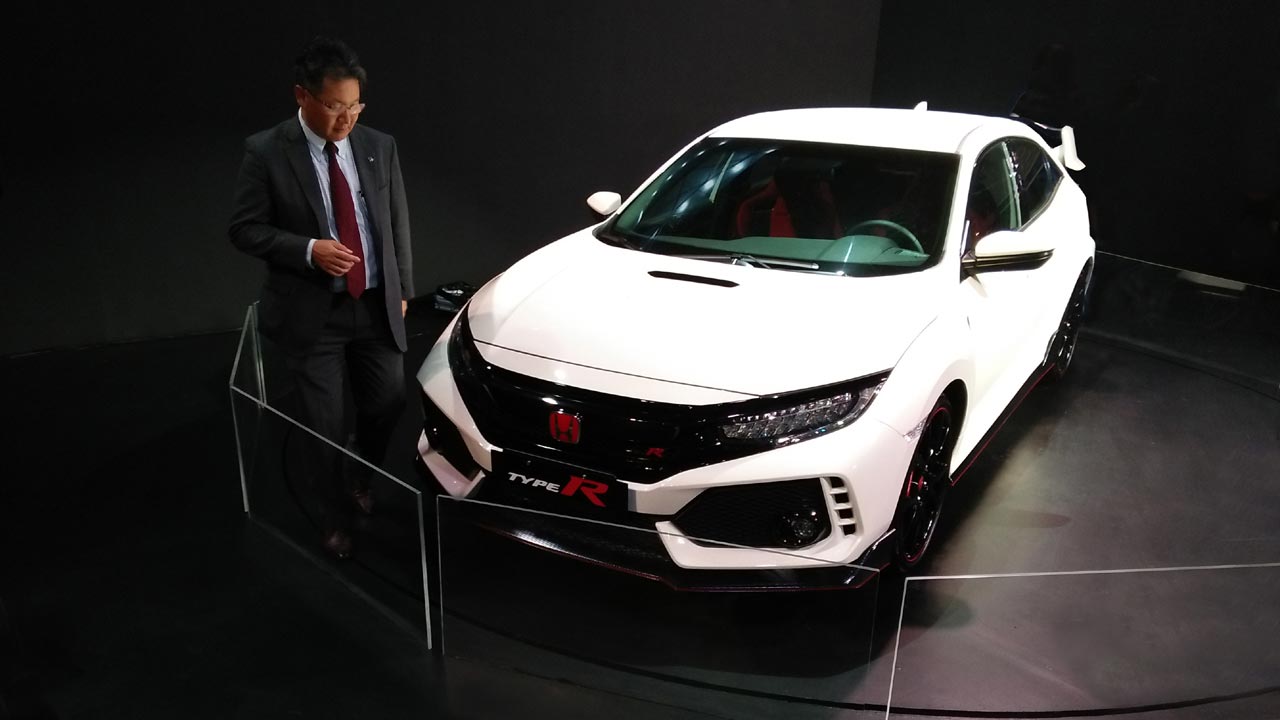
On opening day of the 2017 Manila International Auto Show, on the eve of his departure for his next posting, outgoing Honda Philippines president Toshio Kuwahara got a uniquely appropriate send-off when he launched the Civic Type R, the race-trimmed limited issue of the 10th generation Civic, among the last of numerous new models launched here under this leadership.

You can see the Type R at MIAS 2017 until Sunday, April 2, but Kuwahara-san is away by now, off to his new posting in Vietnam.

Quick note: a modular manual Mobilio photoshoot

If you see a beat photographer toting an SLR, seemingly overdoing it with mainstay smartphones these days already featuring excellent camera optics and sensors, just remember: bringing the gear is merely incidental to him insisting on having traditional options.  

2t5c3894

Case in point: this photo of Honda’s versatile Mobilio, the surprisingly flexible yet compact seven-seat MPV that’s a hair shorter than their popular sub-compact sedan, the City.

To depict the elegance of the Mobilio’s fluid yet compact form encasing its surprising utility, it was important to capture its proportions authentically.  And that, to steer clear of distorting wide-angle optics, takes a far shot pulled in with long glass.  This photo was taken from across a wide, four-lane road, through a middlin’ long 100mm lens on a full-frame SLR.

And, to let the softness of her pearl white paint come through amidst the peeking dusk, the trees left as they were in cool dark shade to offer framing contrast, manual controls were needed to decouple metering from the focusing process.  For this exposure, I chose to spot-meter on whatever midtone was available (not the asphalt which was already in twilight) and still not take the measurement as gospel truth but as mere guide to set the shutter speed manually.   If I had gone with stock metering options, like center-weighted or evaluative, the result would have been the kind of overexposure that could burn all contour off the Mobilio’s faceted fuselage.

2t5c3920

Instead of dismissing the photo as a black-box SLR’s accomplishment (a contradiction, yes, since men accomplish, gear do not), think of it as a study in focal length selection and brazenly overridden exposure settings–the stuff that’s possible with modular and manual equipment that gets out of your way.

Quick note: the Mobilio, long and tall

Built on the platform of the stubby Brio hatchback, the Mobilio stretches matters into the form-factor of a three-row MPV that’s tall inside as well as afoot.  Riding just a centimeter lower than the recently launched BR-V (the Brio platform further evolved into a crossover SUV), the Mobilio must’ve hinted at the possibility of the more rugged people-mover.

2t5c3920

With the Mobilio’s  large diameter wheels and exceptional 19cm of ground clearance, don’t be surprised to find it in the darnedest of places, both lush green and craggy grey.

img20161226173243-1280


Quick note:  Honda Jazz 1.5L

She’s the fleetest, most compact Honda brandishing their 118hp 1.5L i-VTEC engine–a hatchback against the City sedan, the Mobilio MPV and their BR-V crossover SUV.

And, with a squat and long wheelbase geometry underneath a one-box design that makes the cabin paticulalry rigid while making it look more like a two-row MPV, the Jazz’s power and handling puts the maxi-space hatchback at home even on climbing twisties.

Special Report: Honda Philippines’ third generation Pilot

The all-new third-generation model for the Honda Pilot, was launched by Honda Philippines in February 2016, a year after it had been unveiled at the Chicago Auto Show. With all units worldwide being manufactured exclusively in Lincoln, Alabama, Honda Philippines ships in the new Pilot straight from the US, their offering picked right off Honda’s catalogue for North America.

Honda Cars Philippines' Toshio Kuwahara launching the third generation Pilot
Honda Cars Philippines’ Toshio Kuwahara launching the third generation Pilot

Although the Pilot, from the very first generation to its third, has attained both critical acclaim and commercial success in the US, the premium mid-size SUV hasn’t been as popular in the Philippines. It’s in a niche above that of popular Toyota Fortuner, Mitsubishi Montero Sport, Isuzu Mu-X and Mazda CX-9 SUV models, though below luxury mid-sized offerings like the Lexus LX570. Yet this hovering between categories hasn’t lent the Pilot enough distinction to pop up on the radar of prospective buyers. If anything, the previous generations’ burly looks and premium though not-quite-luxury price points, had set the Pilot apart not from the competition but from other Honda models.

IMG20160223200030So, ironically, while the new Pilot comes loaded with an impressive array of engineering innovations, what is immediately notable about this third generation model is something that, on hindsight, was a long time in coming. For this iteration, this time around, the Pilot finally brandishes a design language that reveals its affinity with other things sporty, utile, and Honda … particularly in the Philippine setting.

Design Language

16Pilot_235__Floor_StructurA three-row 8-seat mid-size SUV, the Pilot (badged the MR-V in the Middle East) is big brother to Honda’s popular two-row 5-seater compact CR-V. And yet, all this time, there’s been this disconnect between the two SUV models.

Large for a crossover in the Philippine market where traditional body-on-frame construction is prevalent among utility vehicles, sporty or otherwise, the Pilot actually blends in among the many unibody models in other markets. In fact, even in the Philippines, the Pilot’s gasoline engine, FWD or AWD drivetrain, and supple suspension under a unibody fuselage are similar to those of, should be familiar because of, Honda’s popular CR-V and their Odyssey mid-size MPV. It hasn’t been perceived that way, though, and all this time it’s been because of aesthetics.

1st generation Pilot

The Pilot’s size and angular build made it look out of place in Honda Philippines’ line up, prompting observers to file it away as esoteric, its boxiness making it interesting only to those wiling to go out-of-the-box. Introduced a year into the lifespan of the second-generation CR-V, the first-gen Pilot did look a bit like that 2002 redesign of the smaller SUV. But the similarities ended there. After the third-gen CR-V was introduced in 2007, the Pilot apparently went off on its own design fork entirely.

But the Pilot had actually inspired Honda’s development of the Ridgeline, their radical crossover redesign of the traditional pick-up truck format. So, in a twist of reverse-engineering, Honda had arrived at that place populated by most other brands that had common platforms underneath their pick-up truck and SUV models—reversed in this case because Honda’s crossover SUV came before the crossover sport-utility-truck, or SUT.

16Pilot_159_The Pilot and Ridgeline SUV/SUT tandem would’ve projected a powerful message—hitting well-known and closely-knit categories while pushing innovations in unibody engineering and application.   No surprise that the models that ended up referencing each other’s designs were the Pilot and the Ridgeline, through the Pilot’s first and second generations and the Ridgeline’s several first-gen facelifts.

2017 Honda Ridgeline Debuts at 2016 North American International Auto Show
2017 Honda Ridgeline Sport Utility Truck

Problem is, Honda Philippines doesn’t carry the Ridgeline. On its own, without its truck sibling to back its pitch of innovative rethinking, the Pilot remained almost as much a stranger to this market. So, the seemingly standalone Pilot has been an acquired taste, a Honda only to bold aficionados. Now, finally, things are getting sorted out in a next-generation cascade.

The third generation 2016 Pilot references the design language of the fourth-gen 2012 CR-V which got a facelift only last year. And, the front fascia of the upcoming second generation Ridgeline SUT is now clearly influenced by both the Pilot and the CR-V. End of the day, and suddenly, all three siblings now look alike, and the Pilot, big-brother to the friendly neighbourhood CR-V, now looks the part … it’s finally back in good company despite third brother Ridgeline still not making it to these shores.

Engineering

16Pilot_242_Engine
The new Earth Dreams 3.5L V6 J35Y6 i-VTEC with direct fuel injection

The new Pilot again comes with Honda’s award-winning J-series 3.5L V6, though now with the new Euro4-compliant J35Y6 Earth Dreams engine delivering 280hp @ 6000rpm and 262lb-ft @ 4700rpm. The improvement over the 250hp and 253lb-ft of the previous generation’s J35Z4 engine is brought by the new computer-controlled direct fuel injection system (versus the old port injection set up) with multi-hole injectors that now complements the engine’s i-VTEC variable intake valve timing and lift system and its VCM variable cylinder deactivation mechanism. Based on US EPA tests, fuel economy is as you’d expect on a 3.5L V6 but slightly improved at 7.7km/l in city traffic and 11.05 on the highway with an AWD 6AT drivetrain.

2016 Honda Pilot AWD powertrain

The 2016 Pilot also features new drivetrain options: the new standard 6-speed AT gearbox replacing the previous generation’s 5-speed transmission, and the high-performance ZF 9-speed AT first used on the Honda Acura which is now also featured on the Pilot’s top-spec variants.

Gear 2015 Pilot 5AT 2016 Pilot 6AT 2016  Pilot 9AT
1st 2.697 3.359 4.713
2nd 1.606 2.095 2.842
3rd 1.071 1.485 1.909
4th 0.766 1.065 1.382
5th 0.612 0.754 1.000
6th — 0.556 0.808
7th — — 0.699
8th — — 0.580
9th — — 0.480
Final Ratio 4.312 4.250 4.334

With first gear ratios on both the 6- and 9-speed gearboxes made deeper than those on the 5-speed transmission of the previous generation, it’s clear that the new torque converters have a lower stall speed, a lower tolerance for slippage between drive impeller and rotor. This explains Honda’s claim of earlier, more efficient clutch lock-up on the new generation’s transmission options.

The AWD drivetrain option features a new variable torque management system, Honda’s trademarked i-VTM4, for optimizing traction and tightening up fast turns. The system can vary torque mix between front and rear to mitigate tire spinning, and left to right to create yaw force for assertive cornering. All-weather performance is improved with a traction management system featuring normal / snow / mud / sand modes on AWD variants, and normal / snow modes on FWD models.

1st Gen

2nd Gen

3rd Gen

Wheelbase (mm)

2700

2774

2819

Length (mm)

4775

4862

4940

Width (mm)

1963

1994

1996

Height (mm)

1821

1803

1773

The new Pilot has a longer wheelbase, and is longer and wider overall though with slightly decreased height compared to the second generation model—similar to how that previous one compares to the first generation.

These said, even with the predictable upsizing from one generation to the next, the new Pilot is surprisingly lighter with curb weight trimmed by 150kg and brought down to under 2 tons at 1962kg, and still has a relatively small tuning radius of 5.7m.

Straight from US showrooms

All Pilot units are still manufactured exclusively at Honda’s sprawling facilities in Lincoln, Alabama (Honda Manufacturing Alabama). Shipped from there by Honda Philippines, the Pilot 3.5L EX-L AWD now on offer looks like it was simply picked from among the numerous variants displayed in US showrooms, but with some upscale options made standard on the Philippine market’s one and only Pilot configuration.16Pilot_05

In the US, continued are the Pilot’s LX, EX, and EX-L trim levels, all with the new standard 6-speed gearbox, while a new Touring line and the continued Elite line form the top-tier which feature the 9-speed ZF AT. All told, the US line-up has 15 configurations coming off Honda’s just-in-time production lines.

16Pilot_01To simplify, there are:

  • Two base LX variants with 6-speed transmissions and either FWD or AWD drivetrains.
  • Four mid-range EX variants with 6AT, either FWD or AWD, with or without Honda Sensing driver-assist tech suite.
  • Six upper mid-range EX-L variants with 6AT, FWD or AWD, with options for Navi, Honda Sensing or Rear Entertainment System packages.
  • Two top-end Touring variants with 9-speed ZF AT, either in FWD or AWD configuration, and with 20” wheels.
  • The top-spec Elite variant with 9-speed ZF AT, AWD, panoramic roof and 20” wheels.

16Pilot_08And there’s a big price spread ranging from $30,145 for the base LX FWD, up to $46,570 for the top-spec Elite.

From this selection, Honda Philippines has picked the EX-L 6AT AWD with Honda Sensing package, plus some premium touches off the Elite variant—namely the Elite’s Blind Spot Information (BSI), Cross Traffic Monitor (CTM), and Multi-View Reverse Camera safety features, as well as the top variant’s driver’s seat two-position memory convenience feature. For now, Honda Philippines has no plans for also offering the Elite’s 9-speed ZF automatic gearbox.

New driver-assist technology

That Honda Sensing package they’ve throw in is a set of sensors and impressive driver-assist technologies that do not require any pre-existing infrastructure other than painted lane indicators on the road:

  • Lane Departure Warning (LDW) – detects lane drifting and triggers an alarm.
  • Lane Keeping Assist System (LKAS) – more active than LDW, this system triggers steering inputs if it detects you leaving the center of a marked lane.
  • lane-keeping-assist-systemRoad Departure Mitigation (RDM) – for specific lane keeping scenarios where there is risk of drifting off the road entirely, this system alerts the driver with rapid steering wheel vibrations and could trigger steering and brake inputs to avert
  • Adaptive Cruise Control (ACC) – automated throttle control based on set speed and separation from other vehicles.
  • Collision Mitigation Braking System (CMBS) – a millimetre wave radar sensor monitors against unavoidable collisions and emits an alarm then, if necessary, applies brake pressure to mitigate the effect of inevitable impact.
  • Forward Collision Warning (FCW) – integrated with CMBS, this system adds optics, a camera atop the front windshield, to detect any risk of front collision, emits an alarm and, if necessary, applies brake pressure to avoid impact.collision-mitigation-brakin

New price, new opportunities

SRP for the new Pilot EX-L AWD for the Philippine market now starts at P3.38M. With the previous generation’s SRP adjusted to P2.7M in current pesos to factor in this year’s forecasted USD exchange rate (up by 6 to 7% from last year), this means a price bump of P680,000. About P180,000 of this is may be for an increase in excise taxes made disproportionate by landed costs crossing the P2.1M threshold that the previous generation stayed under.

So, new buyers ought to be evaluating that net real increase in SRP of P500,000 against the major features of the new Pilot EX-L:

  • the more powerful though slightly more economical 280hp 3.5L V6 with new direct fuel injection,
  • the new 6-speed transmission with less slippage and earlier clutch lock-up,
  • the new AWD drivetrain with traction and turn enhancing torque vectoring
  • 16Pilot_68the bigger but lighter body on larger 18” wheel rims
  • the new traction management system featuring normal / snow / mud / sand modes
  • the new Honda Sensing driver-assist tech suite

Interestingly enough, if Honda Philippines had put the base LX trim on offer, buyers would be getting the old P2.6M price tag for the LX FWD variant and the old price adjusted for the new prevailing dollar rate of P2.7M for the LX AWD. These, based on the variance between US list prices for basic LX and high mid-range EX-L trim levels.

CR-V 4th generation
CR-V 4th generation

By settling for the LX trim, buyers would be foregoing conveniences such as the power tailgate and driver’s seat memory on the EX-L, refining touches like leather upholstery, and the traction management system and the Honda Sensing tech suite from the list above. They’d still have the new engine, new transmission, new AWD drivetrain with advanced torque vectoring, and the bigger though lighter body that now, for the first time, would clearly identify the Pilot as the CR-V’s big brother.

A base trim Pilot? Why not? After all, that new design language that unifies the Pilot and the CR-V could eventually become key in Honda Philippines’ marketing long game. They might eventually relent from putting their mid-size crossover SUV on a premium pedestal that separates it from the rest of Honda’s sport utility models and seek opportunities at lower price points (like the price points of the base trim LX), just as CR-V fans might now look at the Pilot as an upsized model smack in the middle of their upgrade path.16Pilot_02

Volkswagen launches Ameo, spotlights India-market notchbacks significant even in the Philippines

Volkswagen has just unveiled the Ameo, a compact sedan designed specifically for the India market. Debuted on February 2 and showcased the day after at Auto Expo 2016 in New Delhi, the Ameo could be a game-changer for Volkswagen in India as well as in other small-car dominated markets.VW-Ameo-2

VW-Polo-Sedan-Philippines1
Volkswagen Polo sedan

Based on their popular Polo sedan but with a notchback trunk to trim overall length down to less than 4 meters, the Ameo features either a 1.2L petrol engine with multi-point injection or a 1.5L TDI diesel. Those key specs put the Ameo, unlike the full sized Polo sedan on which it is based, in India’s small car category for preferential 12% excise tax rates. The sedan is an intuitively up-market form-factor compared to tiny-trunked though sporty-looking hatchbacks that otherwise dominate the roads. And premium brand Volkswagen has managed to put a short sedan in a pricing sweet spot for India where 72% of last year’s over 2 million vehicles sold we’re in the small car category.

Judging by Toyota’s reaction, a game changer

The tax benefits redounding to lower price points are significant since the next bracket, the one in which the longer Polo sedan belongs, jacks excise up drastically to 20%. The wide spread in tax rates is significant enough to have prompted world leader Toyota, as reported by Motorbeam.com last year, to ask the Indian government to remove tax breaks for sub-4 meter vehicles. Their argument: the regulations in India give automakers less opportunity for exports. The claim appears self-serving considering that Toyota itself doesn’t have a sub-4 meter sedan to offer and, observers reckon, is still three years from rolling out a model that they’re currently developing for this category.

suzuki swift dzire
Suzuki DZire notchback sedan

Moreover, Toyota’s justification using the export buzzword is rebutted by the performance of Maruti Suzuki, the Indian-Japanese joint-venture that’s the long-standing market leader in India with 45% market share by year-end 2015 (peaking at 50% mid-year). Their top-selling Swift sub-compact hatchback and Swift DZire sub-4 meter sedan have found good market even here where 1.2L petrol-engine variants subsequently introduced by Suzuki Philippines (thereby quietly introducing India’s sub-4 meter category to the country) contributed to their turning in top growth numbers for 2015. Even while the Philippine market showed growth biased towards light commercial vehicles, Suzuki saw a 52% increase in year-on-year sales with 2015 deliveries coming mainly from their mini and sub-compact passenger cars line up (see our story, “Suzuki Philippines is 2015 growth leader with passenger car sales that defy trend for light commercial vehicles”). The Indian government has not granted Toyota’s request.

Toyota-Etios-Liva
Toyota Etios Liva hatchback

Latest 2015 figures put Volkswagen in close second place to Toyota globally, the former’s 9.93 million in unit sales already at 98% of the latter’s 10.08 million. But the   German brand is a relative newcomer to India where it has just a 2% market share to show against Toyota’s 6.5%. This is the one market where it could tap game-changing growth. Now, with the Ameo set to roll out of showrooms by mid-year 2016, Volkswagen will be fielding both the new sub-4 sedan and their Polo hatchback against the Etios Liva, also a hatch and Toyota’s one and only model in India’s small car category until they roll out their short sedan in 2018. It’s an open field where number two Volkswagen can double team number one Toyota, and in a game that could spill over into other territories.

Indian economies of scale bring de-facto Philippine tax breaks

Unlike the specific taxation behind the 4-meter length and small-engine displacement limits of India for a preferential 12% rate, the Philippines uses an ad valorem structure that levies increasing rates on escalating portions of a vehicle’s import or production cost. For Philippine excise taxes on motor vehicles, 2% is used for the first P600K. If the vehicle costs more than P600K, 20% is used for the next P500K. If the cost is more than the P1.1M of the two lower brackets combined, 40% is used for the next P1.0M. If the cost is even more than the P2.1M of the three brackets combined, 60% is used on the excess. These actually depict a lower tax burden than in India. Excise taxes would hit the 12% equivalent of India’s small car category only when those costs approach P1.2M each.

VW-Ameo-5In the Philippine tax environment, it was Suzuki that pioneered a niche for India-market notchbacks that, at the very least, minimizes excise tax. What Suzuki Philippines broke into was a pricing niche for small hatchbacks and sedans that tops off just above that recurring P600K mark. The Swift hatchback 1.2L and Swift DZire 1.2L notchback they brought in (both with engines curiously downsized from the original 1.4L with which the popular Swift was first launched and is still retained in an up-range variant) are obviously like the Volkswagen Ameo—specially configured to fit India’s small car category.

While these do not benefit from any particular Philippine tax break, the specially configured variants do come from having Indian tax incentives that result in sales volumes which keep prices down by sheer economies of scale. Other words, it’s the pricing that’s kept low by successful India sales that get these vehicles the Philippine equivalent of a tax break. It’s like getting hotcakes at half price because neighbors already got things discounted with a large, wholesale purchase.

Philippine niche for India-market notchbacks

The result: P638K for the Swift 1.2L M/T hatchback with P111K savings off the original variant mounting a 1.4L engine (which doesn’t fit India’s small car profile), and an even lower P568K for the Swift DZire 1.2L M/T short sedan which has no other engine option but the one that keeps it in the sub-4 meter category. At prices that stay near or under the P600K SRP level even after covering ship-in costs and mark-ups, excise tax rates are kept down at the lowest 2%, nearly eliminating the bloat it otherwise could put on the list price.

Honda Brio Amaze notchback sedan

The situation has created an opportunity for other carmakers, later entrants, also willing to engineer products for the sub-4 meter category (instead of lobbying to abolish its tax benefits). Honda’s Brio Amaze notchback sedan was introduced in India with a 1.2L petrol engine, keeping it in the sub-4 meter category and pitting it against the top-selling Swift DZire 1.2L. By most accounts, Honda’s notchback has been showing well.

brio amaze 2Subsequently, in 2014, Honda Philippines brought over the Brio Amaze, although with a larger 1.3L i-VTEC engine, focusing on performance despite causing a departure from the 1.2L engine that had gotten it a tax break in India. Nevertheless, volumes on the components common to the India- and Philippine-spec models appear to let Honda hit that pricing sweetspot with an SRP of just P629K for the basic E variant with manual gearbox. And if they choose to bring in the 1.2L variant later, like Suzuki did, this could introduce another, significantly lower price-point, like it had for Suzuki.

Point is, India-market notchbacks are already in the Philippines, have been here for several years already, even if the market hasn’t perceived these as such but rather as rakish sedans with trunks truncated for sporty aesthetics. And now, with premium German brand Volkswagen having reworked and shortened their popular Polo sedan to become an India-market notchback, the niche has transcended the esoteric, been made overt and apparent by the world’s second largest marque gunning for top spot.

Another notchback for the Philippine mix?

Volkswagen will be pricing the Ameo very competitively for the Indian market. Ex-showroom prices in India ranging from the equivalent of P422K to P562K have been reported.

VW-Ameo-3Philippine-spec vehicles are typically priced at around 150% of the Indian counterpart models, whether sourced from India or off-shore suppliers. This means that if the opportunities prove compelling enough both for Volkswagen global and Volkswagen Philippines alike, they could bring in the Ameo at an offer price starting at P633K.

That’s a surprising notional SRP for an up-market city-sized short-sedan complete with modern staples such as a full-fledged infotainment system, power windows and locks, rearview camera, cruise control, dual airbags, ABS and electronic stability control. A surprising price particularly for a Volkswagen that’s acclimatized for the Philippines with what looks like the same high, 170mm ground clearance of the Suzuki Swift hatchbacks and sedans for negotiating the rough inter-city roads and high speed-bumps in India. A surprising price for Volkswagen with their current lowest priced model, the Polo sedan 1.6L A/T listed P200K higher at P840K. A surprising price for the recently returned European Volkswagen marque that’s premium enough to command a P4.29M price for its SUV top Touareg model. Basically, that notional P633K for the new Ameo is a surprising price for a Volkswagen, period.

Toyota Vios sub-compact sedan

Still, it’s just a notion. But think of how a P633K Volkswagen Ameo can upset the status quo not only in its role evolved for India where driving conditions are apparently worse and more diverse than in the Philippines, but also in a market other than India where arch rival Toyota doesn’t have a counterpart model and instead has the Vios sedan as the closest thing to one.

VW-Ameo-6The Vios, Toyota Philippines’ best-selling model showcased for its track-ready handling in much publicized one-make races, with its near single-minded focus on a ground-hugging ride having committed it to the low, 147mm of ground clearance that causes the occasional underbody scrapes even with just two on board. And lastly, the slightly larger, sub-compact Vios sedan with its less finely trimmed 1.3L J M/T base variant selling for a near-equivalent P630K.

VW-Ameo-4Having spotlighted the India-market notchbacks already in the Philippines and their unique draw amongst region-wide third-world sensibilities, the Ameo should be coming to Volkswagen Philippines showrooms, and coming soon.   This is too good an opportunity, even for Volkswagen global, to pass up.

VW-Ameo-front-quarter-press