

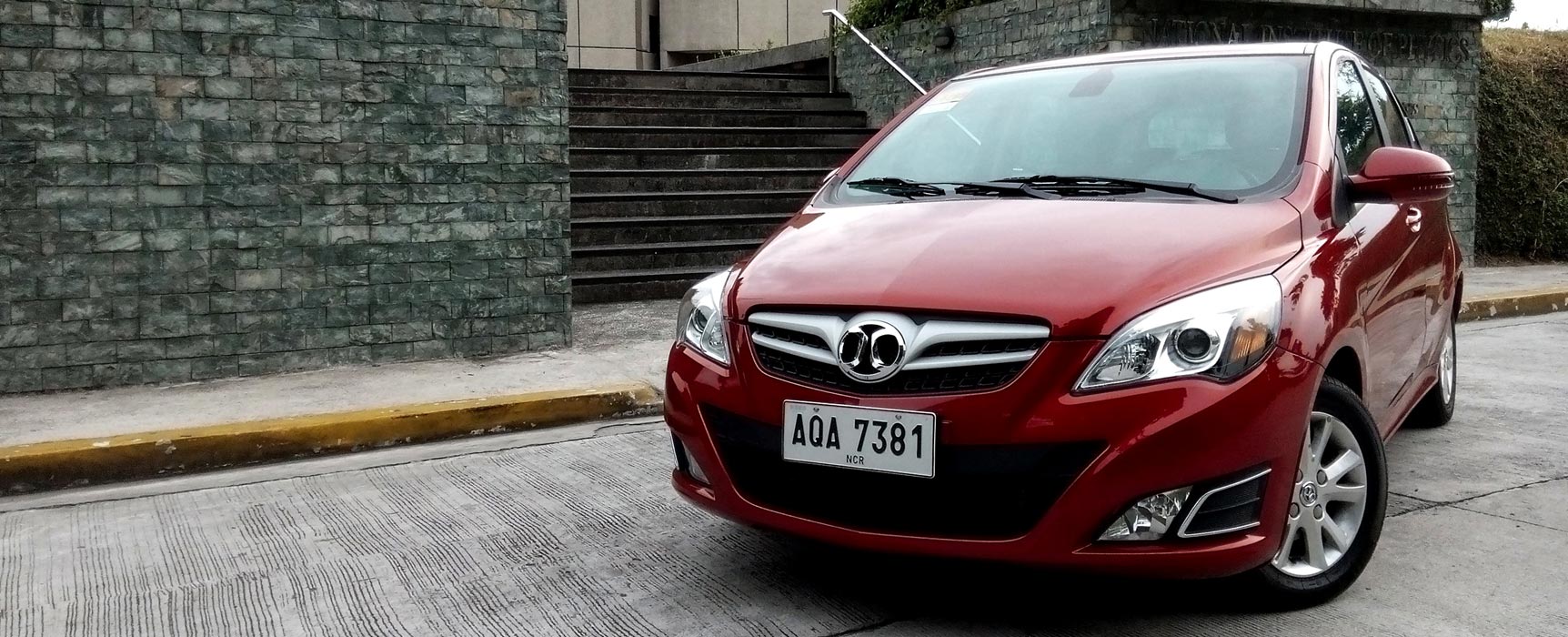
BAIC Philippines is bringing in the M20 MPV, having shipped in a unit of its max-passenger 8-seater variant in time for this year’s round of automotive awards tests. Badged by BAIC Motor either as the M20 or the R315 in different parts of China, the MPV model was introduced there in 2013, first deliveries happening late that year in October.


In China, the M20 is portrayed as a “one-of-a-kind MPV … which combines all the features you would expect to make it what we call an off-road family car” (see http://www.baicintl.com/product/r315/). When asked to elaborate on this reference to rough-terrain use, BAIC Beijing’s Vice Director for the Southeast Asia Region, Emily Liu, said that this was to highlight the ruggedness of its rear-wheel-driven, body-on-frame construction. Adding context to this answer, BAIC’s Robbie Liu (Manager for Southeast Asia) explained that rural, inter-town roads in China are very rough.
A soft-roader, maybe
In a sense, this MPV’s mission brief has been dialled-back somewhat, back to that of the AUVs that have been petering out since the last decade. Not at all a stigma in this market where our notion of MPVs are as evolved Asian utility people movers (not as unibody mini-vans), and where another brand of Western origin even attempted, unsuccessfully, to adopt the moniker, the AUV label appears incompatible with the sensibilities and aspirations of China’s automotive market and industry, respectively.So then, it’s an off-roader mini-van for them, a description that won’t likely stand over here where off-road, really off-the-map motoring, means four-by-fours. Notably, though, literature for BAIC’s other markets eschew the off-road reference and simply describe the M20 as a high-end MPV with a reinforced chassis. So, it could be that strong soft-roader would be a more appropriate description for this new MPV model … and its engineering indicates the M20 has credible claim to this conservative caption.
Soft-sprung, stable wheelbase
From the start, the M20’s 2790mm wheelbase stood out and looked familiar at the same time. With bulk and weight between that of Toyota’s top-selling Avanza mini and Innova compact MPVs, the BAIC M20’s wheelbase is surprisingly longer than that of either one (2655mm on the Avanza, 2750mm on the Innova). On smooth pavement, this should make for more stable vehicle dynamics, either on straight-line cruises and G-pulling turns. On rough, rolling terrain it’ll dampen the seesaw jinks caused by the front and rear wheels individually hitting the road’s bumps and dips.

And, although leaf-sprung rear suspensions are standard on the M20’s basic variants, they’re bringing in just one variant, a higher-end one that has coil springs in back. BAIC Philippines President and CEO George Chua confirms that they’ll be offering just the one variant with its maximum 8-seater capacity featuring the premium ride of MacPherson struts up front and a multi-link independent suspension in back—arguably the variant with highest general value and utility.
A hard, pedigreed chassis

BAIC’s other models and the fact that the M20’s variants offer the option for either leaf- or coil-sprung rear suspensions, these together offer clues to the origin of the M20’s all-important and much-vaunted chassis. BAIC produces the XB424, a full-on, body-on-frame, mid-size SUV that they openly say uses the high-rigidity chassis of the Toyota Land Cruiser Prado 3400, that model’s third-generation 120 series. Although Toyota never included the Land Cruiser in the list of vehicles built on their successful IMV platform, they acknowledged that it shares its chassis with the Toyota 4Runner—and that one, Toyota does list as an IMV-based model.

Connecting the dots then: (1) BAIC’s XB424 SUV uses the short 2600mm wheelbase chassis of the third-generation Toyota Land Cruiser Prado 120 series; (2) the “reinforced chassis” of the BAIC M20 MPV has a 2790mm wheelbase, a number equal to that of the long-wheelbase version of the chassis used on the Prado for both its recent 120 and 150 generations; (3) the Prado’s chassis count among Toyota’s IMV platform configurations, configurations that include those with either leaf (like the Innova’s) or coil-sprung (like the Fortuner’s) rear suspensions; and (4) the M20 has both leaf- and coil-sprung rear suspension variants. With these as premise, it isn’t much of a stretch figuring that either BAIC OEM’d a Toyota Land Cruiser Prado’s IMV chassis into their M20, or, after working with a Toyota chassis for their XB424 SUV, engineered their own version of a high-rigidity frame for their MPV.
The kicker to it all is that this makes it a similar though longer chassis to that of the best-selling Toyota Innova, while still being almost 400kg lighter than that popular mid-size MPV—light enough to be powered by a 1.5liter petrol engine like that of the Toyota Avanza compact MPV. And the engine itself, the BAIC-built BJ415B with DOHC driving 16 valves with VVT (more powerful than the BJ415A—built by BAIC’s powertrain subsidiary—that’s featured on the M20’s more basic variants), brandishes numbers that suggest surprising power.
Table-top power curve

Nominally delivering peak power of 106hp at 6000rpm (typical power density for a 1.5L petrol burner), the BJ415B seems to use its VVT-equipped valvetrain to not only address the torque loss at the lower end experienced with 16 valves as compared to those with 8, but appears to dramatically flatten the power curve as well. Its 106lb-ft of peak torque kicks in over a range from 3000 to 5000rpm, exactly where you’d need it for hauling and acceleration on a powerplant that redlines at 5250rpm. Even with a conservative estimate of just 50% of torque available at idle (under 1000rpm), reaching that 3000 to 5000rpm plateau for 100% torque suggests that 75% or nearly 80lb-ft would already be available at 2000rpm.
If not for anything else, that 80lb-ft at 2000rpm pushing the M20’s 1270kg curb weight would account for some nice short-shifting for fuel economy, while still accelerating smartly enough for prompt up-shifts. BAIC Beijing’s Robbi Liu says that the M20’s fuel consumption numbers measured in China were 11.2km/l in city traffic, 16.9km/l on the highway, and 14.7km/l with mixed driving. If the goal is to deliver similar figures here, the mileage numbers seem attainable with common everyday driving given the 5-speed manual transmission’s slightly taller-than-usual second and third gear ratios—2.104:1 and 1.339:1, respectively—leading up to a true direct drive 1:1 fourth and overdrive 0.838:1 fifth gear ratio.
Bigger shoes to wear, and fill

Finally, though, a note on running gear: the BAIC M20 lists options for either 185/65R14 or 185/70R14 tires. It has to be said that not only would the higher walled 185/70R14 tires be more consistent with the M20’s soft-roading potential, a quick look at the M20’s wheel wells show these to be able to accommodate even further upsized rubber to the tune of 185/75R14 tires. BAIC Philippines could consider either the larger stock or locally upsized options.
 The wheels would look in better, more handsome proportion to the M20’s height, certainly, but more importantly, the cushiony tires would provide a wider inflation pressure range that could be adjusted to suit road and load conditions, and would instantly increase the MPV’s 162mm ground clearance by 9 to 18mm. This’ll raise the soft-roader MPV into true high-rider territory with from 171 to 180mm of minimum ground clearance, while the slightly deeper-than-usual 3.857:1 reduction in first gear ought to be able to handle the slightly larger wheel diameter on roll-outs.
Aggressive price point
Obviously, this is a developing story with many factors that’ll bear testing in an actual drive. But if things do pan out, as is likely, the M20 will definitely present a serious challenge to MPV market leader Toyota. BAIC Philippines’ George Chua confirms that they’re targeting a sticker price of under PhP600k. That’s a price point that’ll put the BAIC M20 within reach of a buyer base that’s much deeper than that of the bigger Toyota Innova , and that of the smaller Toyota Avanza mini MPV as well.


 The
 Now the smaller


 AUTHOR’S NOTE:


 With its maxed out wheelbase under an otherwise compact body, the MZ45 is easy to drive and lithe enough to weave through traffic with composure. It’s visibly narrower than most anything else on the road but that long 2,900mm wheelbase does a lot for making the compact van rock-steady in turns and jinks. Even from a driver’s seat that’s about a meter above ground, there’s no pronounced roll when taking a turn at a good clip, not more than would’ve been felt on a lower slung sedan.
 Once you get your frontage through a gap, that gap that’s smaller than what full-sized vans would need, it’s just a matter of timing to know when the rest of the long body has made it through, when it’s safe to start turning the wheel and not cause the tail-end on its overhang to swing out and sideswipe something. No case of cold sweats even when parking despite that reversing camera not being included as stock equipment.


 Although the MZ45 can be had with factory-installed jump seats on the second and third benches, I find that the lack of these options gives me more, well, options. These could expand seating capacity to 11, yes, but would then entail some anxious load planning. With standard payload maxed out at 675kg, the MZ45 has the capacity to seat 9 people even if all of them are full-grown adults. But, with the 11 seats you’d be able to fill with the optional jump seats installed, you’d then have to worry about the size and weight of each of those 11 passengers so as not to bottom-out the suspension.
 At this wedding last month, I noticed that several groups arrived in chartered UV Express vans—Toyota HiAces and Nissan Urvans, really big vans that they didn’t seem to be able to fill. And yet, the vans seemed practical for them. Practical even for my bunch because we had also arrived in an unmarked HiAce Commuter that our group had chartered despite not being able to fill all its seats. At the end of the day, it always makes sense to take one van instead of several sedans … it’s even more fun, with all of us being in the same space and able to chat as folks would normally want to.
 The new, TNVS category that legitimizes Uber also suggests an area for expansion by the popular online service. TNVS vehicles include not only sedans but also multi-purpose vehicles, minivans and full-sized vans. And yet, the economy-class Uber X service features only compact and sub-compact sedans, while the higher end Uber Black service speaks of premium SUVs. The new TNVS category is not explicit on the matter of SUVs and appears to close the door on the luxury Uber Black service, while also seeming to open another one for an intermediate category of oversized transport such as minivans and bigger. Call it Uber XL, a new category for hiring extra-large vehicles that can seat more than what sedans could, and at an appropriately higher rate than on Uber X.
 However, until Uber XL becomes a reality, the folks who’d want to rent out their vans will just have to do it as before, off-meter and on contracted fees. This isn’t true for a BAIC MZ45 owner. An MZ45 owner can rent out his van as a sedan equivalent under Uber X, taking on 4 passengers at a time and gaining regular customers who may eventually be interested in hiring the vehicle as a full-blown chartered van that’ll carry 8 (excluding the driver). Until another Uber category is introduced for mini and full-sized vans, there’s the BAIC MZ45 that could be useful every day both for business and for the family… a truly variable vehicle.


 By April 2012, the BorgWarner-China joint venture was reporting a large and increasing demand for DCTs in the emerging automotive markets of both Europe and Asia. They estimated that the market for DCTs in China alone would grow from 0.6 million in 2012 to 2.7 million units by 2017, growing each year by 35%. Months later, in August 2012, after they had already launched their F5 sedan with the Ti+DCT package that took two years to develop, BYD both admitted that they had problems with supply of the DCTs for their popular vehicles and reported that they had already solved these. Though they didn’t elaborate on their solution, soon afterwards in November 2012 they announced that by the next year, BYD would be putting their own in-house developed DCTs in their vehicles. Then, in 2013, BYD started featuring their in-house developed DCT even on vehicles without high-end turbocharged engines.


 More efficient with the positive contact of the clutch instead of the hydraulics of a torque converter, a DCT must have the programming to discern when to engage or disengage either of its clutches. Unlike an AT that can rely on slippage to cushion both the torque from and the load on the engine, a DCT needs to actively manage the clutch-work, manage the clutch friction. The DCTs programming triggers when to engage the clutch on the first gear and when to transition to the other clutch for an up-shift, when to go back to the other clutch for another up-shift, and so on until the top gear is reached at cruising speed.


 On a day’s drive in the city, the L3 DCT turned in a figure of 11km/l with frequent prolonged stops burning fuel at a rate of 1ltr per hour being offset by the car’s noteworthy ability to move off again and accelerate decently with the engine never exceeding 2,200rpm—this, even with a full family load of two adults and three kids. With a long enough stretch of open road, that 2,200 rpm cap could bring the L3 up to 60km/h where you could settle back at 2,000rpm and remain in 5th gear. At those readings, at 60 in 5th and with 2,000, the trip computer would show current fuel consumption of just 5ltrs per 100km—the equivalent of 20km/l for those few seconds that you can remain at 60km/h on city streets.
 That smooth shifting indicates that the DCTs programming has good routines for toggling between the dual-clutches. But popping the selector out of D and into N, and then back again, while already at cruise, that shows how well the DCT emulates a human driver. Pop her into N to disengage the active clutch, then take your foot off the gas. The car will go free-wheeling and you’ll see the revs settle back down to the 800rpm idling level. All as expected.

 No wonder that the L3’s DCT has an uphill assist feature—it’s absolutely necessary after all, not just a gimmick. What is surprising is the sheer elegance of how the designers will have you activate it. If you’re stopped on an incline and needing to climb uphill, a tried and tested technique on manual gearboxes is to pull up the hand-brake to keep you stationary while you balance you’re clutch and throttle to put torque on the wheels and make them start pushing against the brake. This way, when you release the hand-brake, the car will immediately start inching up instead of down the incline.


