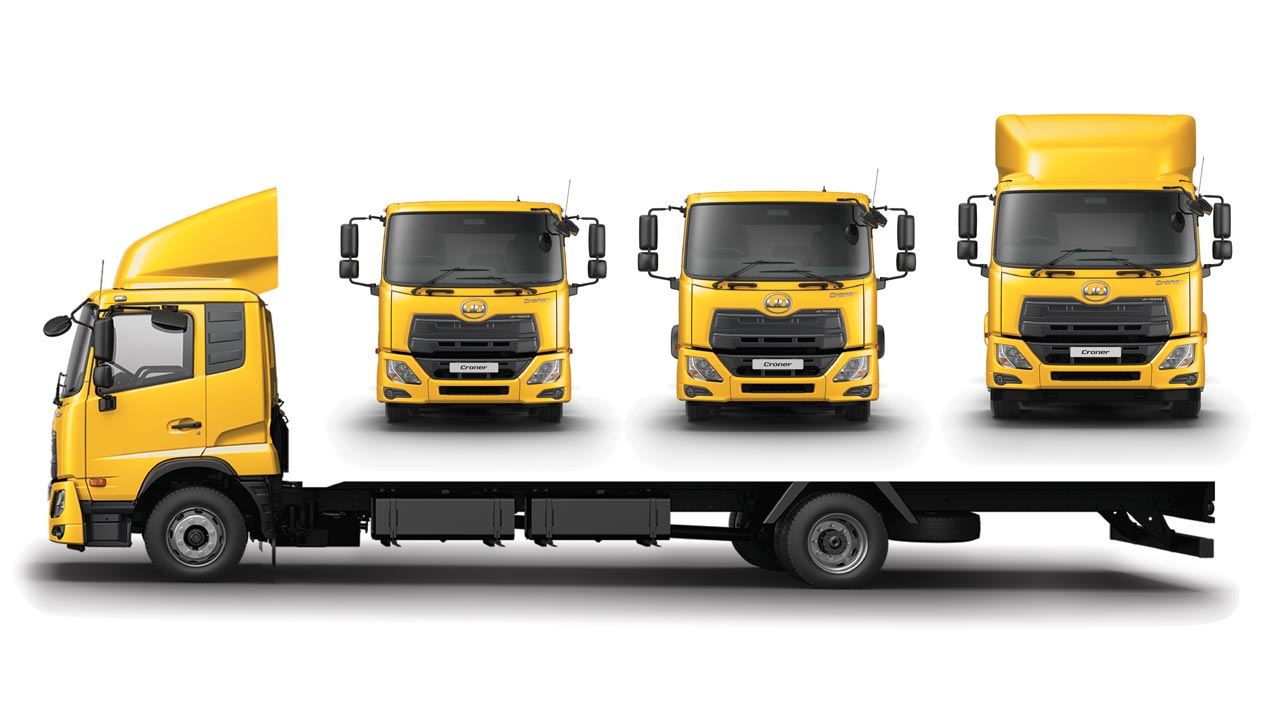

UD Trucks launched their Croner medium-duty truck at a globally attended event in Bangkok last week. Arguably the most versatile truck platform in the medium-duty segment, the Croner line brings numerous cargo capacity, engine power and wheelbase geometry combinations, and has top-end mass and dimensions that make it bump up against the medium-heavy range of the spectrum.

It comes in three types with gross weight ratings from 10.4 all the way up to 17 tons. Units come either factory-built with bodies for long-haul, distribution and construction applications, or delivered as cab-chassis platforms to be worked on further by affiliated body-builders. Wheelbase lengths on all three types can be varied on the factory floor or by downstream builders from a minimum of 3450mm to a maximum of 6500mm, with increments of as little as 250mm.
From Nissan Diesel, to Volvo, to UD Trucks
 Established in 1935 and known before as Nissan Diesel, UD Trucks became a wholly owned subsidiary of the Volvo Group in 2007. The UD name, now taken to mean ultimate dependability, draws on market recognition for Nissan Diesel’s trademark two-stroke Uniflow Diesel engine first introduced in 1955. The Croner is the second new model to come from the integrated operations of the partnered brands, joining the heavy-duty Quester line-up that they introduced four years ago in 2013.
The similarities in the design of the Croner and the Quester indicate an affinity that’s confirmed by Volvo Group Trucks Asia president Jacques Michel. Michel says that the Croner and Quester tandem, sporting a common design language with their cabin fascia and character lines, represents a new class of trucks meant specifically for growth markets across Asia, Africa, the Middle-East and South America. The Croner and Quester now relegate their medium-duty Condor and heavy-duty Quon trucks (popular and long running Nisssan Diesel trucks with origins dating back to before Volvo’s buy-in) to mature markets like those of Japan and Australia.

Asked further about the distinctions between their growth and mature market offerings, Michel said that while mature markets are stereotyped as having stricter emission controls, advanced infrastructure, and better road conditions, UD Trucks’ experience serendipitously points to differing markets having different needs, different sets of expectations, it’s that simple. By the sheer weight of circumspection and engineering apparent in the Croner’s features, how these address essential needs with robust, even generous, engineering, it’s clear that UD Trucks is fielding a new model that’s meant to be ready for anything that’s thrown at it in the workhorse medium-trucks segment of growing markets.
Variable vehicle
 The Croner comes in three size/weight types. Lightest is the compact MKE with dimensions meant for tight city streets and gross weight ratings from 10.4 to 11 tons. There’s the mid-size and multi-purpose LKE with 12 to 14 tons. And there’s the long-hauling medium-heavy PKE with 15 to 17 tons.
 With tensile strength asserted to be the highest in its class and balanced with healthy flexibility to stave off metal fatigue, the Croner’s chassis frame comes pre-drilled with bolt holes for sizing the cargo bed with wheelbase lengths from a minimum of 3450mm on all three types, to a maximum of 5250mm for MKE and LKE types, or 6500mm for the big PKE. Facilitating adjustment in wheelbase lengths by as little as 250mm increments, and to keep things modular for any driveline tailoring, the driveshaft from engine to the differential on the rear axle is composed of undulating segments, each joint dampening and isolating the effect of road shocks on the driveline.
 Unlike other medium-duty models, the Croner offers only two-axle 4×2 drivetrains with wheel pairs on the rear axle, no configurations with three-axle 6×4 layouts. This puts a lot on two axles, both literally and figuratively, and reveals how confident they are in their claims of class-leading axle loads, both up front and in back, and with axle sub-assemblies tolerating extended grease-change intervals nearly three times longer than is typical.
The cabin itself features exceptional ergonomics highlighted by a flowing dashboard design that’s shaped around the driver’s wider range of motions. The driver’s seat is spring suspended, something you seldom see on medium-duty trucks. And, reflecting how its amenities are meant for hours- or days-long drives, the Croner is offered with sleeper-cab options, another rarity in the medium-duty segment.

Downsized diesel
Michel says that when UD Trucks started their four year development of the Croner it was with the express goal of making it 5 percent more efficient than its other medium-duty trucks. Aside from aerodynamic cab designs with reduced drag coefficients, they achieved this with new and downsized engines on which power densities were increased with the use of “super pressure” CRDi systems featuring sophisticated electronic control of injected fuel quantity and timing.

The compact MKE and mid-sized LKE types are powered by a 5L 4-cylinder GH5E diesel engine while the big PKE retains an 8L powerplant, the 6-cylinder GH8E, with both engines being Euro 4 compliant and built rugged enough to have longer oil-change intervals. Those engine codes imply an evolution from the proven 8L 6-cylinder GH8 used on their existing Condor truck, the trailing “E” code on the smaller GH5E and the like-sized GH8E meant to signify fuel efficiency enhancements.
The advanced CRDi system delivers high torque, peaking early and lingering there on the contours of an exceptionally flat torque curve. Torque onset is rich and early enough to deliver an economy range from 900 to 1700rpm. Powerbands are improved tangibly enough that the Croner’s compact MKE type uses the GH5E tuned to 180hp unlike lighter counterpart Condor variants which have a bigger GH8 putting out 210hp. For the bigger mid-sized LKE type, the 4-cylinder GH5E is tuned to 210 and 240hp, numbers rivalling the 215 and 245hp on the old Condor’s 6-cylinder GH8.
Market influences
While the Croner is not meant for mature markets, it seems to also raise the bar somewhat, bringing features that meet the expectations of customers from those parts as well as from their biggest and most advanced growth markets. You’d see this in the air brakes actuators for each of the rear wheels, left and right, to deliver dedicated pneumatics to either side. Engine braking is also complimented with exhaust braking, a feature more common to heavy-duty trucks where exhaust valves are constricted to offer greater resistance to reciprocating pistons in idled engines kept in low gear.

The 6- and 9-speed manual transmissions offered on the Croner have clutch plates that are said to be the biggest in their class, making these feature better grip and durability. For high operating temperatures such as those in bumper-to-bumper equatorial traffic jams, clutches of Cerametallic material are offered as options.

While automatic transmission options were made available on all variants to meet the needs of the South African market, their biggest growth market right now where there’s an emerging shortage of drivers for long haul jobs, UD Trucks went full tilt with the feature and sourced the gearboxes from industry leader Allison Transmissions.
The Croner’s AT gearboxes offer Allison’s advanced Continuous Power Technology where a hydraulic torque converter with high stall speed is used only on launch, potentially doubling torque with hydraulic slippage against the 1st gear, but then is in effect bypassed as the 6-speed gearbox shifts up into 2nd gear and then onwards. Taking over from the fluid coupling of the torque converter, there are five clutches in the transmission, a clutch for each of the gears except for 1st, where pairs on adjacent gears simultaneously grab onto or release from the engine’s torque to execute seamless sequential gear shifts. In essence, you have the equivalent of a industrial grade dual clutch transmission delivering continuous push or engine braking with an over-engineered setup where each gear in play has its own dedicated clutch.

For the ability to adjust ride stiffness on demand (freeing operators from having to switch from durable steel- to flexible nylon-belted tires to soften the ride, for example), the Croner offers an adjustable air suspension system in the rear. The function of the air suspension setup is to soften up the ride when needed, to dampen road shocks in varying degrees to insulate fragile cargo.
Down the road
On all Croner variants, there’s the option for telematics that can receive and display remotely commanded travel routes, track motion on or off those routes, and map all these against the control inputs of truck drivers who are made to log into the system and can then be critiqued and coached by it. Data communications with home base can happen realtime over 2g or 3g cellular networks, or buffered for burst transmission later on when intermittent or low quality carrier signals clear up enough for digital exchanges.

UD Trucks director for aftersales and soft products Samuel Artus says that in South Africa similar telematics on their other models were instrumental in recovering nine stolen trucks, this because perpetrators could not disable the factory-installed telematics equipment, equipment that, in a sense, are fleet trucks’ equivalents to airliner black boxes. So, while the telematics remain tools for fleet management, mainly, UD trucks has firsthand experience of how these may be used for security and they don’t discount the possibility of using the equipment’s telemetry to effect more deliberate protection of both vehicle and cargo in the future. Not yet in existence, still on a notional drawing board, there are further enhancements to the suite that could deter criminal elements from their usual M.O. of threatening or enticing drivers into allowing or abetting theft of their payload.

When it was officially launched last March 1 the Croner was already on the production floor at UD Trucks’ manufacturing facility in Samut Prakan near Bangkok which has a capacity of 10,000 units per year, per shift (they can double their output, running two shifts in a day). There, in a plant originally opened by Volvo in 1976, UD Trucks now produces medium-duty Croners beside heavy-duty Questers and even upscale Volvo haulers meant explicitly for export. Croner trucks are rolled out with bodies for numerous hauling and construction applications, or delivered as basic cab- chassis for delivery to body-builders kitted out to do further sizing and construction.
UD Trucks will announce prices for the Philippines when they bring the Croner to this market by the second half of the year.


 This progression to common classes for their fleet customers, the first in the country, is as pragmatic as it is groundbreaking … it’s simply them doing their part to make sure their multitude of fleet customers, and many new clients, do get what they expected when they chose Isuzu. And, with truck school and its certificate courses being the creation of the country’s biggest truck-maker, well, it’s easy to see how this harks back to when big brands like IBM and Boeing had themselves created instruction programs for their complex products, programs that were eventually mainstreamed into courses from independent, third-party institutions. Would that these developments lead to similar evolutions.


 Hyundai Philippines updates the Grand Starex, the upsized second-generation to their popular Starex line, with a variant configured specifically for the transport sector. Listed at P1.398M, a sticker price that adds P60k to that of their 2.5L GL 5MT base variant with its 10 or 12-seat capacity, the new Grand Starex Super Express is set up with the 15 seats that now make it a stronger contender in both chartered and public transport roles.
 The passenger couches are utilitarian, value-engineered into compact footprints while providing ample comfort and legroom in short to medium duration city travel. The efficiently sized furniture allows fixing of the middle seating rows further forward—forward enough to make room for the variant’s defining rear-most seating area with its two side-facing benches providing 6 out of the Super Express’ 15 seats. The result is commuter-class capacity on the Grand Starex with its large sliding doors on both sides and the full-width tailgate offering quick and easy access for curb-side boarding.
 Other specifications appear unchanged from that of the 2.5L GL 5MT base variant of the popular Starex line that’s known for exceptional ride comfort even on a front-engine, rear-drive layout with its conventionally rigid (and robust) rear axle. The Super Express becomes the second variant (after the base GL) to feature the Grand Starex’s simpler, fleet-sensible 100ps (98hp) 2.5L TCi SOHC 8-valve turbodiesel delivering peak torque of 227Nm an early 2000rpm. And prospective owners are offered warranties capped at three-years or 100,000km.



 IPC sales in the first six months of 2016 reached 13,258 units, a significant 30.4-percent increase from the 10,169 units sold during the first half of 2015. As reflected in the joint report of the Chamber of Automotive Manufacturers of the Philippines Inc. (CAMPI) and the Truck Manufacturers Association (TMA), IPC’s performance traces a steeper upward trajectory than the 27.4 percent rate, or 167,481 units sold, posted by the country’s automotive industry for the same period.
 “The brisk movement experienced across Isuzu Philippines Corporation’s model lineup is a manifestation that the company offers consumers some of the most relevant products available locally. With many of Isuzu products geared toward business use, the growth is also an accurate indication of the market’s optimistic view regarding the economy,” IPC President Hajime Koso said.
 Bolstering this is the performance of IPC’s light commercial vehicle lineup. During the same period, a total of 2,361 Crosswind units were sold, a 20.4-percent increase from a year ago. Deliveries of the D-MAX pickup were not far behind at 1,897 units, which is a 34.3-percent jump.
 The rest of IPC’s models performed equally well in June, with the company posting a 13-percent growth compared to the same month in 2015, or 2,439 vehicles sold in June this year versus 2,159 units sold in June last year. Supporting the mu-X’s tally for the month were those of the Crosswind at 434 units, the D-MAX with 304 units, Category III trucks with 307 units, Category IV buses with three units, Category IV trucks with 140 units, and Category V trucks with 70 units.
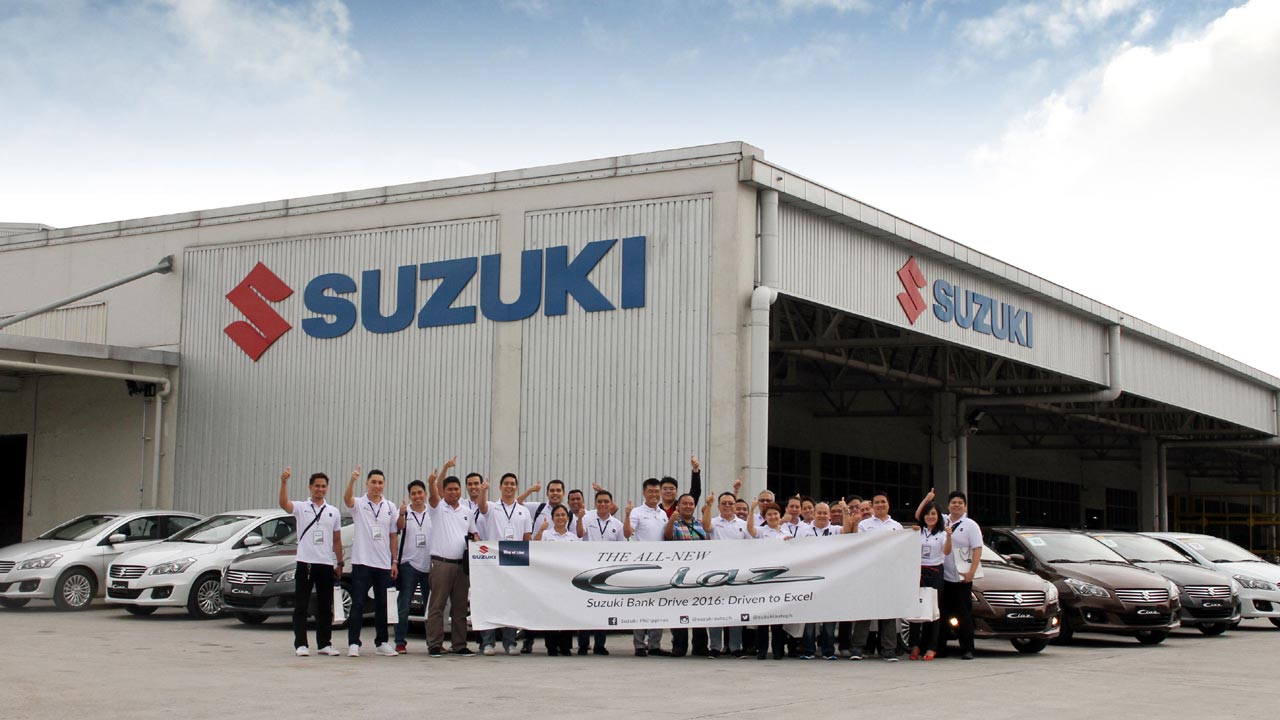
 A total of 27 representatives from the leading names in the banking industry road tested the Ciaz which boasts of best-in-class fuel efficiency, a sporty yet elegant exterior design, and other advanced features.

 Suzuki Celerio CVT emerged to have the best gasoline-powered engine after achieving 29.14km/L in the run which stretched from Angeles, Pampanga through the Subic-Clark-Tarlac Expressway (SCTEX) and Tarlac-Pangasinan-La Union Expressway (TPLEX) and back. Aside from the Celerio, the all-new Ciaz Manual Transmission (M/T) likewise topped the fuel-efficiency test in the gasoline sedan category, clocking in at 27.94km/L. Other Suzuki vehicles also participated in the exercise, including Celerio M/T (27.70), Ciaz GLX A/T (22.93km/L), Swift 1.2 (22.35km/L), and Ertiga GLX A/T (22.03km/L).
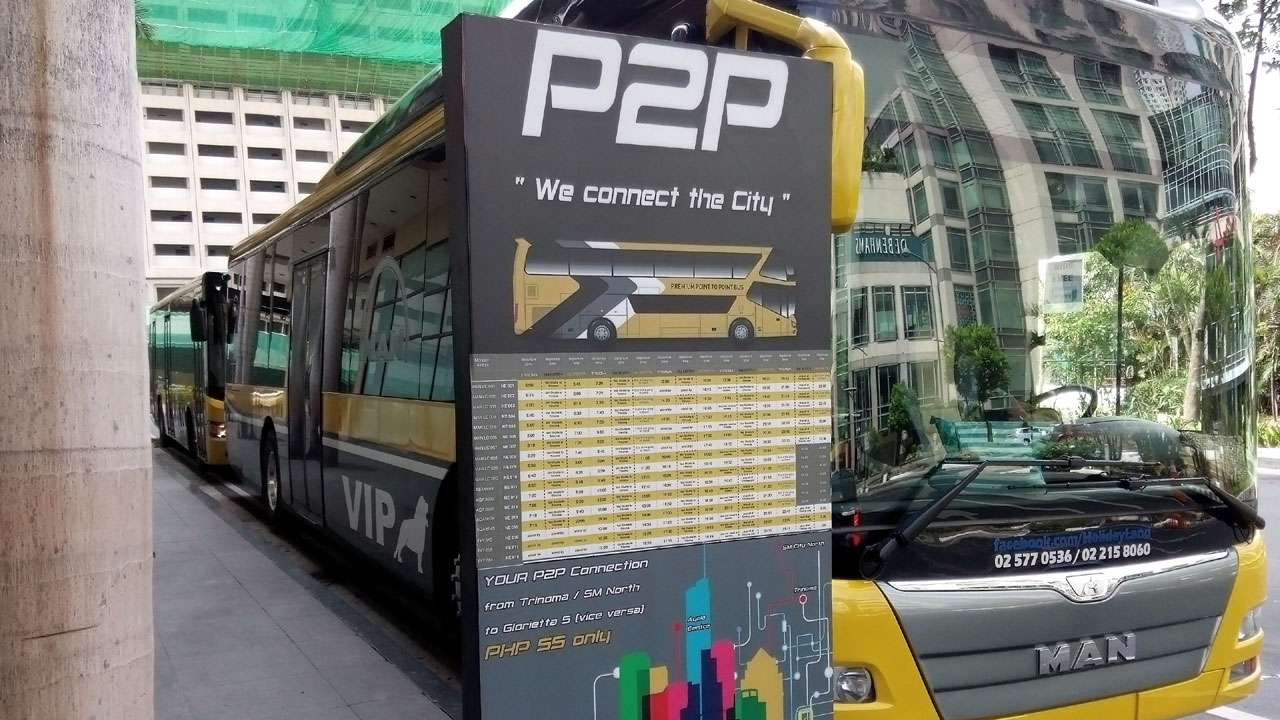
 South-bound buses to Makati City depart from the Trinoma terminal from 5:00AM to 11:15PM daily. North-bound buses to Quezon City depart from the Glorietta 5 terminal from 5:45AM to 1:00AM the next day. Intervals between departures from either terminal range from 5 to 30 minutes (at some point as much as 60 minutes), depending on the time of day.

