The sure-footed Isuzu Mu-X 4×4 LS-A makes the additional expenses of an offroader easy to bear. There’s the 100Kg additional weight, the 1kml hit on fuel economy, and that P100k sticker price premium typical to 4×4 variants.
But, on the Mu-X 4WD SUV, those drawbacks fade away the moment you hit rough country. And, with some contrived shortshifting on the 5-speed automatic gearbox (using her sequential manual override) it’s quite feasible to turn the big bruiser into a city commuter, or bring her economically up to highway cruising speeds–to just sip diesel while still en-route to those fun, far flung hinterlands that the Mu-X 4×4 is built for.
After June sales that put their Mu-X SUV at the top, selling better than market-leading Toyota Fortuners and Mitsubishi Monteros even after these were recently updated to new-generation models, Isuzu Philippines now reports increased sales across the board for the first half of 2016 that puts them ahead of the growth curve in the country’s automotive industry. And, being fully invested in utility vehicles (in cargo haulers as much as, if not more than, people movers) and at price points that paint their buyers as pragmatic owners (low for premium-trimmed vehicles such as their SUVs, but at par with or slightly higher than prices of rival models for their durable trucks, buses, AUVs and pickups) Isuzu Philippines’ numbers somehow suggest a build-up in capacity, in nation-building capabilities, rather than a mere increase in consumption.
Press Statement by Isuzu Philippines Corporation, “Diversity of product range drives Isuzu Philippines’ growth in H1 2016,” 2016:
Manila, 19 July 2016—THE extensive product range offered by Isuzu Philippines Corporation (IPC) has allowed the company to record a phenomenal growth rate during the first half of 2016.
IPC sales in the first six months of 2016 reached 13,258 units, a significant 30.4-percent increase from the 10,169 units sold during the first half of 2015. As reflected in the joint report of the Chamber of Automotive Manufacturers of the Philippines Inc. (CAMPI) and the Truck Manufacturers Association (TMA), IPC’s performance traces a steeper upward trajectory than the 27.4 percent rate, or 167,481 units sold, posted by the country’s automotive industry for the same period.
“The brisk movement experienced across Isuzu Philippines Corporation’s model lineup is a manifestation that the company offers consumers some of the most relevant products available locally. With many of Isuzu products geared toward business use, the growth is also an accurate indication of the market’s optimistic view regarding the economy,” IPC President Hajime Koso said.
The entire product range of IPC registered increases in the first half of the year, with deliveries of Isuzu heavy-duty Category V trucks logging the best result with an unparalleled 833.3-percent spike. The record is aided by the increases achieved by Isuzu’s Category IV buses (25 percent), light-duty Category III commercial trucks (18.8 percent), and Category IV trucks (16.6 percent). Combined, sales of IPC’s commercial trucks and buses totaled to 2,703 units, a 36.7-percent rise from the 1,977-unit tally for the same months last year.
Bolstering this is the performance of IPC’s light commercial vehicle lineup. During the same period, a total of 2,361 Crosswind units were sold, a 20.4-percent increase from a year ago. Deliveries of the D-MAX pickup were not far behind at 1,897 units, which is a 34.3-percent jump.
Meanwhile, IPC’s best-selling vehicle continues to be the mu-X SUV, which for the first six months registered a 30.7-percent increase, or total sales of 6,297 units. The result places the mu-X as among the top models in its category, securing a 29-percent share in the segment. In June alone, the mu-X’s tally of 1,181 units has outpaced the result logged by its direct competitors.
The rest of IPC’s models performed equally well in June, with the company posting a 13-percent growth compared to the same month in 2015, or 2,439 vehicles sold in June this year versus 2,159 units sold in June last year. Supporting the mu-X’s tally for the month were those of the Crosswind at 434 units, the D-MAX with 304 units, Category III trucks with 307 units, Category IV buses with three units, Category IV trucks with 140 units, and Category V trucks with 70 units.
In June, IPC also recorded its best monthly tally this year, besting its result in March by two units.
We dive deep into the details of the JATCO-sourced automatic transmission on Crosswind XUV and Sportivo variants, and come back up with a notion on how to get acceleration that’s closer to how you’d feel it with a stick-shift.
Impressive with its economy, although limited to an 83hp rating because it tops out quickly, the 2499cc 4JA1-L low-boost turbodiesel on the Crosswind packs a big 137lb-ft of peak torque behind that measurement and accelerates quickly enough through a diesel’s typical short-shifting regimen. But that’s with a manual gearbox. The same engine feels very different, sounding more revvy while delivering less acceleration, on the XUV and Sportivo variants with their JATCO-sourced automatic transmissions.
XUV and Sportivo variants of the Crosswind have bigger, heavier tires, of course, but the difference in performance seems to be caused more by the tall gear ratios on the wide-gapped 4-speed automatic, by the high-stall ratio of its torque converter, and of course, by having to delegate shift control to the gearbox. Isolating it to these factors led me to try a technique derived from that of veteran Lancer A/T owners.
Power contour of the Crosswind’s 4JA1-L low-boost turbodiesel
On those sporty Mitsubishi sedans with a 1.5L MIVEC engine and its peaky torque curve driving a 4-speed auto, experts have been surging the accelerator to 3000rpm—the lower edge of the engine’s peak powerband—and then promptly letting off on the gas as soon as the car starts accelerating. This charges the powertrain’s flywheel, cranking in momentum that’ll then deliver smarter acceleration—a surge to quickly overcome the car’s inertia coming off a stop or a slow cruise.
Now, on the Crosswind with its diesel-engine torque curve, the powerband’s meat is from 2000 to 3500rpm. Torque starts at 50% of peak at 1000rpm, climbs rapidly to 88% at 1500rpm, then reaches its 100% figure at 2000rpm before tapering down to 95% at 3000rpm and then to 90% at 3500rpm.
Isuzu Crosswind Gear Ratios
Gear
5-speed M/T
4-speed A/T
1st
4.122
2.784
2nd
2.493
1.544
3rd
1.504
1.000
4th
1.000
0.694
5th
0.855
n.a.
Final
4.100
5.125
Problem is that getting a Crosswind A/T to that 2000rpm threshold takes some doing. Rolling out easy from a 750rpm idle will see you triggering an upshift to 2nd gear very quickly at just 10km/h. When that happens, your revs which had been climbing steadily to 2000rpm will drop back down to 1500rpm and stay there while the engine deals with a fairly tall 2nd (1.544:1) and then with an early direct drive 3rd gear (1.000:1).
Consequently, on a Crosswind with an automatic gearbox, you’ll find that engine revs gravitate to 1500rpm and it takes a fairly deep stomp on the gas pedal to get the tachymeter needle moving again. Now, if you give into the urge and stomp on it, you won’t just reach 2000rpm but will likely overshoot. This makes for a disconcerting, obviously wasteful, rev up with much slippage in the torque converter.
I do suggest that you wait until you’re in 2nd gear or higher before pumping up the revs from the default 1500 up to or above 2000rpm.
That slippage is necessary, tolerance for wide differences between impeller and rotor speeds translates into multiplied torque—indispensable at slow hauling speeds. But it’s not something you always need, and, to be frank, it makes for an inelegant ride, the engine roaring while making acceleration look dismal in comparison. While the Crosswind’s JATCO automatic transmission does have torque converter lockup (creating a hard link between impeller and rotor when the latter’s speed is within 5% of the former), this kicks in only at around 80km/h, late in the acceleration game and only after the upshifts that finally got you to 4th gear.
Now, instead of lamenting this state of things in the torque converter, that hitherto black box that makes stop-and-go traffic crawls far more tolerable, the slippage can be exploited to let you stroke the accelerator. This would be the equivalent of feathering the clutch and stroking the gas pedal to surge up revs on a manual gearbox. Instead of stomping on the gas pedal, give it a two or a three-count pump, quickly charging the flywheel with enough inertia to counter and overcome that of a slow-cruising Crosswind.
A two-count pump—one, a short shallow stroke on the gas, followed quickly by two, the sustained, but just slightly deeper press on the pedal than before you started—will get your revs from 1500 rpm to just under 2000rpm very quickly. A three-count pump—two quick and shallow strokes followed by a third, sustained and slightly deeper pedal push—will get you over 2000 and nearer to 2500rpm smartly enough.
In geek speak: because the torque converter has a high-stall ratio, because it permits and harnesses a lot of slippage, those shallow throttle pumps will speed up the flywheel and impeller in spurts to cavitate the transmission fluid and not yet incur hydraulic resistance. In other words: the pumps let you “slip” in a rev up in quick stages.
I do suggest that you wait until you’re in 2nd gear or higher before pumping up the revs from the default 1500 up to or above 2000rpm. It’s an easy state to recognize. As long as you’re at 10km/h or higher, you’re out of 1st gear and ready to, well, pump things up. Why? It just works out smoother, without the early shift-bump up from 1st gear knocking you off your game.
Then, after a two or three-count pump has put you quickly in the zone between 2000 and 3500rpm, without the hoopla of a roaring engine driving a torque converter with mounting slippage, that’s when you do the Lancer thing and start thinking of easing off the gas pedal as you feel the momentum come on line. You’ll find that easing off the gas is more responsive, can be done with more precision.
End of it all, on a Crosswind with an automatic gearbox, reaching or going beyond that 2000rpm threshold with this two or three-count pump tactic will get you smarter, surprisingly quieter acceleration. You’ll see.
On an Isuzu Crosswind XUV or Sportivo with an automatic gearbox, crossing the 2000rpm threshold with this tactic gets you smarter, quieter acceleration. For the how and the why, see our full write-up.
To answer a reader’s question about the sound of the 3.0L CRDi VGT turbodiesel on Isuzu’s new mu-X and D-Max top variants, here’s the unplugged footage of us taking the D-Max LS-M 3.0L around the BRC track, taking the curves in earnest with a 5-speed manual gearbox.
We try Isuzu’s off-road challenge with their just-introduced D-Max variant with the bigger 3.0L CRDi VGT turbodiesel. Delivering peak power and torque of 160hp @ 3200rpm and 280lb-ft @ 1800~2200rpm, the new 2,994cc engine adds 27hp and 44lb-ft to the numbers of the former top-spec 2.5L engine.
The diesel’s not so high top-end reigns back the horsepower equation, but down low where you’d be for off-road crawls, that 280lb-ft of torque is equivalent to the pull of a plus-250hp petrol engine. Hence the forced upshift into second gear for shallowing up the gear reduction on some of the obstacles–dialing back the torque multiplier for the tires to dig out more traction.
We try Isuzu’s off-road challenge with their just-introduced mu-X variant with the bigger 3.0L CRDi VGT turbodiesel. Delivering peak power and torque of 160hp @ 3200rpm and 280lb-ft @ 1800~2200rpm, the new 2,994cc engine adds 27hp and 44lb-ft to the numbers of the former top-spec 2.5L engine.
The diesel’s not so high top-end reigns back the horsepower equation, but down low where you’d be for off-road crawls, that 280lb-ft of torque is equivalent to the pull of a plus-250hp petrol engine. Hence the forced upshift into second gear for shallowing up the gear reduction on some of the obstacles–dialing back the torque multiplier for the tires to dig out more traction.
We hit the BRC tarmac to try out Isuzu’s just-introduced mu-X and D-Max variants with the bigger 3.0L CRDi VGT turbodiesel. Delivering peak power and torque of 160hp @ 3200rpm and 280lb-ft @ 1800~2200rpm, the new 2,994cc engine adds 27hp and 44lb-ft to the numbers of the former top-spec 2.5L engine.
The Adarna Group Foundation had this two-part mission for Nueva Ecija. First, scout a route through rough roads to an elementary school on the eastern approaches to Gapan City, the place where they’d be bringing their Barangay Early Literacy Program (BELP) the following month. Second, bring volunteers to do BELP classes for the kids and caregivers at the Bahay ni San Jose Orphanage in San Antonio, west of Gapan.
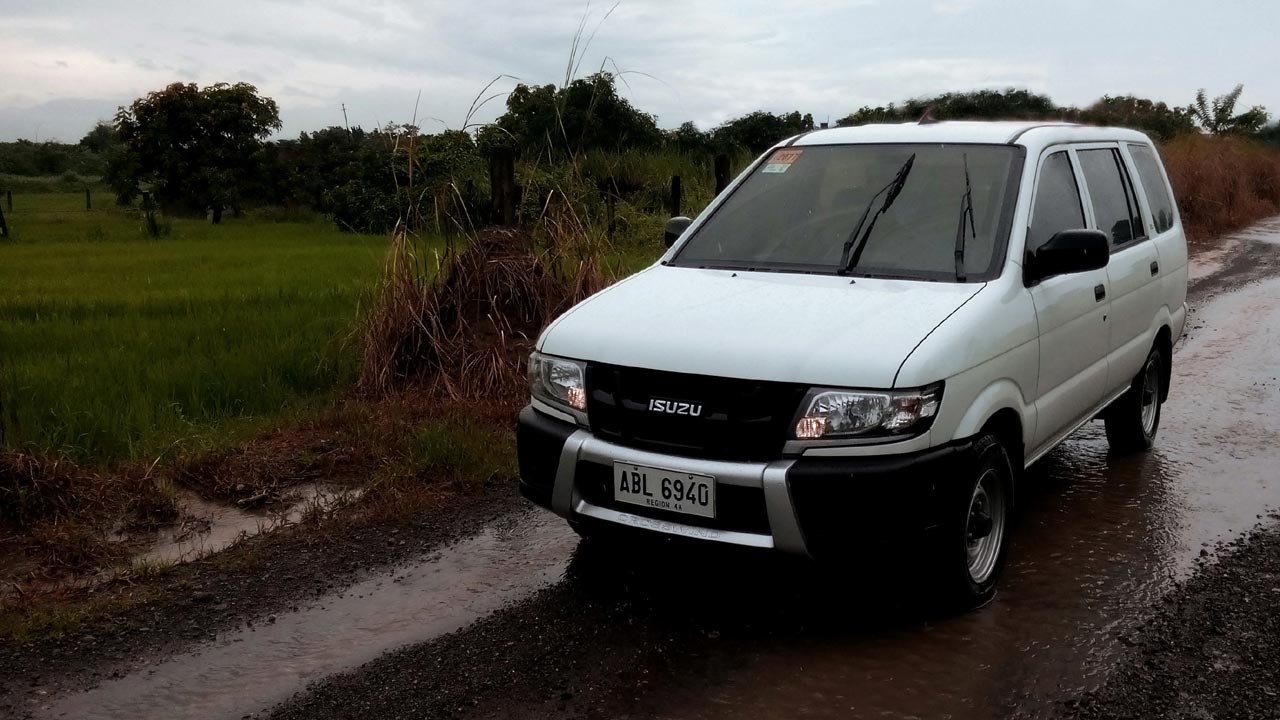
The drive would be a 260km loop through the near north and we needed a vehicle that could: (1) handle rough or broken roads, (2) carry as many as nine people along with a big tub filled with books and equipment, and (3) convey us comfortably enough to have people arrive rested and ready to teach animatedly. And I had a vehicle in mind, an institution by now, actually.
I had driven the top-spec Crosswind Sportivo last year for a story, the one with an automatic transmission, and I was impressed enough with it that I really wanted to see how any of its base models with a manual gearbox would compare. So I reached out to Isuzu Philippines once again and they readily responded, happy to help out.
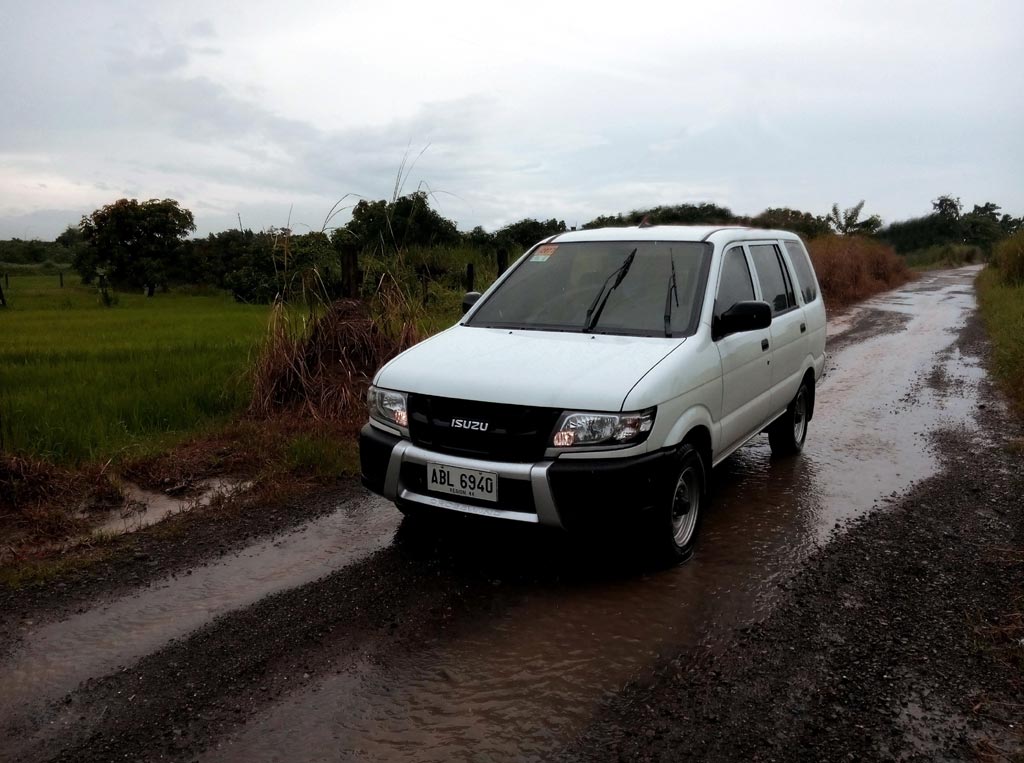
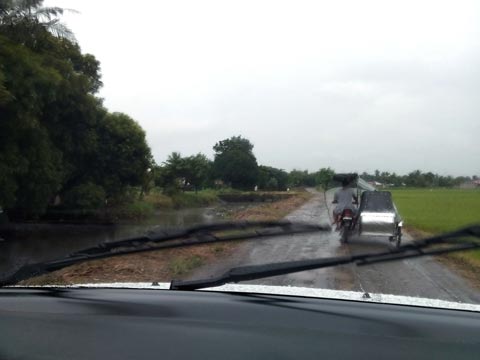
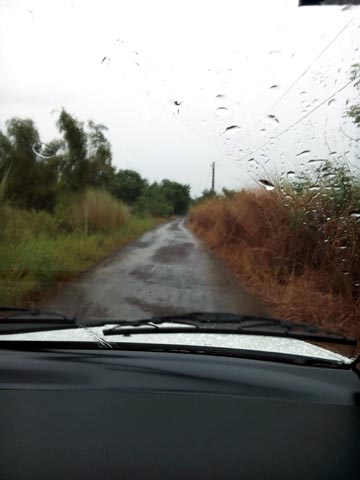
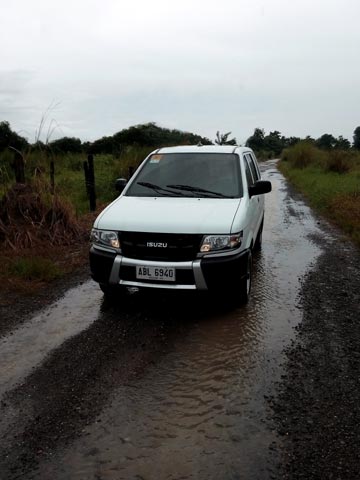
Early on August 24—a Monday, the day starting out very wet with Typhoon Ineng about to depart Philippine waters and head up to Japan—we rolled out for our first stop in Gapan City, snug in a ten-seat 2015 Crosswind XL.
heading out on rainswept NLEX
heading out on rainswept NLEX
heading out on rainswept NLEX
Bulacan, en-route to Gapan, Nueva Ecija
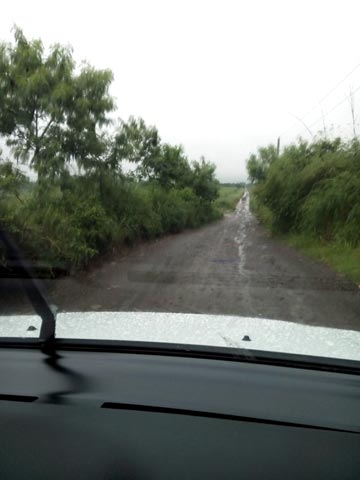
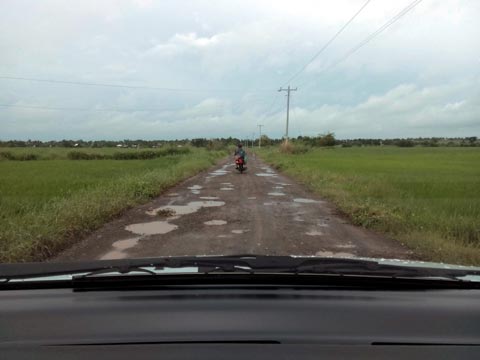
unnamed roads, Gapan outskirts
unnamed roads, Gapan outskirts
unnamed roads, Gapan outskirts
unnamed roads, Gapan outskirts
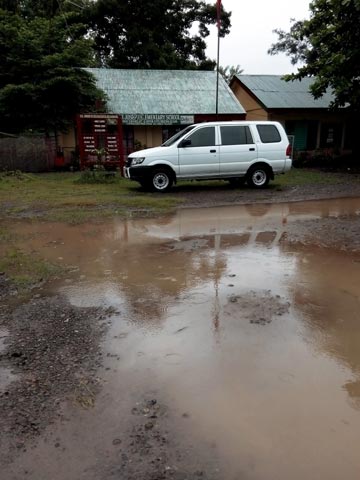
at St. Joseph Elementary, GPS coordinates plotted for September mission
at St. Joseph Elementary, GPS coordinates plotted for September mission
back on the road
short visit to a national shrine
short visit to a national shrine
short visit to a national shrine
heading East to San Antonio
heading East to San Antonio
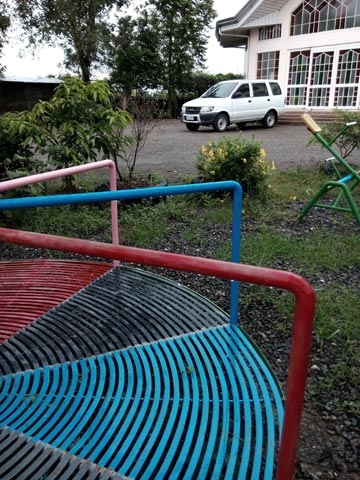
arrived for the day’s main event at Bahay ni San Jose
The hundred thousand
Crosswinds from across the years, they’re everywhere
Early this year, Isuzu Philippines announced having sold its 100,000th Crosswind. Think about it, after launching it initially as the Crosswind HiLander in 2004 and subsequently as simply the Crosswind in 2007, the more than 9,000 units they’ve sold on average for each of those 11 years since means that if you stack these all up, one on top of the other, they’d form a pillar 186km high—enough to put the topmost 14,000 Crosswinds into low earth orbit.
And from a satellite’s vantage point, if you line up those 100,000 Crosswinds bumper-to-bumper, it wouldn’t take any magnification to spot it from space, that 450km long column that could reach from Quezon City all the way to the northern tip of Luzon.
Finally, just to complete the spatial spectacle, if you put those 100,000 side-by-side and abreast, these would form a 170km wall wide enough to span Luzon’s breadth, from its western to eastern coasts, through what would become a border town San Fernando in Pampanga. That’s a lot of Crosswinds.
A replaceable but classic engine
Just before and still after it reached the 100,000 mark, there was talk that the venerable Crosswind is on the final stretch, that it’ll be retired soon because its diesel engine isn’t Euro IV compliant. That’s a rather short-sighted observation if you ask me.
Isuzu Philippines is also in the powerplant business, after all. It supplies diesel engines that are sought after by our own jeepney builders, and its technologies are innovative enough that these prompted giant Toyota to buy stake in their global parent. Is it really a stretch to imagine them updating to a Euro IV engine soon and also offering this as a retrofit for older Crosswinds out there?
But yes, the Crosswind’s inline-4, direct-injection turbodiesel is a hard act to follow. Though it’s only Euro II compliant, doesn’t yet have high-pressure common-rail direct injection, and mounts just a low-boost turbocharger, the Crosswind’s 4JA1-L, with well matched ratios on its manual MSG5K gearbox, delivers torque exactly where its needed for transporting heavy payloads, particularly on rough or hilly terrain.
Kicking in when it counts
While the rugged and fuel-efficient diesel packs torque roughly equivalent to that of a 140hp petrol engine, its nominal power is just 85hp because, well, because it’s a diesel. With longer strokes on those pistons to achieve almost double the compression ratio of petrol engines, diesel combustion is leveraged into much higher torque but with a tradeoff in terms of top revolutions. There’s lots of torque on the low end. It builds and peaks early, plateaus for a short stretch, then drops off as revs approach redline.
On the Crosswind, the torque is already substantial at a little over idle, say at around 1,200rpm, and peaks early at 2,000rpm. On a normally aspirated engine, torque would then start to decline perceptibly, the power equation then relying heavily on increasing revs to deliver peak horsepower. But on the current-model Crosswind, with the turbocharger effectively increasing engine displacement, compressing more fuel-air mix than normal in the cylinders, the turbo spools up and reaches its boost threshold at around 2,500rpm—just in time to take up the slack and bolster torque as it starts to wane on a non-turbo. The result is a relatively flat power curve as the engine reaches peak power output at 3,900rpm, and fuel efficiency that’s downright phenomenal on a heavy hauler. The best I measured on the Crosswind XL with its 5-speed manual transmission was 12km/l in moderate city traffic, and 14km/l on the highway with medium to heavy load-out.
The turbo is easily taken for granted, that’s how low its boost is, but it kicks in at exactly the right time. When you hit cruise and have time to observe your revs against speed, the turbo’s subtle benefit becomes apparent when you decide to go faster than a relaxed 80km/h and reach for 100km/h, or beyond. The engine sounds unstressed but still with its teeth firmly clamped on the bit, always pushing.
Exquisitely elegant in its application, the low boost turbo doesn’t widen the power-band much, but it does flatten it. Peak torque to peak power from 2,000rpm to 3,900rpm is the same as on a normally aspirated 4JA1. But the torque you feel while traversing that power band is really something else with the engine milking each erg of energy from burnt diesel. Unladen or heavy, the Crosswind easily handles a short-shifting regimen with upshifts triggered around 2000rpm at 15, 30, 45 and finally 60km/h to reach fifth gear. Acceleration isn’t immense, but it’s relentless, as you reach a moderate top speed on the order of 130km/h, this even with the Crosswind heavy with people or cargo.
Truck tough
First-generation HiLanders are still on the road, in good repair. More so are those successor Crosswinds from first-flight onwards that are still on mission, in the cities and the countryside. And just this year, the quintessential AUV got its second major facelift after the first one a decade ago. Compared to the Crosswind’s decade-spanning timescale, the updates on rival models look as frequent as those for smartphones and casual-dress sneakers.
Individual Crosswinds could be on the road, and the Crosswind model kept online and relevant, for a service lifespan that rivals that of military vehicles. And why not? I know you saw this coming a mile away: the Crosswind is built like a darned tank. I’ve said it before (though in a story with another publisher), and so say it again: the Crosswind comes across as two tons of truck in thick gauge steel. The only evidence of crumple zones are polymer bumpers, and those side shapers and fender flares on the up-market variants.
She’s heavy, with a curb weight at 1,600kg, but that comes with seating capacity for as much as 10 souls, and a payload nearer to a ton than just a half, its realistic gross weight certainly much more than Isuzu’s officially published 2,200kg.
Finessed down under
All that weight is sprung on a typical truck’s suspension that, like its engine, is far from what you’d expect it to be. The front has independent double wishbones and a stabilizer bar guiding the chassis’ motion over tough, compact torsion springs. And, while the rear is on those familiar semi-elliptical leaf springs, these ones come with a welcome twist.
In back is what they call a FlexRide MOVE suspension. What it does is put five leaf springs on each wheel where only the top, longest spring is actually bolted to the chassis. The middle three leaves are merely shackled at both ends to the top spring, to let the upturned ends slide against each other as the whole set compresses down under load. And the bottom spring, the shortest and the stiffest, is shackled only on its front end. This brings that fifth bottom spring into play only when the vehicle rolls through a major bump or is laden heavily enough to make the Crosswind go way down on its rear haunches. That fifth spring stiffens up the rear’s ride only when needed, hence the “Flex Ride.” The effect is a comfortable ride for when you bring the Crosswind around unladen, or a reinforced and steady one when you’re going heavy.
On the base XL variant with 185R14 Yokohama Super Van 356 truck tires, that high-walled rubber allows for a wide range of inflation options. Recommended max pressures are 28psi in front, 47psi in back. But on the drive to Nueva Ecija with loads varying from five to nine people, with stretches on prime highway tarmac as well as unpaved track, in both wet and dry conditions, I opted to balance control and traction (as well as comfort) with 26psi in front, 35psi in the rear. It worked out fine.
The Crosswind’s substantial weight, tires, treads, suspension and low end torque profile (to take grades gently) made me look good, helping me deliver a surprisingly smooth ride over broken, or frequently absent, pavement. The apparent robustness of the platform, its freedom from extraneous body roll and ambient squeaks, kept me relaxed and surefooted, insulated from the roughness that we undoubtedly would’ve felt if we had been in a flimsy, smaller-wheeled ride.
See the video, it wasn’t just okay, it was downright fun rolling over those holes and bumps.
A rolling box, like an APC
The Crosswind is from an age when internal volumes were kept straightforward and big. Look inside the cabin and you’ll get this sense of being in a simple box, all straight lines and contiguous space. The only significant interruption in the cabin’s cubic area comes from the rear wheel wells which are elegantly put under the foldable side facing seats in the last row. The floor is a flat continuous slab, its height enough to be flush over the rearwheel drive axle.
The best thing about the XL is the contiguous cargo volume you could free up by folding away the second and third row seating. Feel free to double-check me on this, but with all seats behind the front row stowed away, that space looks equal to the cargo bay of a pick-up truck. And on the XL variant, with low maintenance features that include hand-cranked windows, vinyl upholstery, textured linoleum matting, and easy acceptance of bare painted metal peeking between finer interior touches, the utilitarian space simply works.
Decades of Crosswinds
Back when AUVs had that Asian “A” to make a proud pragmatic point, and not to marginalize these in the global market, Indonesia’s Astra conglomerate was the first to roll out these hardy utes with curvy-edged full-pressed hard-bodies. First came the third generation Tamaraw (the Kijang in Indonesia) from Toyota Astra Motors in 1986. Then, five years later, out came the first generation HiLander (their native Panther) from Astra Isuzu Indonesia in 1991.
The models were groundbreaking, the first shaped-metal bodies designed in and for Southeast Asia. Those models that came before (recall the Ford Fiera, the early Toyota Tamaraw, and even the VW Sakbayan) were all fabricated with sheet metal bent to shape and welded together to form boxy, angular bodies.
The HiLander, the Crosswind’s first generation if you look past the name shift, was built shapely from the start, though still on a truck’s robust chassis, and after Astra had half a decade to work out what else and more they’d like to do with a Kijang-like vehicle. The result was a utility that was purpose-built for the region’s roads (or lack of these), our climate (hypothermia cold to blistering hot, low and flooded to high and dry), and with the payload capacity to carry the extended family or anyone’s cargo. Introduced in 1991 globally, the HiLander got to our shores in 1996 and stayed in production until 2004.
With its eight years on the line, the timescale really makes the HiLander look like the precursor, a “demonstrator” in military-speak, of the Crosswind, its operational successor. Already sixteen years in after it was introduced globally in 2000, though introduced here four years later in 2004, new Crosswinds could be rolling off the production line until its two-decade mark … could be even three, it’s happened before.
Rugged because it needs to be
There’s talk that Isuzu’s recent introduction of the mu-X, echoing what others say about that Euro II engine, spells the impending retirement of the rearwheel drive Crosswind’s line. In fact, Isuzu admits that the introduction of the mu-X heralded a significant reduction in sales of its bestseller Crosswind. But do note the difference in price structure.
While the Crosswind’s top-spec and sleeked up Sportivo variant lists at PhP1.195M, slightly above the PhP1.188M for the 4×2 base model of the mu-X, the million-peso range where these intersect is still substantially above the PhP0.794 for the base XL variant I’d driven. The XL makes no reference at all to SUVs, doesn’t dress up into one, the best analog being those vanilla white utilities we saw foreign aid organizations using in-country before the turn of the century. And, although last priority seating is on a vestigial bench ledge between the driver and front passenger seats, that 10-seater capacity is still the most I’ve seen done on anything short of a full-blown passenger van.
The mu-X, an SUV, works because it’s ruggedized, made tough and above things enough to navigate the rougher corners of the land. In contrast, the Crosswind is rugged because it has to work. There’s a difference. It was built for the average multitude who live near or in hinterland. And, after all these years, the Crosswind is still on mission.
We drive the 2015 Isuzu Crosswind XL on unpaved, rain-swept roads. The base-variant XL is a ten-seat people mover that’s become ubiquitous as a “UV Express” transporter in urban settings. But with its FlexRide suspension and high-walled 185/80 truck tires, the Crosswind XL turned out to be a comfortable and competent soft-roader, explaining its popularity among rural motorists.




 IPC sales in the first six months of 2016 reached 13,258 units, a significant 30.4-percent increase from the 10,169 units sold during the first half of 2015. As reflected in the joint report of the Chamber of Automotive Manufacturers of the Philippines Inc. (CAMPI) and the Truck Manufacturers Association (TMA), IPC’s performance traces a steeper upward trajectory than the 27.4 percent rate, or 167,481 units sold, posted by the country’s automotive industry for the same period.
 “The brisk movement experienced across Isuzu Philippines Corporation’s model lineup is a manifestation that the company offers consumers some of the most relevant products available locally. With many of Isuzu products geared toward business use, the growth is also an accurate indication of the market’s optimistic view regarding the economy,” IPC President Hajime Koso said.
 Bolstering this is the performance of IPC’s light commercial vehicle lineup. During the same period, a total of 2,361 Crosswind units were sold, a 20.4-percent increase from a year ago. Deliveries of the D-MAX pickup were not far behind at 1,897 units, which is a 34.3-percent jump.
 The rest of IPC’s models performed equally well in June, with the company posting a 13-percent growth compared to the same month in 2015, or 2,439 vehicles sold in June this year versus 2,159 units sold in June last year. Supporting the mu-X’s tally for the month were those of the Crosswind at 434 units, the D-MAX with 304 units, Category III trucks with 307 units, Category IV buses with three units, Category IV trucks with 140 units, and Category V trucks with 70 units.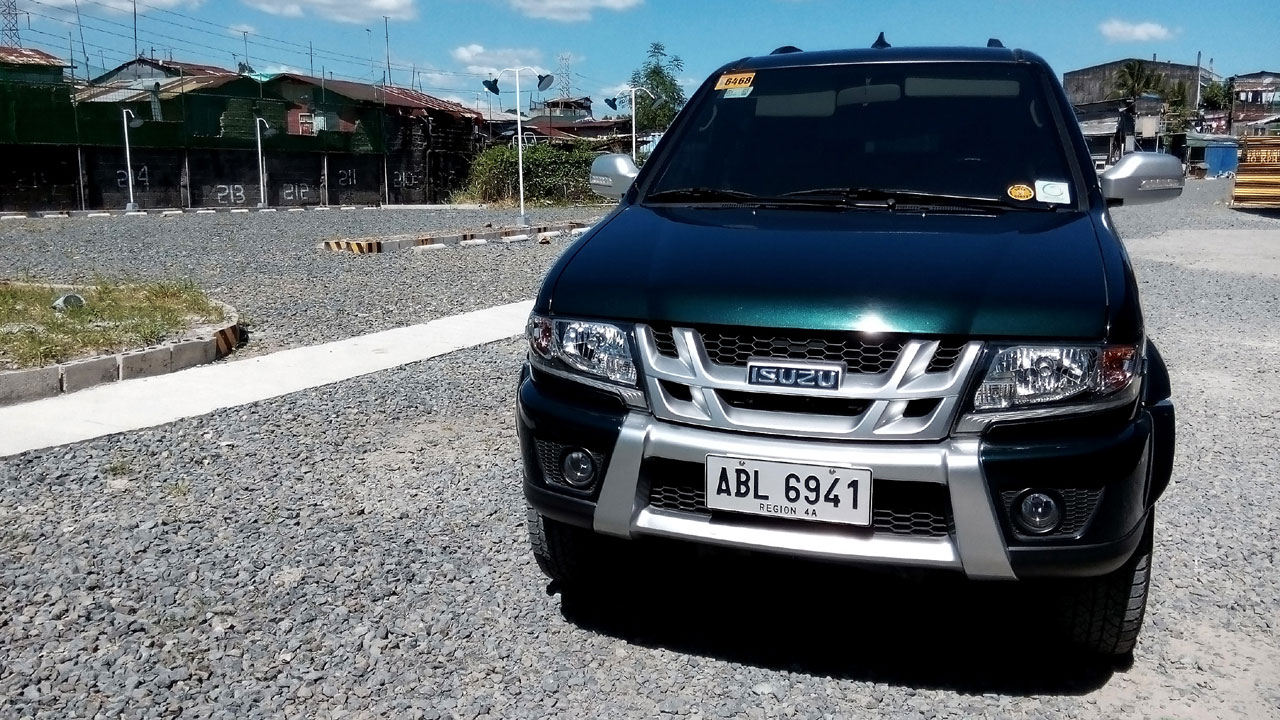

 We dive deep into the details of the JATCO-sourced automatic transmission on Crosswind XUV and Sportivo variants, and come back up with a notion on how to get acceleration that’s closer to how you’d feel it with a stick-shift.
 Now, instead of lamenting this state of things in the torque converter, that hitherto black box that makes stop-and-go traffic crawls far more tolerable, the slippage can be exploited to let you stroke the accelerator. This would be the equivalent of feathering the clutch and stroking the gas pedal to surge up revs on a manual gearbox. Instead of stomping on the gas pedal, give it a two or a three-count pump, quickly charging the flywheel with enough inertia to counter and overcome that of a slow-cruising Crosswind.
 In geek speak: because the torque converter has a high-stall ratio, because it permits and harnesses a lot of slippage, those shallow throttle pumps will speed up the flywheel and impeller in spurts to cavitate the transmission fluid and not yet incur hydraulic resistance. In other words: the pumps let you “slip” in a rev up in quick stages.


 The drive would be a 260km loop through the near north and we needed a vehicle that could: (1) handle rough or broken roads, (2) carry as many as nine people along with a big tub filled with books and equipment, and (3) convey us comfortably enough to have people arrive rested and ready to teach animatedly. And I had a vehicle in mind, an institution by now, actually.






























 Just before and still after it reached the 100,000 mark, there was talk that the venerable Crosswind is on the final stretch, that it’ll be retired soon because its diesel engine isn’t Euro IV compliant. That’s a rather short-sighted observation if you ask me.
 low end. It builds and peaks early, plateaus for a short stretch, then drops off as revs approach redline.
 stabilizer bar guiding the chassis’ motion over tough, compact torsion springs. And, while the rear is on those familiar semi-elliptical leaf springs, these ones come with a welcome twist.
 when the vehicle rolls through a major bump or is laden heavily enough to make the Crosswind go way down on its rear haunches. That fifth spring stiffens up the rear’s ride only when needed, hence the “Flex Ride.” The effect is a comfortable ride for when you bring the Crosswind around unladen, or a reinforced and steady one when you’re going heavy.
 The best thing about the XL is the contiguous cargo volume you could free up by folding away the second and third row seating. Feel free to double-check me on this, but with all seats behind the front row stowed away, that space looks equal to the cargo bay of a pick-up truck. And on the XL variant, with low maintenance features that include hand-cranked windows, vinyl upholstery, textured linoleum matting, and easy acceptance of bare painted metal peeking between finer interior touches, the utilitarian space simply works.
 The HiLander, the Crosswind’s first generation if you look past the name shift, was built shapely from the start, though still on a truck’s robust chassis, and after Astra had half a decade to work out what else and more they’d like to do with a Kijang-like vehicle. The result was a utility that was purpose-built for the region’s roads (or lack of these), our climate (hypothermia cold to blistering hot, low and flooded to high and dry), and with the payload capacity to carry the extended family or anyone’s cargo. Introduced in 1991 globally, the HiLander got to our shores in 1996 and stayed in production until 2004.
 in price structure.