A top editor once told me, “don’t worry if there’s other stuff, even people, in your shot … these could bring warmth.” Well, on this 2015 shakedown drive to Sagada with the then new BAIC M20 MPV, the other stuff were not incidental, not just tolerated but caught deliberately, fortunately, in the composition.
A picture, any picture, ought to tell a story all its own. There’s nuance, there’s atmosphere, there’s a notion of what comes after, all conveyed in life made still for endless scrutiny. And, on the hardy M20 there’s even the odd pun to plumb: people-mover in foreground, a person, and movement, in back. I did warn you, a pun.
Seriously, though, the photo’s story is yours for the telling. There’s the M20–big, wide, metal sleek and placidly parked in the foreground. She’s pointedly stationary, as underscored by the van blurring by (an old L300 Versavan by the looks of her roofline), and she seems empty. Enter the man in red. He’s not the main subject of the image, but his presence, his striding stance away from the scene, could somehow explain it. You have to ask: Is he leaving or looking?
The actual narrative is explained by what he’s gazing at over his right shoulder. It was the seventh hour of a drive that started at midnight, a push from Manila to Sagada to test the new MPV. This scene finds us, a party of five passenger/drivers, on Halsema Highway and caught in the shadows of a mountain sunrise while those peaks to the west were already getting sunlight.
It was a serene moment on what was once considered, up to a handful of years ago, as one of the most dangerous roads in Asia (but is now a proud and well paved wonder). That guy in red, our car buddy, a well traveled engineer, had gotten the jump on us. We put the M20 on a lay-by to do what anyone would do in the situation … look for a spot to do a selfie.
Set to launch next month and priced to move in the hotly contested compact MPV segment, the new BAIC M20 goes on an in-house, pre-launch test-drive to rustic Sagada through historic Kennon Road and Halsema Highway.
Introduced by BAIC Philippines last year in time for the 2015 awards testing season, the M20 MPV is now set to launch in March at prices from P548K to P578K. At price points significantly below those of the competition, and with class-busting dimensions that give it the largest seating capacity in the category, the M20 is likely to shake up the hotly contested compact MPV segment.
Last December, with the one evaluation unit they had shipped in for rounds on the test circuit, BAIC Philippines took their new M20 on a shakedown cruise, a midnight to mid-day drive to Sagada 400km north of Manila, and I went with them. On that long drive through NLEX, SCTEX, TPLEX, Kennon Road and Halsema Highway, the M20 delivered on what its specs promised.
Early in the drive, an informal fuel-eco run on NLEX from Petron Marilao to Petron Lakeshore, showed the M20 consuming just 1.5L of 95-test unleaded over a distance of 50.2km (based on the M20’s trip-meter). This translates to an impressive 33.5km/l on a max-conserve cruise with the engine turning at 2250rpm for 80km/h in 5th gear. (At 2250rpm, the engine had been delivering an estimated 99lb-ft or 89% of its peak torque though at mid-range, keeping power consumption to just 40hp or 38% of maximum.)
The M20 took Kennon aggressively, lingering in 2nd and sometimes hitting 3rd gear even on the steep stretches. Engine revs throughout the climb stayed within the M20’s peak power band, the 1.5L VVT engine producing peak torque of 106lb-ft from 3000 to 5000rpm.
On the winding curves of Kennon Road and Hanselma Highway, the M20’s long 2790mm (longer even than on larger MPVs like the Toyota Innova) kept the tall vehicle stable even through smart, 40 to 50km/h turns. And the M20’s body on frame construction atop 160mm of ground clearance made easy work of rough patches, particularly on unfinished or washed out segments of the access road linking Hanselma to Sagada.
And, finally, at Sagada itself with narrow twisting roads made even more crowded by numerous transports either chartered or plying regular routes to the popular destination, the M20’s precise, electrically boosted steering, was an excellent match for the compact MPV’s heft. With little or no give to the system, with any tug causing a steering change, the M20’s setup needs getting used to but the end result is a relatively compact mini-van that could weave politely amongst pedestrians and vehicles alike.
BAIC Philippines is mounting their Christmas Service Campaign for yearend 2015, a free 21-point inspection check for all BAIC vehicle owners at the height of the holiday season from December 18, 2015 to January 17, 2016. Qualified for the free check up are all vehicles acquired from BAIC Philippines, namely: MZ40 and MZ45 compact vans; A113 and A115 compact hatchbacks and sedans; and their X424 sport utility vehicle.
BAIC Christmas Service Campaign details
All current BAIC vehicles owners (MZ40/45, A1 series, X424) are eligible to join the Christmas Service Campaign
The campaign will be a free “21 point” inspection check on the customer vehicle.
After the free “21 point” inspection, the Service Advisor will inform the vehicle owner the result of the inspection. Any maintenance concerns will be raised to the owner and appropriate repairs will be suggested by the service advisor.
If any maintenance concern will fall under warranty coverage of the vehicle, appropriate repairs will be done free of charge.
Any maintenance concerns which will not fall under the warranty will be for the vehicle owners’ decision to repair subject to appropriate repair charges.
Promo period is from Dec 18, 2015 to Jan 17, 2016
The 21-point check-up includes: engine checks (6 items); instruments, lights and tire pressure checks (7); underbody checks (4); airconditioning checks (4); and general computerized diagnostics. If inspection turns up anything, recommendations for addressing maintenance concerns will include work both among and beyond those covered under warranty.
While a major selling point of rival brands is the widespread availability of replacement parts in the event of breakdown, BAIC of China appears to be going all Sun Tzu on us, putting the spotlight on their strengths and not on those of the competition. BAIC’s 21-point check up is a comprehensive procedure intended to isolate issues before these become likely points of failure, keeping their vehicles as durable as these were engineered to be. In other words, while the BAIC brand builds presence in the country, they appear to be invested in making sure their vehicles don’t break down in the first place—think of it as the vehicles coming with veritable SLA’s, or service level agreements, like for the high availabilities promised by mission-critical Internet servers.
Aside from earning the brand some major good will in the market, the free 21-point inspection check should go a long way in defending BAIC’s image as a manufacturer of durable vehicles. Although the stigma suffered by China-made products is really due to shoddy quality in contract-manufactured and cheap consumer products (contexts far removed from those of state-owned carmakers like BAIC that are as much a part of national pride as are flag-carrying airline operators), the Chinese carmaker still has to contend with this in addition to being a newcomer in, surprisingly, one of the most sophisticated automotive markets in the world. Nevertheless, such dynamic competition is good (compared to the stagnation of oligopolies or monopolies) and manifests itself not only in price-point rivalries but also in how much further new entrants like BAIC are willing to go to ensure customer safety and satisfaction.
“While APEC happened …” I bet a lot of stories out there start with this phrase now. Well, this is our story and it’s one for December—because it was while APEC happened last month that Christmas came early. We had gone to BAIC again, and with their help, we helped some folks who are helping some really special kids. Roundabout you say? Bear with us, read on, you’ll get the drift of why this one’s special.
heading south to pick up cargo … early, no APEC disruption yet
primary pick-up, reached
primary pick-up, reached
heading back north for secondary pick-up, Skyway cordoned off too soon
stuck in the south till evening
queued up, Skyway open again
queued up, Skyway open again
finally, some speed
on EDSA, APEC lane teasing
secondary pick-up somewhere east, check
next day delivery
next day delivery
our consignees
our consignees
our consignees
our consignees
our consignees
our consignees
our consignees
our consignees
cargo in place
cargo in place
cargo ready
cargo ready
cargo delivered
cargo delivered
cargo delivered
cargo delivered
cargo delivered
cargo delivered
cargo delivered
cargo delivered
cargo delivered
cargo delivered
“Good job, Mommy!”
good job, all
good job, all
you too, Rudolph
Them, Santa’s actual helpers
As it’s done for the past two years, Adonais Mercy House again spearheaded efforts to hold a Christmas party for exceptional children. Since organizing into a charitable community in 2013, Adonais has been doing their bit to bring holiday cheer to children on the Munting Panaginip program of Undying Wishes of Pinoys, Inc. (UWPI)—children with cancer relying on the charitable support of the UWPI foundation for their medication and laboratory expenses. Adonais is a non-profit organization that had sprung up to give form to the charitable intent of friends, a community grounded in their christian faith. Hailing from countries across the globe, Adonais members have a simple goal: to help children stricken with—and impoverished by—cancer. Eventually, they hope to start a midway house for them.
The parties in 2013 and 2014 we’re simple affairs, little more than what you’d expect a kiddie party would be, assembled from a fastfood chain’s cookie-cutter selections, and on a tight budget. But the occasions always came with donated gifts—the apparent draw, that bit of Christmas the kids and their families could take home.
This year, the party had grown bigger. The venue was the Fun Ranch at Tiendesitas in Pasig City, the volunteers came from all walks, from diverse groups including Kiwanis and the Global Pilipino organization of professional chefs. Even bonafide educators and actual in-the-flesh entertainers lent a hand. And the gifts! Those came from all over and promised to swamp the bottom of Christmas trees and spread across supper tables.
On mission
The mission then: collect big precious parcels, get all of these to the party and to the kids and their families who could certainly put these to good use. All these, at the height of APEC week with motorists funneled away from reserved lanes and even entire roads. All these, while carmaggedon threatened.
Enter the BAIC MZ40 cargo van. We had driven the MZ40, the passenger van variant, on our very first real world drive back in March (see the story: An Outreach Drive to Dueg with BAIC’s MZ40 WeVan ) and it proved handy in getting some volunteers for an early literacy program up north. So, this time out, we thought, cargo van! And the nice folks at BAIC Philippines obliged us, again.
These days, closed cargo versions of familiar passenger vans seem to be anachronistic. Why go with a metal-walled, bare, flat-bed cargo bay when you can have a nicely glassed passenger version? After all, with foldable seating now common, you can still turn people movers into haulers of oversized stuff.
Answer: it’s what professionals really ought to use. There’s something eagle-eyed and unflinching about a cargo van. It has purpose, and customers sense this. For instance, there’s no need at all to assert that it’s “for official use only.” It’s clearly on the road for a purpose. And, while APEC happened, we were lucky enough to have purpose, to be out and about hauling precious cargo.
Sleigh bells on a cargo van
Metal walls stamped out of uncut steel sheets makes for excellent security, keeping content discreetly hidden from anyone who has no business knowing … all matter-of-factly too. It’s a closed van, that’s how it rolled off the factor floor, so stuff being hidden from view won’t be seen by the unsavoury sort as a deliberate, anxious act.
Put it this way: on the job we we’re on, it was prudent to keep stuff from view of the naughty, those of the not nice variety. And, the lack of vestigial windows even kept everything in shade. The MZ40 has AC vents up front and, predictably, it was enough to keep the whole cabin North Pole cool, cargo bay included.
The missing rear windshield could be an issue, making you rely on side mirrors for backing up. But it’s not really a challenge for any pro worth his salt, any guy willing to roll down the window, stick his head out and crane his neck to get some depth perception into play.
Compared to popular multi-cabs that bolt modular rear cabins onto a frame, the MZ40 cargo van’s single-body on a ladder chassis makes for an extremely rigid and robust vessel. Rolling along doesn’t cause a single squeak or creak, the telltales of a rear body flexing separately from the front cabin.
And finally, exactly because closed vans seem anachronistic, there’s this notion of investment in the premium and, well, the ideal. When you see a FedEx cargo plane soaring above, a widebody without windows and devoted entirely to cargo, don’t you get a sense of just how serious they are about the job? The cargo we had, the folks these were meant for, all deserved the best.
Official use
So it was that while the city’s streets turned officious to welcome visiting dignitaries, we were on the job with a cargo van, putting it to uniquely official use.
With the MZ40 cargo van, the good folks at BAIC Philippines rooting us along, we got a hint of that feeling, of being burdened with glorious purpose—as Norse gods might say. Cargo has a multiplier effect, you see. Like it is with those FedEx planes again: “Hoowee! That sure is a lot of Wilsons on their way to some lucky kids.” Sure, it isn’t people they’re carrying, but can you imagine how many more folk are actually going to be touched, to be helped, by the freight.
On that note: go ahead, spread cheer, and have a merry Christmas, one and all.
BAIC Philippines is bringing in the M20 MPV, having shipped in a unit of its max-passenger 8-seater variant in time for this year’s round of automotive awards tests. Badged by BAIC Motor either as the M20 or the R315 in different parts of China, the MPV model was introduced there in 2013, first deliveries happening late that year in October.
Toyota Innova: heavier and longer than the BAIC M20 but with a shorter wheelbase (note the significant overhangs, front and back)
Initial M20 unit brought in by BAIC Philippines for the testing circuit
Toyota Avanza: smaller than the M20 in all respects
In China, the M20 is portrayed as a “one-of-a-kind MPV … which combines all the features you would expect to make it what we call an off-road family car” (see http://www.baicintl.com/product/r315/). When asked to elaborate on this reference to rough-terrain use, BAIC Beijing’s Vice Director for the Southeast Asia Region, Emily Liu, said that this was to highlight the ruggedness of its rear-wheel-driven, body-on-frame construction. Adding context to this answer, BAIC’s Robbie Liu (Manager for Southeast Asia) explained that rural, inter-town roads in China are very rough.
A soft-roader, maybe
In a sense, this MPV’s mission brief has been dialled-back somewhat, back to that of the AUVs that have been petering out since the last decade. Not at all a stigma in this market where our notion of MPVs are as evolved Asian utility people movers (not as unibody mini-vans), and where another brand of Western origin even attempted, unsuccessfully, to adopt the moniker, the AUV label appears incompatible with the sensibilities and aspirations of China’s automotive market and industry, respectively.So then, it’s an off-roader mini-van for them, a description that won’t likely stand over here where off-road, really off-the-map motoring, means four-by-fours. Notably, though, literature for BAIC’s other markets eschew the off-road reference and simply describe the M20 as a high-end MPV with a reinforced chassis. So, it could be that strong soft-roader would be a more appropriate description for this new MPV model … and its engineering indicates the M20 has credible claim to this conservative caption.
Soft-sprung, stable wheelbase
From the start, the M20’s 2790mm wheelbase stood out and looked familiar at the same time. With bulk and weight between that of Toyota’s top-selling Avanza mini and Innova compact MPVs, the BAIC M20’s wheelbase is surprisingly longer than that of either one (2655mm on the Avanza, 2750mm on the Innova). On smooth pavement, this should make for more stable vehicle dynamics, either on straight-line cruises and G-pulling turns. On rough, rolling terrain it’ll dampen the seesaw jinks caused by the front and rear wheels individually hitting the road’s bumps and dips.
And, although leaf-sprung rear suspensions are standard on the M20’s basic variants, they’re bringing in just one variant, a higher-end one that has coil springs in back. BAIC Philippines President and CEO George Chua confirms that they’ll be offering just the one variant with its maximum 8-seater capacity featuring the premium ride of MacPherson struts up front and a multi-link independent suspension in back—arguably the variant with highest general value and utility.
A hard, pedigreed chassis
The BAIC XB424 SUV with the Prado’s high-rigidity chassis
BAIC’s other models and the fact that the M20’s variants offer the option for either leaf- or coil-sprung rear suspensions, these together offer clues to the origin of the M20’s all-important and much-vaunted chassis. BAIC produces the XB424, a full-on, body-on-frame, mid-size SUV that they openly say uses the high-rigidity chassis of the Toyota Land Cruiser Prado 3400, that model’s third-generation 120 series. Although Toyota never included the Land Cruiser in the list of vehicles built on their successful IMV platform, they acknowledged that it shares its chassis with the Toyota 4Runner—and that one, Toyota does list as an IMV-based model.
Land Cruiser Prado 150 series with the 2790mm wheelbase
Connecting the dots then: (1) BAIC’s XB424 SUV uses the short 2600mm wheelbase chassis of the third-generation Toyota Land Cruiser Prado 120 series; (2) the “reinforced chassis” of the BAIC M20 MPV has a 2790mm wheelbase, a number equal to that of the long-wheelbase version of the chassis used on the Prado for both its recent 120 and 150 generations; (3) the Prado’s chassis count among Toyota’s IMV platform configurations, configurations that include those with either leaf (like the Innova’s) or coil-sprung (like the Fortuner’s) rear suspensions; and (4) the M20 has both leaf- and coil-sprung rear suspension variants. With these as premise, it isn’t much of a stretch figuring that either BAIC OEM’d a Toyota Land Cruiser Prado’s IMV chassis into their M20, or, after working with a Toyota chassis for their XB424 SUV, engineered their own version of a high-rigidity frame for their MPV.
The kicker to it all is that this makes it a similar though longer chassis to that of the best-selling Toyota Innova, while still being almost 400kg lighter than that popular mid-size MPV—light enough to be powered by a 1.5liter petrol engine like that of the Toyota Avanza compact MPV. And the engine itself, the BAIC-built BJ415B with DOHC driving 16 valves with VVT (more powerful than the BJ415A—built by BAIC’s powertrain subsidiary—that’s featured on the M20’s more basic variants), brandishes numbers that suggest surprising power.
Table-top power curve
In-house designed and built BJ415B engine with VVT valvetrain technology
Nominally delivering peak power of 106hp at 6000rpm (typical power density for a 1.5L petrol burner), the BJ415B seems to use its VVT-equipped valvetrain to not only address the torque loss at the lower end experienced with 16 valves as compared to those with 8, but appears to dramatically flatten the power curve as well. Its 106lb-ft of peak torque kicks in over a range from 3000 to 5000rpm, exactly where you’d need it for hauling and acceleration on a powerplant that redlines at 5250rpm. Even with a conservative estimate of just 50% of torque available at idle (under 1000rpm), reaching that 3000 to 5000rpm plateau for 100% torque suggests that 75% or nearly 80lb-ft would already be available at 2000rpm.
If not for anything else, that 80lb-ft at 2000rpm pushing the M20’s 1270kg curb weight would account for some nice short-shifting for fuel economy, while still accelerating smartly enough for prompt up-shifts. BAIC Beijing’s Robbi Liu says that the M20’s fuel consumption numbers measured in China were 11.2km/l in city traffic, 16.9km/l on the highway, and 14.7km/l with mixed driving. If the goal is to deliver similar figures here, the mileage numbers seem attainable with common everyday driving given the 5-speed manual transmission’s slightly taller-than-usual second and third gear ratios—2.104:1 and 1.339:1, respectively—leading up to a true direct drive 1:1 fourth and overdrive 0.838:1 fifth gear ratio.
Bigger shoes to wear, and fill
The M20 with higher-walled 185/70R14 tires
Finally, though, a note on running gear: the BAIC M20 lists options for either 185/65R14 or 185/70R14 tires. It has to be said that not only would the higher walled 185/70R14 tires be more consistent with the M20’s soft-roading potential, a quick look at the M20’s wheel wells show these to be able to accommodate even further upsized rubber to the tune of 185/75R14 tires. BAIC Philippines could consider either the larger stock or locally upsized options.
The wheels would look in better, more handsome proportion to the M20’s height, certainly, but more importantly, the cushiony tires would provide a wider inflation pressure range that could be adjusted to suit road and load conditions, and would instantly increase the MPV’s 162mm ground clearance by 9 to 18mm. This’ll raise the soft-roader MPV into true high-rider territory with from 171 to 180mm of minimum ground clearance, while the slightly deeper-than-usual 3.857:1 reduction in first gear ought to be able to handle the slightly larger wheel diameter on roll-outs.
Aggressive price point
Obviously, this is a developing story with many factors that’ll bear testing in an actual drive. But if things do pan out, as is likely, the M20 will definitely present a serious challenge to MPV market leader Toyota. BAIC Philippines’ George Chua confirms that they’re targeting a sticker price of under PhP600k. That’s a price point that’ll put the BAIC M20 within reach of a buyer base that’s much deeper than that of the bigger Toyota Innova , and that of the smaller Toyota Avanza mini MPV as well.
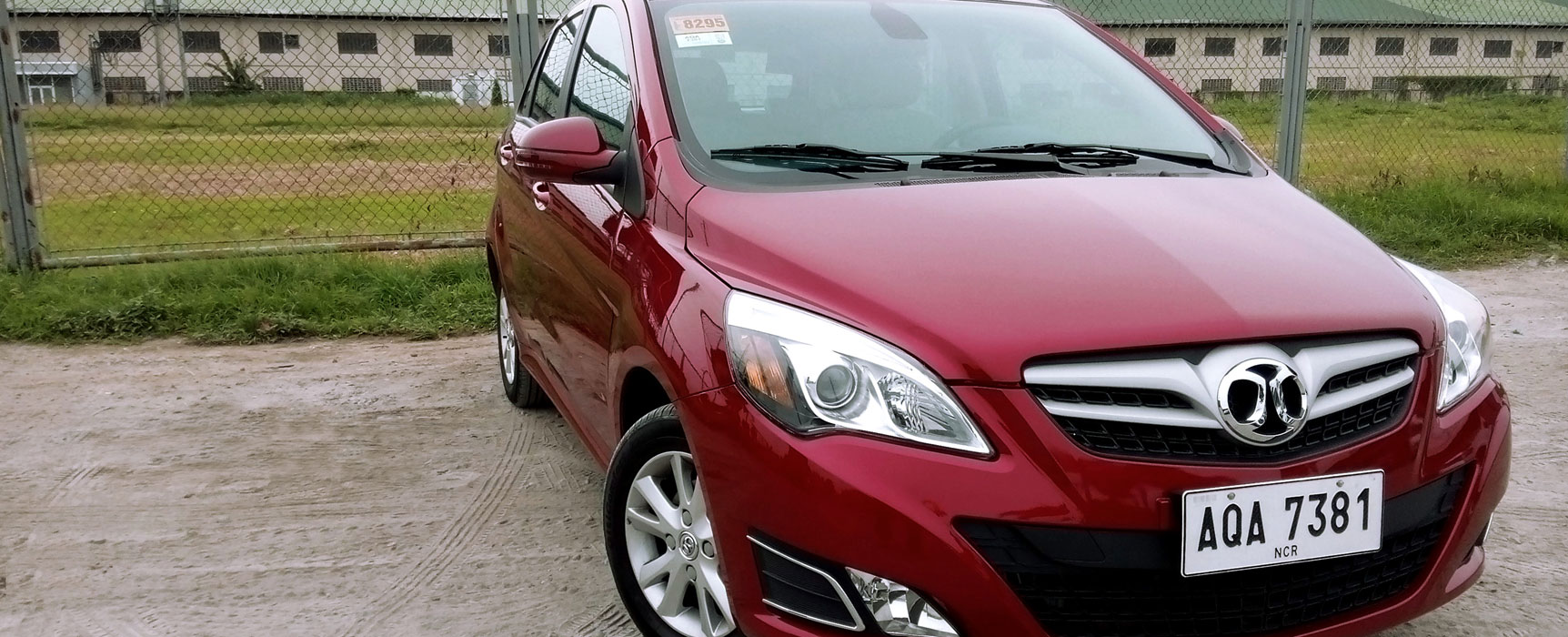
With its sub-compact size and decent cargo space, the BAIC A115 fits the up-market definition for a family’s proper-sized city car. But with vehicle dynamics that make it at home on the highway , the A115 ought to be let loose on road trips that’ll put even its powertrain to good use.
A form-factor sweet-spot
[youtube=http://www.youtube.com/watch?v=eHCArkCCj8c&w=480&align=right]The BAIC A115 hatchback feels exceptionally stable, with light or heavy load, at city or highway speeds. She feels tight and planted with just the driver on board, or with the entire family plus groceries or luggage, cruising in the city at the typical maximum 60km/h, or on the highway beyond 100km/h. And it all points to BAIC finding a sweet-spot in the dimensions of a hatchback built on a pedigreed vehicle platform that’s been used both for shorter and longer sub-compacts.
BAIC’s A1 line is built on the Z-platform developed jointly by Daimler AG and Mitsubishi for their global small car initiative back when they where allies (see our previous related story, The BAIC A1 series: how Daimler-Mitsubishi engineering lives on in a Chinese sub-compact). Daimler used the platform for its sporty Smart ForFour, Mitsubishi for its sub-compact Colt. And, when it became apparent that the hatchback could be more practical, friendlier to families with a larger boot space, Mitsubishi stretched the Colt’s rear overhang by 300mm, deepening the cargo area, to create the Colt Plus variant. In contrast, the BAIC A1 works with a straight top cabin with MPV proportions (though not a mini-van’s size) that’s just 113mm longer than the Colt, resulting in a practical hatchback that doesn’t bump up against station-wagon dimensions like the Colt Plus does.
Just right, in the right places
With a length that’s a hair’s thickness shy of four meters, a reassuring 62% of the A115’s body still sits atop the long 2500mm wheelbase with its 1460/1445mm front and rear treads. And most of the overhang is kept up front, away from the rear where it would’ve added to the force that could pendulum the car into oversteers, or could side swipe close-aside pedestrians and cars when doing a full turn.
The weight distribution on this middle child feels optimal. The typical front-weight bias on the front-engine, front-wheel-drive A115 is mitigated somewhat by the mass of that roomy cabin with max headroom all the way back to the rear dash. Judging by its official axle-loading figures, the hatchback has a front weight-bias of just 51:49 (actually, just 50.4:49.6). Plus, the car’s form seems not to let any wind get under its skirt, with tangible down-force created front and back by its down-turned and faceted hood, and its slightly tear-dropped roof-line ending in an integral rear wing.
A MIVEC under the hood
The BAIC A115 mounts the 1.5 liter inline-4 Mitsubishi 4A91 MIVEC engine with variable valve timing (VVT) logic that doesn’t put a premium on low-end torque but instead on mid to high-end sustained horsepower. The MIVEC engine’s power curve starts low but rises quickly to deliver peak torque of 107lb-ft at 4000rpm and 107hp at 6000rpm, and redlines starting at 6500rpm.
Just above idle with 1000rpm brings up just 48% of potential torque, 2000rpm brings a sudden rise to 83%, and 3000rpm to 94%. And, with a conventional 4-speed AT with widely spread gear ratios, that humpy power curve needs some management.
Four gears, all tall
A 4-speed AT compared to the 5, 6, and 7-speeds these days might bring on assumptions of the box not having an efficient overdrive gear for cruising. Not so with the A115’s 4-speed. All the gears are exceptionally tall, starting at 2.842:1 in first and hitting the 1.000:1 direct drive ratio early in third, with a 0.712:1 fourth gear ratio that’s even taller than those of most fifth gears with the typical 0.810:1.
An easy roll off with revs brought up to and then pegged at 2000rpm will see the A115 up-shifting at a familiar cadence: up to 2nd gear by 20km/h, to 3rd by 40, 4th by 60, and then this nudge that feels like half an up-shift at 80 when the lock-up clutch on the torque converter engages, creating a hard link between engine driveshaft and transmission gears. Think about it: the tall gearing means you’d hit the equivalent of the 4th gear on a manual transmission when you up-shift to 3rd at just 40km/h, and already reach extreme overdrive when you go up to 4th at just 60km/h on the conventional AT.
Torque converter, torque multiplier
But being tall and wide means that the gearing has to make the most of the slippage in the hydraulic torque converter to bring up some dynamic gear reduction on demand. Step back a bit and consider that torque converter, critical in more ways than one. With it, the engine’s impeller propels automatic transmission fluid against the transmission’s turbine, causing the latter to rotate.
An automatic can be stopped while in drive, or allowed to crawl, while the engine is still idling under 1000rpm. The reason is that fluid link between engine and transmission (a “fluid coupling” it’s actually called, but I’ve chosen “link” to lose the innuendo). If it had been a clutch with its hard contact against the pressure plate, the vehicle would’ve stalled. Instead, on an automatic, the impeller just keeps on rotating while the turbine is either braked or allowed to rotate to push the car forward.
Allowing the automatic to make the car crawl means the engine’s impeller would rotate as much as twice as fast as the transmission’s turbine, effectively creating gear reduction (though there are no gears) that multiplies torque to as much as twice its raw value. This is why the A115, in its optional “snow” drive mode, starts you off in 2nd gear: to keep the slippage internal, in the torque converter, and away from between your tire rubber and the road. (By the way, there’s also a “sport” mode available, to keep you accelerating in each gear longer … pretty much a standard algorithm, not the focus of this story.)
Aside from telling us, yes, its okay to habitually leave the selector in D while in stop-and-go traffic, this state of things means it’s also okay to rev up the engine a bit to get some dynamic, on-the-fly gear reduction into play. And this is all-important on the BAIC A115, again with its humpy power curve and that conventional AT with tall and widely separated gear ratios.
A powetrain that stands finessing
Surge up the revs a bit, inducing slippage to temporarily deepen gear reduction and deal with the sudden upshift to a much taller gear. Just wait as the vehicle’s momentum builds up and lets the transmission’s turbine eventually catch up to the engine’s impeller, thus shallowing and restoring the reduction back to that of the actual gear. It’s like having an auxiliary continuously variable transmission (CVT) before the main gearbox, if you think about it.
On the A115, if you want a stronger roll-out, go ahead and slightly surge up the revs to 2800-3000rpm while it shifts up through 1st and 2nd gears, then settle it down to the 2200-2500rpm range when you reach 3rd gear for the onset of cruise. If you like, keep it up even as you go through 80km/h, to prevent the lock-up clutch from kicking in, retaining that fluid gear reduction until you hit your desired cruising speed and reel things back in (at around 2000 to 2200rpm for a 100km/h cruise, depending on your load).
There’s one school of thought that proposes this “fast to cruise” technique to be more economical than a slow climb to 100km/h. In any case, it’s nice to see the trip computer’s actual consumption monitor go from 20 to just 5L/100Km (from 5 to as much as 20km/l, measured the more familiar way) as soon as you settle into a cruise.
Like the veterans do it
This rev surging takes practice—inherent tachymeter delay means you’ll be relying more on engine sound than on rpm readings, letting off the gas even before the needle finishes its climb to the surged revs level—but it makes for a more satisfying drive, maybe a more economical one, and perhaps more interestingly, it’s somewhat of a tradition among veteran Mitsubishi Lancer drivers.
The exact same powertrain, tuned identically, was once used on the 2006 Lancer EX. And on that big sedan that weighed about 200kg more than either the Mitsubishi Colt or the BAIC A115, drivers have learned to surge the accelerator a bit while the AT up-shifted through the lower gears. Imagine how much more fun those Lancer vets could have doing the surge on a lighter, nimbler hatchback that’s rock solid both in the city and in autobahn country.
Put one way, the design language of the BAIC A1 line of sub-compacts, flowing but still angular with the subtlest of tapering to the rear for a tear-drop airfoil profile, speaks assertively of a long-standing engineering tradition—very European with its reference to a deep technical heritage.
Top-spec BAIC A115 with 1.5liter MIVEC engine mated to a 4-speed AT
Put another, the BAIC A115 looks like the bigger Mercedes-Benz B-class and somewhat like the sportier looking A-class, and current stereotypes would depict this as a case of another state-owned Chinese manufacturer trampling all over intellectual property rights like a bull in a, well, in a China shop.
BUT, and this is a big “but,” the corporate moves by all the potential litigants in this case point to the contrary, showing them to have struck up an alliance deliberately and legitimately, although not overtly.
Under the hood, underneath it all
Mitsubishi Colt after 2008 facelift (photo by Wikimedia user S_400_Hybrid)
The BAIC A1 line-up features Mitsubishi 4A9-series MIVEC engines and, apparently, along with the engines, the China carmaker also acquired license to use the Z-platform for which these powerplants were developed. The engines and vehicle platform were developed jointly by DaimlerChrysler and Mitsubishi at the outset of their alliance which lasted 69 months. Early in 2000, just several years after DaimlerChrysler itself was formed from the merger of Daimler AG and Chrysler in 1998, the US-German automaker acquired controlling stake in Mitsubishi, seeking a gateway to the Asia market, but eventually divested itself of all interest in the Japanese carmaker by November 2005.
2006 Smart Forfour (photo by Wikimedia user Matthias)
The 4A9 engine and Z-platform combination was first used in the Mitsubishi Colt in 2002, then in the Mitsubishi Colt Plus and in Daimler Chrysler’s Smart ForFour in 2004. The Smart ForFour stayed with Mitsubishi engines and on the Z-platform only until 2006 (ending soon after the Mistubishi-DaimlerChrysler alliance was dissolved), the Mitsubishi Colt was retired in 2012 (succeeded by the substantially smaller Mirage), and the Mitsubishi Colt Plus (the sub-compact Colt design and the same 2500mm wheelbase, but lengthened by 300mm for a deepened cargo bay) is now being sold only in Taiwan.
BAIC E-series hatchback, as the A1 was originally introduced in China in 2012 (photo by Wikimedia user Navigator84)
Mitsubishi Colt Plus for Taiwan after 2013 facelift (photo by Wikimedia user CEFICEFI)
In 2012, BAIC introduced their A1 line (originally called the BAIC Motor E-Series then the D20 under their Senova brand in other markets), based on the same Z-platform with its 2500mm wheelbase and featuring either 1.3liter 4A90 or 1.5liter 4A91 Mitsubishi MIVEC engines. Interestingly enough, the Colt Plus which continues to be sold in Taiwan received a facelift soon after in 2013 which made it look similar to the BAIC A1 hatchbacks.
Coming full-circle
BAIC’s relationship with Mitsubishi seems to have evolved into a two-way thing: the Chinese carmaker acquires engines and builds on a vehicle platform from Mitsubishi, while the Japanese automaker seems to have access to BAIC’s coachwork design shop, if not its actual production line.
More interesting in its coincidence, 2013, the year an A1-looking Colt Plus facelift came out for Taiwan, was also when Daimler AG (the surviving entity after Chrysler pulled out in 2007) then acquired 12% stake in BAIC. Even after its separation with Mitsubishi in 2005, DaimlerChrysler AG, and then Daimler AG later on, continued to produce Mitsubishi 4A9 engines under exclusive license at MDC Power GmbH, their manufacturing subsidiary in Kölleda, Germany.
Daimler AG’s buying stake in BAIC had come soon after the German automaker got onto the supply chain of the Chinese carmaker through a lingering arrangement with Mitsubishi. In any case, by buying 12% stake in BAIC, Daimler had, in effect, given the Chinese automaker its imprimatur for referencing the design of their A and B-class models, albeit after the fact.
Elegant enterprise
All told, the BAIC A1 line perpetuates the utility of the Z-platform and 4A9 engines developed by Daimler and Mitsubishi when they were still direct allies, while filling a niche that Mitsubishi abandoned when it retired the Colt sub-compact in favor of the Mirage micro, and that Daimler has to stay on the premium side of with it’s up-market Mercedes-Benz A-Class.
In short, the BAIC A1 from China presents a business-to-business revenue stream for both the German and Japanese carmakers while not competing directly with their own vehicle offerings.
The move seems to have been good enough for Daimler and Mitsubishi to scale things up and replicate it in the Haima 2, another Chinese make and model built with their Z-platform and 4A9-series of MIVEC engines. But the Haima angle is something for another story line altogether.
AUTHOR’S NOTE: See the related piece, The BAIC A115: family-sized city car, at home on the highway, our continuation of the BAIC A1 story where we describe its exceptional stability at both city and highway speeds, and the throttle work for reaching cruise on the top-spec A115 hatchback with its 4-speed automatic transmission that has a top-gear ratio even taller than on typical 5-speed gearboxes.
We drive the top-spec BAIC A1 hatchback (called the E1 in some markets). Built on the Z platform developed jointly by DaimlerChrysler and Mitsubishi, and powered by a Mitsubishi MIVEC made by a DaimlerChrysler subsidiary, the engineering of the defunct American-German and Japanese alliance still shines through on the China-made sub-compact.
The Philippines is now Uber country. On May 11, the government introduced the Transport Network Vehicle Service (TNVS) category. Covering vehicles that provide pre-arranged transport for compensation using online apps that link up prospective passengers with drivers, the TNVS classification applies to the likes of Uber as well as GrabTaxi, EasyTaxi and Tripda.
This is the first time that an explicit category has been implemented on a national level. All previous implementations elsewhere were done through city and local government regulation. Uber Senior Vice-President David Plouffe says the Philippine government’s move would “advance urban mobility, create new economic opportunity, and put rider safety first.” Economy and enterprise, these are the critical points for legitimizing Uber. Apparently, hopefully, Uber and government are on the same page.
Uber’s crowd-sourced transport fleet is divided into two categories: Uber Black counts SUVs such as the Toyota Fortuner, Mitsubishi Montero and Ford Evererest as part of their virtual inventory, while Uber X, the “low cost Uber” as they call it, singles out the Toyota Vios, Mitsubishi Mirage G4 and Honda City.
Under the new rules, only sedans, Asian utility vehicles (a.k.a. multi-purpose vehicles and minivans), vans, or similar vehicles can qualify, and only those that are seven years old or less. As such, the TNVS category lumps in non-sedans with vehicles in the Uber X economy class that features compact and sub-compact passenger cars, while leaving out the SUVs that are featured under the high-end Uber Black service class.
Uber folk are out to put family cars to work, or to acquire second cars that can pull double-duty as revenue-earners—a predictable outcome of the Uber trend. Now, what if that family or second car can be another thing as well, other than for personal commutes or for metered under-Uber service as it were? Like say something for big family vacations or a point-to-point charter service. Enter the MZ-45 WeVan from BAIC.
A sedan’s footprint under a van’s body
She’s big sister to the MZ40 we tested last March (see the story: BAIC’s MZ40 WeVan on an Outreach Drive to Dueg), adding 465mm in overall length, 220mm in wheelbase length and 90kg in curb weight to the smaller compact van. And yet, given all these, the MZ45 still has the modern and amazingly versatile gasoline engine that’s smaller than on any sub-compact intended for taxi duties, has both dimensions and weight to match the compactness of these fleet-service sedans, and has nearly double the seating capacity of any compact passenger car.
The BAIC MZ45 is almost 4cm shorter than the biggest taxi model on offer right now, the BYD F3 1.5L MT, yet it seats 9 to the compact sedan’s 5, and it costs PhP100k less. The MZ45 is just 8cm longer (about the width of your palm), albeit 200kg heavier, than the Toyota Vios Base MT, the most popular taxi model in the country, yet is driven by a slightly smaller 1.2L engine that matches the power and economy of the 1.3L on the sub-compact sedan, and costs just PhP6,000 more. And all these, again, with seating capacity that’s nearly double of either taxi model, that’s enough to transport what a pair of sedans would’ve and with only one chauffeur instead of two.
Toyota
BAIC
BYD
Aspect
Unit
VIOS 1.3 BaseMT
MZ45 Luxury 9
F3 1.5 MT
Dimensions and weight
–
Length
mm
4410
4495
4533
–
Width
mm
1700
1636
1705
–
Height
mm
1475
1912
1490
–
Wheelbase
mm
2550
2920
2600
–
Turn radius
mm
5.1
5.9
5.1
–
Clearance
mm
147
150
170
–
Seating
pax
5
9
5
–
Curb weight
kg
1060
1275
1200
Engine
–
Displacement
ltr
1.3
1.2
1.5
–
Valvetrain
VVT-i, 16V DOHC
CVVT, 16V DOHC
VVL, 16V SOHC
–
Peak power
hp/rpm
85/6000
86/6000
107/5800
–
Peak torque
lb-ft/rpm
90/4000
80/4400
107/4800
List price
PhP
592,000
598,000
698,000
The MZ45 has four rows with 2+2+2+3 seating, front to back. The first row is of bucket seats for driver and front seat passenger, the second and third rows are each a two-seater bench with the aisle running down the right side, and the fourth row is an end-to-end three-seater bench that can be folded up to expand on (actually, create) luggage space. And, like on most any van models, the middle rows offer the most comfortable ride, while the rearmost is the bumpiest—best occupied only when the van is full, all other seats used and the vehicle’s rear springs dampened by a heavy load.
Although, unlike other compact vans with efficiency layouts, the MZ45 has the engine and driver’s seating position well behind the front wheels which are almost flush with the fascia. This makes for a comfortable ride in the front row as well (it being inside the van’s wheelbase span), and for this sedan-like steering and handling experience from the driver’s seat.
Threading the needle
With its maxed out wheelbase under an otherwise compact body, the MZ45 is easy to drive and lithe enough to weave through traffic with composure. It’s visibly narrower than most anything else on the road but that long 2,900mm wheelbase does a lot for making the compact van rock-steady in turns and jinks. Even from a driver’s seat that’s about a meter above ground, there’s no pronounced roll when taking a turn at a good clip, not more than would’ve been felt on a lower slung sedan.
That narrow width still gives the MZ45 true three-abreast seating but keeps things tight enough that the whole of the vehicle’s frontage remains squarely in your field of view and its wing heft is predictable enough to make you “feel” its width in your shoulders. There’s a palpable link between your body kinetics and the motion of the van, the front body corners aren’t so remote that it takes a week of driving to start “wearing” the vehicle. All the better for navigating older inner city streets where road space is often encroached on by the likes of elevated train columns and the occasional sidewalk vendor.
Once you get your frontage through a gap, that gap that’s smaller than what full-sized vans would need, it’s just a matter of timing to know when the rest of the long body has made it through, when it’s safe to start turning the wheel and not cause the tail-end on its overhang to swing out and sideswipe something. No case of cold sweats even when parking despite that reversing camera not being included as stock equipment.
I took the MZ45 with its 5.9m turn radius through the tight turns of a food-chain’s drivethrough, the kind where you see marks on the wall where lots of wide-bodies apparently missed the turn-in point and smacked the concrete. My transit with the narrow van: piece of cake, easy as pie.
Variable mileage
The MZ45 has a 1.2L petrol engine with continuous variable valve timing (CVVT) technology and a multi-point fuel injection system that deliver peak power and torque of 86hp at 6000rpm and 80lb-ft at 4400rpm, respectively. The specs are on the high end for a 1.2L engine, though on the lean side for a van body with a curb weight of 1275kg.
But they make the arrangement work, and rather elegantly for city driving, with relatively short gear ratios on its 5-speed manual transmission where the top fifth gear (not the fourth) is the one with the 1:1 direct drive ratio. The MZ45 (as observed also on its smaller MZ40 sibling) is conservatively geared to be a full-time hauler with some engineering choices deliberately made to keep a constant power reserve for carrying its full rated capacity.
The versatile 1.2L CVVT 16-valve DOHC engine, tucked under the front seating row
With 5 people on board, roll-out is at 1200rpm and would peak at around 2500rpm before up-shifts at 10, 30, 50 and then at 70km/h to finally hit fifth gear. But with a full load of 9 passengers including the driver, roll-out revs climb up to 1500rpm and those shift-points become more conventional at 20, 40, 60 and then 80km/h to hit fifth, with engine turns peaking at 3000rpm right before the up-shifts. On the open road with a full load, maintaining an 80km/h cruise puts engine revs at 2700rpm, 90km/h at 3000rpm, and 100km/h at 3500rpm.
Keeping revs under 3000rpm seems to hold the variable valve timing on the 1.2L engine at its most efficient setting. But this 3000rpm ceiling is not always practicable in city driving where you’d have to be proactive to keep your place in lane. So, in day-to-day city driving with a light foot on the gas pedal when possible, you can expect fuel mileage of 9km/l with a full 9-passenger load, 12km/l with 5 people on board, and an excellent 15km/l when you’re all alone in the van, ferrying it to where you’ll be picking up passengers. Mileage on the MZ45 definitely varies with passenger load but is good enough, and predicable enough, to manage fuel costs—particularly when trying to keep these at a fraction of whatever revenues that the erstwhile driver/entrepreneur expects to earn from a paid run.
Mastering loads
Back then to the notion of using the MZ45 as an Uber ride, a chartered van, and a private family van: she can emulate the ride, drive and mileage of a sedan while still having the capacity of a business transport, and yes, definitely the legs and body for a fun family van … but how to load it for these different roles?
“Uber ride” for 4 passengers in comfortable, reclinable couches
Generous luggage space created by folding up the rearmost bench
As an Uber ride, the MZ45 actually offers equivalent yet better seating than on a sedan. Fold up the fourth seating row to free up generous “trunk” space for luggage and this leaves the second and third row seating benches for all four passengers to ride in the middle of the wheelbase span—right in the sweet spot for a gliding ride and without the need for anyone to ride shotgun up front with the driver. All passengers even have the option of adjusting their seat backs for a more laid back ride, that’s something they wouldn’t be able to do in the back of a sedan.
In chartered-van configuration, all seats made ready
As a full-on people carrier on those chartered-van jobs, unfold the rearmost bench and dust-off the front passenger seat and you’ll have seating for 8 passengers and their day-trip bags. For an overnight trip or a shuttle run to the airport, keep the rear-most bench folded up to create luggage space and you’d still have room for 5 passengers in addition to the driver.
And finally, for a fun and casual family trip, you’d have the ability to go informal and push the MZ45’s capacity to its limits. Sure, you might want to fold up the rearmost bench for luggage or groceries, but you can also bring the extended family along by deploying all seats, having everyone board the van first, and then piling the other stuff in after them and into the generous aisle space. You’d have to be both driver and loader in that case since everyone else would already be in the van while the luggage or groceries are still on the sidewalk … but what father would mind that job when, in return, he can bring the whole kit and caboodle?
A trip to the supermarket with the extended family, groceries and an oven in the aisle
Add-ons
The only factory-installed option I’d recommend is the step-board that they didn’t make standard since both the MZ40 and MZ45 are so versatile, these could be configured as rather comfortable cargo vans (they have the MZ40 “Comfort” cargo variant with a cavernous rear compartment bare of any benches).
Although the MZ45 can be had with factory-installed jump seats on the second and third benches, I find that the lack of these options gives me more, well, options. These could expand seating capacity to 11, yes, but would then entail some anxious load planning. With standard payload maxed out at 675kg, the MZ45 has the capacity to seat 9 people even if all of them are full-grown adults. But, with the 11 seats you’d be able to fill with the optional jump seats installed, you’d then have to worry about the size and weight of each of those 11 passengers so as not to bottom-out the suspension.
For my money, I’d rather have seating at the standard 9, keep the aisle space free for some cowboy luggage loads, and incidentally, leave the ends of the rear benches unobstructed (no folded up jump seats getting in the way) for a classier feel when needed (you don’t see fold-out seats on executive jets now, do you?). Sure, the jump seats would max out its people carrier capacity, but without these I’d have more load options for those family trips that make owning and earning with the MZ45 really worthwhile. If it comes to it, I can have the kids sit all cozy and giggling on futons piled in the aisle.
All-in
At this wedding last month, I noticed that several groups arrived in chartered UV Express vans—Toyota HiAces and Nissan Urvans, really big vans that they didn’t seem to be able to fill. And yet, the vans seemed practical for them. Practical even for my bunch because we had also arrived in an unmarked HiAce Commuter that our group had chartered despite not being able to fill all its seats. At the end of the day, it always makes sense to take one van instead of several sedans … it’s even more fun, with all of us being in the same space and able to chat as folks would normally want to.
Now that the Philippines has legitimized Uber as a new mode of public transport, it’s high time for a more creative take on the vehicle types that can be put to task by new entrepreneurs. The market is ready for bigger transports hired under new, legitimized modes. But, at the same time, these don’t have to be the traditional kind of big transports that would burden owners and the country’s road system overmuch.
The new, TNVS category that legitimizes Uber also suggests an area for expansion by the popular online service. TNVS vehicles include not only sedans but also multi-purpose vehicles, minivans and full-sized vans. And yet, the economy-class Uber X service features only compact and sub-compact sedans, while the higher end Uber Black service speaks of premium SUVs. The new TNVS category is not explicit on the matter of SUVs and appears to close the door on the luxury Uber Black service, while also seeming to open another one for an intermediate category of oversized transport such as minivans and bigger. Call it Uber XL, a new category for hiring extra-large vehicles that can seat more than what sedans could, and at an appropriately higher rate than on Uber X.
However, until Uber XL becomes a reality, the folks who’d want to rent out their vans will just have to do it as before, off-meter and on contracted fees. This isn’t true for a BAIC MZ45 owner. An MZ45 owner can rent out his van as a sedan equivalent under Uber X, taking on 4 passengers at a time and gaining regular customers who may eventually be interested in hiring the vehicle as a full-blown chartered van that’ll carry 8 (excluding the driver). Until another Uber category is introduced for mini and full-sized vans, there’s the BAIC MZ45 that could be useful every day both for business and for the family… a truly variable vehicle.
On the first Saturday of March, with the season heading seriously into summer but with the air still cool and dry in the hours before the sun came out, I rolled off with a van full of teaching volunteers intent on bringing early literacy to a community in need. With the assistance of BAIC Philippines, I had the chance to test drive their MZ40 WeVan while helping bring volunteers 180 kilometers north to the municipal hall of San Clemente town in Tarlac. There we switched to a 6×6 surplus military truck that is the municipality’s sole means of heavy transport to our final destination: the Dueg resettlement area on the mountain ridge west of the town proper and right on the border with Pangasinan.
4:30AM — roll out from Adarna House
6:00AM — a breakfast stopover and most of NLEX behind us
6:00AM — a breakfast stopover and most of NLEX behind us
7:30AM — off SCTEX and heading West on the Hacienda Luisita access road
On a Northeast heading again, approaching Camiling
8:45AM — arrived at the San Clemente municipal hall
Switched rides to the town’s 6×6 surplus military truck
On the access road to Dueg
Halfway up the road, the unpaved part
A particularly steep stretch
The author on deck
10:15AM — arrived at Sitio Dueg
10:15AM — arrived at Sitio Dueg
Setting up
The community hall, filling up
The community hall, filling up
With some kids, catching up
With some kids, catching up
Intros: hello, thanks for having us
Intros: hello, thanks for having us
Arts and crafts
Arts and crafts
(photo by Camille Quiambao)
Then, music and movement
Then, music and movement
(photo by Camille Quiambao)
(photo by Camille Quiambao)
And a wee bit of storytelling
And a wee bit of storytelling
Then finally, the kids got books of their own
Then finally, the kids got books of their own
(photo by Camille Quiambao)
The kids came away with new books and modest goodies
The volunteers found new stories of their own
The volunteers found new stories of their own
(photo by Camille Quiambao)
On the truck again for the drive down the mountain
And back in the van, for the drive home
And back in the van, for the drive home
Literacy Drive
The volunteers were out on their latest mission under the Barangay Early Literacy Program (BELP) of Adarna Group Foundation, Inc. (AGFI). This one was to the Aeta resettlement community at Sitio Dueg, Barangay Maasin, Municipality of San Clemente, Tarlac. Back in 1991, the eruption of Mt. Pinatubo in Zambales forced the relocation of hundreds of thousands of Aeta tribesmen that had lived near the volcano. Some of them were brought to Dueg. Of the 2,000 families originally resettled at the mountaintop location, just around 200 families now remain.
Singing up those they could help in Dueg (photo, compliments of Camille Quiambao)
The Dueg Resettlement Elementary and High Schools have a combined population of some 300 students, with teachers who trek up weekly from San Clemente’s seat of government, 9 kilometers as the crow flies though twice that distance on a winding road going up the mountain with about half its length already paved. The mountaintop can be tough on its residents. The days are hot and arid, the nights chill if not freezing, and the surrounding foliage is sparse in comparison to the lush jungle that the hunting-gathering Aetas had once had down in Zambales.
The volunteers brought to the community a morning of storytelling, arts and crafts, and nutritional training for 80 children and their mothers. In the words of Ruth Martin, AGFI Executive Director: “We carry out BELP as a one-day activity in small and deserving communities … we distribute age-appropriate books to children and engage their parents in learning sessions. We also involve volunteers mostly from college organizations and institutions to facilitate storytelling, music and movement, and art activities for the children of the community. We have done BELP in communities like Payatas in Quezon City and Bayan ni Juan in Calauan, Laguna … and we are set to do more in Barangays Sacred Heart and Sangandaan in Quezon City.”
A singular transport
I joined the drive to Dueg to transport 18 volunteers, that’s 19 including me, turning it into it into a convoy of two vans, one the usual people mover provided by a charter service, a big current-model Toyota HiAce, and the second, my ride, BAIC’s new and unusual MZ40 WeVan. Appropriately, the vehicle we we’re lent for this mission, this worthy cause, is itself an award winner. Introduced just last year by Bayan Automotive Industries Corporation (yes, with the initials BAIC), an affiliate of Nissan distributor Universal Motors Corporation, the MZ40 WeVan is a sub-compact passenger van that’s already garnered industry recognition both here and in China, its country of manufacture.
Last November, the MZ40 was named the 2014-2015 Sub-Compact Van of the Year by the country’s Car Awards Group. In the same month, J.D. Power Asia Pacific released its 2014 China Automotive Performance, Execution and Layout (APEAL) Study which showed that while Chinese customers now expect more in terms of design and technology, the MZ40 (badged the Weiwang 306 internationally) came as the highest ranked in the face of such expectations and was thus named the winner of the APEAL’s mini-van segment.
Not a micro-van but maybe one for old Europe
The WeVan’s proportions fit those of what some have called “bread vans,” those compact though oddly proportioned people movers that look unusually tall and thin, like a loaf of bread you’d find bundled with a second one on the grocery shelf. In obvious deference to tight city spaces, on the WeVan’s larger size and heft, the proportions speak of something else.
Seen in images without passengers to put it in scale, it’s easy to mistake the WeVan to be as small as the Suzuki SuperCarrry and the Daihatsu HiJet, both popular micro-vans characterized by small wheels and just a second seating row, no third. The WeVan might look to have the same proportions but is significantly larger, though with curiously narrow shoulders.
With LxWxH dimensions of 4030x1636x1907mm, the WeVan is slightly shorter and narrower but also taller than vehicles of similar role such as the Toyota Avanza compact MPV with its 4140x1660x1695mm measurements, and the Suzuki APV compact van with its 4155x1655x1860mm. But, while the Avanza and APV both project a distinct Asian lineage, the WeVan seems to ironically fit a European ethos instead.
With its generously proportioned interior, the WeVan is the sort of cargo and people carrier I’d expect to see in Europe where old world roads in towns and the countryside are just wide enough for horse carriages and very, very polite motorists going in opposite directions. Not that I’ve been on any of these roads. I’ve just seen the small tracks on the big screen, often times with big-boned masterless spies and furtive fugitives behind the wheel of small getaway cars.
A full-blown people carrier
Weighing just over a ton, the WeVan is a sub-compact, a smaller interpretation of the conventional passenger van that could weigh twice as much, but with proportions and ingenious space touches that let it take on a respectable load of passengers with its three seating rows. On our trip, with eight reasonably fit individuals (that’s on a bell curve average with me on the wrong end, of course) each with light day-trip baggage, we had tipped the scales at just over half a ton, leaving a large part of the WeVan’s impressive 700kg carrying capacity for several more persons to squeeze in if needed, or for all of us to bring overnight bags if it had been a longer trip.
The seating layout, though on thin but adequate padding, is generously spaced with deep leg areas as well as expansive seat cushions deeper than the average person’s thighbone is long. These dimensions made for a comfortable slouch if and when the drone of the road lulls you to sleep, as it did for my passenger volunteers both on the trip out and the one back.
Because the seats are generously spaced, the last couch nearly touches the tailgate, yes, but with the floor laid flat atop the running gear, there’s a lot of under-seat space to complement the shrunken rear cargo area. Have your passengers pack duffels instead of rigid carry-ons and everyone will have enough nooks and crannies for stuffing in their, well, stuff.
The floor covering is of vinyl, cheesy to some but a real plus for charter service operators and harried heads of families who have to give in to their passengers wanting to take meals on the road. And, of course, there’s always the option of throwing in some rugs for that cozy touch, and for improving the acoustics.
Spartan but comfortable
I mention acoustics because the variant we had was big on utilitarian elegance—lots of exposed body metal on the inside that could reverberate with road noise as well as the engine’s throaty exclamations. This said, the interior noise, though noticeable, was not oppressive, at least not in the rear passenger cabin where, as I mentioned, each one of them had managed to doze off during the trip, and twice too.
And, on the hot day that the Saturday had turned out to be, the air-conditioning also made it easy to nod off. The WeVan’s relatively small engine was matched with an A/C compressor impressively strong enough to cool down the large cabin space, particularly with air being circulated through ducted vents with their own blower and controls for the rear.
There’re no repeater controls up front for the rear blower but a stretch up and back to iron out the kinks in tired shoulders put those in back within easy reach of the driver. But I’d have to say that the cooling capacity on that A/C seemed to come at the price of a rather noisy compressor. Still, the rhythmic thumping whenever the compressor engaged could’ve been due to excessive refrigerant charging. Just a balancing issue, is what I’m saying.
A svelte, stable platform
Somewhat unique in chassis layout, the compact WeVan seems engineered to be a stable bulk carrier (with significant people and cargo carrying capacity) capable of long haul intercity drives. Although the WeVan is shorter than either an Avanza or an APV, its 1,150kg curb weight makes it slightly heavier than the former with its 1,090kg, and almost as heavy as the latter with its 1,165kg. And that grounding weight is set on a wheelbase that’s longest among the group with the WeVan’s 2,700mm versus the Toyota MPV’s 2,655mm and the Suzuki van’s 2,625mm.
With the WeVan’s front wheels almost flush up against the fascia, the front engine, rear wheel drive vehicle benefits from an engine mounting that’s actually more of a mid-front arrangement. Instead of sitting atop both, the driver rides behind the front wheels and on top of the engine compartment. While this explains the higher than usual engine noise heard up front, with the driver’s bum weighing down the engine cover, it makes for excellent steering with significant rear weight bias (a front-rear weight distribution of 44:56 judging by recommended tire pressure variances) to keep the drive wheels well planted even if the driver makes the mistake of braking in a curve and foolishly flirting with lift-off oversteer.
220kpas on the front tires converts to 32psi, 280kpas on the rear to 40psi
Put together, the long wheelbase and the mid-front engine location puts the compact, city-friendly WeVan on a stable platform that steadfastly refuses to seesaw left and right, that stays rigidly upright when weaving through city traffic or even when going out and quickly back into lane when overtaking on the highway. The unusually long wheelbase with full-sized sedan-grade 170/70R14 tires on a sub-compact van chassis, puts passengers on a long span bed that packs enough leverage to dampen road shocks at speed, and atop large high profile tires that have the diameter to glide over small potholes.
Put under the front hood for easy access are the fluid reservoirs, but the engine is elsewhere
Although the long wheelbase does make for a slightly bigger turning radius (5.2m versus the Avanza’s 4.7m and the APV’s 4.9m), it’s still tight enough to negotiate u-turns on main roads. And, frankly, the marginally less sensitive steering, makes for a heavier feel that doesn’t tie the driver’s shoulder muscles into tight knots on a long drive … it didn’t stiffen up my upper back on the hours-long drive to San Clemente, and that was mighty nice.
An efficient engine at the right speed
After the drive to ferry the MZ40 WeVan north from BAIC’s Makati office to Quezon City in off-hours traffic on a Friday, then to the assembly point near Tomas Morato for a before-dawn roll-out on Saturday, and finally to the Petron station on NLEX at Marilao Bulacan to top off, the van’s tank took all of 2.66liters of petrol to refill. I was dumbfounded. That’s a total of 61km in light to moderate traffic at a consumption rate of just 22.9km/l (definitely worth an exclamation point)!
The compact 1.2l inline-four underneath the front seats
A remarkable number and one that’s explained by the WeVan’s 1.2L multipoint-injected inline-four engine having Continuous Variable Valve Timing (CVVT) technology with solenoid actuators constantly adjusting engine tune through changes in load and commanded revolutions. There’s a caveat though. The fuel-saving settings appear to compensate only while the engine is revving at or below 3000rpm.
And, with those turns pushing a full passenger load, the WeVan can cruise only at 80km/h, maybe 85, tops. Good enough for a relaxed, diligently steady drive at your own pace. Not so when you need to stay in trail position behind a big diesel Toyota HiAce that cruises efficiently at or even above 100km/h. Pushed up to a 100km/h cruise in fifth gear, the WeVan’s engine has to spool up to around 3,500rpm bringing it closer to its peak 85hp at 6,000rpm and making fuel consumption shoot up dramatically to a typical 13km/l on the highway.
Fast enough if you can spare the fuel
It didn’t help when, on a particular stretch of multi-lane highway, an overtake attempt put me abreast with another HiAce (not the one I was in convoy with) that chose to speed up and prevent me from pulling ahead and tucking back into the outer lane. The road ahead was open with my convoy lead nowhere in sight so I floored the accelerator to see if we can pull ahead of our curious neighbour.
And we did! Even with eight people on board, the WeVan gradually accelerated to its published top speed of 130km/h, the engine revving to just over 4,000rpm, sounding throaty but not strained. The fully loaded van remained firm on pavement, no shimmies to alarm or even indicate that we were topped out, and with the wind noise from the outside not at all becoming intrusive.
The WeVan can definitely speed up in a pinch, with a power curve that has substantial reserve at the top end, though it sure throws your fuel plan out the door.
A drivetrain meant for full loads
When we were several car lengths ahead of the challenging HiAce, I put the WeVan into neutral to get a feel for how well its transmission was matched to the engine. Lo and behold, putting the van in a coast didn’t result in a feeling of letting up but rather caused this sensation of being released into momentary, momentum-charged acceleration. It seemed like the top gear wasn’t even getting the most out of the engine’s peak torque of 80lb-ft at 4,000rpm.
It turns out that this is par for the course given the WeVan’s specs. Its 5-speed manual transmission has gears that are all shorter than on typical petrol engines with reduction ratios that average 15% more across all speeds, and a fifth gear that’s not an overdrive but instead has a 1:1 direct drive ratio. With the shorter gears and relatively high rev shiftpoints at around 3,000rpm, up-shifts are typical at 10, 30, 50 and then at 65km/h to finally hit fifth gear–shift points more typical of small to medium diesels than on small petrol-fuelled fours, albeit at twice the rpm’s.
Obviously, the WeVan is conservatively geared to be a full-time hauler with some engineering choices deliberately made to keep a constant power reserve for carrying its full rated capacity. My advice is to keep things steady and middlin’ fast with any load and at any gear. The WeVan is more of a little van that could, not something to be hot-rodded into a low-riding hipster.
All in all
The compact WeVan was an ideal transport even for that semi-long drive out to San Clemente. It felt like it could handle even more in terms of load and distance. It can be miserly with the petrol if your timetable allows it. And, though its appointments aren’t plush, it’s comfortable enough for my passengers who surely needed to save their energy, and then regain it, on that hot excellent day when us city slickers visited the no longer nomadic but still noble Aeta of Dueg.
—o00—
A field note
From the wikipedia entry on the Aeta people: “The life expectancy at birth of the Aeta is just 16.5 years, with only a third of children surviving to adulthood at 15 years at which point life expectancy is still only 27.3 years. Young women reach full adult height (average 140 cm (4 ft 7 in)) at age 12 or 13. The most thorough longitudinal study done of any Aeta group (or any ethnic community) is available on the Web.”
A final note
This time the Adarna Group Foundation helped 80 kids and their folks, would that it had been more with the simplest of items—a book, some cookies, maybe some pencils and paper to help out—making an immeasurable difference for each and every child.


 Early in the drive, an informal fuel-eco run on NLEX from Petron Marilao to Petron Lakeshore, showed the M20 consuming just 1.5L of 95-test unleaded over a distance of 50.2km (based on the M20’s trip-meter). This translates to an impressive 33.5km/l on a max-conserve cruise with the engine turning at 2250rpm for 80km/h in 5th gear. (At 2250rpm, the engine had been delivering an estimated 99lb-ft or 89% of its peak torque though at mid-range, keeping power consumption to just 40hp or 38% of maximum.)
 And, finally, at Sagada itself with narrow twisting roads made even more crowded by numerous transports either chartered or plying regular routes to the popular destination, the M20’s precise, electrically boosted steering, was an excellent match for the compact MPV’s heft. With little or no give to the system, with any tug causing a steering change, the M20’s setup needs getting used to but the end result is a relatively compact mini-van that could weave politely amongst pedestrians and vehicles alike.





 The wheels would look in better, more handsome proportion to the M20’s height, certainly, but more importantly, the cushiony tires would provide a wider inflation pressure range that could be adjusted to suit road and load conditions, and would instantly increase the MPV’s 162mm ground clearance by 9 to 18mm. This’ll raise the soft-roader MPV into true high-rider territory with from 171 to 180mm of minimum ground clearance, while the slightly deeper-than-usual 3.857:1 reduction in first gear ought to be able to handle the slightly larger wheel diameter on roll-outs.


 The weight distribution on this middle child feels optimal. The typical front-weight bias on the front-engine, front-wheel-drive A115 is mitigated somewhat by the mass of that roomy cabin with max headroom all the way back to the rear dash. Judging by its official axle-loading figures, the hatchback has a front weight-bias of just 51:49 (actually, just 50.4:49.6). Plus, the car’s form seems not to let any wind get under its skirt, with tangible down-force created front and back by its down-turned and faceted hood, and its slightly tear-dropped roof-line ending in an integral rear wing.
 The BAIC A115 mounts the 1.5 liter inline-4 Mitsubishi 4A91 MIVEC engine with variable valve timing (VVT) logic that doesn’t put a premium on low-end torque but instead on mid to high-end sustained horsepower. The MIVEC engine’s power curve starts low but rises quickly to deliver peak torque of 107lb-ft at 4000rpm and 107hp at 6000rpm, and redlines starting at 6500rpm.
 Just above idle with 1000rpm brings up just 48% of potential torque, 2000rpm brings a sudden rise to 83%, and 3000rpm to 94%. And, with a conventional 4-speed AT with widely spread gear ratios, that humpy power curve needs some management.
 An automatic can be stopped while in drive, or allowed to crawl, while the engine is still idling under 1000rpm. The reason is that fluid link between engine and transmission (a “fluid coupling” it’s actually called, but I’ve chosen “link” to lose the innuendo). If it had been a clutch with its hard contact against the pressure plate, the vehicle would’ve stalled. Instead, on an automatic, the impeller just keeps on rotating while the turbine is either braked or allowed to rotate to push the car forward.
 On the A115, if you want a stronger roll-out, go ahead and slightly surge up the revs to 2800-3000rpm while it shifts up through 1st and 2nd gears, then settle it down to the 2200-2500rpm range when you reach 3rd gear for the onset of cruise. If you like, keep it up even as you go through 80km/h, to prevent the lock-up clutch from kicking in, retaining that fluid gear reduction until you hit your desired cruising speed and reel things back in (at around 2000 to 2200rpm for a 100km/h cruise, depending on your load).
 This rev surging takes practice—inherent tachymeter delay means you’ll be relying more on engine sound than on rpm readings, letting off the gas even before the needle finishes its climb to the surged revs level—but it makes for a more satisfying drive, maybe a more economical one, and perhaps more interestingly, it’s somewhat of a tradition among veteran Mitsubishi Lancer drivers.



 AUTHOR’S NOTE:


 With its maxed out wheelbase under an otherwise compact body, the MZ45 is easy to drive and lithe enough to weave through traffic with composure. It’s visibly narrower than most anything else on the road but that long 2,900mm wheelbase does a lot for making the compact van rock-steady in turns and jinks. Even from a driver’s seat that’s about a meter above ground, there’s no pronounced roll when taking a turn at a good clip, not more than would’ve been felt on a lower slung sedan.
 Once you get your frontage through a gap, that gap that’s smaller than what full-sized vans would need, it’s just a matter of timing to know when the rest of the long body has made it through, when it’s safe to start turning the wheel and not cause the tail-end on its overhang to swing out and sideswipe something. No case of cold sweats even when parking despite that reversing camera not being included as stock equipment.


 Although the MZ45 can be had with factory-installed jump seats on the second and third benches, I find that the lack of these options gives me more, well, options. These could expand seating capacity to 11, yes, but would then entail some anxious load planning. With standard payload maxed out at 675kg, the MZ45 has the capacity to seat 9 people even if all of them are full-grown adults. But, with the 11 seats you’d be able to fill with the optional jump seats installed, you’d then have to worry about the size and weight of each of those 11 passengers so as not to bottom-out the suspension.
 At this wedding last month, I noticed that several groups arrived in chartered UV Express vans—Toyota HiAces and Nissan Urvans, really big vans that they didn’t seem to be able to fill. And yet, the vans seemed practical for them. Practical even for my bunch because we had also arrived in an unmarked HiAce Commuter that our group had chartered despite not being able to fill all its seats. At the end of the day, it always makes sense to take one van instead of several sedans … it’s even more fun, with all of us being in the same space and able to chat as folks would normally want to.
 The new, TNVS category that legitimizes Uber also suggests an area for expansion by the popular online service. TNVS vehicles include not only sedans but also multi-purpose vehicles, minivans and full-sized vans. And yet, the economy-class Uber X service features only compact and sub-compact sedans, while the higher end Uber Black service speaks of premium SUVs. The new TNVS category is not explicit on the matter of SUVs and appears to close the door on the luxury Uber Black service, while also seeming to open another one for an intermediate category of oversized transport such as minivans and bigger. Call it Uber XL, a new category for hiring extra-large vehicles that can seat more than what sedans could, and at an appropriately higher rate than on Uber X.
 However, until Uber XL becomes a reality, the folks who’d want to rent out their vans will just have to do it as before, off-meter and on contracted fees. This isn’t true for a BAIC MZ45 owner. An MZ45 owner can rent out his van as a sedan equivalent under Uber X, taking on 4 passengers at a time and gaining regular customers who may eventually be interested in hiring the vehicle as a full-blown chartered van that’ll carry 8 (excluding the driver). Until another Uber category is introduced for mini and full-sized vans, there’s the BAIC MZ45 that could be useful every day both for business and for the family… a truly variable vehicle.


 Seen in images without passengers to put it in scale, it’s easy to mistake the WeVan to be as small as the Suzuki SuperCarrry and the Daihatsu HiJet, both popular micro-vans characterized by small wheels and just a second seating row, no third. The WeVan might look to have the same proportions but is significantly larger, though with curiously narrow shoulders.
 The seating layout, though on thin but adequate padding, is generously spaced with deep leg areas as well as expansive seat cushions deeper than the average person’s thighbone is long. These dimensions made for a comfortable slouch if and when the drone of the road lulls you to sleep, as it did for my passenger volunteers both on the trip out and the one back.
 The floor covering is of vinyl, cheesy to some but a real plus for charter service operators and harried heads of families who have to give in to their passengers wanting to take meals on the road. And, of course, there’s always the option of throwing in some rugs for that cozy touch, and for improving the acoustics.
 And, on the hot day that the Saturday had turned out to be, the air-conditioning also made it easy to nod off. The WeVan’s relatively small engine was matched with an A/C compressor impressively strong enough to cool down the large cabin space, particularly with air being circulated through ducted vents with their own blower and controls for the rear.


 And we did! Even with eight people on board, the WeVan gradually accelerated to its published top speed of 130km/h, the engine revving to just over 4,000rpm, sounding throaty but not strained. The fully loaded van remained firm on pavement, no shimmies to alarm or even indicate that we were topped out, and with the wind noise from the outside not at all becoming intrusive.