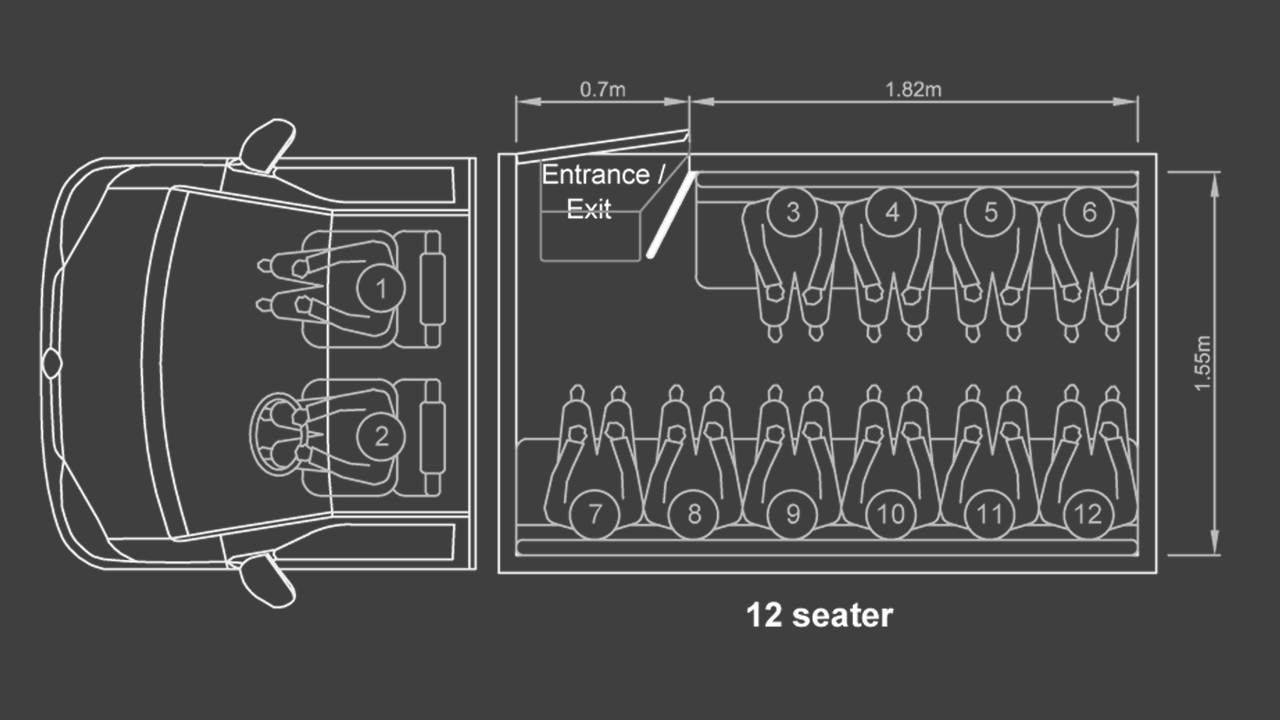

BAIC Philippines unveiled their Kalayaan jeepney prototype last month, putting it on display at the Land Transportation Office’s 106th anniversary motor show last month and, in so doing, announcing their participation in the country’s public utility vehicle modernization initiative. Based on BAIC’s Freedom compact truck and meant to be a compact commuter for short routes on crowded city streets, the 12-seat Kalayaan is the biggest prototype in the Class 1 category so far. Before the Kalayaan, the Suzuki’s 10-seat Super Carry jeepney prototype dominated the category.

Still in prototype stage with an Almazora-built body that looks to be from the same template as that on the Suzuki Super Carry, the Kalayaan’s 810kg payload can conceivably be made to seat even more, up to 14 people including the driver. Adding to the two seats in the front cabin, the rear body seating capacity can be increased to an even dozen if allowances are reduced from 40cm- down to 35cm-wide seating for each passenger, and the rear door is narrowed down from 70 to 65cm wide (to accommodate more side-facing seating on the door’s side).

Suzuki Origins
Interestingly enough, Japanese-Suzuki origins are starting to look commonplace in the Class 1 jeepney category. Before the Kalayaan came along, the Class 1 category was dominated by Suzuki Philippines’ 10-seat Super Carry jeepney. And, that Suzuki Super Carry truck platform actually comes from another Suzuki joint venture, this one from the Maruti-Suzuki partnership in India.
Both prototypes are built on Suzuki platforms evolved further by joint-ventures outside of Japan. And, predictably, both the BAIC and Suzuki platforms feature very similar rear bodies built by Almazora, though with the Kalayaan having the advantage of single-body construction with the rear box being welded to the front cabin.
In contrast, where the Suzuki Super Carry is a slightly enlarged version of the 9th-generation Carry micro-truck with it’s cab-over cabin (driver position atop front wheels), the BAIC Kalayaan’s platform is the Carry Extra–a significantly scaled up version of the Carry’s 10th-generation with that edition’s distinctive semi-forward cabin (driver behind front wheels). This explains the difference in payloads and dimensions that result in one having 10 seats, the other having 12.
The Kalayaan is based on BAIC’s Freedom compact truck that’s in turn sourced from the BAIC Group’s Jiangxi-Changhe joint venture with Suzuki Automobile of Japan. Notably, the Kalayaan is powered by a license-built Suzuki K14B-A inline 4 petrol burner, an engine from the same series as that of the Suzuki Ertiga MPV and Ciaz sedan.
<SOURCE> Press Statement by BAIC Philippines, “BAIC Philippines introduces biggest Class 1 modern jeepney prototype so far,” 2018:
BAIC Philippines, seller of rugged body-on-frame people movers like the MZ40 WeVan, MZ45 Transporter and M20 compact MPV, has officially joined the public utility vehicle (PUV) modernization initiative with their 12-seat Kalayaan jeepney. Making its first public appearance at the Land Transportation Office 106th anniversary motor show last month, the Kalayaan prototype puts an Almazora-built body on the rear deck of a Freedom compact truck–what BAIC Philippines President George Chua asserts to be the “smart man’s pick-up.”
The Kalayaan is the biggest prototype in the Class 1 category so far. Intended as compact transport for short routes on crowded inner-city roads, the Kalayaan can seat 12 people, including the driver and a front-seat passenger, with 10 people in the rear cabin afforded generous 40cm wide seating on side-facing benches. Based on the Kalayaan’s useful 810kg payload and going by the PUV modernization program’s narrower 35cm wide seating standard, the modern Class 1 inner-city jeepney can actually seat one to two more passengers in the rear.
 Built by BAIC’s Changhe joint-venture with Suzuki Motors of Japan, the Kalayaan featues a license-built Suzuki K14B-A 1.4 liter gasoline engine delivering peak numbers of 94hp at 6000rpm and 115Nm at 3200rpm. The Kalayaan’s cleaner burning Euro 4 compliant gasoline engine could be advantageous on the short, crowded inner-city routes it’s meant to serve. And, the engine’s conventional valve-train, eschewing the K14B’s variable valve timing (VVT) option, could translate to easier, less complicated maintenance.
The Kalaayan jeepney benefits from a semi-forward cabin layout that enhances its handling as well as its engine-cooling characteristics. Putting the driver behind the front wheel axle line (instead of on it like on cab-over trucks) makes for a more stable and comfortable driving position. The engine is set back to an under-seat location, improving the vehicle’s front-rear weight balance. And the water-cooling radiator is kept up front under the hood and in normal airflow’s direct path, keeping the system separate and less affected by the engine heat-source–a definite plus on hot and crowded inner-city routes.
 Another distinction of the Kalayaan jeepney is its body-on-frame single-body construction. Unlike modular two-box implementations with the front cabin and the rear body separately bolted down to the chassis-frame, the Kalayaan features front and rear cabin compartments that are welded together into a single body. This contributes to the body’s overall rigidity, making the Kalayaan resistant to body twisting and delivering greater stability that’s critical on the modern jeepney with its mandatory high ceiling and consequently higher center of gravity.
BAIC Philippines Vice President for Marketing Honeymae Limjap says the 12-seat Kalayaan jeepney was developed explicitly to list at around P600k in its base configuration. She adds that operators can expect to spend another P50k for the CCTV cameras, GPS tracker and BEEP payment system being mandated for modernized jeepney franchises.

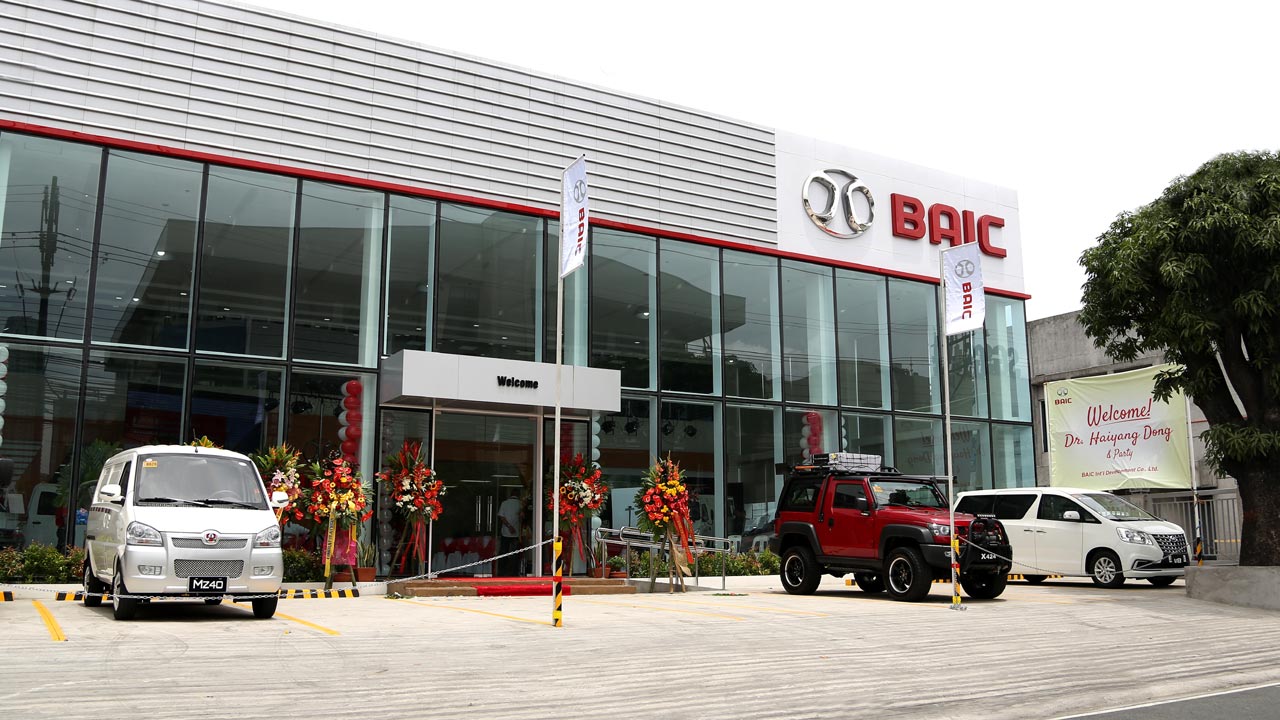


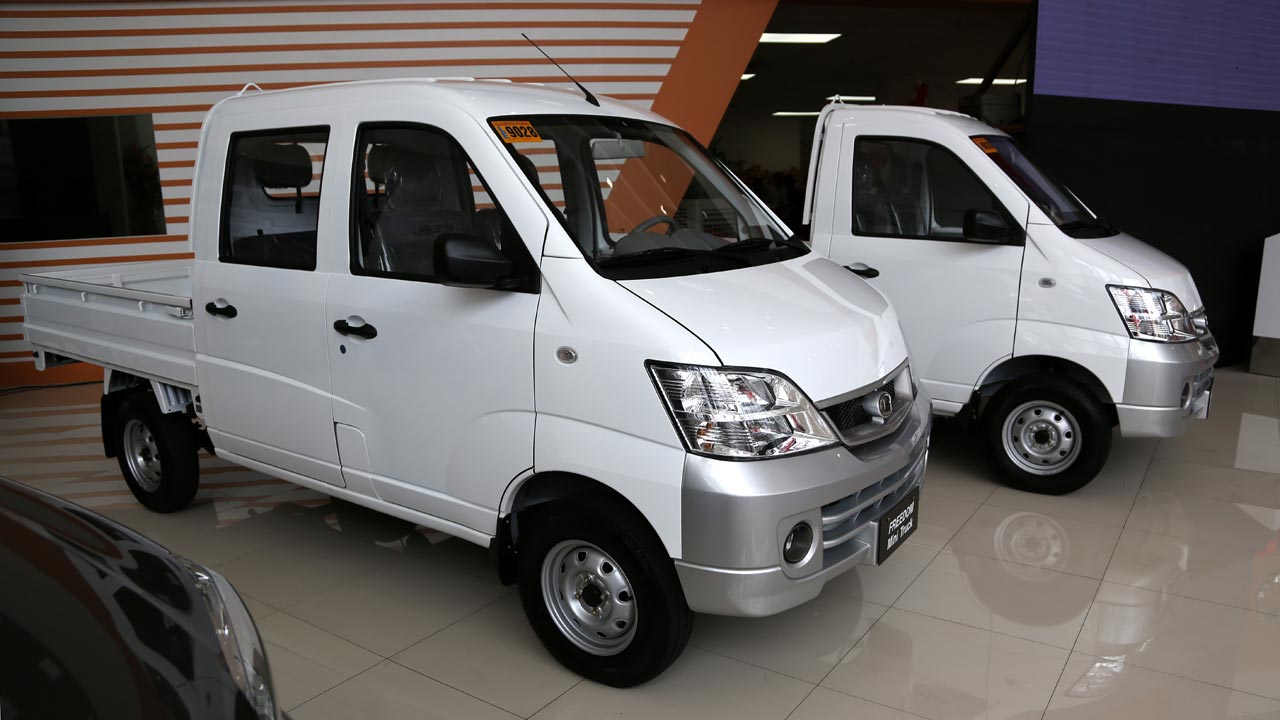

 The Freedom measures around 4.5m in length (the single-cab at 4.400m, the double at 4.565m), much longer than the 3.8m of the Suzuki and Tata models. This up-sizing translates into greater capacity with the Freedom having payloads of 990kg on the single-cab variant and 905kg on the double. At close to one ton of payload, the Freedom brandishes a significant margin over the 735kg of the Super Carry and the 800kg of the Ace. The Freedom’s cargo bay is much longer, to the tune of more than 0.3m when comparing single-cab variants. On the double-cab variant, the cargo bay is similarly longer than those on sporty mid-size double-cab pickups.
 A surprising plus: the Freedom mounts a Euro 4 compliant 94hp 1.4L Suzuki K14B-A engine (from the same, well-proven series that powers the Suzuki Ertiga MPV and Ciaz sedan). That Suzuki mill hasn’t been outsourced but manufactured in-house instead, and legitimately, by the Freedom’s original manufacturer. Coming to this market by way of the global BAIC Group of China, the Freedom is manufactured by Jiangxi Changhe Suzuki Automobile Co. (Changhe), the light commercial vehicle manufacturer that’s in a joint venture with Suzuki Motor Corporation of Japan. Changhe became a subsidiary of the BAIC Group in 2013 when the big conglomerate acquired 70% controlling stake. (In the China domestic market, the model is differently branded but similarly badged as the Changhe Freedom Mini-Truck.)
 And, finally, that double-cab option on the Freedom is a game-changing rarity in its category (not counting those on small, surplus multi-cabs). With the option for sedan-like seating for five passengers combined with her close to mainstream dimensions and full-grown engine (an engine that’s aircon-ready, no less), the Freedom stands an excellent chance of becoming widely accepted as a common family pickup truck. Not like the high-riding and sleeked-up pickups from the big brands that figured in the truck wars last year, but something that’s less sport and more utility, something that’s more of a truck. Sure, the Freedom is less pretty, more of your money invested in function, damned little of it in form, but that also speaks to character, makes a fair statement about the owner, doesn’t it?