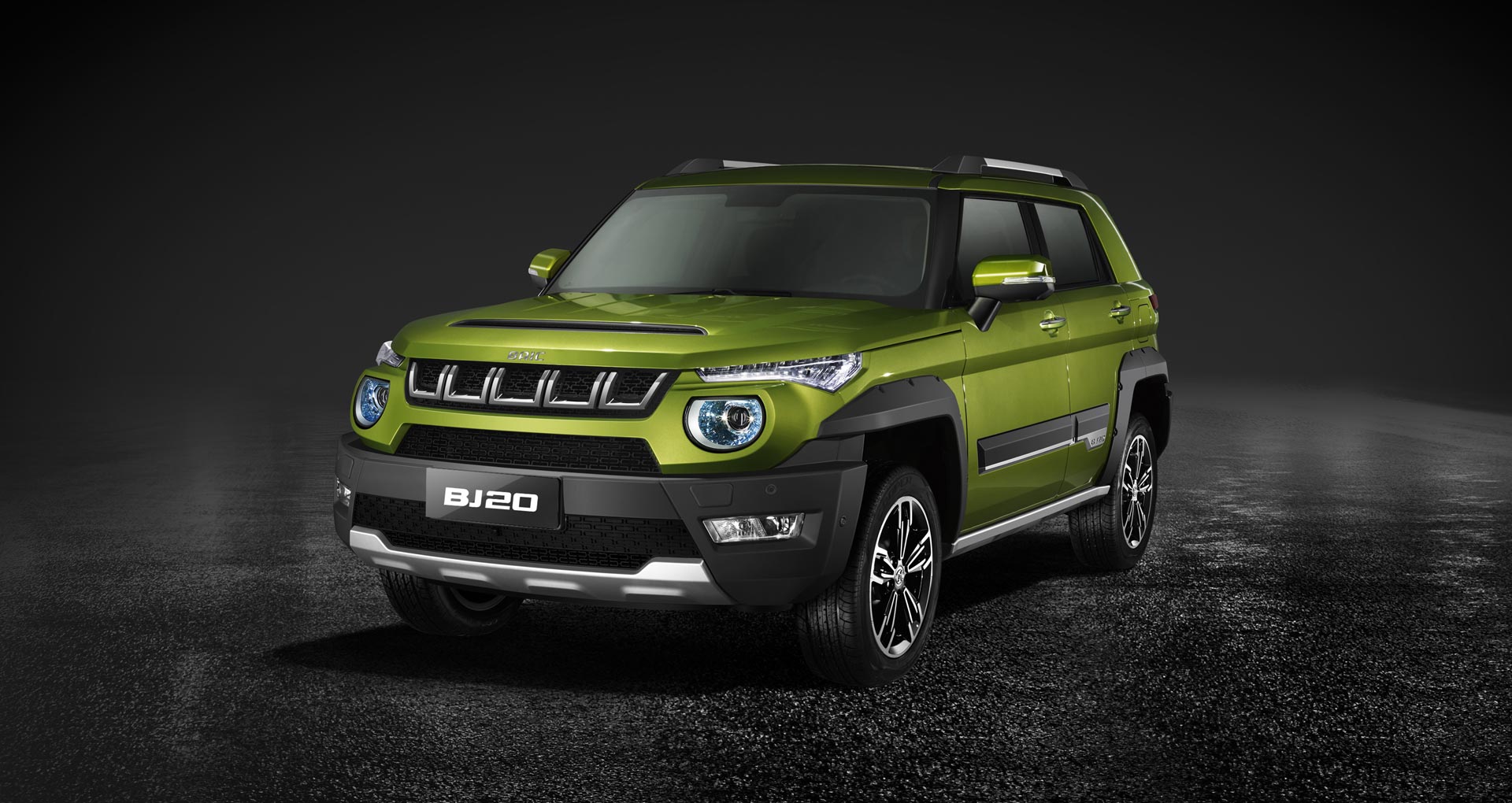

Makati City, 28 September 2018–A month before this year’s Philippine International Motor Show (PIMS), the auto-industry’s major semi-annual event where the brand was introduced here four years ago in 2014, BAIC now launches the Bravo Jeep BJ20 compact crossover SUV. In the crowded two-row SUV super-segment that blurs the line between sub-compact and compact five-seaters, the large BJ20 faces off against dozens of rivals by pitching a new sensibility to the multitudes who seem to aspire for SUV versatility.

Sure, the BJ20 looks like what a general-purpose government-issue military transport would evolve into after decades of service in cold and wet hinterland. But, get past that striking lack of sleekness and you’d find engineering that’s elegant and nowhere near the brute force mindset that it projects … engineering that makes it at home on hard smooth roads as well as soft, unpaved tracks.


The BJ20 is a front-wheel-drive crossover with fully independent suspension up front and in back that floats atop 215mm of ground clearance. That kind of altitude makes for generous articulation where each wheel assembly has ample telescoping range for the suspension to keep both front drive wheels well planted on uneven ground. And those stock 225/55 R18 tires on alloy rims make for wheel discs with 0.685m diameters, the gentler arc on those large wheels making for easy rolls across potholes and for good leverage to float up and over inevitable bumps. It’s by no means an off-roader, it still needs a semblance of roadway, but the BJ20 won’t balk at straying from hard pavement.
(It’s like they had appraised the OX Truck: that 2.5 ton hauler designed by a MacLaren Formula One engineer for relief work in Africa; that truck with its front-engine and front-wheel-drive managing to get enough traction to carry tons of payload over unpaved roads. It’s a way to thumb noses at 4×4 purists … and that’s cool.)
The powertrain is also a surprise, evincing quips of “how the heck did they do that?!” and similar invectives. The BJ20 mounts a 1.5 liter Mitsubishi 4A91T 4-cylinder gasoline burner with that maker’s trademark MIVEC variable-valve-timing tech and their TF036HW turbocharger. Sourced from the Shengyang Aerospace Mitsubishi Sino-Japanese joint venture, the 4A91T’s turbocharger delivers early onset and lingering boost. In fact the turbo boost is so early and prolonged, the engine’s torque curve looks like that of a turbodiesel but, of course, with a higher and less stressed top end.

On a naturally aspirated 1.5 liter 4A91 (note the missing “T” from the end, like the type mounted on the Mitsubishi Xpander SUV-wannabee), peak torque is 141Nm @ 4000rpm. But, with the TF036HW turbocharger that Shenyang Aerospace asserts to have turbine vanes with advanced aerodynamic geometry, the 4A91T has torque already reaching 160Nm immediately after roll out with 1500rpm, then hitting 180Nm for early transition at 1750rpm, then peaking with a rich 210Nm at 2000~4500rpm. That’s an extra-wide powerband that starts at 2000rpm, stays peaked until 4500rpm and lingers long enough to deliver a top power figure of 147hp with the system hitting its highest “torque x revolutions” numbers at 6000rpm.


BAIC asserts that the 4A91T was chosen as much for efficiency as for performance: good reminder of why turbochargers were first mainstreamed back in the 1990’s, for cleaner emissions and better fuel mileage. In effect increasing engine displacement by 33 to 50 percent, but only when you step on the gas and spool things up, the plumbing on that 1.5 liter engine makes it push like a 2 liter mill but with a turbocharger’s typical 15 percent fuel mileage improvement over a naturally aspirated engine of that size. BAIC reports getting 13.15km/l on a comprehensive mixed-mode drive.
Undoubtedly contributing to that mileage number is the continuously variable transmission (CVT) they’ve mated to the engine. It’ll be a sore point for some prospective buyers, it not being a traditional or manual transmission with discrete gear ratios, and instead having a chain between pulleys that automatically change diameters (and thereby vary their reduction ratio). But that continuously changing ratio without need for shifting between gears is what keeps the turbo unceasingly spooled up for acceleration–talk about an effective and efficient match up.
Plus, if the BJ20 has the JATCO CVT8, the CVT gearbox that’s been widely paired to Mitsubishi engines with actual or boosted displacements of 2.0 to 3.5 liters, it gives the compact crossover an exceptionally deep “first gear” ratio for hauling itself out of sticky situations. The JATCO CVT8 has a maximum deep ratio 7.0:1 that’s better than the 6.0:1 typical of other CVTs and can multiply torque significantly more than manual or automatic transmissions with first gear ratios that are typically around 4.0:1.

The BJ20 with its pugnacious looks, elegant powertrain and sublime undercarriage comes in two variants: the 1.5L Turbo CVT Standard that lists at PhP1.148M and the 1.5L Turbo CVT Luxury at PhP1.288M.