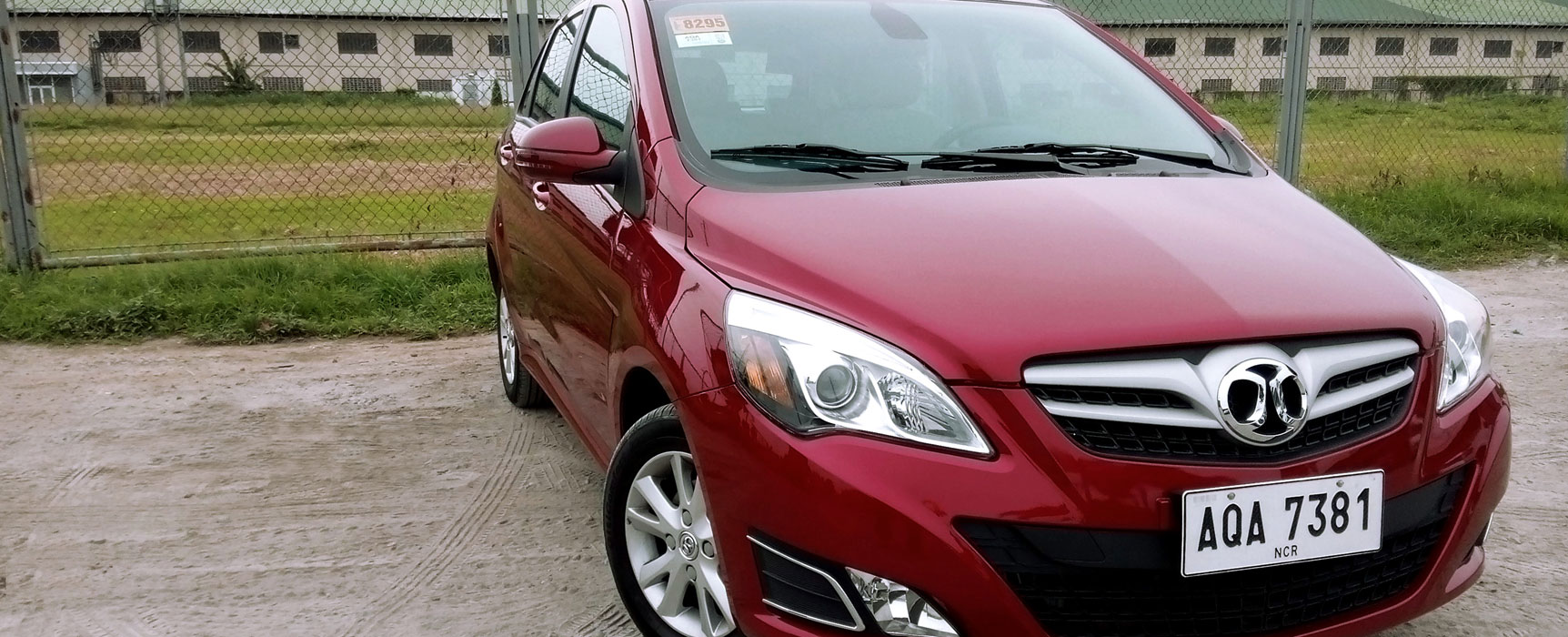

With its sub-compact size and decent cargo space, the BAIC A115 fits the up-market definition for a family’s proper-sized city car. But with vehicle dynamics that make it at home on the highway , the A115 ought to be let loose on road trips that’ll put even its powertrain to good use.
A form-factor sweet-spot
[youtube=http://www.youtube.com/watch?v=eHCArkCCj8c&w=480&align=right]The BAIC A115 hatchback feels exceptionally stable, with light or heavy load, at city or highway speeds. She feels tight and planted with just the driver on board, or with the entire family plus groceries or luggage, cruising in the city at the typical maximum 60km/h, or on the highway beyond 100km/h. And it all points to BAIC finding a sweet-spot in the dimensions of a hatchback built on a pedigreed vehicle platform that’s been used both for shorter and longer sub-compacts.
 BAIC’s A1 line is built on the Z-platform developed jointly by Daimler AG and Mitsubishi for their global small car initiative back when they where allies (see our previous related story, The BAIC A1 series: how Daimler-Mitsubishi engineering lives on in a Chinese sub-compact). Daimler used the platform for its sporty Smart ForFour, Mitsubishi for its sub-compact Colt. And, when it became apparent that the hatchback could be more practical, friendlier to families with a larger boot space, Mitsubishi stretched the Colt’s rear overhang by 300mm, deepening the cargo area, to create the Colt Plus variant. In contrast, the BAIC A1 works with a straight top cabin with MPV proportions (though not a mini-van’s size) that’s just 113mm longer than the Colt, resulting in a practical hatchback that doesn’t bump up against station-wagon dimensions like the Colt Plus does.
Just right, in the right places
With a length that’s a hair’s thickness shy of four meters, a reassuring 62% of the A115’s body still sits atop the long 2500mm wheelbase with its 1460/1445mm front and rear treads. And most of the overhang is kept up front, away from the rear where it would’ve added to the force that could pendulum the car into oversteers, or could side swipe close-aside pedestrians and cars when doing a full turn.
 The weight distribution on this middle child feels optimal. The typical front-weight bias on the front-engine, front-wheel-drive A115 is mitigated somewhat by the mass of that roomy cabin with max headroom all the way back to the rear dash. Judging by its official axle-loading figures, the hatchback has a front weight-bias of just 51:49 (actually, just 50.4:49.6). Plus, the car’s form seems not to let any wind get under its skirt, with tangible down-force created front and back by its down-turned and faceted hood, and its slightly tear-dropped roof-line ending in an integral rear wing.
A MIVEC under the hood
 The BAIC A115 mounts the 1.5 liter inline-4 Mitsubishi 4A91 MIVEC engine with variable valve timing (VVT) logic that doesn’t put a premium on low-end torque but instead on mid to high-end sustained horsepower. The MIVEC engine’s power curve starts low but rises quickly to deliver peak torque of 107lb-ft at 4000rpm and 107hp at 6000rpm, and redlines starting at 6500rpm.
 Just above idle with 1000rpm brings up just 48% of potential torque, 2000rpm brings a sudden rise to 83%, and 3000rpm to 94%. And, with a conventional 4-speed AT with widely spread gear ratios, that humpy power curve needs some management.
Four gears, all tall
A 4-speed AT compared to the 5, 6, and 7-speeds these days might bring on assumptions of the box not having an efficient overdrive gear for cruising. Not so with the A115’s 4-speed. All the gears are exceptionally tall, starting at 2.842:1 in first and hitting the 1.000:1 direct drive ratio early in third, with a 0.712:1 fourth gear ratio that’s even taller than those of most fifth gears with the typical 0.810:1.
An easy roll off with revs brought up to and then pegged at 2000rpm will see the A115 up-shifting at a familiar cadence: up to 2nd gear by 20km/h, to 3rd by 40, 4th by 60, and then this nudge that feels like half an up-shift at 80 when the lock-up clutch on the torque converter engages, creating a hard link between engine driveshaft and transmission gears. Think about it: the tall gearing means you’d hit the equivalent of the 4th gear on a manual transmission when you up-shift to 3rd at just 40km/h, and already reach extreme overdrive when you go up to 4th at just 60km/h on the conventional AT.
Torque converter, torque multiplier
But being tall and wide means that the gearing has to make the most of the slippage in the hydraulic torque converter to bring up some dynamic gear reduction on demand. Step back a bit and consider that torque converter, critical in more ways than one. With it, the engine’s impeller propels automatic transmission fluid against the transmission’s turbine, causing the latter to rotate.
 An automatic can be stopped while in drive, or allowed to crawl, while the engine is still idling under 1000rpm. The reason is that fluid link between engine and transmission (a “fluid coupling” it’s actually called, but I’ve chosen “link” to lose the innuendo). If it had been a clutch with its hard contact against the pressure plate, the vehicle would’ve stalled. Instead, on an automatic, the impeller just keeps on rotating while the turbine is either braked or allowed to rotate to push the car forward.
Allowing the automatic to make the car crawl means the engine’s impeller would rotate as much as twice as fast as the transmission’s turbine, effectively creating gear reduction (though there are no gears) that multiplies torque to as much as twice its raw value. This is why the A115, in its optional “snow” drive mode, starts you off in 2nd gear: to keep the slippage internal, in the torque converter, and away from between your tire rubber and the road. (By the way, there’s also a “sport” mode available, to keep you accelerating in each gear longer … pretty much a standard algorithm, not the focus of this story.)
Aside from telling us, yes, its okay to habitually leave the selector in D while in stop-and-go traffic, this state of things means it’s also okay to rev up the engine a bit to get some dynamic, on-the-fly gear reduction into play. And this is all-important on the BAIC A115, again with its humpy power curve and that conventional AT with tall and widely separated gear ratios.
A powetrain that stands finessing
Surge up the revs a bit, inducing slippage to temporarily deepen gear reduction and deal with the sudden upshift to a much taller gear. Just wait as the vehicle’s momentum builds up and lets the transmission’s turbine eventually catch up to the engine’s impeller, thus shallowing and restoring the reduction back to that of the actual gear. It’s like having an auxiliary continuously variable transmission (CVT) before the main gearbox, if you think about it.
 On the A115, if you want a stronger roll-out, go ahead and slightly surge up the revs to 2800-3000rpm while it shifts up through 1st and 2nd gears, then settle it down to the 2200-2500rpm range when you reach 3rd gear for the onset of cruise. If you like, keep it up even as you go through 80km/h, to prevent the lock-up clutch from kicking in, retaining that fluid gear reduction until you hit your desired cruising speed and reel things back in (at around 2000 to 2200rpm for a 100km/h cruise, depending on your load).
There’s one school of thought that proposes this “fast to cruise” technique to be more economical than a slow climb to 100km/h. In any case, it’s nice to see the trip computer’s actual consumption monitor go from 20 to just 5L/100Km (from 5 to as much as 20km/l, measured the more familiar way) as soon as you settle into a cruise.
Like the veterans do it
 This rev surging takes practice—inherent tachymeter delay means you’ll be relying more on engine sound than on rpm readings, letting off the gas even before the needle finishes its climb to the surged revs level—but it makes for a more satisfying drive, maybe a more economical one, and perhaps more interestingly, it’s somewhat of a tradition among veteran Mitsubishi Lancer drivers.
The exact same powertrain, tuned identically, was once used on the 2006 Lancer EX. And on that big sedan that weighed about 200kg more than either the Mitsubishi Colt or the BAIC A115, drivers have learned to surge the accelerator a bit while the AT up-shifted through the lower gears. Imagine how much more fun those Lancer vets could have doing the surge on a lighter, nimbler hatchback that’s rock solid both in the city and in autobahn country.



 AUTHOR’S NOTE: